This is a blog about music, photography, history, and culture.
These are photographs from my collection that tell a story about lost time and forgotten music.

Mike Brubaker
{ Click on the image to expand the photo }
Showing posts with label Königsbrück. Show all posts

The Königsbrück POW Camp, Music in Captivity

07 December 2024

 
It looks like a military band playing a typical outdoor concert.
The soldiers are all in uniform led by bandleader
wielding a baton as long as a sword.
But it's not really a band
as the only wind instruments
are a clarinet and a flute
and the rest are string instruments.
Their uniforms are an odd mix of regimental dress.
And slippers are rarely included in an army kit.
The men also sit on stout rustic stools
with crude wooden music stands.
Not really military issue.


A closer look shows that the violins
are simple wooden boxes made roughly like folk instruments,
and the drummer has only a tambourine and triangle.
They couldn't make enough noise
for a platoon to march to
much less a regiment.


The group also has a cellist,
rarely seen in a military marching band.
but his instrument is strangely made, too,
with a flat angular shape and a simple headstock for the string pegs
instead of a cello's traditional curves and carved scroll box.
There is also a guitarist which is also an uncommon instrument
to find in any orchestra or concert band.
His instrument is more shapely than the violins or cello
but its wooden top has a very coarse grain.

The men wear French Army uniforms
of the Great War of 1914-18.
But instead of defending their homeland
they are hundreds of miles from the battle lines
playing music in a place they never expected to be.

They were captives,
French soldiers held in a German prisoner of war camp
located in Königsbrück, Saxony, Germany.

It was a quiet place
far removed from the constant terror
that tormented their comrades
on the Western Front.

Here the men were confined but safe
with a lot of time to pursue other avocations 
that most soldiers never dreamed of in this violent age.
In Königsbrück one of these popular recreations for soldiers was music. 

There was a lot of it.


The full postcard photo shows 12 French soldiers with musical instruments seated on a flat dirt plaza in the shade of some trees. It could almost be a park in Paris. But the caption gives a different location: Gefangenen Lager Königsbrück Musik Kapelle ~  Prisoner of War Königsbrück Music Band. The men wear an assortment of different coats and tunics, but they all have the French army field cap. Their collar and cap badges have a mix of different regimental numbers with the addition of a white paper sticker signifying their prison barrack's number. 

The back of the postcard has a lengthy message in German with a handwritten date of 3 October 1915, about 14 months since the beginning of the war in August 1914. On this same date the commander of the French Army, General Joffre, abandoned his attempt at a breakthrough in Champagne, ordering the local commanders to fight a battle of attrition, which was terminated on 6 November. The  offensive had only advanced the French line for about 2.5 mi (4 km) at a cost of ±100,000 French and British casualties. The French attack in Champagne used 35 divisions against 16 German divisions and its artillery fired 2,842,400 field artillery shells and 577,700 heavy shells, which, at that time, exhausted the French stock of ammunition.

The photographer was Carl Schmidt of Königsbrück, and his studio produced thousands of photos of the prison camp. Most were used by the prisoners or their German guards. 


Königsbrück was one of 176 similar camps set up by the Imperial German Army, 96 camps for enlisted and non-commissioned officers and 80 separate camps for officers. The camp at Königsbrück was chosen because, conveniently, there was already an army training base there, just outside the town. The camp received its first prisoners, about 1,000 French soldiers from the Western Front, on 27 August 1914. Soon afterward several thousand Russian soldiers from the Eastern Front arrived. The German military command quickly realized that success in war created a new problem. They would need a much larger prison system, so a new expanded camp for common rank soldiers was hastily constructed in Königsbrück. 

Two months later at the end of October 1914, the Königsbrück POW camp housed 14,535 enlisted men and noncommissioned officers. All were secured by a guard detail of around 1,800 German soldiers. By 1916 the camp was divided into four sections: a French camp with 4,000 prisoners; a Russian camp with 8,000; a Serb camp with 3,000; and a smaller Italian camp of just a few hundred. The last two nationalities were prisoners taken in action against the forces of Austria-Hungary, Germany's ally. 

Several years ago when I first discovered postcard photos of soldier orchestras from WW1 prisoner of war camps, I was intrigued by how many camps developed music and theater programs for their captive audience of soldiers. My collection now has hundreds of these postcards which depict the ways the men entertained themselves after they had been removed from the battlefield. In 1914 none of the nations at war ever expected it to continue beyond a few months, but after the initial battle lines settled into a stationary conflict, the logistics of maintaining prisoner-of-war camps became a major challenge that had not been included in war planning. By November 1918 when the war ended Germany had around 2.5 million men confined in prison camps. 

With so many captive soldiers, there was only limited work that they could be used for, and then only the enlisted men, not officers. The camps retained internal order using each captive army's military rules and language. But how could a camp prevent boredom, the tedious malaise of every prison? International postal service was disrupted because of closed borders but agreements were soon reached that allowed prisoners' mail to follow a circuitous route through neutral countries like Switzerland. Postcards were already a popular and easy method of  communication so photos like the one of the Königsbrück band were produced for both domestic post and enemy prisoner mail. 

In the first years of the war, the United States was also neutral before it finally joined the allies in April 1917. It also had a very large German-American population. American aid societies like the Red Cross and YMCA worked to provide prison camps on both sides of the war with book libraries and, surprisingly, musical instruments. In this era before radio and recorded music a band or orchestra was considered vital to manage the morale and spirits of imprisoned soldiers. However the handmade instruments suggest that at the beginning of the war the Königsbrück prisoners found a way to make their own musical instruments even before the YMCA provided assistance. 


In this photo an ensemble of 23 soldiers, all string players, pose for Carl Schmidt's camera. Nearly all are holding a mandolin, with just a few violinists and a cellist to add variety. The caption reads: Gefangenen Lager Königsbrück Franzosen Kapelle ~ Königsbrück Prisoner of War Camp French Band. Most of the instruments have the same folk style construction. The cello has the classic body shape but it is flat, not arched, and the peg head is plainly made. It may be the same instrument as in the first photo but the player is a different man

Making a violin, much less a cello, requires a number of sharp tools like saws, planes, chisels, drills, etc. plus some descent timber, too, not to mention gut strings and horsehair for the bow. A mandolin is similar to a violin but has doubled strings. How were these instruments acquired? While it's possible the instruments were donated or purchased from a German woodworker in Königsbrück, I think it is more likely that a fellow soldier with the special skills of a luthier constructed these instruments. The wood probably came from boxes or was salvaged from piles of kindling around camp. The horse hair for the bows was likely easy to find in a rural community like this. But where did the tools come from?

Like the previous postcard, this one was sent by a German soldier, most likely a guard, using free military post on 8 September 1915. On that same evening in September, four German Navy Zeppelins flew across the English Channel on a bombing raid of London. Two of the airships turned back because of engine trouble, while another got lost and instead attacked a petrol plant at Skinningrove, Yorkshire that caused little damage. However the fourth zeppelin reached London, where it released a 300-kg (661-lb) bomb, the largest yet dropped on Britain, which killed 22 people and inflicted the most damage by a single airship or airplane bombing raid throughout all of World War I.


Of course music doesn't have to be played in large groups. The men interned in the Königsbrück camp also formed smaller ensembles. This private photo has a quartet of a French sailor and three soldiers seated on a park bench and playing a mandolin, a trumpet, an accordion, and a violin. They look like friends but the photo may have been staged as propaganda to demonstrate the pleasant conditions in the camp. Unlike in the other ensembles the string instruments are properly made. The violinist looks very competent, even professional, in his stance. The trumpet has rotary valves which would not be the favored design in France where piston valves were used on brass instruments.

This postcard was never mailed but has the same printed form on the back used by Carl Schmidt's photography studio for the Königsbrück camp.


This next POW ensemble from Königsbrück is an octet of string players, except for one trumpet player in the back who may be the same man pictured on the park bench. The other instruments are violins, a cello, a double bass, and possibly a viola. The men are seated very close together on a small stage framed by curtains and a painted backdrop. Written in ink is a caption: "Baracken lager – Lauenstein – Orchestre." The name may refer to a nickname for the barrack as Lauenstein, Germany is about 250 miles east of Königsbrück. 

The octet's instruments all look to be of traditional construction. The men appear to be quite serious about their music and except for the uniforms they could easily be professional musicians performing in a theater. I wish I knew how they found instruments during wartime. Did they have help from their German captors? And what about sheet music? Any skilled musician could make arrangements for the camp's eclectic mix of instruments, but they would still need blank music paper, another commodity that would have been in short supply or rationed. 


The postcard was sent to Michael Pineau of Courdemanche, a commune in the Sarthe department of the Pays de la Loire region in north-western France. The sender was Adrien Pineau, a soldier in the 90th Infantry Regiment. The red censor stamp has a date of 28 October 1918, just two weeks before an armistice was declared to end the war. Already the allied forces had prevailed over the Ottoman Empire in the Middle East. And by this date the Hapsburg Empire was beginning to break up with the Austrian-Hungarian army retreating in Italy and new democratic governments in Czechoslovakia and Hungary rushing to establish new independent nations. In ten days Kaiser Wilhelm is forced to abdicate the German throne and flees to the Netherlands. 


It seems the soldiers confined to the Königsbrück camp had no shortage of talent as there was a vibrant theater there. I last wrote about some postcards from these productions in my story, The Königsbrück POW Camp, A Theatre of War, published in December 2023. Most of these shows seemed to include a small orchestra seated in front of the theater's small stage. In this photo an orchestra of ten musicians watch attentively to the action on stage where two French officers appear to question a woman while her maid and houseboy set (or clear) a meal. Music was often used in all kinds of theater works as an interlude between scene changes. Here the caption reads: Gefangenen Lager Königsbrück Teater.


Most of the prisoners in Königsbrück were Russian and that section of the camp had its own theater and orchestra. Here a group of seven musicians watch a play that looks like a romantic comedy involving a happy (or unhappy) couple, a judge or father, and an old crone. The play's title is written in Russian Cyrillic script on a poster in the center. The musicians are seated on the same rustic stools used in my first orchestra photo. We can't see their instruments by I believe they are all string instruments with at least two or more Russian balalaika, a triangular strummed instrument.


The back of this card has a long message in German, again likely sent by a German guard at the Königsbrück camp. I think it is dated 14 March (März) 1915, but German handwriting is quite challenging. ( Zs and umlauts are particularly difficult to spot.) Just four days before this date the Battle of Neuve Chapelle started in the Artois region of France. The British Army and the Indian Corps attacked a point on the German trenches and briefly captured a new position, but were repulsed a day latter and forced to retreat. The British sustained 12,892 casualties, ±7,000 British and ±4,200 Indian, while the Germans lost around 8,500–10,000 men over the full 11-day campaign.  


Several photos in my collection are of variety shows put on in the Königsbrück POW camp. In this photo there are 15 musicians in the orchestra and 24 performers in the cast. The two women on stage, and in the other theater photos too, are not women, of course, but men, a theatrical illusion that goes back to ancient times. To assign any sexuality/gender terms from our 21st century to these entertainers of 1914-18 is grossly incorrect and an injustice, I think, to the history of theatrical artists.

The orchestra is predominantly French but there are some Russian soldiers in it too, marked by their peaked caps. The instruments are mostly traditional made, but the guitar and cello/bass on the right are clearly made in a crude folk style. 

This photo was produced by Carl Schmidt's studio of Königsbrück, but was never posted.


This photo is captioned Gefangenenlager Königsbrück Serben and shows a string band of seven Serbian soldiers standing on the same sandy plaza as my first photo of the French orchestra. Their violins are all traditionally made and there is a double bass, too, played by the shortest musician. 

Though in July 1914 Germany declared war on Serbia in support of its ally Austria-Hungary it did not initially send troops there until October 1915 when a second campaign was launched under German command. At some point after that, thousands of captured Serbian soldiers were sent to the Königsbrück POW camp, a number that eventually reached around 3,000. They were housed in a separate section that probably had more connection to the Russian section, since their language also uses a Cyrillic alphabet. 


This card was sent by a French soldier named Georges Cretté of the 82nd Infantry to Mademoiselle Renee Piette of  Beauvais, a town in the Oise département of northern France, 75 kms (47 miles) north of Paris. 


In this next photo the same seven Serbian musicians are surrounded by their fellow Serbs. The caption reads Königsbrück Serbenlager. 

Serbian music was probably considered pretty exotic for the other French and Russian soldiers, not to mention the German guards at Königsbrück. Serbia like the other Balkan ethnic nations has a  folk music tradition that uses modal scales and asymmetric rhythms that are not part of central European musical culture. 

The card was sent by a German soldier but without a date.


Perhaps the most unexpected musician see in the Königsbrück POW camp was a bagpiper. In this case a Serbian piper accompanied by two  E-flat clarinetists play while a ring of Serb soldiers dance around them. The high treble clarinets are typical piccolo instruments found in many brass bands around the world but they would not have been common in German bands. I think they must have come with the musicians when they were captured. Likewise the bagpipes are very unusual to see. Though it's a simple folk instrument with a single drone and chanter, the Serbian pipes are very different from the Scottish highland pipes, or the German Dudelsack, or the dozens of other European bagpipes. 


In this photo the Serbian piper is playing alone in the midst of other Serbian and Russian soldiers. It has recently rained and the camp street has turned into sandy mud. Carl Schmidt numbered this photo #654. 


This photo was numbered  #653 and shows a different pose of the same piper. This postcard was sent by Alfred Gigout, a Sergeant of the 153rd Infantry Regiment, to his wife Madame Gigout of Manonville, a commune in the Meurthe-et-Moselle department in north-eastern France. What did she think when she saw this photo? 


When the captured Serbian soldiers were sent to Königsbrück they arrived with a large number of sick men, mainly suffering typhus, which required them to be quarantined. Contagious disease was the worst calamity that any prison could experience but it was especially onerous for a POW camp which had limited resources. In Königsbrück 176 Serbs died from typhus and were buried in a cemetery there. 

In September 1918 a monument to the fallen Serb soldiers was erected in the cemetery. It was made in stone and carved by sculptor Edmund Delphaut, a French adjutant of the 153rd Infantry Regiment. I wrote about this impressive statue in my August 2021 story Monument to the Fallen, Königsbrück 1918. 


In this clip from a photo of the Serb monument, the artist Delphaut is looking up at his statue. I believe the other man next to him, looking at the camera, is Alfred Gigout. During the four years  he was confined to the prison camp, Alfred regularly sent photos of Königsbrück's camp life to his wife . Many of these postcards are now in my collection and have inspired me to tell the story of this remarkable place.

If you Google "Königsbrück Germany" the first image that pops up is of this same monument to the fallen Serb soldier of World War One. It is all that remains of the German prisoner of war camp of 1914–18. After the war most of the remains of soldiers buried there were disinterred and taken back to their native lands. The barracks and grounds of the Königsbrück prison camp were taken over for other military use.  Eventually after the Second World War and then the division of Germany in the Cold War the land reverted to a forest and it is now preserved as a park watched over by a brave Serbian soldier. 

That monument bears witness to a terrible time of war. Yet it is also an example of a uniquely peaceful endeavor made by soldiers who put their skills and talents toward producing art, music and theater. So far I have far more questions than answers but the photo collection I have acquired of the Königsbrück POW camp shows that it was a place where culture thrived and was shared across multiple foreign languages and traditions. How that happened and why was it recorded by Carl Schmidt's camera is still a mystery but I think it is a story worth telling.  

The next chapter to this series will be about the art work produced by the soldiers in the Königsbrück prisoner of war camp. Stay tuned, as the Serbian bagpiper will return. 


I can't resist including a video
about Serbian bagpipes.
Here is a short one from
the YouTube channel of Vladan Radisavljevic 
who has compiled a large collection of vintage photos
of Serbian, and maybe Croatian, bagpipers to the sound of the bagpipes.
My impression is that there are two types of Serbian bagpipes.
One has a short chanter with a high pitch sound,
and the other is longer with a lower pitch
and an upturned bell like the one played by the Serbian soldier.


Even for a bagpipe, the Serbian pipes make a very jarring noise
that is possibly one of the most teeth-grinding sounds you will ever hear.
Its constant drone and 
dissonant noodling reeds
are so annoying that it could start another war
if you had to listen to it every day.


This is my contribution to Sepia Saturday
where making a piece of cake
and a case for Peace
require two different recipes.


The Königsbrück POW Camp, A Theatre of War

16 December 2023

 
In show business 
it's always good to start
with a clown act
that gets the audience laughing. 


Of course every successful show
needs a handsome man
to play the lead,
the hero of the drama.


And an actress or two is important
to add romance and intrigue to the story. 

Sets, props,
costumes, wigs, makeup,
complete the illusion. 

Once everything on stage is arranged,
the actors have studied their lines,
and all the blocking and cues are rehearsed,
the call goes out to the company.
It's time for the show to begin.


The patrons have taken their seats in the hall 
awaiting an evening of entertainment.
No matter if it's a comic farce,
a musical revue, or a tragic melodrama,
this captivated crowd will welcome any distraction
from a life of perpetual monotony
far removed from a terrible war.

This is a story of theater productions
produced at a prisoner of war camp
in 
Königsbrück, Germany.

It is 1916
and this was the company's second season
There would be two more
before the curtain finally closed forever.


. 

WW1 Serbian Memorial, Königsbrück, Germany 2020 

The location of this World War One prisoner of war camp was a short distance north of Königsbrück, a small town in the German state of Saxony. In a strange twist of irony in our age of the internet, if you search on Google for Königsbrück, the first image offered is a photo of a war memorial found at the site of this camp. It's a dramatic sculpture of a fallen Serbian soldier created to honor his comrades who are buried at the camp's cemetery. It was carved by a Frenchman, Edmond Delphaut (1891 1957), a talented artist and soldier who was also imprisoned there. In August 2021 I told the story of this sculpture in Monument to the Fallen, Königsbrück 1918.  Since then, I acquired this next photo of Delphaut and his assistants putting the finishing touches to the monument before its dedication in September 1918. Delphaut is the man dressed in a white suit on the right.


Several years ago my first interest in the Königsbrück camp was sparked by discovering photos of its orchestra of French and Belgian soldiers. After more research I learned that from 1914 to 1918 this German POW camp produced hundreds of photo postcards recording the activities of thousands of French, Belgian, British, Italian, Russian, and Serbian soldiers imprisoned there.  

Last week I presented a story about a set of photos from the Königsbrück POW camp called Soldiers at Ease, which followed a theme of men seated at tables doing a variety of mundane things. This week we will follow them to the camp theatre which was the center for a variety of entertaining pursuits for the soldiers. 


The Königsbrück camp was number 87 in a 1917 gazetteer of 177 prison camps in Germany and Austria. It was described as:  "A camp of wooden hutments situated on sandy soil amidst pine-woods a short distance from the town. Capacity, 15,000. 12th Army Corps."  It was hastily set up in August 1914, just weeks after the start of the war, at a training base for the Imperial German Army. This was chosen for convenience as the first prisoners, mainly French and Belgian soldiers, were quickly housed in some of the former German army barracks. However within a few months the military command realized it would need much more space for captured Russian troops, so new extension camps, Neuen Lagers, were constructed.  

This postcard was taken outdoors with the camera several meters above the ground, presumably from a guard tower, and it shows several casual groups of men, mostly French by their uniforms, standing along a "street" in the camp. The trees are too tall to have been planted in 1914, so I think this is somewhere in the old camp. The white building in the center looks like a stables. The raised section on the left with a barn-like roof seems large enough for a small stage. Though it is impossible to be certain about its use, it does demonstrate that there were buildings at the camp with space suitable for a stage and theater seating. 

The photo's location is identified on the back with both an official Königsbrück stamp and the writer's message. It is addressed to Monsieur A. Mazot of  St. Denis-de-Cabanne, a commune in the Loire department in central France. The postmark and message date is 16 October 1918, just 4 weeks before the end of the war. But more interesting is the note and date written on the front:

A bientôt  18-11-18
~
See you soon   18 November 1918


My first postcard at the beginning of this story was of Million, Comic Exentric who signed the card with a salutation to a friend and a date: 15 February 1916. The photographer, Carl Schmidt of Königsbrück whose name was on almost all the postcards, was generous enough to write the clown's caption just like it would appear on a typical entertainer's promotional card. The card was never mailed but has the standard imprint of the Königsbrück POW camp.

Million's wild plaid suit and Buster Keaton porkpie hat are the classical costume of a music hall/circus comic. Was he a professional clown before the war? My bet is that he was a hilarious mime who needed no language to be funny. 

My second postcard of the man with the long dark hair, goatee and artiste's bowtie is labeled a Schauspieler ~ actor, from the French prisoner of war camp in Königsbrück. This card went through the Germany military post, presumably from a camp guard, and sent to Kötzschenbroda, a district in Saxony north of Dresden. It has a postmark and written date of 30 November 1916. The closeup portrait is unusual to find in photos of prisoners, and because it lacks the usual prison camp backstanp, it may be a private photo produced by Carl Schmidt for only the camp's guards to use. It does suggest that the German captors got to enjoy the shows too. 


My third image was of two "women" performing in a play. Of course there were no female soldiers held at the prison camp, so these two "actresses" were men cleverly dressed in wigs and fashionable costumes. I believe they are also pictured in this next stage scene. The woman with the white headband is now seated on the right, and her companion may be the woman seated center who gasps in shock at the detective's report. The cast of five, two men and three women are in a residential drawing or dining room, artfully fitted with faux paneling , paintings, and china racks.

Unfortunately the caption was cut off in this photo, but the other photo has the title: "La Roulotte, MMe. Delattre et Braconnier dans la fin tragique ~ Mademoiselle Delattre and poacher in the tragic ending." The title is a match for a French novel of the same name from 1897 but I could find no mention of the name Delattre in it. However La Roulette was a celebrated cabaret in Paris. 

As an aside, I should mention that men playing female roles is a theater tradition as old as Shakespeare. In this era it was quite common to find cross dressing entertainers of both sexes performing on the European and American theater circuits. I've posted several stories on them in this blog.  At times these performers could be suggestive, maybe a bit bawdy, even titillating, but I don't think it is fair or accurate to assign our 21st century assumptions about sexual orientation and gender to unknown people in antique photos. In these photos it was just another kind of show biz illusion.


This card was sent by Alfred Cerene of the 156th infantry regiment to Mademoiselle Fernande Montels of Decazeville, a commune in the Aveyron department of the Occitanie region in southern France. In the corner is No. 52 which I interpret as Alfred's 52nd card to Fernande, presumably his sweetheart. Though this card has no postmark date, I have a number of Alfred Cerene's postcards from Königsbrück which were preserved for a hundred years and then sold through a dealer to collectors like me. 

Alfred's neat penmanship made it easy to read his name and unit which led me to find him in the gigantic database of WW1 prisoners of war that was compiled by the International Commitee of the Red Cross, both during and after the war. There I learned that Alfred Cerene, infantryman of the 156th regiment was captured on 20 August 1914 in a battle in Mörchingen, a commune in the Moselle department in Grand Est in north-eastern France. It is now called Morhange but in 1914 it was in the Lorraine territory captured by German in the Franco-Prussian War of 1870-71. It's no wonder then that Alfred had time to write so many letters and cards. 


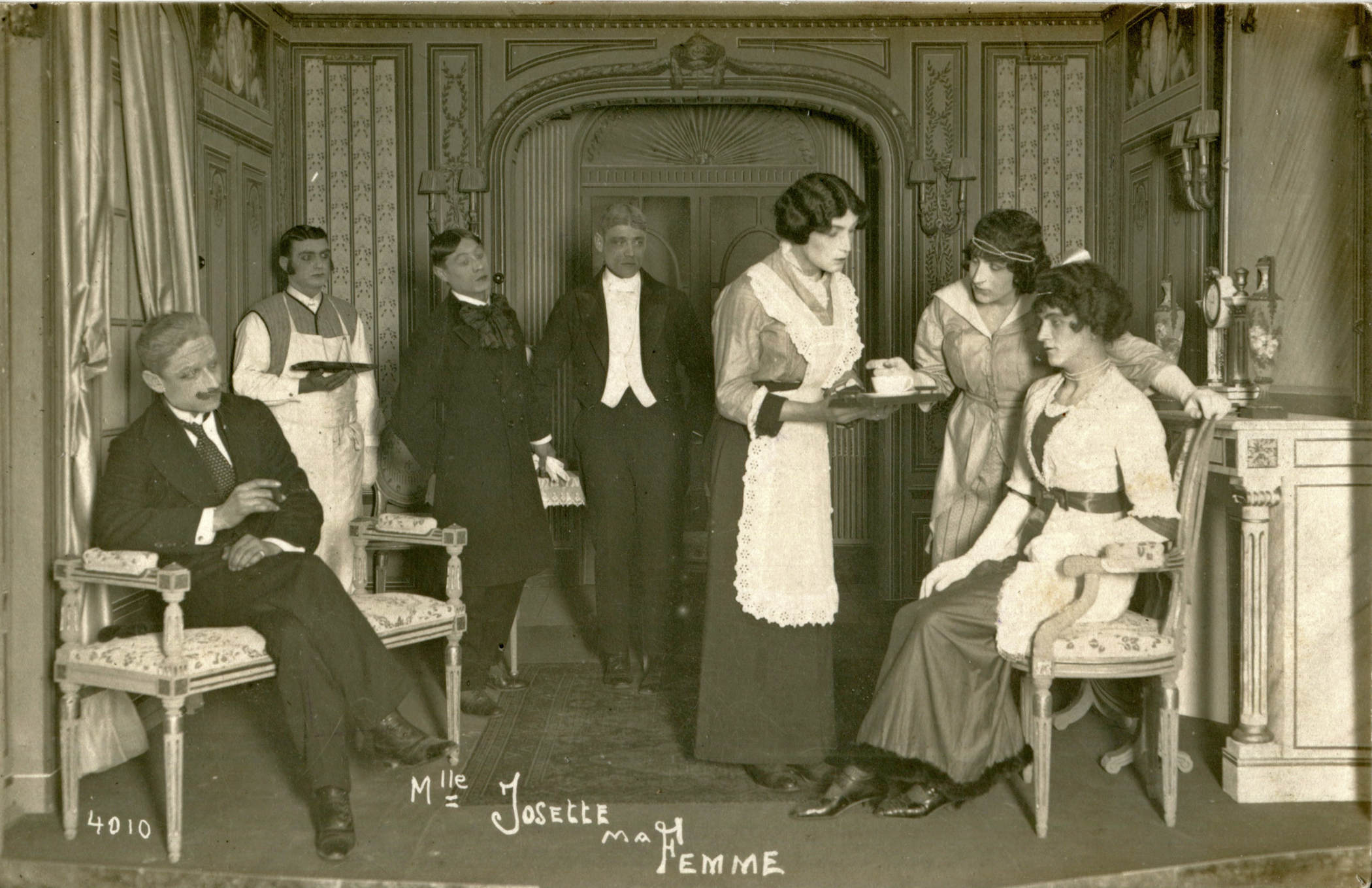
This next scene comes from a different play, "Mlle. Josette ma Femme ~ Miss Josette my Wife." Seven characters, four men and three women seriously ponder some point of uncertainty. The maid's offer of a cup of tea does not seem to allay the seated woman's discomfort. The set is another drawing room, but it is a few degrees classier than the other play. 

This card was also sent by Alfred Cerene to Mlle. Fernandes Montels. He numbered it 32, so it is earlier than the other play. Alfred included a brief message: "Received your photo 1000 times thank you, and am very happy. Soon will write more." 

My fourth photo from the top, the one showing soldiers seated close to the stage, was sent by Alfred too and marked as number 27. It's a testimony to the high standards of European postal services of this era that even in wartime a postcard from eastern Germany could make its way to a small town in the south of France. I wonder what the number was for his final postcard to Fernande? Surely it was her that saved all his cards. 


This next scene has no caption but I think we can get the idea even without a translation. A man and a woman are having a discussion, perhaps an argument. He sits relaxed in a chair, maybe smoking, I think, with a haughty expression on his face. She has an gutsy air about her even though she is dressed only in her undergarments. There is a bed between them. Who will prevail? 

This card is marked from Königsbrück but was never posted. I have more examples of scenes from plays of the French theater, but it was not the only theater in the camp. Russian soldiers enjoyed theatrical entertainments just as much as the French.


Alfred marked this next card number 41. This scene is similar to the last one but with a twist in location. A man and woman are seated at a low table. The man, old with a beard, pours the young woman a glass of spirits or wine. She is seated on a narrow bed. The set is not of a room in a Parisian hotel but in a crude Russian log cabin. In one corner is a large brick oven suitable for cold Siberian winters. What did soldiers worry about or lose sleep over? Not the battles or the bombs, but the menace to their unprotected wives and sweethearts back home. It's an old story every trooper feared. And as playwrights well know, anxiety breeds drama. 


This next card is captioned as the prisoner of war camp at Königsbrück, the Russian Theater. Here we see an exterior set somewhere in a birch forest with a lake and mountains in the distance. Two young women confront an old woman who is seated on a park bench. The women look surprised at something the old crone has revealed. I think this play has a fairytale quality as it seems more rustic and  less sophisticated than the French plays. 

As the number of prisoner of war camps increased in 1915, on both sides of this now global conflict, the Red Cross and YMCA stepped in as neutral agencies to monitor the condition of prison camps. Besides checking on the food, housing, and medical services in the camps, these organizations also found ways to look after the captive soldiers' morale by suppling library material, sports equipment, and musical instruments to the prisoners. Some of these instruments came from local German music stores while others were handmade by the captive soldiers.


By the end of 1915 both the French and Russian sections of the POW camp in Königsbrück had their own orchestras.  And what do you get if you put instrumentalists and actors together? A musical revue! In this photo nearly two dozen men fill the tiny stage. The caption identifies it as the Königsbrück Russian Theater and this show has everything needed for a proper musical. There are a bunch of costumed actors and actresses at the back. A chorus of men in military tunics. And in front a string orchestra of two mandolins, violin, guitar, and two triangular Russian balalaikas. A playbill in the center announces the acts in Russian Cyrillic characters. Notice the Corinthian columns on each side of the proscenium.    


Not to be outdone, the French theater put on their own musical revue. Here the cast has eighteen characters on stage, including four wearing clown makeup and two women. In front of the stage an orchestra of at least nine musicians sits in a makeshift "pit" with four violins, flute, clarinet and tambourine. This is a group large enough to bring the roof down. Did the German command allow the singing of "La Marseillaise"? I doubt they could have stopped it on this night.


For over four years, several thousand soldiers were held at the Königsbrück POW camp. Some, like Alfred Cerene, came early and endured a full sentence until finally released in November 1918. Others arrived late, having suffered the horrors of a brutal war of attrition on the Eastern Front, or the terror of relentless bombardments on the Western Front. And hundreds more came from now forgotten battles in Italy, Serbia, and Romania. How the camp commander managed to control so many men speaking different languages is difficult to understand. But how he tolerated, and maybe even promoted, the theater arts is astounding to me. 

Concerts, dramatic plays, or musical revues are not art forms that can be produced by just one or two people. It takes real teamwork by an army of people, if you will, to design sets, fashion costumes, write scripts, and arrange music. Even in the best of times this is hard work. How did ordinary soldiers, sidelined from combat, and now held captive deep inside enemy lines manage to generate  so much entertainment in this prison camp?  Where did they get the material to build scenery and props? How did they write out the scripts or the music? Where did they find the time to do all this? Oh, wait. They are confined to a prison, so there's the answer to that question at least.

I have many more questions and even more photos from the Königsbrück prison camp that I want to introduce in the near future. My next story in this series will be on the musicians of the camp with maybe some more photos from the theaters too. Stay tuned.  It's enough to make you forget that there was a war on.


And as Loegel the Comique 
probably would say,
"Don't worry. Cheer up!
Life is but a joke!
"


This is my contribution to Sepia Saturday
where the play is the real thing.


The Königsbrück POW Camp, Soldiers at Ease

09 December 2023

 
Most of the men walked there.


Those that couldn't walk
got a ride.


And those men from further away
came by train.


And for the next 4 years
this would be their home.

It was the time of the Great War
and these men were enemy soldiers
who had been captured on the battlefield.
They came from France, Russia,
Belgium, Britain, and Serbia.
Now they were in the heart of Germany.

They had arrived at
the Königsbrück Prisoner of War Camp. 

It was only the end of August 1914. 
They were removed from combat
but they now had a lot of free time on their hands. 


The first photo postcard shows French troops guarded by German soldiers marching along a dusty road. It was captioned Königsbrück, Ankunft der Kriegsgefangen ~ Königsbrück, Arrival of prisoners of war. The date was 28/8/1914, just 26 days after the first military action on the Western Front, a small skirmish at Joncherey, a commune on the border in the Territoire de Belfort. It was also only three weeks after the start of the Battles of the Frontiers on 7 August 1914 when a massive German force overwhelmed Belgium and Luxembourg and invaded France with a goal of crushing its capital Paris. The only resistance came from the French 5th Army and the smaller British Expeditionary Force. 

In this first month of World War One the battles were about rapid maneuver, unlike the static trench warfare that would later dominate most of the war on the Western Front. Over 30 days the German army suffered nearly 300,000 casualties while the French sustained 330,000 and the British 30,000. Both sides also captured thousands of enemy soldiers and immediately began sending them to  internment camps far back from the frontlines. 

The prison camp at Königsbrück, a small town in the eastern German state of Saxony, was just one of over 175 POW camps that Germany established during the war. By November 1918 there were over 2.4 million men held prisoner in Germany. 


The captured French, Belgians, and British soldiers came from the west, probably traveling most of the way on the same trains that had taken German troops westward for the invasion. The distance from the first battles along the French-Belgian border is about 440 miles from Königsbrück.


The captured Russians came from the east, transported along the railway lines that connected Prussia to eastern Europe. The German and Austrian-Hungarian rail networks had 32 routes that went to the Russian border with 14 having two-lane tracks. Russia had only 13 lines headed west with just 8 available for two-way traffic. This greatly hindered the mobilization of its armies delaying a full deployment of Russian troops by a month or more. 

During the Battle of Tannenberg, 23–30 August 1914, the German Eighth Army practically destroyed the Russian First Army in a great victory that strengthened German resolve to continue the war. The German army took only 13,873 casualties at Tannenberg but the Russians lost 30,000 – 78,000 soldiers killed or wounded and 92,000 taken prisoner. The Russian defeat severely crippled its army which ultimately led to its capitulation later in 1917. It is roughly 350 miles from that region, now in Poland, to Königsbrück.


Königsbrück is about 27 km (17 mi) northeast of the Saxon capital Dresden, and 114 km (71 mi) east of Leipzig, two major centers for German culture, music, and art. When the war began the town's population was only a few thousand, maybe less, but nearby was a large military base used for army training by the XII (1st Royal Saxon) Corps. As German forces advanced east and west and more enemy soldiers were being apprehended the troop barracks of this base were converted into a detention camp for French and Belgian soldiers. Within a year it would intern more than 15,000 men including many Russian and Serbian soldiers. 

This picturesque view of Königsbrück likely was produced before the war for German soldiers stationed there, but in October 1916 it was used by a French soldier to send a message home about the address of his new posting.   


Some years ago I discovered several photo postcards of large Sandplastik sculptures made by the soldiers held at the Königsbrück POW camp. I featured them in my story Art in a Time of War. 
I also found several postcards of the camp's orchestras and theater productions. As one thing led to another, I began to recognize that the photographers of the Königsbrück POW camp were very prolific and recorded a wider range of subjects than any other camp. So I began to collect these photos and now, after several years, have acquired hundreds of photos that depict the captive soldiers and their activities in the Königsbrück camp. I've previously written about some of them in The Prisoners of Königsbrück and Monument to the Fallen, Königsbrück 1918. 

My collection is far too big for just one story so I'm going to break it into parts. Today I will begin with pictures of soldiers at ease, resting and enjoying some light recreation by sitting down to table with their comrades. Or just standing around, goofing off for the camera.


This photo shows one of the barrack lanes in the Königsbrück camp filled with a crowd of soldiers. French, Belgian, and British soldiers were housed in a section separate from the Russians and Serbians. This was likely because of the challenge of maintaining good order between men who spoke and wrote in different languages. Though all POWs remained soldiers and were obliged to obey orders, ordinary military rules were suspended in favor of those of their captors. However in this photo there is a mix of French and Russian uniforms so evidently the men were free to move around the whole camp.

The back of the postcard has a distinctive printed format as a Kriegsgefangensendung or Prisoner of War Letter from Königsbrück. This makes it easy to confirm that a photo came from this particular camp. It has a stamped date of 13 Août (August) 1915 and was sent to someone in Dejon, France, the center of fine French mustard. The spaces for the prisoner's name and barrack number were a way for the German postal censors to monitor prisoner's mail.


In this photo a group of seven French soldiers sit around a crudely-made low table for a simple meal. I think it is inside a barrack room. One man reads a thin magazine. This wasn't a spontaneous snapshot as the men appear distracted from each other, probably instructed to look away from the camera flash. Since all enemy soldiers were taken captive during a battle, they usually had only the uniforms the wore and the contents of their haversacks with maybe a blanket bedroll. Anything else had to be acquired in camp, either issued through the German camp authorities or bought using barter or camp scrip.


Here another group sit at a table and read. Hanging on the barrack wall behind them are several backpacks and cases. The photographer numbered the photo 3424 which implies there were many photos taken before this one. As postcards were a simple and efficient way for a soldier to communicate with his family, the Königsbrück camp may have commissioned one of the prisoners to take these photos. The images would both appeal to soldiers and, at the same time, work as propaganda to convey the impression that the POWs were being treated well.

This card was sent to Dejon by the same French soldier who sent the barrack street photo. I presume he is in this group but I think the name he has written on the bottom is that of a comrade. 


Card games have always been a favorite activity of soldiers since probably forever. Here a quartet of men play a game while a comrade watches from a bunk bed. There's no betting but the soldier on the left is keeping score. It's interesting to see coffee mugs hanging from pegs on the wall and an electric lamp is on the table. Penciled on the top right is Décembre 1915.


Board games were another way that soldiers could endure the interminable dullness of camp life, and here two men play a game of checkers, being closely followed by most of their comrades. A message in French is written on the photo along with place and date, Königsbrück 9 Mars 1917. 

Now reader can play a game too. Can you spot the differences between this photo and the previous one?  They were both taken at the same place in the same barrack but at least one year apart. Any message on the front of the 1915 card would probably have been verboten and rejected by the censors, but by 1917 the rules seem to have relaxed a bit. 


Here a larger game of cards is played outdoors at a table. The Königsbrück camp was intended for enlisted and noncommissioned ranks and their uniforms often provide clues to the soldiers' units. But over time wardrobes wore out and were often replaced with an assortment of hats, garments, and footwear not found in military handbooks.  


The enemy prisoners held in Germany were entitled to send and receive letters and parcels. This photo shows either a mailroom or a soldiers' library as these men seem intent on some serious correspondence. I'm not certain about the logistics of the POW camps' postal service. I presume it was conducted using a neutral country like Switzerland, Denmark, or Sweden. It seems likely though that there was a long delay. Most of the personal messages are carefully dated and refer to  recent letters to reassure correspondents that letters and parcels were received.   


A group photo was a popular style of photo for POWs. This one looks like a party as it includes a man seated on the floor playing a mandolin. Just to the right is a man at a table showing us his  winning hand of cards. It has two aces and I think it's a full house which is appropriate for the 42 men of this barrack. 


I finish with a colorized photo postcard from Königsbrück of a small group of French, English, and Turko (Algerian) prisoners of war and their two German guards. This style of postcard was produced for the domestic market and was sent by a German soldier on 3 January 1916. It would be nearly three more years before these men could return home to their families.


What I like about these photos is that we see individual men and not faceless masses of marching soldiers. The men were granted salvation from the hell of warfare but condemned to a purgatory that was both a prison and something like a holiday resort. Though there is an element of propaganda in the images, I don't think this was overt disinformation or political promotion of a false narrative. As I hope to demonstrate, the prisoners at Königsbrück had freedom within the camp that was unusually liberal for this era. It raises a lot of questions for which I have not yet found answers, but I think the pictures do tell a good story.


Next weekend is theatre night at the Königsbrück POW camp.
Mark the date! You'll not want to miss this show.


This is my contribution to Sepia Saturday
where tea and cake always sounds nice.


nolitbx

  © Blogger template Shush by Ourblogtemplates.com 2009

Back to TOP