This is a blog about music, photography, history, and culture.
These are photographs from my collection that tell a story about lost time and forgotten music.

Mike Brubaker
{ Click on the image to expand the photo }
Showing posts with label saxhorn. Show all posts

The Big Brass Return

08 November 2025


Back in the olden days,
let's call that anytime prior to our own memory,
folks had decidedly fewer things to brag about
than they do in our 21st century.


A man might strut about in a new hat or coat;
show off a new pocket watch or custom carriage;
or brag about a fancy necklace he bought for his wife.
But in those olden times men just didn't have  
very many luxury items to choose from. 


Yet in the mid-19th century some fellows
chose to pose for their portrait leaning on
a very large, shiny brass contraption
twisted into a complicated form
with valves and slides.


These were not ordinary pictures
for friends and family.

They wanted us to pay attention.
This was a musician in charge
of the foundational notes in music.
The Big Brass. 


Today I present four portraits 
of gentlemen who posed with their pride and joy,

a Bass Saxhorn.


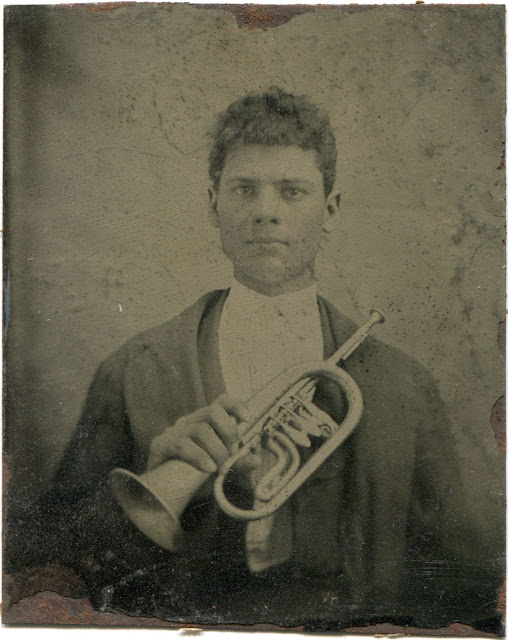
My first musician is a young man who proudly posed with his over-the-shoulder E-flat bass saxhorn. The image was developed on a dark metal tintype or ferrotype photograph, roughly 2¼ by 3¾ inches. The little tintype plate is inserted into the camera and captures the light onto a special emulsion that the photographer has painted on the thin sheet metal. It records a positive mirror image instead of a negative image like on film. Consequently his face and saxhorn are reversed from a true likeness. 


This is clear when you look at his cap which has reversed letters. When I "flip" the image using digital software we can see how the instrument, now properly oriented, was played balanced on the left shoulder with the right hand on the valve keys. The letters on his cap now read C. C. BAND. The tintype process produces a unique single photo that was not reproducible at the time. It was popular in America from from around 1859 to 1880. The simplicity of the background on this young man's photo suggests it was a quick novelty photo, maybe taken outdoors or in a tent by a photographer working a fair or amusement park where this man's band was performing. 


1868 catalog of the Isaac Fiske Brass Instrument Company
of Worchester, Massachusetts  


Over-the-shoulder saxhorns were a brass instrument family that became popular in America bands  in the years before the Civil War of 1861-1865. The design originated in Paris in 1845 with a patent by Adolphe Sax who wanted to create a set of conical brass instruments which would cover a full range of sound from sopranino to contrabass. His original patent was for saxhorns with upright bells but the plumbing design cleverly allowed for different configurations. In America the saxhorn bell was arranged to rest on the player's left shoulder with the bell pointing backwards. Since a band usually marched at the head of a parade, this rear-facing bell aimed the music back toward the marching soldiers, thereby keeping everyone in military step. 

The bass saxhorns were especially popular because previously there had been no brass instruments capable of producing low bass tones LOUDLY. The slide trombone in this era had a narrow cylindrical bore and did not have as dominant a voice as it would later have in modern times. It was also difficult to play in tune, given the infinite positions of the slide. But saxhorn's conical bore gave it a greater dynamic range and its valve action let it play in tune over a full chromatic scale. Adolphe Sax's best known invention, of course, was the saxophone which is also made of brass and comes in a variety of sizes. 


1869 catalog of the Boston Musical Instrument Manufactory 

In the 1860s saxhorns were produced by a number of American band instrument companies who marketed them as a ready-made set in seven sizes beginning with the smaller soprano voiced E-flat and B-flat cornets and then expanding to alto, tenor, baritone, bass, and contrabass saxhorns. Manufacturers also offered the same set in an optional design with the bell pointing upwards. In 1868 an Isaac Fiske E-flat bass in brass would cost $130. Made with German Silver, a shiny nickel plate finish, added $20 to the price.  According to the website calculator at www.in2013dollars.com that $130 bass saxhorn in 1867 would now cost around $2,846 in 2025.    


My second bass saxhorn player is pictured with his instrument on a carte de visite, a photo made by an albumen print from a collodion negative. Mounted on cardstock it is about 4½ x 2½ inches, roughly the same size as the tintype but lacking some of its clarity. First introduced in the late 1850s, the carte de visite, or cdv, was contemporary with the tintype but it overtook the tintype in popularity because its process allowed for multiple copies from an original negative. Most photographers offered a dozen prints for $1.00.   

Dressed in a bandsman's uniform this man rests his elbow on top his saxhorn's bell. His long uniform coat, epaulet bars, and kepi hat are similar to the uniform of a Union army regimental band. Unfortunately the cdv has no imprint on the back for the photographer, so the bandsman's location could be anywhere. But his cap does have letters above the brim. The focus is not very clear but I think it reads: WA & ** 58 I.  The WA would stand for Washington D.C. but it might be MA for Massachusetts instead. I think this photo dates from the Civil War years mainly because his uniform is very simple. After the war ended uniforms became very elaborate with lots of ornamental braid and fancy shako hats with feather plumes. 


Band of 107th U.S. Colored Infantry
Source: Library of Congress

A military band in the 1860s was largely just a brass band with drums. Generally woodwind instruments were not used though a few bands included a single E-flat clarinet or piccolo to play high treble melodies. In this photo from the Library of Congress archives, the Band of 107th U.S. Colored Infantry stands at attention outside the band's barracks. It was taken during the Civil War. The band of 18 musicians has a full set of over-the-shoulder brass instruments from cornets on the left to basses on the right. The bandleader stands on the left with a front-facing cornet. A band like this would typically perform concerts standing in a circle around their leader with all their instrument bells facing outward like the spokes of a wagon wheel. This amplified the band's sound and allowed their music to be heard all over an army's encampment.


My next bass saxhorn player is not dressed as a military bandsman but is clearly a dapper young civilian with his feet casually crossed and with, again, an elbow resting on his saxhorn's bell. This is another unmarked cdv so it is impossible to identify his location. But I think the round corners of the cardstock dates it to after the war, maybe 1870s. Notice the ribbon on his lapel. A prize for a band competition? Maybe a souvenir of a fraternal convention? 


Unknown Union regimental band
from Dowagiac, Michigan
Source: Library of Congress


In this albumen photo from the Library of Congress archives we see a Union regimental brass band from Dowagiac, Michigan. There are twelve men posed with a set of ten over-the-shoulder saxhorns and a pair of drums. They appear to be in a photographer's studio, but I suspect this was taken outdoors. Most of the brass instruments of this era used rotary valves, a German invention, rather than French piston valves. Like any technology in the early industrial age, musical instrument companies were constantly seeking to improve designs and boost sales of their instruments. The rotary valves in the 1860s were not as reliable and had a slower action than piston valves, so by the 1880s American musicians no longer favored over-the-shoulder saxhorns and instead switched to piston valve cornets, euphoniums, helicons, and tubas. 


My last saxhorn player is also in civilian dress with a velvet collar suit coat and satin vest. He upends the standard saxhorn pose to have his instrument resting on its bell. I believe it is the smaller B-flat bass. His chinstrap beard gives him a very patrician air, not a farmer but a businessman, I think. He is also posed in a kind of improvised studio with a linoleum floor and a simple fabric backdrop. 

Surprisingly, he is one of the few musicians in my collection of saxhorn players that has a name. On the back of this cdv is written Samuel Miller and there is an imprint for the photographer, too. "Photographed by Geo. W. Wilcox, Travelling Photographer". Unfortunately both names are too common and not enough to identify where or when this photo was taken. My best guess is sometime in the 1870s and somewhere in Pennsylvania, which was known to have a lot of itinerant photographers and Quaker chin beards.


These men chose to include their saxhorn in their portrait for a reason. It was not a photographer's prop. They wanted to project an image of personal pride and of musical accomplishment. In a way the saxhorn could be a tool signifying their occupation as a musician or a symbol of their musical avocation. But in the mid-19th century a big shiny saxhorn was also something to show off and brag about. Look at me. Listen to my voice. I play the BIG BRASS.  


Here is great video of Tanner Morgan,
band director of Edmond Memorial High School, in Edmond, Oklahoma, 
demonstrating his E-flat Over-the-Shoulder Bass Saxhorn.
His instrument has piston valves instead of the rotary valves seen in my photos.
His YouTube channel Musical Maintenance has more terrific videos 
of his school's Historical Brass Band. 


And here is a short 1955 film of
"Rally Round the Flag" by G.F. Root
played by "The Presidents Own" United States Marine Band
on authentic early instruments including a rank
of over-the-shoulder saxhorns.
Where they found these antique instruments is as big a puzzle
as some of the mysteries in my vintage photographs.
Maybe they borrowed them from the Smithsonian Museum?


For more photos and history 
of over-the-shoulder brass instruments
click these links to my other stories: 
The Big Brass


This is my contribution to Sepia Saturday
where bloggers around the globe
celebrate 800 weeks of inspiration!


Short People

25 February 2023

 
A skilled portrait photographer
always tries to satisfy a customer.
Yet when taking photographs of children
a photographer recognizes that
their clientele is not the child but its parents.
The photographer provides only the camera.
A child's wardrobe, hair, and accessories
are mother's responsibility.


In the brief time that a photographer
has charge of an unfamiliar child,
they must quickly arrange the subject,
position the lights, focus the camera,
and wait for that perfect moment
to release the shutter.


Even the best cameramen know they can command
the attention of a young boy or girl for just an instant.
Any delay brings unwanted movement,
a fuzzy eye blink or blurring shudder.
Likewise undue haste might miss
a candid gaze or youthful smile.


If the photographer's timing is good
they capture a perfect picture for the parents.
An image of childhood yet one full of blooming personality
and brimming with a parent's hope for the future.


Today I present
four beautiful studio photos
of handsome young boys holding musical instruments
that I'm fairly certain
none of them could actually play.


The first little boy sits on a hard wooden chair that is too tall for his feet to reach the floor. His long hair has been neatly curled and oiled as he gazes at someone to the side of the camera. Mother maybe? He clutches a slide trombone in a tight two-handed grip. The instrument gleams in the studio light showing off its elaborate engraving on the bell. He looks like a child who has been told several times, "Be very careful of Daddy's trombone. Don't drop it!"
 
A trombone's slide has seven positions that lengthen the instrument and give it a full complement of musical notes. It requires a fairly long arm stretch which would clearly be beyond the reach of this boy. My guess is that dad (or maybe mum) aspired that their son might soon take up the instrument. But looking at this kid, I have a hunch he chose something different. Unfortunately his postcard is unmarked so all I know is that it was taken somewhere in America around 1900-1910.


 * * *


The next boy is about the same age, around four or five maybe. He is dressed in a dark sailor suit with short knee pants. He stands on a fur rug in front of a large wooden bench and holds a shiny cornet. Once again the lighting picks up the fancy engraving on the bell. His short hair is cut in a military style and pinned to his blouse is a small medal. It resembles the crossed guns insignia worn by a U.S. Navy Gunner's Mate, though it might be the crossed cannon of the U.S. Army artillery or crossed rifles of the infantry. 
 
The way the boy holds the cornet is a not the usual way a real cornet player would hold the instrument. But more critical is that his fingers are too small to mash the valve buttons. So I think this was a picture taken for dad, maybe a sailor serving aboard a navy ship, who also played the cornet. 
 
 
This postcard does have a note on the back but sadly the clues are incomplete. There is a date, April 15: a name, Chas. Erb.; a place, Green Wick, K-town, and a mystery number, –16
 
Without a year we have only the little corner triangles in the AZO stamp logo to go by. When two point up and two point down it is roughly a photo paper style that the AZO company produced from 1918 to 1930.

The forename Chas. is Charles, but is Erb. a full surname or an abbreviation? It is an uncommon name in Ancestry.com.

And the place name doesn't match anything in Google Maps. There is no Green Wick, though plenty of Greenwichs. Initially I though K-Town was a short name for Kansas City, but Wikipedia has an entry for K-Town which does not include it. Of the cities in the United States with that nickname are Kaysville, Utah; Knoxville, Tennessee; Kenosha, Wisconsin; and Kearny, New Jersey. My guess is that it signifies Kearny, NJ which is on the Hudson River east of New York City, and near a major naval shipyard.
 
_ _ _


  * * *


The next postcard photo is of an older boy, somewhere between 8 and 12 years old. He is dressed in a proper bandsman's uniform and is holding a bassoon that is an inch or two taller. A bassoon is an unusual instrument to find in a small town band. Typically it was played only in large military bands. It's a bass instrument with complicated keys that require a wide finger stretch. This boy's hands are again too small to properly cover the finger holes and keys. 
 
His cap, and braided cord accoutrements are of a military style but a closer look shows his tunic sleeves are folded under and his trousers cuffs are tucked into his socks. This was clearly a borrowed uniform and bassoon to stage a photo for Dad or Grandpa. The photo's location may not even be a photographer's studio but instead it was taken behind a concert stage or even in a residential home. 

There are no marks on this postcard, but the letters, MINN are on the tunic's collar. Minnesota? I date the photo to around 1905-1915. He seems a sharp lad that any dad would be proud to see playing in a band.  


 * * *


The last boy is the oldest in time, though he is only about age 5 or 6. His picture is on a small CdV photo, a carte de viste, taken in the 1870s or 80s. He stands with a tenorhorn in a photographer's studio in front of a crudely painted backdrop. His hair is neatly combed and he wears a sturdy corduroy jacket with knee pants. It's not impossible that he played this instrument, a member of the saxhorn/euphonium brass family. I have several photographs of family bands which had young siblings who played a tenorhorn. However he just doesn't have the air of a real brass player so I'm uncertain.

However his small size certainly fits with my group of diminutive pseudo-musicians. The photo has a backstamp of the photographer, Adolph Rapp of Glasgow, Kentucky. This town is about halfway between Nashville, Tennessee and Louisville, Kentucky. In 1870 Glasgow, KY had a population of 733 residents. It jumped 106.0% to 1,510 in 1880 and then to 2,051 in 1890, so this photo likely comes from Glasgow's boom years.


I can't finish this post about young non-musicians
without showing off what talented kids are capable of
when they get the right musical training.
 
Here is an astonishingly great concert from Japan
by the Hirasanishi Elementary School Brass Band
performing the Benny Goodman classic, "Sing Sing Sing".
Look out for something that is not there
and you will be even more amazed. 


Did you spot any music stands?


This is my contribution to Sepia Saturday
where cuteness in any size is always awesome.


More Tinplated Brass, the Uniform Edition

13 August 2022

 
American musicians used to pay strict attention
to the gleam of their brass buttons,
the fringe on their shoulder boards,
and the frill in their shako.


 Collars and cuffs,
 aiguillettes and epaulets,
braids and buckles,
all required fuss and bother to assemble
into a proper bandsman's uniform.


Today I feature a selection
of ferrotype photos—tintypes
of musicians in their best dress uniform.
It's a continuation of my story from earlier this year
The Tinplated Brass.

As we admire these outfits and instruments,
all members of the low brass family,
let us appreciate that each musician
has either just finished, or is about to commence,
marching in a long parade with their fellow bandsmen.
It would not be an exaggeration to say
that 19th century America
was one endless parade
of scintillating music played by men
in seriously flashy uniforms.


{click any image for a closer look}


The first ferrotype is of a bandsman dressed in a fancy cutaway jacket with tails, triple rows of buttons, striped trousers, and a plumed shako hat.  His instrument has a kind of flugelhorn shape with a large bell, almost a bass trumpet in size. He stands in front backdrop with a fake interior scene painted with a very poor sense of perspective
 
A ferrotype, or tintype photograph captures light through a camera lens as a reflection onto a photographic emulsion that was painted onto a thin metal sheet. It was typically made of iron but despite its name, never of tin. The exposure creates a positive image much like the reverse image we see in a mirror. It's very similar to the grey-tone images made by daguerreotype and ambrotype photographs. But like those early photography mediums the ferrotype was a singular unique image that couldn't be duplicated. Nonetheless the ferrotype photo proved popular with the public in the 1865-1885 era because it required very little preparation by the photographer and the result was very cheap to produce.
 
Because these photos produce mirror image, I like to flip them with digital photo software to show the musical instruments as they would really be played. In this case, all brass instruments, with the exception of my instrument, the French horn, are designed with valve keys played with the right hand. Here is the same bandsman now reversed.


* * *


This next portrait shows a trombonist dressed in a similar uniform as the previous bandsman. However this man's jacket has two ornamental braided cords, the aiguillettes, draped over his chest. This military decoration has no practical purpose though its placement is particular to regimental traditions. 
 
The instrument is a piston valve trombone, possibly in E-flat as it looks shorter than the standard B-flat models. It also has engraved designs on the bell. The image above is what the tintype looks like without any digital correction. Here is how it looks flipped horizontally and with better contrast.


* * *


The next bandsman's picture once lived in a 19th century photo case. The light ovoid halo around the image is the stain from the paper or metal matte. Ferrotypes often have irregular edges because they were cut from a larger piece of sheet metal. Some were as small as a postage stamp called "gem", and were intended to be displayed in a locket. Others were very large, 11" x 14" which necessitated a larger camera and special processing. These were of course more expensive. This one came in the most popular size called a "Bon-ton", approximately 2-3⁄8" × 3-1⁄2" (60 mm × 89 mm). It's about the same size as the carte de visite, or CdV which was introduced to the public in the 1860s at the same time as the ferrotype. But unlike the ferrotype the CdV is made with a negative that could be easily and quickly reproduced to make more copies of a photograph.
 
The bandsman's uniform is  a variation of the others and I think it's a style from around 1876, the Bicentennial of the United States, which was an event when every band in America, at least those from the northern states, wanted to look sharp when it joined in the celebrations. The instrument is a type of saxhorn with three rotary valves. It's about the same length as the previous valve trombone, an alto, I think, with a bell that points up. Here the image is reversed to show the man's right hand in proper playing position.


* * *


This bandsman's portrait began my parade of ferrotypes and I have reversed it to show the difference between his tenor saxhorn and the previous alto saxhorn. Both have bells up but this instrument is longer with a larger bell so that it makes a lower pitched sound. It also has keys place atop the valves, called top action rotary valves TARV, where the other smaller saxhorn has side action rotary valves, SARV. Neither design is used on modern brass instruments.  

This fellow's picture is very clear and demonstrates how tintypes can have a very realistic quality despite the photo's dark appearance. Many early CdVs do not have this level of clarity where you can see the grain of the plume's feathers and the twist of the epaulet's fringe.
 
 
* * *


Most of my collection of musician ferrotypes are cornet players, the soloists of any band or orchestra in this era, roughly 1865–1890. But for this presentation I've chosen a selection of low brass instrumentalists. This tuba player's photo is originally fairly dark but when reversed and contrast corrected, we see his tuba the right way around, if upside down resting on the bell, and a pretty clear portrait with even a hint of rouge in his cheeks added by the photographer.

The uniforms are often misinterpreted as military type, which is only partly true. The styles and decorations resemble official army and sometime navy uniforms, but these were not musicians in the regular army. In the post-Civil War era, army regiments did not typically have full-time bands dressed like this. These musicians were not soldiers but represented semi-professional civilian bands that on occasion accompanied state volunteer militias, the precursors to the National Guard.


* * *


My last ferrotype is of a pair of young brass players. One holds an SARV B-flat trumpet and the other "wears" a tenor helicon over his shoulder. Their uniforms are equipped with white belts and harness to hold a music pouch. They also wear wide brimmed hats instead of shakos with one side turned up and a dark feather on the crown. The boys don't look much above 16 or 19 years old, but their hats give them a rakish debonair look that must have impressed the girls as they marched by. Look closely at the helicon player and you can see a small cluster of flowers pinned to his jacket.
 
When image correction and reversal is applied, the letters WCB are revealed on their belt buckles and one music pouch. There is also a hint of pink on their cheeks, again applied by the photographer after the ferrotype was processed.


Prices for the early daguerreotype and ambrotype photographs of musicians tend to reach hundreds if not thousands of dollars. Yet ferrotype/tintype photos generally go for much less while displaying more variety in subjects. Unfortunately it is very rare to find any clues as to where and when the photos were taken, much less the identities of the musicians, as there was no place to write a note on the metal. Scratches on the back would only ruin the image's emulsion on the front.
 
There are more tinplated musicians in my collection
so stay tuned for another sequel.


This is my contribution to Sepia Saturday
where no matter where you look
there's always something interesting to see.


The Tinplated Brass

14 May 2022


 It's a special bond,
a love affair really,
that every musician forms
with their musical instrument.
 
Most often it starts
with the sound an instrument makes.
But players soon become attached
to their instrument's shape, its design,
and the material it's made of.


For brass instrumentalists
it's a combination of all of those qualities.
It's an affection for the shiny brass
and nickle silver tubing artfully twisted
into a curvaceous shape that lets the player's lips
sing a tone that no voice could match. 


Today I present four photographs of cornet players
who chose to have their picture taken
with the instrument they loved.


But their instruments are different
from modern cornets and trumpets,
as they are holding instruments
of two early American designs
now obsolete.
 
The photographs are also unusual
because each image was produced on sheet metal
as a unique tintype,
or more correctly called,
a ferrotype.


Eb and Bb cornets, top and side action,
1872 catalog, John F. Stratton Musical Instrument Co.,
New York City

Today the trumpet is the high brass instrument most people are familiar with. But in 19th century America it was the cornet that was the lead instrument in any brass band. Though they both use essentially the same design to amplify the sound of a player's vibrating lips, and are of the same length, the cornet has a slightly more conical flare to its tubing, while the trumpet is more cylindrical.  Pictured above are E-flat and B-flat cornets offered in 1872 by the  John F. Stratton Musical Instrument Co. of New York.
 
The earliest brass instruments were horns and bugles of a fixed length that were restricted to one musical key and a limited number of pitches. With the advent of the industrial age in the early 19th century, improved metal working techniques using new precision machinery inspired many innovations in brass instrument design. The most important development was a valve mechanism to instantly change the instrument's length and give the player a full chromatic scale. But instead of piston valves as seen on most modern trumpets and cornets, the first American musical instrument manufacturers like John F. Stratton chose to use three rotary valves. These were arranged in two different positions, either with the finger key action on top the cornet's wrap or on the side. 
 
In the catalog illustration the cornets on the left and top right use a top action rotary valve (TARV) where the player's right hand is placed atop the instrument, pressing down on small semi-circular keys that turn the valves. On the lower right is cornet with side action rotary valves (SARV) where the keys are longer and the cornet is held so that the tubing wrap is horizontal instead of vertical like on the TARV models. Each version had ergonomic advantages for the player but the sound produced was identical.


In this ferrotype photo a young man poses with his SARV cornet with one elbow resting on the photographer's imposing studio plinth. He's dressed in a nice three-piece suit and his hair looks freshly oiled by a barber, but it's difficult to judge his age, maybe between 15 and 20 years old. Since his cornet is typically 14 inches long, I calculate that his height is 4 times that length. making him around 4 ft - 9 in tall which suggests the younger age. 
 
Careful observers will notice that the boy's left hand is on the keys. This is because a tintype/ferrotype photograph is a positive image much like the reverse image made by a mirror. The light is reflected through a camera lens onto a photographic emulsion painted on thin metal sheet, typically made of iron but never, despite its name, of tin. It records a singular grey-tone image similar to the earlier daguerreotype and ambrotype photographs. Like those early photography mediums the ferrotype is a one of a kind and can't be duplicated. Later technology introduced cameras that made a negative image on glass plate or film which could be used to reproduce an infinite number of albumen photos.


Using modern digital software it's easy to reverse the image to give a proper realistic perspective of the boy. Now we can see that he parts his hair on the right. Even without the cornet the original photo can be recognized as a reverse mirror image just by looking at the buttons. On men's clothing, buttons are always on the right and buttonholes on the left, while women's garments are the reverse positions.


Eb cornets, side and top action
1868 catalog, Isaac Fiske Musical Instruments
Worcester, Massachusetts

 
The boy's cornet is an E-flat model which is shorter than the standard B-flat cornet and typically plays the high solo line in a brass band. In 1868 the Isaac Fiske Musical Instrument company of Worcester, Massachusetts offered models with either side action or top action valve made in either brass or German silver, which is a durable copper alloy using nickel and zinc to give a silver appearance while not containing actual silver. The Fiske catalog price was $55 / $65 for the SARV models and $60 / $70 for the TARV, which is roughly valued as between $1,200 and $1,425 in 2022 prices.


* * *


My second cornetist is a dapper looking fellow wearing a light weight summer suit with a straw boater hat. Similar to the previous ferrotype, the photographer has added a delicate pink tint to the man's cheeks. 
 
Compared to the earlier daguerreotype and ambrotype photos, the technique to make ferrotype photographs was relatively easy and fairly cheap to produce. First developed in France in 1853, a tintype method was patented in the United States in 1856, but the popularity of the medium began during the Civil War period, 1861-65,  and continued through the 1880s.
 
The process used thin iron sheets cut into various sized rectangles and then painted with a black japan solution which creates the tintype's distinctive dark background. The photographer then prepared each little "tin sheet" with a collodion emulsion, either wet or dry, that contained suspended silver halide crystals. After the exposure was made a photographic fixer made of potassium cyanide was applied. Later a tint or varnish might be added. For a skilled photographer the ferrotype method produced quick and appealing results for their customers.


When the image is reversed the cornet player looks correct to the eye of a modern brass player like myself since his instrument now corresponds to the ones in the Stratton and Fiske catalogs.


John F. Stratton Co. musical instrument display
1876 Philadelphia Centennial Exhibition
Source: Free Library of Philadelphia: Philadelphia, PA.


For the 1876 Centennial Exhibition held in Philadelphia, the John F. Stratton Co. presented a large display containing a wide variety of instruments that they offered for sale. In this photo from the archives of the Free Library of Philadelphia we can see one side of a huge glass case is devoted just to brass instruments. Hanging inside are over-the-shoulder saxhorns in different sizes from treble to contrabass along with  multiple upright bass horns, trombones, French horns, and helicons. It was the great era of American expansion and brass bands were going to lead the way.


Eb cornets, side and top action
1868 catalog, Boston Musical Instrument Co.

 
Today most trumpet players use either B-flat or C trumpets for solo work. But in American brass bands during the 1860s and 1870s, the higher E-flat cornet was considered the premier solo brass instrument. In 1869 the Boston Musical Instrument Company promoted the E-flat cornet in both a SARV and TARV model as the choice of virtuoso cornetists. Perhaps knowing that many musicians can't resist a challenge the company shrewdly warned that the E-flat was "perhaps the most difficult to bring under control; it requires great strength of lip and strength of lungs  together with many years of practice to to make a good Eb Cornet player."  This copy writer knew how to charm a musician's heart.


* * *


This next cornet player has a side action B-flat cornet which he holds across his chest as he gazes directly into the camera lens. I think he looks about 18-20 years old. I've left this image uncorrected in its original raw state to show the faded tone which is like many tintypes, very dark, (though not as dark as some can be.) The chemistry of early photography was more akin to alchemy, and it took skill and art to concoct a proper emulsion and place a subject in just the right amount of light. Very often photographers worked outside using natural sunlight and I think that was the case here where the background is a canvas sheet.
 
When the image is corrected for contrast and reversed it demonstrates the qualities that made it superior. The camera focus is clear with a good depth of field. Even though the plate has numerous scratches, has lost some emulsion, and even developed a bit of rust it still makes a very realistic portrait. 


 * * *


My last "tinplated" cornet player is preserved in a paper envelope that is not common to find with a ferrotype photograph. Like the previous young man, this musician is also staring into the camera lens as he holds his B-flat cornet in one hand and a folio of music in the other. He's clean shaven, a bit older, perhaps in his early 20s. He wears a dark coat with light seersucker vest and wool trousers with a stripe on the leg. It can't say if that stripe makes it a military uniform as there are no other insignia of rank or unit visible. But in any case, he is very well dressed.

The size of the paper mount is 2 38 inch × 3 7⁄8 inch (60 mm × 98 mm) while the photo is about 2 inch by 3 inch. After it was placed into the paper frame a smaller paper rectangle was pasted on the back to secure it.


The iron rust spots show that the paper is authentic with the little photo and it offers one small clue. Along one edge is embossed:

Potter's Patent March 7, 1865


This mark was for Ray W. Potter, New York, NY who received patent No. 46,699 for a “Picture-Card Frame” which he sold from his shop in New York as an inexpensive substitute for the more expensive hard shell cases used for daguerreotypes and sometimes ferrotypes. Mr. Potter's shop also sold those along with his paper mattes as he was a supplier to the photographic trade. But it doesn't link this cornet player to New York or even 1865 since the photographer might be anywhere.  It does however give a better idea of when it was taken, roughly sometime after the end of the Civil War, and most likely by a photographer in the Boston, New York, Philadelphia area.


Once again when the ferrotype photo is reversed
the cornet looks correct and another nameless musician
is rescued from the mirror universe. 
 
  
The nature of tintype/ferrotype photos did not leave any room for annotations or photographer's marks. Occasionally a date might be scratched on the back of the sheet metal or the paper mount or thermoplastic case might have a note attached. But they are very rare to find. This makes identification of ferrotype photos very difficult to impossible beyond just broad time periods and locations.

There were specially made cameras that on a single exposure could take twelve small ferrotype photos, postage stamp size 3⁄4 by 1-inch, called "gems". But each one had subtle difference of perspective based on its position behind the lens. There were also cameras that used a mirror or right-angle prism to reverse the mirror effect but examples of those are rare. There is one in my 2018 story The Big Brass which features  tintypes of the early over-the-shoulder bass saxhorns.


* * *


According to my blog counter, this story marks my 600th post for TempoSenzaTempo. When I began this blog back on 14 December 2009, with my aptly titled, The first post, I had no expectation that I would write so many stories, much less amass the number of musician's photos and postcards that are now in my collection. All I wanted was to tell the internet world about a few interesting musical photographs that I had found. A year and a bit later on 8 January 2011, I discovered Alan Burnett's wonderful blogger digest, Sepia Saturday. I left this comment on Sepia Saturday #56, "Great website. I hope I can contribute from time to time."  As they say, "the rest is history".
 
Now 565 Saturdays later, (I have skipped a few Saturdays) I know I've displayed countless more photos and postcards than just 600. I continue to take inspiration from Alan's themes every weekend and I take great delight in meeting other bloggers at his virtual pub to share old photos and stories. Thank you, Alan, and thank you, Sepia Saturday bloggers, present and past, for your friendship. I can't say what my final blog number will be, but I have a long way to go before I write The Last Post.   There are a LOT of photos in my collection and every one has a story that needs telling.


This is my contribution to Sepia Saturday
where watching the world go by
is always a treat.


nolitbx

  © Blogger template Shush by Ourblogtemplates.com 2009

Back to TOP