This is a blog about music, photography, history, and culture.
These are photographs from my collection that tell a story about lost time and forgotten music.

Mike Brubaker
{ Click on the image to expand the photo }
Showing posts with label folk. Show all posts

Music of the Mountains

21 June 2025

 
It's a smile that gleams like sunshine.
From just a glance
we can recognize
that this is a fellow
of natural good cheer. 


Likewise the shy smile
of this young man
reveals a person we wish
we could hear more from.


And even though a smile
might be hidden
eyes can still invite us
to stop and listen.

Such is the power
of a good portrait photograph.


Today I present three photos 
of musicians I wish I could have met in person.
They represent a mountainous region of central Europe
called the Tyrolean Alps, whose folk traditions
have helped define western music.


My first Tyrolean folk musician is a man seated on a rustic fence below a magnificent snow-covered mountain. He wears lederhosen - short leather breeches, wooden clogs, wool shin-socks, and a broad floppy hat. Besides his smile, what first caught my attention was the small instrument he holds. It's called a recorder, or Blockflöte in German, a woodwind instrument that is very rare to see in antique photos, and the only example in my collection. And what makes it even more unique is that it's a little sopranino recorder in F, the second smallest member of the the recorder instrumental family. 

Recorders make a whistle sound and come in a wide variety of sizes. They are associated with so-called "Early Music" from the Medieval, Renaissance, and Baroque eras. Long ago in another life, I was a member of an early music consort that featured recorders and other forgotten wind instruments. For formal concerts we dressed in quasi-Renaissance costumes. I still have two handcrafted "peasant shirts", very like what this man is wearing, which my mother made for me. I also have about two dozen recorders.


This man's costume is characteristic of a rustic Germanic fashion that was worn in the Bavarian, Austrian, and Italian Alps. His cabinet card photo was taken at the studio of J. B. Rottmayer on Griessstätterstrasse in Berchtesgaden, a town in southeastern Germany, near the border with Austria, 30 km (19 mi) south of Salzburg and 180 km (110 mi) southeast of Munich. The town and its surroundings were once an independent state of the Holy Roman Empire. However during the turbulent Napoleonic era Berchtesgaden changed rulers a few times until 1810 when it was taken  over by the Kingdom of Bavaria. In the 19th century it became popular with tourists and the Bavarian royal family, the House of Wittelsbach, who maintained a hunting lodge in the former Augustinian monastery in Berchtesgaden. 


The Grand Hotel in Berchtesgaden, 1898
photo by J. B. Rottmayer
(later Grand Hotel Auguste Viktoria,
and from 1936 Hotel Berchtesgadener Hof.)
Source: Wikimedia

In 1898 the photographer of my alpine recorder player published a large landscape photo of Berchtesgaden showing the Grand Hotel Auguste Viktoria. His full name was Johann Bapta Rottmayer (1828–1899). Born in Wien - Vienna, Rottmayer became a successful photographer first in Wien, and later established studios in Graz, Brno, and the port of Trieste. He made countless carte de visites of Austria's aristocracy and upper class, as well as grand landscapes, seascapes, and urban views. However he did not start a studio in Berchtesgaden until around 1898 and then died  in 1899. So my photo very likely dates from 1898-1899. 

This portrait has a novelty quality which suggests it was a holiday/vacation style photo made to fool the folks back home. It's not impossible that this sunny fellow was outfitted in a costume borrowed from the studio and given a recorder and walking stick to complete the illusion of a mountain rustic. Even so, it is still a terrific portrait that delights the eye. 

Johann Rottmayer's name is still remembered because of his connection to a bizarre musical story.  In October 1863 a group of medical scientists exhumed the bodies of Ludwig van Beethoven (1770–1927) and Franz Schubert (1797–1828) who were buried near each other at a cemetery in Währing, northwest of Vienna. The purpose of this macabre disinterment was supposedly to prevent further decomposition to the bodies and establish more worthy resting places for these two great composers. After the skeletons were removed it was Rottmayer's duty to take a series of photographs of the skulls of both Beethoven and Schubert. Each body was carefully examined and measured and plaster casts were made of the skulls. Two weeks later the remains of both composers were reverently placed into new metal coffins and installed into vaults at the cemetery. 

The 1860s were a time when phrenology, a pseudoscience that involves the measurement of the skull, was used as a way to predict human behavior, personality, and intelligence. In the case of these two famous composers, it was thought that their musical genius could be determined from the shape of their brain case. Needless to say, phrenology is a stupid and wicked theory that has been disproven many times. 

To add further insult to the memories of Beethoven and Schubert, in June 1888 the remains of both composers were relocated to the Central Cemetery (Zentralfriedhof) in Wien. 

(Since Rottmayer's photos of Ludwig and Franz show them in a rather undignified condition, I've decided they don't need to be presented on this blog. Better to remember them by their music.)


* * *


In this photo postcard my second Tyrolean musician is standing in a photographer's studio dressed in longer lederhosen fastened below the knee, white stockings, sensible walking shoes, a wool jacket and a large hat with a long thin feather. The card's caption identifies him as Rudolf Hechensteiner, Zithermeister and on a table he displays his instrument, a zither. This string instrument has a strings over a fretted fingerboard and more open strings to add bass notes. It is usually played on a table which increases its dynamic resonance. Rudolf looks very young to be a master musician, late teens or early 20s maybe, but presumably the medals on his belt are a testimonial to his musicianship  

The postcard was sent from Kufstein, a city in the Austrian state of Tyrol, right on the southern border with Bavaria. It's the second largest Tyrolean town after Innsbruck, the state's capital. The postmark imprint on the green face of Kaiser Franz-Joseph is not clear but fortunately the photographer, D. Amort of Kufstein, has left a notice Nachdruck verboten ~ Reprinting prohibited with the year 1910. 


* * *


My last photo is another string player, this time an older man with a contraguitar, also known as a Schrammel guitar. He sits in a photographer's studio with dramatic thunderclouds looming in the backdrop. He is identified in a caption as Seppl Lorenz. Like my recorder player, he is dressed in lederhosen, wool shin-socks, wool jacket and a classic Tyrolean hat with its distinctive Gamsbart plume, made exclusively from hair taken from an Alpine chamois' lower neck. His mustache conceals a hint of a smile but the photographer has captured a moment in his eyes that I think conveys a lighthearted spirit. 

The card was sent from Chemnitz, Germany on 9 October 1919. I expect Seppl Lorenz earned those medals pinned to his jacket in the late war which may account for his good humor. Chemnitz is the third-largest city in the German state of Saxony after Leipzig and Dresden, and is about 260  miles north of Berchtesgaden, a long way from the Alps. But I think Seppl Lorenz's folk costume is enough to connect him to Tyrolean traditions. Certainly his Schrammel guitar is very much an Austrian instrument. 


To finish here is the "Schrupp-Schrupp Polka"
played on Zither by Balthasar "Hausl" Brandhofer
and on Kontragitarre by Florian Möckl.
Notice how bass notes are played
on the contra
guitar with the right thumb
and on the zither with the right pinkie.


And to demonstrate how Tyrolean music
is connected to dancing,  
here is a short historic film
of a Tyrolean dance filmed in 1896.
It was colorized  by the "not.bw" project
and uses the jaunty zither music used as
the soundtrack for the 1949 British film "The Third Man". 
It was written and performed by Anton Karas.


 Berchtesgaden, Germany with a view of Mount Watzmann, 2007
Source: Wikimedia


This is my contribution to Sepia Saturday
where you don't have to climb every mountain
to get to where you are going.


Peruna Presents: Crockett's Kentucky Mountaineers

01 June 2025


They were all there.
Albert was on bass,
Allen and George on fiddles,
Pauline, Christine, and Elnora looking very pretty,
and Johnny and Clarence on guitars. 


Little Dorothy and Sonny joined in the show
along with Glen Hardy,
and, of course,
Ma and Dad, too.

They played some snappy music
and sang a couple of old-time songs.
You should have seen them dancing.
They were the Crockett Family Kentucky Mountaineers.
They were swell!


This battered card, a half-tone print, is captioned:

Greetings from The Crocket(sic) Family, K.N.X.
and Peruna

What makes it a special souvenir is that someone wrote  the names of each member of the band onto the card. The Crockett Family were a country string band who called themselves the Kentucky Mountaineers. This card is a souvenir from when they performed on KNX, an AM radio station in Los Angeles, California, a very long way from their origins in Kentucky. This family band was started by John Harvey "Dad" Crockett, who was born in 1877 in Wayne County, West Virginia, but as a young man moved to Bath County, Kentucky. The University of Kentucky archives keeps a collection of the Crockett family papers and has the best biography of John H. Crockett with a history of his string band, which I will reprint here.
John Harvey Crockett, Sr. was a musician, music teacher, and maker of musical instruments who taught fiddle, banjo, shapenote singing, harmonica, and guitar in communities throughout the mountains of West Virginia and Kentucky. He married Admonia Jane Patrick of Tennessee, with whom he had eleven children, seven of whom lived to adulthood: Ethel (1898), George (1900), Clarence (1905), Albert (1907), Johnny (John Harvey Crockett, Jr, 1909), Alan (1915), and Elnora (1920).

In 1916, the Crockett family moved to California, where they lived for several years near Fresno. The Crockett children performed for their schools and at local dances throughout their youth. In the mid 1920s, the Crockett brothers were an early hit on the Fresno Bee radio station KMJ. The brothers sang songs written by Johnny, popular songs, novelty tunes, cowboy songs, songs from minstrel shows, and old-time songs that the boys learned from their grandfather, George A. Crockett.

The Crockett Family Kentucky Mountaineers was formed in 1926 and included all of the Crockett children except for Ethel. Earlier names of the group included The Crockett Minstrels and The Crockett Family Orchestra. Albert, Johnny, Alan, and Elnora, who grew up mostly in California, gravitated towards modern music and old-time music that they learned from elder family members. George and Clarence, who were rooted in Appalachia, always preferred the music of the hills where they and their parents were born and raised.

Following their success on Fresno radio, John Harvey Crockett, Sr. and his five sons played for stations in Los Angeles and southern California. In 1927-1928 the group signed with the Keith-Orpheum Vaudeville Circuit and became a headline act on that nationwide circuit. They toured vaudeville theatres throughout the United States and Canada, played regularly over the radio, and broadcast nationally from New York station, WABC. The Crockett Family Kentucky Mountaineers returned to California after their WABC stint and became the lead act on The Hollywood Barn Dance, a program on Los Angeles radio station, KNX. The Crockett Family Kentucky Mountaineers' final tour was of the west coast in 1936-1937. Family addictions to alcohol led to the downfall of the group, with George Crockett's death from alcohol poisoning (1941) and the suicides of Clarence (1936) and Alan (1947).

Before we go any further
in their story let's listen to 
Crockett's Kentucky Mountaineers
playing Buffalo Gal's Medley
in a recording made in 1931.


Though my picture of the Crockett family is the size of a postcard, instead of the usual stamp box on the back there is a small calendar for the year 1935. It has a title:

TRY PERUNA
TO HELP BUID UP
—COLD CHASING—
—COLD FIGHTING—
RESISTANCE


The band was led by John Harvey Crockett, Sr., "Dad", on fiddle and banjo, and accompanied by his wife, Admonia Jane, "Ma", and their five sons, George (fiddle), Johnny (banjo, guitar, vocals), Alan (fiddle, bones), Clarence (guitar), and Albert (bass, tenor guitar) and daughter, Elnora (vocals). The two other young women in the photo were sisters, Pauline and Christine Stafford, reportedly neighbors from Tennessee. The two children, Dorothy and Sonny, and the young man, Glen Hardy were likely extras used to add more youth to this family entertainment.  


Coos Bay, OR The World
7 May 1935


The group pictured on the card has 13 members but they usually toured with 10, as pictured here in a 1935 theater promotion in the Coos Bay, Oregon newspaper. By 1935 the Crockett family were seasoned entertainers having played on both vaudeville and radio. In January 1928 the Crockett Family (Kentucky) Mountaineers appeared at the Orpheum theater in Oakland, California as one of a half-dozen acts arranged around a featured film. A reviewer in the Oakland newspaper said "One of the greatest novelties which has ever played the circuit is the act of the Crockett Family Kentucky Mountaineers, whose old-time music and square dances are something really out of the ordinary."  

Oakland CA Tribune
13 January 1928

The film was "Show Girl", starring "Hollywood's newest sensation", Alice White, as "the hottest little hotsy-totsy that ever shook a scanty at a tired businessman." I don't think she did square dancing. The "Show Girl" was a semi-silent film with caption cards for the drama and no audible dialog, but it did use a new audio technology with a synchronized musical score and sound effects that used the Vitaphone sound-on-disc process.

One tune was not enough.
Let's have an encore!
Here again are the
Crockett's Kentucky Mountaineers
in a rendition of that great old-time classic
 Little Rabbit (1931).


In around 1927 the Crockett boys got their start on radio in Fresno, California at station KMJ. This station was one of oldest in America having secured its commercial license in March 1922. The first radio stations used an amplitude-modulated (AM) signal which, with enough power, could be picked up by listeners who were hundreds, or even thousands, of miles from the radio transmission antenna. Performances of radio plays and music concerts were broadcast live, and not pre-recorded. Over the next decade, as the technology of microphones, amplifiers, and receivers improved, radio shows were produced in front of a studio audience, which allowed performers like the Crockett family to appear dressed in costume. 

After some local success, the Crockett Family Kentucky Mountaineers were taken up by larger stations and then national networks. As more and more people around the country began purchasing radio sets, their infectious music quickly created a sensation in the new medium. This opened up opportunities for the Crocketts to tour the vaudeville theater circuit.   


Fresno CA Bee
2 September 1929

The Crockett's home in California was in Fowler, a little farming town in the San Joaquin Valley about 12 miles southeast of Fresno. On 2 September 1929 the Fresno Bee, which now owned the KMJ radio  station, published a front page feature and photo about the meteoric rise to fame of the Crockett family.  The popularity of the Kentucky Mountaineers was bringing them new bookings in major cities like New York City. They were publishing their own songbooks, starting a nationwide tour of vaudeville theaters, and planned to release new recordings. They were now reputed to earn $2,000 a week. Not eight weeks later, on 24 October, also known as Black Thursday, the American stock market crashed, marking the beginning of the Great Depression.

The people of Fresno seemed just as proud of the Crocketts as the folks back in Kentucky. The writer of the article explained their success this way:  
"The high praise that is accorded the Crocketts throughout the country is evidenced in the following review of their act, printed by a Denver, Colorado, newspaper: "In this sophisticated age, when there is consorted effort upon the part of the the majority of performers to be arty, Crockett's Kentucky Mountaineers offer such a startling contrast that they all but caused a riot. 

   "The parent Crockett and his five sons present such a picture as has not been seen here in ages. That they are authentic is plain to be seen. Without any flourishes they fiddle away at the old tunes familiar to every one, keeping time with their swinging feet. 

   "Then to disclose their versatility two of the boys sing 'Sipping Cider'—and how they can sing it. The baby of the family then fiddles a tune accompanied by his brothers. 

   "But the riotous feature is when one of the boys calls off the old fashioned dances and trips about the stage showing this generation how it is done, while the rest of the family provide. the melody. 
   
   "The family also have a. priceless possession, huge, shy smiles that will win an audience no matter what they do. Really, no one should miss this troupe if for no other reason than to be convinced that people can, in this day and age, be so ingenuous and present their talents with such disarming simplicity." 


The following summer in 1930 the friends and fans of the Kentucky Mountaineers learned that they would get a rare treat courtesy of the Fresno Bee. Albert Crockett, the bass player with the big grin, was to be married to Miss Josephine Phillips of Pineville, Kentucky. The wedding ceremony was to be held in New York City, but it would be broadcast live over the CBS radio network which included the Bee's KML station.


Fresno CA Bee
8 July 1930


The audience demands more!
So here again is 
the Crockett Kentucky Mountaineers
in Sweet Betsy From Pike.
It was recorded in New York City
in either January or February 1931


The Crockett family's national tour in 1935 followed a route familiar to many family entertainers over previous decades. It was a trail of theaters in cities and towns linked by America's railway lines. Early vaudeville in the 1890s had all live performers of course. Change was coming though and after 1910 entertainers shared the stage with a new fade—movies. The actors may have been mute, mouthing their words, but the films were certainly not silent as there was always an orchestra, a pianist, or organist to provide accompaniment. And as early feature movies were usually short, theaters still depended on live acts to keep audiences entertained while the film reels were changed. But by the mid-1930s movies with full sound and exciting cinematic action forced theaters to give up on house orchestras and quit booking live acts altogether. Vaudeville struggled along in smaller towns but it would soon disappear.


Casper, WY Star-Tribune
22 August 1935

In August 1935 the Kentucky Mountaineers appeared in Casper, Wyoming at the America theater. The local newspaper ran an advert which showed eight members of the "internationally famous" Crockett family onboard a horse-drawn farm wagon. They were radio stars from KNX Hollywood.  The movie feature was "We're in the Money", a romantic comedy film starring Joan Blondell and Glenda Farrell in a kind of "buddy" story. 

The Crockett family finished that 1935 season but despite their success, they seemed to have given up the vaudeville circuit and radio too. I could not find their group's name on radio listings or in theater adverts after 1937. Beginning in 1935 another group called "Uncle Henry's Original Kentucky Mountaineers" showed up in several newspaper, mostly in the East. Like the Crocketts it was a mountain string band, but with eight musicians. I suspect this band was produced as a deliberate imitation of the more famous Crockett family. It lasted up to the war years and then disappears.

From John H. Crockett's brief biography we learn that the Crocketts suffered some cruel sadness in their family. Their first loss occurred on 20 August 1936 when Clarence Crockett took his own life. After he had threatened his wife several times with a gun, she took their children and left their house. Shortly afterward Clarence shot himself. Tragically it was his father who discovered his son's body.

Oakland CA Tribune
20 August 1936

Such terrible events are a burden to any family, but for those working in show business, it can be even more stressful to keep performing. But the Crockett Family tried anyway, playing a show in December 1936 and a couple more in 1937. Yet like in all family  bands, the kids inevitably grow up and find other interests, start their own families, and pursue new ambitions. It was also the height of the depression which was affecting every industry including show business. After 1937 Crockett's Kentucky Mountaineers seems to have broke up. Some of the other family members found music work in other string bands and even in Hollywood, too. But newspapers did not record any further concerts of the whole Crocket family. 

John Harvey Crockett, born 1877 in West Virginia died in Sacrament, California in January 1972.


* * *


I don't know how influential the Crockett family string band was to the growth of Country & Western music. The Crocketts called it old-time music,  even though some of the boys wrote new tunes for their band to play. They were influenced by Grandfather Crockett and a family memory of Kentucky mountain songs and dances. At the time some newspapers called it Hill Billy music, or Barn Dance music. What it lacked in sophistication was made up by its infectious toe-tapping rhythms. But I think the real reason for the Crockett family's appeal was that they were authentic. 

This was an era when traditional folk music was still alive and unspoiled by commercialization. The Appalachian mountains, from Alabama to Maine, were home to a mix of many cultures that in the 1930s were still very much isolated from the rest of America. By moving to California the Crockett family managed to take advantage of two new mediums—radio and recording. For a brief few years their genuine mountain music entertained American audiences with a sound that was fresh and novel. Eventually the world would recognize Appalachian music for its roots in Scotland, Ireland, Africa, and other musical cultures. For the Crocketts I think it was all about playing homemade music that kept you dancing on your toes.


Readers who have got this far may ask,
"Wait! What's the deal about Peruna?"


St Louis, MO Republic
28 February 1901


Peruna, or Pe-ru-na as it was sometimes called, was a patent medicine concocted by Samuel Brubaker Hartman,1830–1918, and sold to the public at great profit in the late 19th and early 20th centuries. Peruna was purported to cure catarrh, a general purpose word for inflammation that covered all manner of ailments in the human body. Hartman was a trained physician and surgeon but his true talent was as a quack doctor. 

When his patients complained that their pharmacists were not preparing his prescriptions correctly, Hartman decided to manufacture his own special cure-all medicine. He called it Peruna and began selling it in 1885. He claimed it was beneficial for anyone suffering from pneumonia; tuberculosis; grippe – influenza; the common cold – catarrh of the lungs; canker sores – catarrh of the mouth; appendicitis – catarrh of the appendix; chronic indigestion – catarrh of the stomach; mumps – catarrh of the glands; Bright's disease – cattarh of the kidneys; and Yellow fever. It could also help people gain weight.

This wonder drug became a miraculous tonic, a magic elixir that was advertised in thousands of newspapers and magazines. Peruna was endorsed by hundreds of politicians, military officers, and other prominent dignitaries and received testimonials of its wonderous qualities from countless ordinary people. It made Hartman a very wealthy man. 

In 1905, Collier's magazine published a series of eleven articles by the journalist Samuel Hopkins Adams entitled "The Great American Fraud". In his report Adams exposed Peruna and other patent medicines as complete frauds and, in some cases, dangerous due to toxic substances. The only active ingredient in Peruna was 28% ethanol. Supposedly it was at least better than other panaceas which used opium and cocaine as ingredients. Adams' work was widely read and it led to the passage of the Pure Food and Drug Act of 1906. 

However Peruna continued to be manufactured though now under a different formula with less alcohol. After his death in 1918, Samuel Brubaker Hartman's company (No relation to me that I know of. Yet.)  stayed in business selling its fantastic brew to foolish people desperate to find cheap cures. 

By 1935 Peruna was still sold to the public but it was now just an ordinary household brand name. But in order to promote sales the Peruna company began sponsoring radio programs and musical artists. What I did not know until I began doing research on the Crockett family this week was that Peruna sponsored other radio bands too. There are promotional cards for Western, country, swing bands and more, all with a calendar for 1935 printed on the back.

Thus a new genre in my collection has begun—the Peruna Presents series. Stayed tuned for the next episode.


This is my contribution to Sepia Saturday
where everyone is tuned to their radio, 
so
DON'T TOUCH THAT DIAL!


Musical Artists of Norway

15 April 2023

 
To the casual observer
this ornate string instrument looks like a violin.
Many people might call it just a fiddle,
which is closer to the truth.
But a closer look
reveals some important differences
that are not part of classical violin construction.

The first thing to notice
is that the elongated string box on the end
has twice as many pegs as a violin.


The pair of cutout curves or F-holes
that center the bridge
are longer and straighter than a violin's.
And of course few violins are as embellished
with fancy geometric patterned inlay
on the fingerboard and tailpiece. 
 
Though this instrument is played with a bow
and fingered like other members of the string family,
it is actually a special Norwegian cousin of the violin.

It is the Hardanger fiddle
or in Norwegian, the Hardingfele.

 
Hardangerfele, 1651
by Ola Jonson Jaastad (1621–1694)
University Museum of Bergen
Source: Wikimedia

The Hardanger fiddle is folk instrument that was first credited to Ole Jonsen Jaastad (1621–1694) of Hardanger, Norway who made one in 1651. His instrument is contemporary with those of the famous luthier, Antonio Stradivari (1644–1737), who was making violins in Cremona, Italy at the same time. Unlike the violin, a Hardanger has extra sympathetic strings running under the decorative fingerboard which add resonance to the fiddle's sound giving it a ringing quality. There are four principal strings to play the music but they are tuned differently from the violin as the Hardanger fiddle is a transposing instrument, meaning the written music for it is different from its sounding pitch. The strings are also tuned according to a Norwegian player's native region which could be one of several different combinations of pitches. 
 
But the most distinguishing feature of the Hardangerfele is the fine inlay work on the fingerboard and tailpiece. Though the patterns follow traditional Norwegian folk designs, each maker had their own style. The craftsmanship and artistry of the instrument are as much a part of the Hardanger fiddle's heritage as its music. This next images show the strings as they pass over and under the bridge of another fiddle with a closeup of the top's floral design.


Detail of a Hardanger fiddle made by Knut Gunnarsson Helland.
Source: Wikipedia


Here's a demonstration of the Hardanger fiddle
in an appropriate folk setting
at the Telemark museum in Norway.
The fiddler is Annika Westgård
playing the tune Fanitullen at the Brekkeparken.
She uses a special
left hand technique of plucking the strings without the bow
and she is also tapping (stomping) her foot in time to the dance tune.


My first Hardanger fiddle image came from a postcard that names the player in a printed caption. He is Sjur Larsson Helgeland (1858−1924), born at Voss in Hordaland, Norway. He was a celebrated fiddler and composer who won the first annual Norwegian folk music and dance competition in 1896 at Bergen. This postcard was sent to someone in Bergen on the day before Christmas, 24 December 1910.


Sjur Larsson Helgeland (1858−1924)
Norwegian hardingfele fiddler
Source: Wikipedia

The postcard was printed for the photographer, Hulda Marie Bentzen (1858–1930) who was an early professional female Norwegian photographer with studios in Bergen and Voss. The original image is on Helgeland's Wikipedia page. The ghostly background was likely painted on by a newspaper's print shop to isolate the image in order to make a half-tone copy. Sjur Helgeland came from Voss which is a district around the village of Vossevangen. Wikimedia provides several images of this picturesque place, and I chose one because it was taken in the 1890s, so this is Voss as Sjur Helgeland would have known it. It was also colorized and printed in Detroit.
 

Vossevangen, general view c. 1890
(Lake Vangsvatnet, Norway)
Source: Wikimedia


Voss is situated in the rugged landscape of western Norway and is one of nine traditional districts of the Vestland county. Voss lies in the center and is adjacent to the Hardanger district. But recently in 2019 a merger of Voss with another community required designing a new coat of arms. The result is an outline of a Hardanger fiddle on a bright red shield. It's a symbol of how Norwegian folk music heritage is still cherished in this part of the country.


Voss, Norway
Coat of Arms since 2020
Source: Wikipedia


* * *


The second image shows a young man dressed in his Sunday best and seated on a bench in a photographer's studio. He holds his Hardanger fiddle upright on his leg to show off its intricate inlay. I don't think he is smiling, but by Norwegian standards, maybe he is. 
 
The photo is mounted on a small carte de visite card, the same size as two other photos of Hardanger fiddlers which I featured in my story from January 2015, Isn't it good, Norwegian wood?. The photographer's name is Per Braaten of Gol, located about 150 miles east of Vossevangen. It's a very nice clear image that I initially mistook for an occupational or folk photo. Unfortunately there is nothing on the back to identify the young man or date the photo.
 
But as soon as I searched for the photographer's name, Google instantly directed me to a website with examples of the Braaten family's work. Embrik Torkjellson Braaten Braaten (1866–1906) and his wife, Henriette H. Olsgaard (née Kierulf), were photographers as was their son, Per Bratten (1893–1944), who took over his father's studio in Gol in 1909. And the photo used as an example of his work is an identical CdV of the same fiddler! But on this website he is named, "Master fiddler Olav Sataslåtten photographed at Per Braaten probably around 1914." And to my surprise this was no ordinary musician but another champion fiddler who went on to great success as a player and composer.


Olav Sataslåtten (1891–1971)
Norwegian fiddler
Source: Wikimedia

Olav Sataslåtten (1891–1971) was from Hallingdal, Norway, abut 8 miles south of Gol, and he began his musical career around 1904 by playing for dances. If the date for my photo's twin on the Braaten family website is correct then he would be age 23 and already a respected musician in his region. He is credited with being a major influence for later fiddlers and helping to preserve the old tradition tunes, which like most folk music, was rarely written down but instead learned by ear. From 1939 to 1971, the year of his death, he made over 366 recordings that have survived.

 
Courtesy of Orchard Enterprises, which has remastered his recordings,
we can still listen to Olav Sataslåtten on YouTube.
Here is his rendition of a Springar, a Norwegian folk dance,
called Krullafuru ~ Curlew Pine.


But to really appreciate
the sound of a Handanger fiddle
we should listen to one
in the context of a Norwegian dance.
Here's a short video of one from 2019
entitled Fela Flott - Hamborgar etter Sjur Helgeland,
which I believe is the band's cover of a tune
composed by Sjur Helgeland.


This is my contribution to Sepia Saturday
where everyone is on spring break.


A Fiddler on the Street

25 March 2023

 
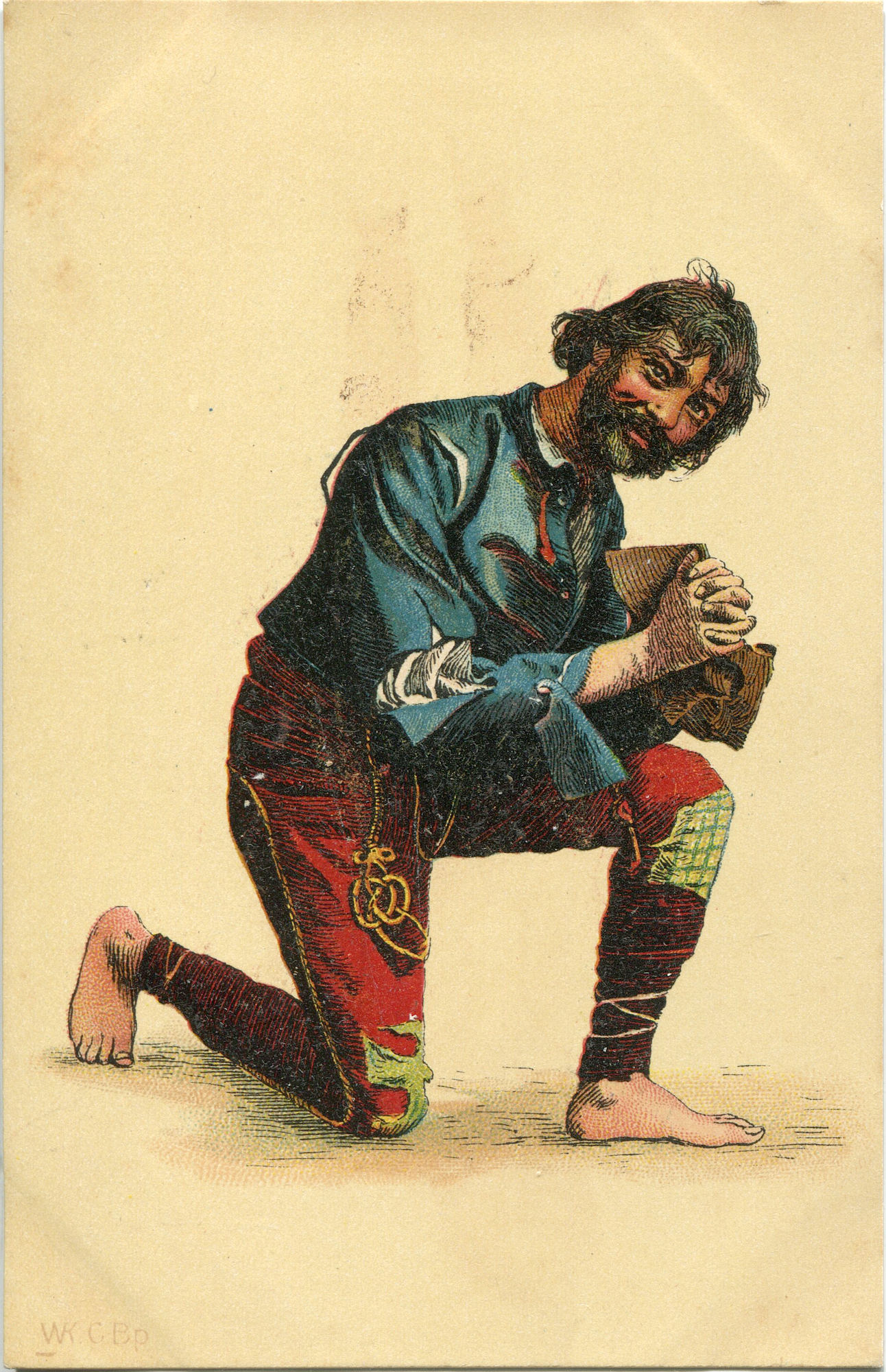
 The fiddler bows low in supplication.
His clothes are ragged and his feet are bare.
"A few coins, please, for my music," he pleads.

The caption in Hungarian reads:
 
Ide azzal a borra:
Szomjazik a Kátsa,
Csiklandozza torkát még
Töpörtus pogάcsa.

 ~
Here with that wine:
Kátsa is thirsty,
Tickle our throat with some more
Puff pastry.


This colorful illustration of a musician appears on a Hungarian postcard dated 1903 June 20. The dating convention in Hungary at that time was to use a year/day/month pattern and leave off the first numeral 1 from the year. It was sent from Dunaszerdahely, which is now called Dunajská Streda in southern Slovakia. The town was first mentioned in records from 1256. The word Szerdahely means "Wednesday (market)place" in Hungarian and today the town is still predominantly inhabited by ethnic Hungarian people.


The fiddler's postcard caught my attention mainly for its vivid colors which despite the passage of 120 years are still bright. The musician's shabby appearance is not unlike that of street buskers seen in cities around the world. In fact he looks better dressed than some of the street musicians found here in my hometown in western North Carolina. What sold me on this whimsical card was the discovery that there were more in the same series.


On this card the fiddler clasps his hands in prayer while gazing up to the sky. If his first plea did not work then perhaps an appeal to a higher authority will. His tattered blue jacket and red trousers are similar to a European military bandsman's uniform. In the lower left corner are initials:  WK.C.Bp. which I interpret as the mark of the publisher and not an artist. The printing method is lithography which probably accounts for it better quality ink. It needed only a tiny bit of digital correction of some faded contrast. The card has no printed verse and was never mailed.


Jól izlet a májas hurka,
Meg a malacpecsenye,
Ilyen ếtel a czigánynak
Minél többször kellene.
Koplal sokat a szegény
Kóczos, fekete legény.

~
The liverwurst looks good,
And the pork roast,
Such food for gypsies
As often as possible.
The poor man fasts a lot
A disheveled black fellow.


Now the fiddler glances covetously at some tempting food according to the verse. The sender of this postcard adds a line: Tanifókkal eqzyűl ~ He met with Tanifos, which probably was a funny remark that made sense only to the recipient. Like the first card this postcard was also sent from Dunaszerdahely on 3 June or July 1902.  In this era Dunaszerdahely was in Hungary, a part of the Austrian-Hungarian Empire, but Hungary was still a separate kingdom and had its own postal service. Notice that someone, maybe the postman, has struck through the alternate foreign names of this postal media leaving only the Hungarian name: Levelező-Lap, which translates literally as Correspondence-Sheet.


Here the fiddler holds out his hat to ask for coins, a universal gesture recognized since ancient times. The unknown artist has kept a consistent style and given the man a variety of charming expressions. This card shares the same style printed back as the others but was never posted.


My last card of the fiddler has him begging down on bended knee with his dark eyes turned to the viewer in an imploring gaze. I feel certain there is a 6th card where he is playing his violin as this was the typical number printed for postcard series, but I will have to remain patient and watchful until I find it. 

The artist's depiction of this vagabond musician fits with artwork I featured in my story from August 2022, The Romantic Violin. Like those passionate violinists, this fiddler is a fanciful romantic creature too, but unlike them he is also an example of a racial trope. European people in 1902 would have instantly labeled him as a Zigeuner, a Gypsy, or more properly a Romani. Though he is rendered in a gentle way as a poor tramp he embodies an ethnic cliche that appears in many other postcards from this same period.


The Romani people are said to have originated in the northern Indian state of Rajasthan. After the  invasion by Islamic forces in AD 1000-1040 the Romani migrated into the Byzantine empire and then central Asia. They appeared in Europe first in the Balkans in the 13th century; then Bohemia in the 14th; followed by Germany, France, Italy, Spain and Portugal in the 15th; and by the 16th century they were in Russia, Denmark, Scotland and Sweden. They were a nomadic people who seemed never able to settle in one place, mainly because they were abused and persecuted everywhere they went.

The Romani were often portrayed disparagingly in Western culture for their stubborn independence, criminal pursuits, and knowledge of arcane arts like mysticism and fortune telling. Yet many artists, writers, and composers were attracted to their culture and created Romani, Gypsy characters to add an exotic or provocative allure to their work. Perhaps the best-known musical character is Carmen, the beautiful Spanish Gitano (Romani) woman in Georges Bizet's popular opera of the same name, adapted from Carmen, an 1845 novella by the French writer Prosper Mérimée.
 
But Romani culture was also recognized for its music, especially on the violin. Many great composers like Brahms and Liszt were influenced by Romani rhythmic dance forms and melodies played in a characteristic minor mode. Thus the Gypsy fiddler became a popular figure for European artists.


  * * *


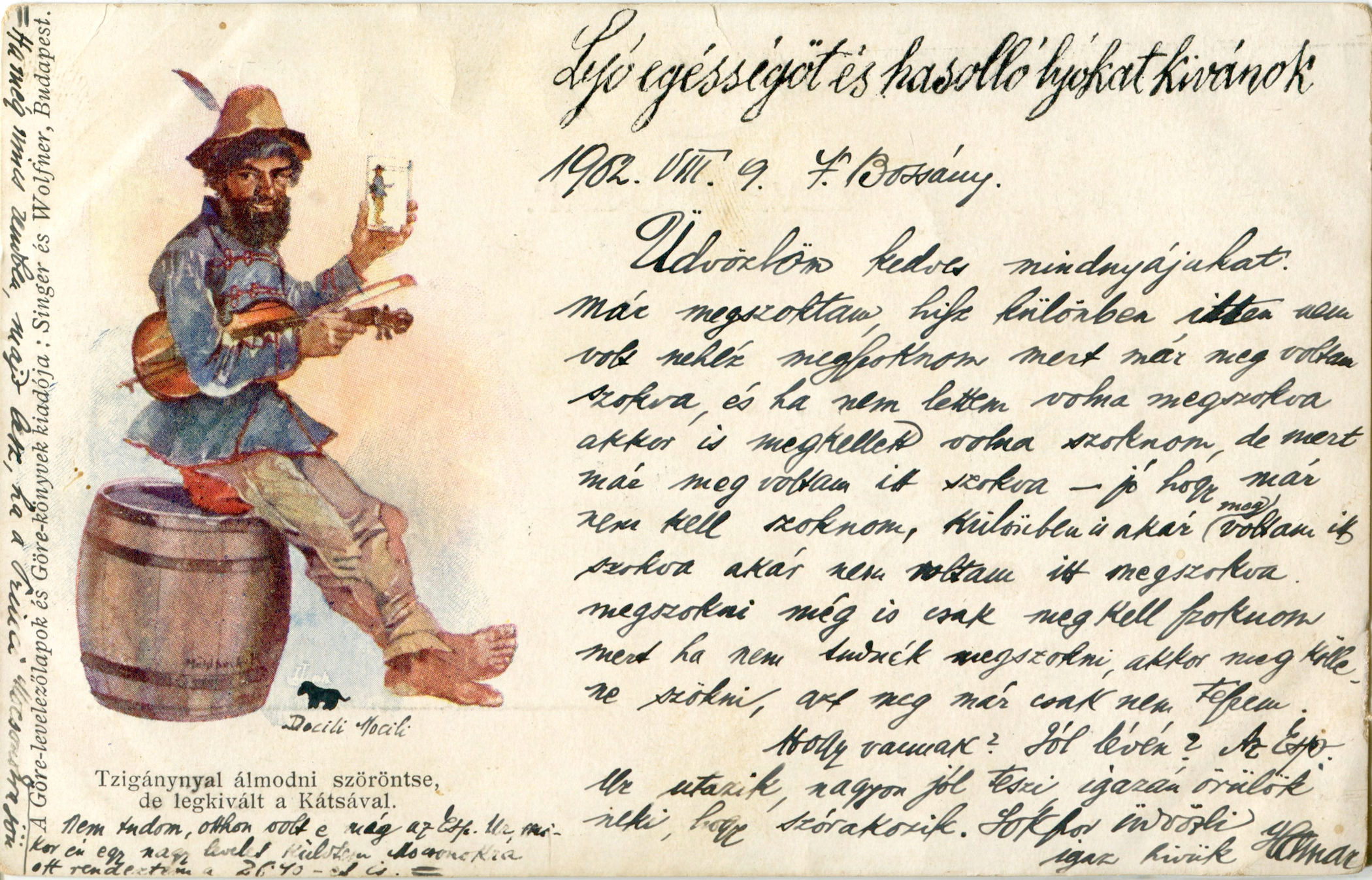
In this postcard another artist renders a colorful bearded fiddler seated on a small keg. He is dressed very like the other fiddler with a short blue jacket and soft hat and his violin and bow under his arm. Curiously he holds a postcard-sized painting of himself as if offering it for sale. Under this small printed watercolor is a name: Docili Mocili just beneath a tiny silhouette of a black dog or pony. The caricature also has two lines of verse.

Tzigánynyal álmodni szöröntse, de legkivált a Kártyával.
~
Don't be afraid to dream with Tzigány, but especially with the Card.

 
This is Google's translation but Hungarian is a very difficult language so I'm not satisfied that this is the best interpretation. I tried to translate the lengthy message but despite the relatively clear handwriting, there are far too many letter choices to get a good translation. I have a feeling that it just says, "We did/did not receive your letter. Everyone is well/not well. Write more soon."  The Hungarian postmark is too faded to read, but the sender wrote a date of 1902.VIII. 9.


 * * *


The next postcard is a German print of children in a farmyard dancing to a raggedy fiddler as the farmer and his family watch cheerfully. The illustration is by O. Baditz with a German title: Der erste Csárdas ~ the first csárdas. A csárdas is a traditional Hungarian folk dance popularized by Hungarian and Romani bands.
 
This quaint image was printed in München (Munich), Bavaria and sent from there to someone in Württemberg on 3 December 1899.


To demonstrate the fantastic quality of Romani music
here is a short video of “Caliu” aka Ghoerghe Anghel,
a violinist with the Romani group Taraf de Haidouks,
playing solo for his family in his back garden.


  * * *


From the beginning of the postcard era in the 1890s novelty cards of Romani individuals like a happy busking village fiddler were not uncommon, but I've discovered that during World War One a different kind of picture postcard of Romani people was produced. These were photos usually printed in a grim sepia tone and often captioned: Zigeunerleben ~ Gypsy life like this card. It shows a Romani mother with five small children standing outside their thatched roof cottage.
 
This postcard was sent via German military post on 18 January 1918. The publisher's name is from Berlin and this was likely printed especially for soldiers either leaving or returning from the front. The location of the Romani family is unknown but since Germany's Eastern Front with Russia was much longer and included Romania and Serbian forces too, this family was likely living in eastern Europe.


 * * *


This next postcard shows another Romani family standing outside their home alongside some German soldiers. The caption reads: Zigeuner und Feldgraue vor einer Zigeunerhütte ~ Gypsies and military men in front of a gypsy hut. The soldiers have no weapons and the picture seems almost pastoral, but the shoddy condition of the house implies a level of grim poverty that would fit the German idea of the Romani people. Were the soldiers seen as liberators or benevolent saviors? 
 
In February 1917 the Imperial Russian monarchy was overthrown in the first Bolshevik revolutions. After that the war with Russian ended, but the war with Romania continued. Though this front was shorter it involved a huge number of combat units and several important battles were fought in the region of Moldova where the Romanian army was able to halt the advance of the German and Austro-Hungarian armies. This isolated conflict of WW1 was not resolved until the Treaty of Bucharest in May 1918.

This postcard was sent in a letter by a German soldier on 17 March 1918. I'm unable to translate the content of the message, but it seems very likely that it was sent from the Romanian Front.


My last postcard is a photo of a rural encampment of Romani people. They sit on the ground under simple tents and one man holds a donkey laden with packs and three small children. The caption, in both German and Hungarian, reads: Wanderzigeuner – Vándorczigányok ~ Wandering gypsies. This card was never posted but the back is imprinted with the Hungarian word for postcard, Levelező-Lap, and it has a caption identifying the publisher: Nr. 436 Kunstanstalt Jos. Drotleff, Hermannstadt. Nachdruck verboten ~ Reprinting prohibited. Hermannstadt was the German name of Sibiu, a medieval town in central Romania, situated in the region of Transylvania, then part of the Austrian-Hungarian Empire. 
 
Throughout the war years millions of German, Austrian and Hungarian people shared postcards with each other. Though the colorful prewar cards were often printed in dull monotones to follow government rules on restricted materials, the demand for unusual and novelty themed cards increased with so many soldiers serving on multiple fronts. I'm not certain how it was ordered but many of the wartime postcards were obviously devised as propaganda. See my recent story, Looking Through the Lens of History, where I compare two versions of the same Ukrainian peasant couple, one sepia tone and the other in color. 

One of the common themes on these wartime cards is images of exotic people–foreign folk marked by their unusual headdress and sometimes dark swarthy complexions. I think the idea was to diminish the enemy people, making them appear weak, unintelligent, even ridiculous. It was a method used throughout history and around the world to create The Others, that is, People Not Like Us. The Romani people were included in this larger collective group along with Russians, Africans, and other ethnic and national minorities. Tragically the Romani, who had already experienced centuries of wicked pogroms, would soon suffer the worst injustice with the murder of hundreds of thousands of Romani, perhaps as many as 1.5 million, during Hitler's genocidal extermination of Jews and other so-called "undesirable" peoples.
 
I don't make any direct connection between my small collection of early 20th century Romani postcards and the evil of the Holocaust which happened a few decades later. However these images do convey a  public acceptance of European bigotry and prejudice in much the same way that early America postcards depicted African-Americans, Native Americans, Hawaiians, Mexicans, Chinese, and Japanese in similar degrading racial tones and tropes. Our Western culture once included many racist elements that in olden times were considered inoffensive but which today we would deem totally unacceptable. Yet if we fail to remember this difficult history of bigoty our society may regress and repeat it.


 * * *


I will finish with two videos of the Romanian band, Taraf de Haidouks.
These are excerpts from a 1993 film called Latcho Drom (Safe Journey)
which tells a story of the history of Romani musicians
from Rajastan (India), Egypt, Turkey,
Romania, Hungary, Slovakia, France and Spain.
 
The two simple scenes vividly connect
the postcards of the poor Romani fiddler
to the images of Romani village life. 


This is my contribution to Sepia Saturday
where the horse always
comes before the cart.


zxc


nolitbx

  © Blogger template Shush by Ourblogtemplates.com 2009

Back to TOP