This is a blog about music, photography, history, and culture.
These are photographs from my collection that tell a story about lost time and forgotten music.

Mike Brubaker
{ Click on the image to expand the photo }
Showing posts with label BEST Photos. Show all posts

Have a Seat, Ladies.

26 September 2026

 
"If you please, Miss, you may sit
here at the chaise longue
for your photograph."

"Thank you, I do feel a bit weak at the knees."


"Now if the young lady
will arrange herself at this chair,
I will adjust the camera."

"How's this?"


"Many of our young patrons
find this a very handsome chair
to sit for their portrait."

"Well, it is quite pretty,
but I'd really like my instrument
to get the attention." 


"Our studio offers several choices in chairs, Fräulein.
Which would you prefer?"


"I think this one will do nicely.
There's something about its shape I like."


Skilled photographers know that the key
to a fine portrait is getting their subject
comfortably settled and relaxed
to capture the best of their personality. 
For a musician though,
including their instrument in the picture
requires extra attention
to balance lighting and focus.
When it's done right
the effect can be magical.

Today I present
four elegant cabinet portraits of young women
posed with their musical instrument.

Each one an example of beauty
and camera artistry.


My first musician is a clarinetist posed at one end of an fine upholstered chair or settee. She leans over it with her instrument while dreamily gazing upwards to her left. She wears a white formal gown with puffy shoulders and short sleeves. 

Her cabinet photograph was taken by the Putnam Studio of 462 Broadway in Chelsea, Massachusetts, north across the Mystic River from Boston. Putnam was noted for producing many portraits for Boston's society people. On the back is a wonderful dedication from the young woman. 


With best wishes
L Lillian Lutz
Jan 30, 1899
42 Cunard St.
Roxbury  Mass.

Lillian's address on Cunard St in Roxbury is on the south side of Boston, not far from Boston's Museum of Fine Arts and Northeastern University. Her name appears in the 1880 U.S. Census for Charlestown, Massachusetts with her father, Philip Lutz, and mother, Ellen E. Lutz, showing she was born Lena Lillian Lusk on 1 November 1876. That would make her age 22 in this photo. 

Unfortunately, like many Americans born in this era, Lillian's life spans the terrible 20 year gap between the 1880 and 1900 census records caused by a terrible fire in January 1921 at the U.S. Department of Commerce building in Washington, DC. Consequently there are few records from those decades of Lillian's family. The only thing I could find from the 1890s was her mother, Ellen Lutz, listed as "widow of Philip" in the 1899 Charlestown city directory.


Boston, MA Globe
21 January 1899

Her father Philip Lutz worked as a "baker", though not necessarily operating his own bakery. Sadly I found his death notice in the Boston Globe reporting that he died at home on 19 January 1899, just a week before Lillian signed her portrait. This may explain her choice of pose and wistful expression.    

A few years later Lena Lillian Lutz found her way to California, possibly as a member of a Boston Ladies' Orchestra on tour in San Francisco. In January 1904 she married Gerald Groesbeck of New York in Oakland, California with who she had four children. She died in Connecticut in 1973 at age 96.  


* * *


My second musician is another female clarinetist who chose to perch on the arm of an elegant renaissance chair. She wears a formal white dress, too, but in a more demure style without inflated shoulders. She also wear rimless glasses which, while not uncommon in this era, presented the photographer with a lighting challenge to avoid unwanted reflections. 

That photographer was Purdy Studio of 146 Tremont Street in Boston, Massachusetts at "The Richmond" block, which is opposite the historic Boston Commons park. It was a favorite studio for Boston's elite to have a fine portrait taken as well as a production shop that supplied entertainers, politicians, and celebrities with multiple photo prints for promotional and commercial use. On the back this young woman signed and dated her photo.


Oct. 15, 1903
"Feathers"
Clara Akeroyd
 

Clara Beatrice Akeroyd was born in Boston in 1880, the daughter of Evans and Mary Akeroyd. In the 1880 census Evans, age 22, was a professional musician and he and his family were living with his older brother Vincent Akeroyd, age 31, who was also a professional musician. Both were immigrants from England who found lots of musical work playing in bands and orchestras in Boston's thriving theater district. 

However finding Clara's name in the 1880 census at age 5/12 uncovered an unexpected genealogy puzzle. Her uncle Vincent Akeroyd and his wife, Mary E., also had a daughter, age 2, named Clarinda Beatrice Akeroyd. So which Clara was my clarinetist? 

Using clues from newspapers reports and family trees on Ancestry.com I found that in December 1905, a Clara B. Akeroyd  married Joseph H. Saltsman, an attorney, and that they settled in Cleveland, Ohio. But that wasn't a full confirmation. Her cousin, Clarinda B. Akeroyd, seems to have never married, worked as a nurse in WW1 and made it a career serving in the British Red Cross. She lived a long life reaching age 81 on her death in January 1961. But for all I know, Clarinda once played a clarinet, too. 


Cleveland, OH Plain Dealer
24 March 1909

Clara B. Saltsman died in March 1909 and Boston newspapers ran notices that her memorial service would be held at the home of her father, Evans Akeroyd. She was survived by her husband and a son. But it was not enough to confirm which Clara is in my photo. Then I found a very small notice of her death in a Cleveland newspaper.

Wife of Lawyer Dies.
    Mrs. Clara B. Saltsman, wife of J. H. Saltsman, attorney, with offices in the Beckman building, died at her home, 3193 W. 25th st., shortly after 7 o'clock last night, after a brief illness. Mrs. Saltsman was formerly a member of the Boston symphony orchestra. 

Evans Akeroyd was a talented clarinet player whose name appears in many reports of band and orchestra concerts in the Boston area from 1880 to his death in 1920. His brother Vincent played violin, viola (even naming one daughter Viola Akeroyd), and altohorn, and also taught music at his home. But Evans seemed to concentrate only on clarinet, and may have played in the Boston Symphony Orchestra, too, perhaps as a sub or extra.

However, I think this simple addition to Clara's report refers to her work in one of Boston's women's orchestras, of which there were several professional groups that played in the Boston area and toured the country. They were not so large as full symphony orchestra but they did perform regularly as professionals.  


[On a side note, Clara Akeroyd's clarinet is unusually long. The common versions of clarinets are the short E-flat, the standard length B-flat, and the slightly longer A clarinet used in orchestras. Clara's is about 2 inches longer, possibly in the unusual key of G. I checked with my clarinet colleagues in my orchestra who confirmed it is too long and not an instrument design that is familiar to them. It might be a basset clarinet, an instrument for which Mozart composed his Clarinet Quintet in A major, K.581 and Clarinet Concerto in A Major, K.622. In any case, I think it is the kind of rare instrument that only a professional clarinetist like Evans Akeroyd might own. And one he would give to his favorite student to play.]


* * *


My third musician is a cornet player casually seated on the corner of a rattan chair. She too wears a white gown with larger puffy shoulders and short elbow-length sleaves. Her face also has that faraway gaze with a hint of a shy smile.    

She left her name and, curiously, her family relationship on the front. 

Your Daughter    Anna

Her full name was Anna K. Burroughs and she was from Marysville, Kansas where she was born in 1870. I have found Anna in a photo of a Boston ladies' orchestras that toured the Midwest in 1898. The photo included a roster of its members so that is how I learned her surname. Anna had previously played as cornet soloist of a celebrated Kansas ladies' military band in Kansas, starting in 1889 at age 19. 

Her cabinet photo was taken by Burkholder & Owens studio of Ashland, Ohio. Though she did not leave a date I believe it was taken in 1898-99 while on tour with this ensemble. I believe Anna Burroughs has a connection to several other portraits of female musicians in my collection, all with a connection to Boston, too, so I will reserve her full story for when I tell about this Boston women's orchestra. 


* * *


My last musician is a young violinist who sits relaxed in fine decorative rattan chair. Wearing a white shirtwaist with a high collar and a dark skirt she looks directly at us with a calm, confident air. Unfortunately she did not sign this photo so her name in unknown, as is the date of her sitting. My best guess is 1898-1900.

Her cabinet photo was taken at Rudolph's Studio at 957 Milwaukee Ave, in Chicago, Illinois. The owner of the studio was Louis Rudolph, and according to a reference I found online he operated his shop on Milwaukee Avenue from 1892 to 1900. Evidently he was rather proud of it as the back of this cabinet photo has a wonderful illustration of the building.


It looks rather narrow, perhaps situated between other larger buildings on the block. Just above the ornate top cornice is a curved nameplate with RUDOLPH and above the ground floor windows is Louis - Rudolph. Lettering on the upper widows advertiser his price for photos—12 cabinets and a life size crayon $4.75; Cabinets $2.00 per dozen; Children's pictures a specialty. At the entrance is an octagonal kiosk showing examples of his photo work. Sadly the building and address are no long visible in Chicago. But the quality photography that Mr. Rudolph created was preserved and gives us an appreciation for Chicago's musical culture.


This is my contribution to Sepia Saturday
where summer days can last as long as you like.


Hats and Clarinets

01 November 2025


What makes me choose a photograph for my collection?
Usually it's due to the musical instruments.
Often it's on account of the era or decade.
Occasionally it's because I know who they are.
But sometimes it just comes down
to smiles and hats.

And every now and then I get lucky 
and find a beautiful photo,
a perfect portrait.

This is one of them. 


These two fellows, maybe father and son, were artfully arranged by a skilled photographer who understood side lighting. In this neatly crafted pose the younger man sits on a low rattan chair as his older partner leans over a bass drum. Their clarinets, bowler hats, and affable smiles attract immediate interest. The mustache and bouquet of roses are a bonus. It's a postcard print on AZO brand paper but the divided back is blank. The drum head has a wonderful musical lyre design with the name "Hartford City Band."   

Most of the musician portraits in my collection are images of people like this, whose names are unknown to me. Their photographs were taken long ago and the details of who, when, and where were not recorded on the print. Though sometimes there are clues that let me deduce a rough idea of time or place, more often than not the faces remain anonymous. According to Wikipedia there are 22 towns and cities in the United States named Hartford. And bowler hats were pretty popular for several decades. The best I can do is guess: two bandsmen in nice suits somewhere in America around 1906-1928.

Of course the two men in the photo knew who they were and why they posed for a camera. Investing time and money for a proper professional portrait was once, and still is, an occasion to look your best since the main purpose of a photo is to share it with friends and family. And for musicians it's an opportunity to show off their instrument and get a memento of a special concert.  

The reason I collect these photos is naturally because of their musical theme. But not every musician's portrait makes the cut. Antique photos of clarinet players are as common as pigeons in the park. So for me to add a picture of two clarinetists to my archive it has to be special. This photo hit all the marks. We don't need to know their names to see two good friends proud of their music. Their expressions make us genuinely happy to make their acquaintance. If they were selling tickets to a concert of the Hartford City Band we'd buy six, please.


Though these two clarinetists must remain forever silent
 we can still imagine what music they might have played.
Here is an arrangement for two clarinets
of the famous Flower Duet 
from Léo Delibes' tragic opera Lakmé.
It is beautifully played by
Jose Franch-Ballester and Bernardino Assunçao, clarinets.

They produced this in 2020 as part
of a series of videos made during covid isolation.


This is my contribution to Sepia Saturday
where every photo has a story.


Connect the Dots

03 May 2025

 
Most people call them notes
or sometimes the dots.
It's a written language for musicians
that is universally understood
no matter a player's nationality.
The note shapes spell all
the musical pitches and rhythms
that anyone needs to make music.

Of course, the dots are just instructions.
Musicians still need to know
how to produce a musical sound
on their instrument too.


And to correctly prepare for a performance
sheet music must be carefully arranged in order
and secured to a sturdy music stand.

It's a universal exercise
that every musician from anywhere
learns to do before a concert starts.


This old double bass player 
sorts his music on a folding wire stand.
Leaning against a tree next to him 
is his instrument 
quietly watching the activity,
like a loyal companion.

It's a rare photo of a musician doing
simple routine preparation before a gig begins.
It's a
 beautiful image that invites us
to stick around and listen to the concert.

The place and time of this photo postcard is unknown.
But on the back is a printed stamp box symbol
for the 
CYKO paper manufacturer
which likely places this musician
somewhere in North America
at some time between 1906 to 1920.

I like his hat. 


Since we can't hear this bass player
let's listen to another one.
Here is Alexander Muravyev
playing one of his own pieces
aptly entitled "Cheshire Cat".


This is my contribution to Sepia Saturday
where a blogger's virtual desk
is often messier than a real desk.


One Times Three

20 July 2024

 
 Sharp eyes and self-assured poise.
In a child it's a face that always inspires
affection, love, and pride
from parents and teachers.


Today it's common to see it
in children involved with sports or athletics.
But once upon a time it was more often found
in kids with musical talent.


It's a first sign of maturity and independence.
So parents cherish this expression in a child
because of its promise for a bright future.
And teachers treasure it because it reveals
talents they predicted were there along.
 
Today I'd like to introduce a young lady
who once posed for three beautiful portraits
that shine with this wonderful quality
that I'm sure pleased her parents as much
as they charmed me.

Unfortunately I do not know who she is.
But I've given her a name anyway
that I think suits her.
 
This is Katie, who once lived in Kansas.


The first photo shows Katie standing in a photographer's studio and holding a violin. Her dark long tresses frame her lovely face and flow onto the folds of her plaid dress. The balletic position of her feet gives her a graceful stance and lowering the camera lens makes her seem taller than she actually is.
 
All three photos are cabinet cards produced by 4d's Photos of Leavenworth, Kansas. The back of the cards are blank, though two photos have a very faint ghost image transferred from the other photos showing that they have been kept stacked together in the same drawer or box. The style of card and the embossed lettering seem to me more like those from the 1890s than the 1870s or 1880s which were the decades when cabinet card portraits were most popular. Katie's knee length dress, high button shoes are fashions that also seem more 1890s than 1880s but dating children's clothing is always tricky.


The photographer's location is the best clue for dating the photo, but the logo left out the state. In the United States there are three incorporated places named Leavenworth in Washington, Indiana, and Kansas, but only Leavenworth, Kansas was really a thriving community in the era of the cabinet card. In the 1890 census its population was 19,768 citizen which at the time was a good size for any city west of the Mississippi. The city and its county of the same name are situated on the Kansas side of the Missouri River about 25 miles northwest of Kansas City, Missouri/Kansas. 
 
The name comes from Fort Leavenworth which is a U. S. Army post established in 1827. It is the second oldest active United States Army base west of Washington, D.C., and the oldest permanent settlement in Kansas. It has a long history with the 24th and 25th Infantry Regiments and the 9th and 10th Cavalry Regiments which were formed for African-American soldiers in the segregated post-Civil era. Fort Leavenworth is also known as an important military training center for soldiers and officers, notably the School of Application for Cavalry and Infantry established in 1881 by General William Tecumseh Sherman. In modern times that school has evolved into the U.S. Army Command and General Staff College.  
 
In 1885 the Western Branch National Military Home ("old soldiers' home") was established in Leavenworth as a residence for disabled or retired soldiers. Leavenworth is also the location of the U.S. Army's maximum security prison.
 
With this military base in the heart of the continent, Leavenworth was a hub of activity for thousands of soldiers. There were railway lines north, south, east and west. Soldiers liked to have their picture taken. 


1892 Leavenworth, Kansas city directory

I expected to find 4d's Photos in Leavenworth's city directory. But was disappointed that the business was not listed in any directory from 1870 to 1900. However after several futile searches I noticed an interesting arrangement of the seven photographers in the 1892 directory. Four of them, C. E. Ford, Josepe Haag, E. E. Henry, and Harrison Putney had studios on Delaware St. and three were on the 400 block. The coincidence seems a good reason for a cooperative name if these photographers sometimes shared work. It's also possible that this 4d's was a traveling railroad photographer like the one I wrote about in October 2018, The Haynes Palace Studio Car. In any case the photographer was quite skilled and had an excellent camera.


The second photo shows Katie slightly turned with her violin in playing position, her feet having remained exactly in place. It's a classic pose very similar to other photos I have of child violinists, yet her right wrist and left fingers demonstrate a confident understanding of the instrument. It doesn't imply that she was a child prodigy, only that she looks very capable of making a good sound on the violin. In other words, she does not look like an awkward beginner.


1894 Leavenworth, Kansas city directory
Kansas Conservatory of Music & Elocution, advertisement

Old city directories are my favorite source of information on people and places. In addition to the long lists of names, occupations, civic groups, institutions, and government bodies, there are advertisements by all kinds of businesses that were once an important aspect of a city's heritage and culture. In 1872 a pastor in Leavenworth started a small private academy for teaching music and elocution. It was still in business in 1894 directed by the pastor's son, Alexander B. Brown as the Kansas Conservatory of Music & Elocution. 
 
The advertisement in the 1894 city directory included an endorsement by Ede or Eduard Reményi  (1828–1898) a Hungarian violin virtuoso then living in the United States. Reményi was a celebrated concert artist and teacher who was a friend of composer Johannes Brahms and rival to violinist Joseph Joachim. In the mid-1800s Reményi had great success as a concert artist in Europe and later in the 1880s in North America. In 1886 he made a grand concert tour of the world which included Japan, China, Cochinchina (Vietnam), and South Africa. 
 
In 1894 Reményi was back in America and evidently performed in Leavenworth. He visited Prof. Brown's Kansas Conservatory and praised Brown's "Prismatic Charts of Music and Elocution" as textbooks that "will revolutionize present methods of instruction, and especially facilitate a knowledge of ryhthm—the very soul of expression—yet so generally omitted or but partially presented in most works of elementary instructions."
 
The few references I could find on the Kansas Conservatory describe it as an academy for music instruction on piano, reed organ, violin, and voice, either in singing or oration. I don't think it included any band instruments. Lessons were $3 a month. It did call itself a "college" so its students came in ages from elementary school age to young adults. In this era many parents signed up their daughters for music lessons as proficiency in music was considered essential for hooking a good husband. Every fall and spring the conservatory would present a recital of its students, but reviews suggest the music was not exceptional. The Kansas Conservatory in Leavenworth remained in business almost 30 years until the death of Alex Brown.
 
In addition to the music conservatory there were at least a dozen or more music teachers in Leavenworth so it seems likely that Katie had a music teacher in this city. However there was one business heading missing from the city directory—Theatres. This is surprising as most towns this size in the 1890s would have had several theatres or an "opera house".


In this third photo, Katie lounges on the 4d's photographers' upholstered corner chair. She has a different expression that is equally familiar to parents and teachers. It's the look of a smart but bored child waiting, patiently perhaps, for this event or lesson to be over. In ten seconds the photographer will probably hear, "Mother! Can we pleasssse go now?"


Leavenworth, KS Times
28 January 1897
 
 
In January 1897 the Leavenworth Times ran a review of an afternoon entertainment put on by the Fort Leavenworth Century Club at the home of a woman "noted for her entertaining qualities." While enjoying "delicious punches and bon bons" the guests listened to seven musicians from the 20th Infantry "orchestra" who performed in the smoking room. Mr. R. B. Kanouse, "who possesses a very fine baritone voice rendered several solos. 
 
"Little Miss Katherine Phister played several violin selections which were loudly encored.  Although only eight years of age, Miss Katherine's future career as a musician is very promising." 
 
Katherine Phister was the youngest of two daughters to 2nd Lieutenant Nat P. Phister and his wife Mary Phister. Lt. Phister was a native of Maysville, Kentucky, a graduate of West Point, and in 1897 a regular army officer then assigned to the 1st Infantry Regiment at Fort Leavenworth. Previously he had been stationed in California at the Presidio of Monterey where Katherine was born in February 1887, and in Arizona where Katherine's older sister Belle was born in 1884. In the 1900 census Mary Phister and her daughters were living at Fort Thomas, Kentucky while Capt. Phister was serving in Cuba. Later he would take the family to the Philippines where he was posted during the American occupation. 

I could continue with much more on the Phister family history. I found it interesting to research because Katherine grew up the daughter of an army officer whose career was not unlike my father's 25 year service in the U.S. Army, except my dad never had to deal with horses or invade Cuba. And when I was Katherine's age my dad was stationed at Fort Riley, Kansas, about 110 mile west of Fort Leavenworth, so I already knew about its importance to an officer's advancement.
 
Finding little Miss Katherine Phister's name in this brief two sentence review is by no means a positive identification of the girl in my three photos. At best it is a coincidence, since even the approximate date of these photos can't be determined. But it does offer a very slim possibility that I might be correct which is why I've named this charming young lady Katie. 
 
Sometimes all that is left in an old photo is what we imagine we see. I see someone I would have happily listened to and shouted bravo just to see her smile.


This is my contribution to Sepia Saturday
where no one really minds
if they get sand in their shoes.


The Eye Behind the Camera

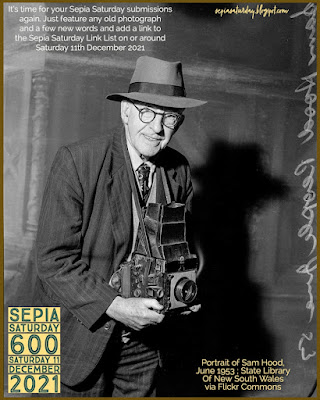
11 December 2021


  This is my dad,
Lt. Russell Brubaker,
with his new camera,
an Alpa Reflex #4, purchased for $166
at the Tokyo post exchange in May 1952.
He also paid a little extra
for a roll of 35mm Kodachrome film,
which was probably his first venture into color photos.
This self-portrait posed before a mirror in his hotel room
was his first photo with the Alpa.
He guessed the exposure and got the focus wrong.
It was not his first camera
and would not be his last either,
but it was this particular camera
that introduced him to
the wondrous world of photography.
 
The reason I know this detail of camera trivia
is that my dad left notes.
Lots and lots of notes
attached to albums, binders, and boxes
containing thousands of photographs
that he took over a long lifetime
as an amateur photographer.

It began almost immediately after his graduation
from the Army ROTC program
at the University of Maryland.
It was 1951 and the United States was at war.
 
Again.
 
My dad, with his new lieutenant's commission,
received orders for Korea.
There was barely enough time
to get married to my mom.
Which, fortunately for me, they did.


After his arrival in Korea my dad was first assigned as a platoon leader of Company L (Love), 3rd Battalion, of the 38th infantry regiment, 2nd Division. A few weeks later he was reassigned as the battalion's communication officer and sent to Japan for training at the Army's Air/Ground School in Tokyo. The Far East was pretty exotic for a boy who grew up in a small farming community outside Baltimore and who had never seen real mountains or oceans except in schoolbooks. A camera must have seemed a fantastic device to record this new adventure, and the Alpa would document many more.
 
This is my favorite action shot of my dad. The Alpa is attached to a tripod and my dad, wearing his helmet, is about to pull the trigger.  I featured it in my 2018 story, Everything In Focus. Presumably the photo was taken by one of his fellow officers.
 
 
Perhaps his target was this soldier.


Or this lieutenant.


Or maybe this captain.


 Or maybe this young officer.
 

The detail of who took the shot of my father got left out of my dad's annotations, but I may yet uncover it. Like I said, there are a lot of notes. It's interesting to me that in the hundreds of personal photos he took during his year in Korea, my dad never recorded anything resembling actual warfare. There are no guns, bombs, destruction, or worse. Though he served under fire and was even awarded the Bronze Star, all his photos are more like the fun kind that a tourist, or maybe a boy scout camper, might take.
 
From the number of photos he took of other soldiers with cameras, it's clear my dad was participating in a new fad for photography. Considering that this was only 6-7 years after the end of World War 2, the availability of fine Swiss cameras like the Alpa, must have been a novel change for American consumers, particularly with soldiers serving in foreign countries.
 
When my dad returned safely home at the end of 1952, he switched from the infantry to the transportation corps. After more training in Virginia, he was sent to France, another exotic place for a camera enthusiast, but this time he could take his wife Barbara. A few months later I came along and the rest is history, as they say.


My mom was an artist and quickly learned the basic techniques of photography. Years later on a trip to Scotland, Wales, and England, my dad took a photo of her taking a photo of him on a ferry platform in western Scotland. I'm still hoping to find the matching photo. Did I mention that there are a lot of photos?

After my dad's first tour in Korea, then came an assignment in Virginia, followed by three years in France. Then another tour in Korea, now peaceable after the armistice, then stateside again. Then Germany, then Virginia, then Vietnam, then Virginia again. Throughout his army career, my dad used his cameras to record hundreds of pictures of the people and places he saw. He had a good eye and a talent for framing a good photo.
 
This passion for all things photographic led my dad to take up developing film, printing photos, and eventually amassing a camera collection large enough to rival any museum. The Alpa was just the first of dozens of Swiss, German, Russian, and Japanese cameras that my dad would buy, almost always at a pre-owned used price. Every camera is listed in several long spreadsheets with details on provenance, price, condition, etc. I no longer have the Alpa, the rewinder was broke anyway, and most of his collection was sold to a vintage camera dealer shortly after his death in 2014.
 
I do, however, still have that first tripod, one of maybe two dozen, and maybe the leather case to, if I hunt for it. Cameras used to need lots of accessories like lens, light meters, filters, etc. It was once cutting-edge technology. Did I mention that I still have a lot of this stuff? Make me an offer. Please.


 Finally in closing,
here is a matched pair of photos
of two photographers
seeing eye to eye.


A few years ago, my dad took this photo of me taking a photo of him.


 By coincidence we both wore a watch that recorded the same time.
It was about 11:08 in the morning.
Two eyes, two cameras,
each reflecting the other.


Time without time.
Tempo senza tempo.


This is my contribution to Sepia Saturday
where every point of view is always welcome.


Portrait of a Young Violinist

23 October 2021


It was a special day for a photograph.
The young girl is dressed in
black hose, buckled shoes,
and a beautiful white lace frock.
Her wavy hair has been carefully combed back
and tied with a large white bow.
She directs her gaze downward
with tiny hint of a smile,
while holding a violin and bow
that rest on an elaborate rattan chair.

It's one the finest portraits in my collection
as the print condition is near perfect,
requiring no digital correction.
The camera's lens was of superior quality
as it picked up the detail of her frock's stitchwork
and even the chain links on her heart shape locket. 

It could easily be the high class work
of a photographer from Chicago or Philadelphia.

So it's surprising that it came from
a small town in Texas.


The photographer's name is unclear as the embossed logo was pressed onto buff cardstock without ink. The left side has an Aladdin lamp with sparkling rays from the spout, but next to it are just a few letters in a broad italic font, perhaps Fuss or other initials. But the photographer's location is clear — Sealy. Tex., a small town west of Houston, Texas that was built in 1879 on the Gulf, Colorado and Santa Fe Railroad. When this photo was taken there were less than 1,000 residents in Sealy, yet its history is interesting because of a public health issue that we are dealing with in our time. 
 
Sealy, Texas was named after George Sealy (1835–1901) of Galveston, a business tycoon who developed this railroad as a way of avoiding the Galveston, Houston & Henderson Railroad (GH&H) which was then the only rail link between the two cities. During the 19th century the port city of Galveston was regularly subjected to strict quarantines imposed by the city of Houston when Galveston had outbreaks of yellow fever and other epidemics. So the businessmen of Galveston decided to bypass Houston by building their own railway line that would cross Texas to reach Santa Fe, New Mexico. However it did not succeed and in 1886 the Gulf, Colorado and Santa Fe Railroad was bought out by the Atchison, Topeka & Santa Fe Railway. 
 
Sealy, Texas is also known by a famous brand name. In 1881, Daniel Haynes, a cotton gin maker in Sealy began filling orders in town for a cotton-filled mattress of his own invention. It proved so popular that he registered a patent and formed a company which he named the Sealy Mattress Company after his hometown.


What makes this lovely portrait extra special is a note on the back.
In a large cursive hand the girl is identified as:
Helene Rossler
age 11 years
Fort Worth, Tex

 
It did not take long to find her in the 1900 US Census for Fort Worth.
 
 
1900 US Census - Fort Worth, Texas
 
Helene or Helen Rossler was the second child of Conrad and Helen Rossler, both immigrants from Germany. Helen, then age 6, was born in Texas, as were her other siblings, an older sister, Kate Rossler, born in 1890, and a younger brother, William Rossler, born in 1896. The 1900 census usefully includes birth months and Helen's was June which dates her photo sometime between June 1904 and May 1905.


1913 Austin, TX city directory

In the 1900 census, Conrad or Konrad Rossler listed his occupation as salesman, but in 1913 the Rossler family was living in Austin, Texas where Konrad Rossler ran a barbers' supply business dealing in cutlery and grinding, i.e. sharpening. Miss Helen E. Rossler, now age 20, was listed separately, as was her brother William, a grinder, though both still lived at home.


On the 30 May 1917, Helen Rossler and Alfred Dieckert took out a marriage license in Houston. Helen was age 23 and Alfred 28. Like Helen, his parents were also from Germany. He worked for the Houston gas company, and in 1923 the couple moved to St. Petersburg, Florida where Alfred took a foreman position with the city gas department and also worked in real estate.

 
Tampa Bay Times
11 December 1927

I don't think Helen was ever a professional musician, but a search for her name and instrument did bring up one social event where she performed for a bridge party in Tampa/St. Petersburg.  
 
Helen's father suffered a heart attack in January 1932 and died at age 62. His wife, Helene Rossler had moved to St. Petersburg and passed away there in June 1953 at age 80. In December 1960, Alfred Dieckert, by now retired at age 72, died in a St. Petersburg hospital. And finally on 27 October 1974, Mrs. Alfred Dieckert, née Helen Rossler, a retired beautician and resident of St. Petersburg for 52 years, died at age 81. As far as I can determine, she and Alfred never had children.

 
Tampa Bay Times
29 October 1974


It was indeed a special day.
We may admire the photograph by its own merits,
but learning the background of young Helen Rossler
gives us a better portrait of the child and her family.
Her violin is displayed not only as evidence
of her parent's pride in Helen's musical talent
but is also a reflection of how the old world culture
came over from Germany and contributed to American music.
Since it's likely that Helen's brother and sister
also learned to play a musical instrument,
the Rossler family home must have resounded with constant music.
 But discovering that her father's trade was in barber supplies,
that is what really makes Helen's hair shine.


This is my contribution to Sepia Saturday
where every child is as pretty as a picture.


nolitbx

  © Blogger template Shush by Ourblogtemplates.com 2009

Back to TOP