This is a blog about music, photography, history, and culture.
These are photographs from my collection that tell a story about lost time and forgotten music.

Mike Brubaker
{ Click on the image to expand the photo }
Showing posts with label school. Show all posts

The Pierian Sodality of Harvard

22 June 2024


Antique photographs of musical groups
often have musicians arranged
in almost random disorder.
Tympani might be at the front,
cellos and violins at the back,
cornets next to flutes,
so the placement of players looks nothing like
how a band or orchestra is typically seated in concert.
Instead the photographer reorganized everyone
to fit inside the camera's frame.


And unlike modern photos where everyone in a group
is told to smile and look directly at the camera,
in antique photos people are usually gazing in different directions
with only a few eyes turned towards the lens and scarcely anyone smiling.
It's a perplexing viewpoint that is not how a conductor
expects to see musicians on stage.

As I've written about before,
taking a good photograph of
a class of schoolchildren is perhaps
the most challenging undertaking for any photographer.
Everything must be carefully planned,
choosing a setting with ample, but not harsh, light,
and hopefully finding the subjects well dressed and alert.
All this leads to a final split second decision
to click the camera shutter.


Today I present two impressive, if slightly quirky,
school photos of a musical ensemble.
However these students are not
in an elementary band or a high school orchestra.


They are young men from Harvard College,


and members of one
of the oldest musical ensembles in America —

The Pierian Sodality.  


The first photo is a large albumen print, about 10 x 8 inches, of 25 young men and a dog arranged on the entrance steps to a brick building. Almost all are holding a musical instrument and since more than half are string players it's a decent size orchestra. On the bass drum are stenciled letters and a heraldic shield identifying them as from Harvard College. A framed testimonial letter has a title that reads: Members Pierian Sodality. A large greyhound-type dog is lying down in front, unconcerned but maybe with one ear cocked to listen. 


The second photo shows a different set of young men placed in a slightly more uniform grouping. Here there are only 29 musicians and no dog. The bass drum is missing but the same framed document of the Pierian Sodality, a charter perhaps, is at the feet of one man in center who is presumably the conductor. As best as I can tell, there are no musicians who appear in both photos. And unfortunately neither photo has any annotation for a date or names of the orchestra's members. Though there are some similarities in the styles of hair and suits, I think this photo is younger than the first photo, possibly taken a few years later. It is the same size print but has suffered some abuse and has a lot of foxing, the scattered grey fuzzy dots on darker areas.


Both photographs were produced by the Pach Brothers studio of New York City, though the actual photographer was likely an associate working in Cambridge, Massachusetts. The Pach brothers, Gustavus (1848-1904), Gotthelf (1852-1925), and Morris (1837-?) came to New York from Berlin as children and in the 1860s developed an interest in the new art/technology of photography. Gustavus established the first Pach studio in 1867 at the Atlantic resort town of Long Branch, New Jersey and in 1872 relocated to Manhattan in New York City. By the 1880s the Pach Brothers' studio was considered one of the most diversified photography companies in America producing  hundreds of thousands of photos for many elite academic institutions like West Point, Yale, Princeton, and Harvard, as well as fine portraits of high society people, government officials, and later theatrical celebrities.
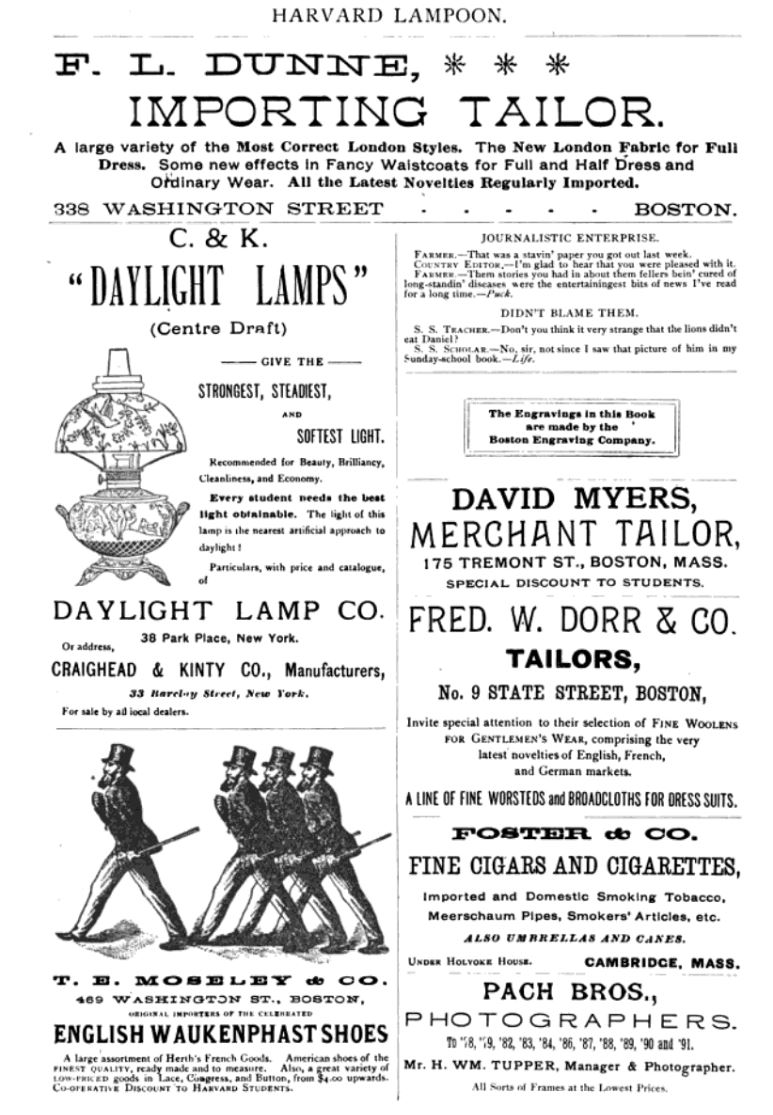

1890 Harvard Lampoon

The Pach Brothers studio regularly advertised in college magazines and newspapers and in 1890 they ran an ad in the Harvard Lampoon. A Mr. H. Wm. Tupper was the local manager and photographer in Cambridge. This was probably a seasonal operation as the ad promoted being at Harvard in '78, '79, '82, '83, '84, '86, '87,, /88, /89, '90, and '91. It's also interesting to see other businesses that marketed to Harvard's students like the Daylight Lamp Co. and the English Waukenphast Shoes.


1887 Harvard Advocate

In 1887 the Pach Brothers advertised in the Harvard Advocate along with a local brewery special, Musty, the Queen of Ales. By coincidence it was on the same page as a calendar of January events at the college which included two concerts of the Pierian Sodality. There were also concerts by the Harvard Glee Club and Banjo Club.


Pierian Sodality logo
Source: Wikipedia


The Pierian Sodality was founded in 1808 as a musical social club for Harvard students, which in that era meant it was only for men. The word "pierian" refers to the Pierian Spring of Macedonia  in Greek mythology, which was sacred to the Pierides who worshiped the Muses, the goddesses of literature, science, and the arts. It was used as a metaphor for the source of knowledge in art and science in a popular couplet from Alexander Pope's poem "An Essay on Criticism" from 1711: "A little learning is a dang'rous thing; / Drink deep, or taste not the Pierian spring."  The word "sodality" is defined as an organized fellowship, brotherhood, or society. 

In its first charter the Pierian Sodality stated that its purpose was to "perform music for the enjoyment of others as well as serenade young women in the square". Though it has been sometimes described as the oldest symphony orchestra in the United States, the club's informal music making with often a very mixed instrumentation meant it was never a proper orchestra suited for the standard repertoire of symphonic music.


Pierian Sodality Orchestra, 1908
Source: The Harvard Illustrated Magazine, vol IX, 1907-08


Here is a picture of the Pierian Sodality orchestra taken in 1908 that shows 39 young men in formal dress arranged more orderly in a photography studio or maybe on a stage. As in the other photos, the framed charter with the club's name is placed in front. The ensemble's concerts were regularly reported on in Harvard publications but in the early decades the few programs that were listed were largely of lighter popular music and not works of great composers. 


Jacobs' Orchestra Monthly
October 1924

In October 1924, Lloyd G. del Castillo, a former member of the Pierian Sodality, wrote a short remembrance of his time in Harvard playing with the group for Jacobs' Orchestra Monthly. The magazine also printed a photo of the Pierian Sodality that Del Castillo described as being from 1888. It is identical to my first photo or the orchestra. The article is entitled: 

                            A Jazz Orchestra of the Nineteenth Century 
                                             by Lloyd G del Castillo 

    Into the seething maelstrom of words which of late is attempting to suck the good ship Jazz down into its invidious depths, I aim to inject a few soothing ripples explanatory of the medium jazz employs—the Fount it uses to spray its cult to the True Believer.  I don't pretend that the foregoing sentence means anything, but such an introductory wealth of mixed metaphor adds dignity to an article, and jazz certainly needs all the dignity it can get.  In other words in this Vulgarian Atmosphere of jazz I am the Spirit of Culture, and to prove it I am going to take you into the classic confines of Harvard and show you an association, which if not an exemplification of jazz is at least its prototype.
    ............
    Most important of all, in this picture can be seen the original jazz-hound—not the one at the right end of the top row, but the one in front of the bass drum.  And if I am not mistaken the earnest young man in the front row holding the diploma is Nicholas Longworth, president of the Sodality in that year (1888), and since become nationally famous.  The conductor seated next to him should be Louis A. Coerne who afterward became well known as critic and composer, although I cannot vouch for the identification other than by the chronological records of the society.  The rest have all gone their separate ways, adopted modern garb and removed the hirsute adornments, unwept, unhonored, and unsung, so far as my humble researches are concerned, although to follow their individual destinies would no doubt be productive of entertaining results.
    But my present purpose is more to indicate the influences of this musical organization on contemporary jazz. In the first place modern jazz is inextricably linked with dancing, social diversion and liquid refreshment, and I will show that the development of the Pierian Sodality was along similar lines.  Their principal activity for the first forty years of their existence was to set out with their instruments in the evening and go serenading from house to house, at each of which they would be treated to cake and wine to cake and wine—probably in a good deal the same fashion as more modern housewives throw a few pennies to the organ grinder to induce him to distribute his musical tid-bits more impartially through other and more distant parts of the neighborhood.  Evidently inherited the stern rock bound constitution their Puritan forbears, for they take no shame in recording that often they would visit a score or more of houses and not return home the dawn was breaking, and sometimes the ringing for morning chapel.
    ...........     
    The second point of similarity with modern jazz is in a more musical aspect: the instrumentation.  I venture to say that in no up-to-the-minute jazz band of today can there be found more fantastic cacophony of instruments the following combination of 1842:  flutes, ophicleide, bass viol, E-flat clarinet, post horn, violoncello, and two trombones. Ten years earlier uncovers a more modest assembly, but still unique with flutes, two French horns, bass horn, trombone, and double-base (invariably spelled so in these records).  In 1839 , we even find mention of a guitar.  It is of interest that throughout these early days it always the flutes that predominate, and not until 1870 is the string quintet found to gained a firm ascendency over them.  In the early music books of 1820 or so, the fullest arrangements are:  first, second, and third flutes, first and second violins, horns, tenor bassoon.  
    But it can hardly be said that there was consistent scheme about the orchestra's instrumentation.  The ups and downs of life are clearly reflected in the Society's history, and the year following the ambitious display of 1842 mentioned above, finds the Sodality in doldrums with a discouraging handful of five members.  "So gloomy were the members that after listening to a doleful duet Messrs. Greenwood and Curtis on the ophicleide and trombone, they adjourned without playing a note."  Probably the duet would have made anybody gloomy! 
    This was not the worst, however.  In 1832 the orchestra dwindled to one man, who was forced to rehearse with himself for a month or two until he was able to elect two new members by unanimous vote.  Contrasted with this is the later prosperity in 1889, which shows a respectable symphony orchestra of a goodly number of strings, 3 flutes, 2 clarinets, 2 bassoons, 4 horns, 3 trumpets, 3 trombones and tuba, and 5 percussion—a complete symphony instrumentation with the exception of the oboes.  Any aspiring leader of amateur orchestras can well appreciate what good fortune is there indicated.
    The last point of analogy with modern jazz is more visionary.  It is that jazz is the spirit of youth.  Through all the records of this college undergraduate society, there runs the youthful exuberance that is the very essence of jazz, a spirit more sophisticated today than in the 19th century, but at bottom the same priceless heritage that we gray-beards look back upon with an uneasy yet envious eye.  Throughout all the turgid, blundering attempts to uncover the source of jazz, we inevitably find the same comment recurring because of its fresh spontaneous effervescence. 
    In a final word, to conclude the aimless debate, it is my privilege to unfold to its purveyors the real meaning of this observation—that if I am the Spirit of Culture, Jazz is the Spirit of Youth, and all this unnecessary alarm and pother is nothing but another form of ubiquitous sentiment expressed by the older generation that the younger is displaying wild and unnatural tendencies, and is probably going straight to the jazz hounds. 

    Note:  To quell any possible doubts as to the authenticity this article, it should be stated that Mr. del Castillo was a member of the Pierian Sodality not so terribly many years after the type of whiskers pictured above went out of style.  We have the author's own statement that he was a tympani virtuoso there in 1911, and in 1912 and 1913 was conductor of the Sodality.  In 1914 he forsook the paths of glory for the more lucrative fields of professional music, his first experience being with dance orchestras.  For a number of years Mr. del Castillo has been the photoplay houses popular organist at the Fenway Theatre one of Boston's leading photoplay houses.


I've included most of Lloyd G del Castillo's account because he was drawing a connection between the old traditions of the Pierian Sodality and jazz music, the new craze of the 1920s. What he did not know then was that his work as a theater organist accompanying silent films was about to be made redundant with the introduction of "Talkies"—movies with recorded soundtracks.  


Using Castillo's identification of my first photograph, I found a list of all the 1888 members of the Pierian Sodality published in the Harvard Index.   

1888 Harvard Index


1888 Harvard Index

There are 48 names so the photograph shows only a small portion of the Pierian Sodality that school year. Inevitably the nature of student turnover each semester led to a very changeable roster for the ensemble. In December 1888 the Boston Globe published a brief review of a benefit concert presented jointly by Harvard's Glee Club, Banjo Club, and Pierian Sodality. 


Boston Globe
21 December 1888

They performed "before a highly-appreciative audience that completely filled the theatre. The concert was one of merit." The report included the "programme" which carefully outlined the music, composers, and performers. The banjo club had the fewest pieces with just three tunes, while the glee club had thirteen "college songs". The orchestra of the Pierian Sodality opened the concert with a march by Mendelssohn and then returned with a set of short classical works that featured Mr. Longworth, '91, playing a violin solo. If Mr. Castillo, the writer for Jacobs' Orchestra Monthly. was correct, the young man seated center and holding the Pierian Sodality charter was Nicolas Longworth, the club's president and one of the orchestra's first violins. 


Felix Mendelssohn's March in D Major, Op. 108
played by the George Cathie Orchestra
from a 1920s recording provided by 
NAXOS of America.


However the 1888 roster for the Pierian Sodality named J. M. Hallowell, '88, as president and F. H. Whipple, '88, as the conductor.


comparison of Nicholas Longworth III (1869-1931)

Nicholas Longworth III (1869–1931) was an American lawyer and politician from Ohio who became 38th Speaker of the United States House of Representatives in 1925. He was an alumni of Harvard College, Class of 1891 where he also played violin in the Pierian Sodality. In 1906 Longworth married Alice Lee Roosevelt, the eldest child of President Theodore Roosevelt and his first wife, Alice Hathaway Lee. According to her: "In Washington, Nick never had much time to play his violin, and in those days there were very few people to play with him. In Cincinnati there were the orchestra, the College of Music, and the Conservatory to draw on, and soon we were having musical parties, at least once, and often two or three times a week. ... We would all have dinner first, the musicians and a few others who cared for music, and afterwards lose no time getting started, by about nine at the latest. From then on music and yet more music until midnight and usually long after.". 

But comparing a 1903 photo of Nicholas Longworth III to the young man holding the Pierian Sodality charter, I don't see any resemblance. I think Castillo is mistaken and that it is Mr. J. M. Hallowell, '88 who is in the photo. Also there are three other violinists with features that seem a better match to Longworth. 


comparison with Louis Adolphe Coerne (1870–1922)


Castillo identified the conductor as Louis A. Coerne. Born in Newark, New Jersey Coerne studied music composition at Harvard under American composer, John Knowles Paine, and later at the Stuttgart Conservatory in Germany. He wrote some pedagogical studies for piano, several larger works for orchestra, and five operas. His cantata, Hiawatha, Op. 18 premiered in Munich in 1893 and was performed by the Boston Symphony Orchestra in 1894. Louis A. Coerne died in Boston in 1922. 

While there is perhaps some resemblance between Coerne's circa 1906 photo and the young man holding a baton in my photo of the Pierian Sodality, I think once again, Castillo is mistaken. The hair color, even in sepia tone, looks too blonde to be Coerne and the neck length is different as Coerne seems more slender. So I think the conductor is Mr. F. H. Whipple. 

I was unable to trace records on Hallowell or Whipple, so I have no later images of those men for a proper comparison. But I could not let Castillo's 1924 identification pass without checking his names against the faces in my photo. If anyone reading this story has more information on either photograph, please contact me. My email is on the sidebar. 


Harvard is now a very large modern university with 21,613 students, both undergraduates and postgraduates, having merged in 1999 with Radcliffe College, a formerly all-female college also located in Cambridge, Massachusetts. Not surprising for an institution founded in 1636, Harvard has preserved countless traditions and physical structures from its history. And that includes the noble wooden doors with wrought iron hinges that are the backdrop to the two photos of the Pierian Sodality.


Harvard University, Sever Hall, east facade
Source: Wikipedia

The doors are located on the east side of Sever Hall, next to Quincy St. and now opposite of the Harvard Art Museums. The building was designed by American architect H. H. Richardson and constructed in 1878-1880. It was named for James Warren Sever (1797-1871) who was an 1817 alumni of the college. Considered one of the most beautiful academic buildings n America, it is made of 1.3 million red bricks in 60 different varieties, following an interpretation of the Romanesque style. 

The entrance appears unchanged from when the Pierian Sodality posed on its steps in the 1880s. 


Harvard University, Sever Hall
Source: Wikipedia


Today the Pierian Sodality has evolved into
the Harvard-Radcliffe Orchestra. 
Here is a short video released in January 2021 
of a "virtual concert" produced
by the musicians of the Harvard-Radcliffe Orchestra
during the Covid-19 pandemic. 
It is the Masks movement from the ballet suite
Romeo and Juliet, by Sergei Prokofiev.  


I think the members of the Pierian Sodality
from the classes of 1880s - 1890s
would applaud this effort to share a love of making music.
It's a tradition that has a long and venerable history.


This is my contribution to Sepia Saturday
where summer is just beginning
to warm up.


The Glee Club of East Palestine, Ohio - part 3

09 September 2023


I have a dream that one day this nation will rise up
and live out the true meaning of its creed:
‘we hold these truths to be self-evident – that all men are created equal’.

Martin Luther King Jr. – “I have a dream” speech, 1963


This the third story of a 3 part series. 
I recommend starting with the first one:


Asheville NC Citizen-Times
3 June 1914

On 3 June 1914 the Asheville Citizen-Times published its regular notice of matters of public record from the city's registrar of deeds. Under marriage licenses were two names.

J. M. Washington, colored, to Vivian B. Alston, colored.

This brief line was not like the wedding notice found in The New York Age that finished my first story in this series, The Glee Club of East Palestine, Ohio - part 1. Here James' first name is missing and his middle initial was incorrect, while Vivian's middle initial and surname are at least properly separated by a space which the New York Age mistakenly reported as "Balston." But the Age did include details like James was a graduate of East Palestine, Ohio and Miss Vivian a graduate of the Allen Home in Asheville and that they were wed June 2 at the First Baptist Church. All very useful information that helped me identify them in other records.

But in Asheville a single bureaucratic word was added
that made this record standout in stark contrast—"colored".

A century later it is difficult to describe how awkward, even offensive, this word is. Yet history does not allow us to ignore institutional racism and in fact I could not have done my research without taking advantage of this word. The name James Washington is shared by more men than I can count, yet I have been able to identify the young man in my photos from East Palestine, Ohio because in 1908 America marked people by the color of their skin. Sometimes it was "colored", or an initial C or B or M, or just an asterisk next to a name. It was an era when every government or official document included a line or box to indicate race.

In North Carolina the word was used everywhere. Parks, churches, restaurants, businesses, schools, libraries, and hospitals, not to mention public toilets and drinking fountains were labeled "Colored". The state mandated "Jim Crow" codes that defined racial segregation throughout every part of North Carolina society and assigned strict penalties for any infraction. These laws devised  by white men effectively divided Southern culture into two separate communities. White people were pretty much free to go and do as they like without causing offence. "Colored" folk needed to know the right entrance to use at a theater; the right place to sit in a restaurant; where their children could play; and even how to speak to a white person in a deferential manner. 

Going to school in East Palestine, Ohio, James Washington had a rare opportunity to experience a part of America where the rules of racism were less strict and the community was more accepting. No doubt Ohio had its share of prejudice and bigoty, but in 1908 it was not a society that blatantly placed restrictions and boundaries on people of color. So why did James return to Asheville?

Maybe because his family and friends were more important to him. 


Asheville NC Citizen-Times
18 December 1904

While James was in East Palestine high School, Vivian Alston was a student at the Allen Home School. Originally called the Allen Industrial Training School, it was established in 1887 by the Woman’s Home Missionary Society of the Methodist Episcopal Church as a private school to teach African American children to read and write. It was named after Marriage Allen, an English Quaker philanthropist, who donated money for construction of a dormitory building when it added a boarding school for girls. The teachers were white female missionaries so classes followed “Christian ideals” but there was also vocational training in domestic tasks such as cooking and sewing. The Allen Home School set high academic standards which let it train teachers too. It became a state accredited private high school in 1924 and closed in 1974.


Asheville Academy and Allen Industrial Home
1916 Asheville city directory


Boys were allowed to take classes there as day students, and it's possible James attended during his middle school years. But it's very likely that he met her at the Young Men's Institute, the Y. M. I. where in December 1904 she and her brother sang for an entertainment there. When James returned to Asheville in the summer of 1910 before going to Raleigh to enter Shaw University, it seems likely he renewed a friendship with Vivian then. She may be part of the reason his time at Shaw was limited to just two or three years.  

After their marriage they moved to 47 Circle St. on the east side of downtown Asheville, a very short distance from the home on Valley St. where James had lived in 1900 and close to his elementary school on Catholic Hill. In the 1915 city directory his occupation was listed as a porter for the Southern Railway. Curiously the address on Circle was also where James' mother, Lula (Louise) Sims, lived in 1910, presumably after her employment with families in Ohio and Massachusetts ended.  [See the previous story in this series: The Glee Club of East Palestine, Ohio - part 2]


1915 Asheville, NC city directory


Despite its small population in 1915 Asheville was becoming a tourist destination in the region and could boast of 25 hotels, several offering high class service, and 92 boarding houses, many catering to seasonal visitors who came to Asheville for its cooler mountain summers. As a railway porter, James may have worked long days onboard trains serving the area, perhaps supplementing that occasionally as a hotel porter. He did find time for music and his name appears in notices for entertainments at the Y.M.I. where he sang in a men's quartet. 

On 8 August 1916 there was a concert at Asheville's city auditorium of two hundred "colored" singers celebrating "the first Negro Folk-Song Festival". It was organized and led by Mrs. E. A. Hackley of Chicago who was on a mission to resurrect and present "negro folk-songs and plantation music." She was aided by Dr. J. W. Walker, a "colored physician" of Asheville who helped assemble a chorus of men, women, girls, and boys who learned the music in just two weeks. The audience was a rare mixed group of black and white patrons who were generous in their applause. I like to think James and Vivian Washington were part of that chorus. Sadly, though the organizers promised this concert would become an annual event in Asheville, it never did.


Meanwhile James and Vivian started a family and by 1916 had two children. But for some reason they left Asheville in the early half of 1917. This was actually fortunate as they missed a terrible tragedy that happened in November, not 300 yards from their home. 


Asheville NC Times
16 November 1917

Around 11:30 Friday morning, 16 November 1917, a fire swept through the Catholic Hill School where James had attended elementary grades. After teachers first noticed smoke coming from the basement it took 20 minutes before the firemen arrived, and then more time was lost laying out hoses up the hillside as the nearest fire hydrants were down below on Valley Street. Fanned by a strong wind the school building's roof and walls collapsed at 12:30. Though most of the students and teachers escaped, seven children perished in the fire and several more were injured. The school was totally destroyed. Afterwards the teachers and children moved into temporary classrooms set up in a nearby "colored" sanatorium. In 1922 a new school for African-American children, Stephens-Lee High School, was built on the site. Its construction cost $115,000. Seven years later in February 1929, a new high school for white children was opened. It cost $1.3 million.


In June 1917, like most American men between the ages of 18 and 45, James Aaron Washington registered for the draft as the United States prepared to join the war in Europe. He was living at 1810 Sharswood St. in Philadelphia, Pennsylvania. He listed as dependents his mother, wife, and two children and he was employed as a cook at a diner run by Henry Burns on Girard St. He was 26 years old, born on 1 May 1891 in Asheville. The lower left corner of his draft card was clipped to indicate to military administrators that he was of "African origin".  

I looked up James' employer and discovered that Henry Burns' home residence was the same address as James'. I believe Henry was Lula Sims' father, which would explain why they were living there, but I was unable to find enough records to confirm that relationship. And in this case the huge Philadelphia city directory was not helpful to a genealogist as it did not mark people's race. However of the 15 men with the name Jas Washington in the 1918 directory only one was a cook and living at 1810 Sharswood. 

1920 US Census Philadelphia, PA

To make it more confusing the 1920 census for Philadelphia has James and Vivian living with three children, a son and two daughters, all born in North Carolina, the youngest at age 1 being marked as both Son and F  (female). James is now age 28 and he works as a "R R C" at the "Terminal", which I interpret as railroad clerk at the Philadelphia train terminal. His mother's name was not Sims but was now Lulu Dyer, She was age 48, born in South Carolina and she had another son living with them, John C. Dyer age 19, born in South Carolina. Adding another layer to the household was an aunt, Catherine James (? or Janes), and a brother-in-law, B. P. Austin, which I think was another spelling error of Alston, Vivian's family name.

The reason the Washington family moved to Philadelphia in 1917 and remained there for 4 years are unknown to me, as are reasons that brought them back to Asheville in 1922 when they returned to 47 Circle St. James was now employed as a clerk at the "Ry M S" which stands for the Railway Mail Service. This work involved sorting mail at the Asheville train terminal or sometimes working on a post office railcar included on mainline train routes. Interestingly, his mother is living with them too and has taken the name Lula Washington.


1923 Asheville, NC city directory

The Washington family had added another child and no doubt found Asheville familiar and small after living in Philadelphia. The Asheville newspapers make no mention of James or Vivian, but in June 1921 there is a court notice that a divorce has been granted to George and Lula Dizer after 5 years of separation. A check of the city directory showed that Lula Sims lived at 47 Circle in 1910, and George and Lula Dizer lived there in 1911. [Figuring out name misspellings and phonetic homophones are just one of the many challenges my research encountered]

Sadly on 7 April 1926, Lula Washington Deyer (another misspelling of Dizer) died of cancer. James Washington provided the information for her death certificate. She was age 54. occupation: Domestic. Her father's name was Henry Burns. 

James and Vivian stayed in Asheville for a bit longer, but in 1927 only James was listed in the city directory. He worked at the Service Drug Store, a "colored" pharmacy on the ground floor of the Y. M. I., but his residence was in Washington, D. C.! 


* * *


When I first acquired the two postcards of the East Palestine High School Glee Club and Orchestra, the face of one young man fascinated me. Who was he? How did an African-American boy get to perform with white boys in 1908? Was it even possible to identify him? Needless to say this research involved a lot of detective work. None of the preceding history of James Washington came from Wikipedia or the  New York Times or a family tree on Ancestry.com. It involved checking a lot of false leads and mistaken connections as well as triangulating locations in three states. However I am confident that I have correctly identified that young man and learned enough to describe some of his history behind these two photos. 


But there is also a history in front of the photos too. It involves a connection that was so intriguing that I had to continue my research to prove it. It's a personal detail about James Washington that hinges on his middle name—Aaron.  


Following the trail of little breadcrumbs of history is often very frustrating because most individuals share a name with dozens, even hundreds, of other people at any one time. Such is the case with tracking down James Washington. Fortunately America's institutional racism eliminated anyone who was not "colored." When he became a married man it narrowed the list to only those men with a wife named Vivian. But James' middle name eluded me as only occasionally did he use an initial A. Then I found his 1917 draft notice, carefully filled out by James Aaron Washington, who kindly gave enough information to confirm his identity on other records. But there was one problem. There was another James Aaron Washington. And this one had a more recent biography that was fairly well known. However it did not include enough family history to positively connect him to my James Washington. But after piecing together all the crumbs I determined that they were actually father and son.  

In 1927 the Washington family moved to Washington, District of Columbia. This was probably a decision based on James' work with the U.S. Postal Service. By this time he and Vivian had four children, two daughters and two sons. Vivian Louise was then age 9; Placide was 8; Charles, the  youngest, was 6; and James Jr. was 12. 


1932 Washington, District of Columbia city directory


It took a few years before finding the right place, but the Washingtons settled on a brick townhouse in the 1200 block of Columbia Rd. in northwest D.C. [The 1932 directory got the number wrong.] It was very close to the National Zoological Park, the Old Soldiers Home, and Howard University, one of the most prestigious historical black universities in America. 

The family had not escaped racism by leaving North Carolina as James Jr. attended three schools in D.C. from 1st to 12th grade, all segregated for only Black children. As a young man he entered Howard University and graduated with a B.A. degree in 1936. Choosing to pursue a degree in law he was was awarded an LL.B. from Howard University School of Law in 1939 and a LL.M. from Harvard University in 1941. 

During the war James Jr. served briefly as a second lieutenant in the army's chemical warfare service. But he found his true calling as an attorney, first working with the U.S. justice Department and then in 1946 becoming a professor at Howard University Law School. He also worked closely with other attorneys and in a 1942 case helped the National Association for the Advancement of Colored People, the NAACP, represent a black employee of the War Department who sought $5,000 damages after being struck on the head by a guard who prevented him from entering the department cafeteria. After filing the case, the "restrictions on service to Negroes at the cafeteria were removed."


Staunton VA Daily News Leader
9 August 1950

In 1950 Gregory Swanson, a prospective student at the University of Virginia law school, was denied admission because of his race. He filed a lawsuit seeking an injunction to prevent the university from barring Negroes. On the legal team representing Swanson were three attorneys from the Virginia conference of the NAACP; two from Howard University, George M. Johnson,  the dean of the school of law, and James A. Washington Jr.; and a special NAACP attorney from New York City, Thurgood Marshall.   


Miami FL Times
6 October 1951

In October 1951, the United State Supreme Court heard a case from Negro public school students of the District of Columbia who sought a court order that would remove racial segregation from their school system. For many decades the Supreme Court had addressed the concept of "separate but equal" in several cases, always allowing states the right to set their own "equal accommodation" for segregated schools and other public facilities. But in this case the plaintiffs asserted that "segregation of American citizens is of itself wrong and unconstitutional and in violation of the fifth amendment to the constitution of the United States." Among the group of seven lawyers representing the students was James A. Washington Jr.  


Durham NC Morning Herald
18 May 1954

The students from D.C. did not win their case, but the struggle was not finished. In 1952 the Supreme Court agreed to hear collectively five separate cases filed by the NAACP regarding school segregation. Though each case was different in some aspects, they all involved children from Black elementary schools that were deemed inferior to white schools. Instead of challenging the inferiority of the separate schools, each case claimed that the "separate but equal" ruling violated the equal protection clause of the 14th Amendment. Arguments were presented to the court over three days in December 1953. The five consolidated cases were given the title: Brown v. Board of Education

Five months and eight days later on 17 May 1954 Chief Justice Earl Warren delivered the court's  unanimous opinion. School segregation by law was unconstitutional and "in the field of public education, the doctrine of 'separate but equal' has no place." This landmark decision overturned three Supreme Court rulings from over a half-century earlier that sanctioned segregation in both public and private schools. 

The three lead attorneys who presented this monumental case were George E.C. Hayes (1894–1968),  James Nabrit, Jr. (1900–1997), and Thurgood Marshall (1908–1993), a NAACP attorney and future Supreme Court Justice. Among the several legal scholars and attorneys assisting them to prepare this case was a professor from Howard university School of Law, James Aaron Washington Jr. 
 

Winston-Salem NC Journal
18 May 1954

In this 1954 map of the 20 states that required schools to be segregated, it is worth noting that only 11 were states that seceded from the Union in 1861. Maryland, Delaware, Kentucky and Missouri were called Border States and stayed in the Union. Kansas became the 34th state on January 29, 1861 when it was admitted as a free state. West Virginia, originally the northwestern part of Virginia, rejected Virginia's secession and its people organized their own government and constitution, eventually joining the United States as the 35th state on June 20, 1863. Wyoming, Oklahoma, and New Mexico were still territories during the Civil War and were not admitted as states until 1890, 1907, and 1912 respectively.

In February 1953 as the nation began to take notice of the school segregation cases being considered by the Supreme Court, James A. Washington Jr was a member of a panel of legal experts that discussed it at a meeting of an inter-racial group celebrating Abraham Lincoln's birthday. Mr. Washington said, "We're living in a time when the Supreme Court can't go backwards, but must go forward.  We can be sure we're not going to lose anything by its ruling.  The old idea of separate-but-equal facilities was so imbedded even in us, that we took two months to write an argument that did not mention it."

That was the insidious way that racism had become an accepted part of American culture and its  laws. Even oppressed people can become accustomed to injustice, bigotry, and abuse. The attorneys in this historic case knew the only way to reverse racial segregation was to insist that all people were equal under the Constitution.

The 1954 ruling on Brown v. Board of Education unleashed countless legal challenges and years of public protest, often horribly violent. The civil rights movement was beginning to slowly bring about changes but it would be decades before all schools were desegregated. Even today, almost 70 years later, America continues to struggle with issues of equality and fairness in our public education systems. 


What surprised me when I tried to solve the puzzle of the unidentified African-American face in my two photos of the East Palestine Glee Club and Orchestra, was that James Aaron Washington Sr. was not just a peculiar accident of tolerance and acceptance. Someone recognized that he had merit and potential. However it happened, James was given a chance to thrive in an environment of Ohio people who accepted him without following the engrained prejudices of North Carolina.  

What is more amazing is that his legacy became his son and namesake, James Aaron Washington Jr., who turned these pictures into a kind of prophesy of what life could be like if people were judged by their character instead of the color of their skin. 

I will never know the entire picture of these two lives, James Washington, father and son. Did James Senior share his  stories of East Palestine High School with his children? Were they happy ones, full of promise and hope? And did James Junior take these stories to heart when he used his education and knowledge of the Constitution to help correct one of America's great injustices? 

To begin this story I chose a line from Martin Luther King Jr.'s famous speech delivered on 28 August 1963 on the steps of the Lincoln Memorial. Hundreds of thousands of people were there that day. I hope James Aaron Washington, father and son, were with their families somewhere in that great congregation listening to Dr. King's inspiring words.


CODA:


There are still a few pieces missing from this puzzle.


Washington D.C. Evening Star
22 July 1977

Dr. James A. Washington of Columbia Rd. died on Thursday 21 July 1977. He was 86 years old. He was survived by his wife Vivian A. Washington; one son, Judge James A. Washington Jr.; one daughter, Placide T. Robert; eleven grandchildren; and sixteen great-grandchildren.

The mystery is his honorific, Dr. James A. Washington. What did that mean? Was he a doctor of medicine? A doctor of divinity? A doctor of some academic study?  Until I found his obituary, I had not uncovered any evidence of higher education other than two years at Shaw University. But when I looked closely at the 1940 census I saw that on the question, "highest grade of school completed", Vivian Washington listed C2, two years of college and James had C5 for five years. Yet for most of his life James worked for the U.S. Post Office. How was he a doctor?

Most physicians would put the letters M.D. after their name. A church pastor would have Rev. Dr., and an academic would have PhD after their name. My hunch is that James was a pharmacist and that he operated the Service Drug Store in Asheville from around 1926 until he left in 1928. It was taken over in December 1928 by the Y.M.I. Drugstore which was in the adjacent shop space. One of his mentors in Asheville was the Y.M.I. director and bandleader, Dr. William Johnson Trent Sr. (1873–1963) who ran the Y.M.I. drug store and later became president of Livingston College in Salisbury, NC.  By odd coincidence, his son and namesake, William Johnson Trent Jr. (1910–1993) went on to be a civil rights activist and the first executive director of the United Negro College Fund, from its inception in 1944 until 1964.


Judge James Aaron Washington Jr.
Source: The O’Shaughnessy’s Reader


Raleigh NC News and Observer
2 September 1998

James Aaron Washington Jr  continued representing clients in other civil rights litigation in the 1950s while remaining professor at the Howard University School of Law. For a time he was assistant, and later, dean of the law school. After a long distinguished career he was appointed judge to the Superior Court of the District of Columbia in 1971 by President Richard Nixon. Despite a serious injury from an accidental fall in 1976 that left him confined to a wheelchair, he remained on the bench until his retirement in 1984. He died at his home in Silver Spring, Maryland, outside of D.C., on 29 August 1998. He was 83.


For the first and second parts of this series check out:


Postscript


A few months after I wrote this series I came across two more photo postcards from East Palestine High School. Both were listed by the same dealer in Ohio and had been attached to an old scrapbook found at a family estate sale. Other that the caption on the front there are no annotations for date or names. The E. P. H. S. Glee Club is clearly the same group of boys that are in the photo that started this series, but here they are playing their instruments. The instrument that James Washington is blowing is a bugle, not a trombone as I first thought. The fellas are showing off a bit more in this photo with some goofiness that lets their individual personalities come out. I bet they made an impressive good noise too.


The second photo is identified in the caption as the E. P. H. S. Track Team 08. There are twelve boys wearing white athletic shirts and shorts and their coach. The boys have sashes across their chests with initials EPHS. The tallest boy in the back is the drum major in a top hat in the Glee Club photos. James Washington is standing back row left and skipping one over is another African-American boy that I believe is likely William Mitchell, James' cousin, who was mentioned in the April 1908 report that Mrs. Louise Sims was taking her son James and his cousin William to Canada for a summer vacation, courtesy of her new employer. 


I was unable to find William Mitchell in census records or newspaper reports in Asheville, North Carolina or East Palestine, Ohio. But I did find a North Carolina certificate of death of a William E. Mitchell, dated 23 January 1922, who died from "tuberculosis pulmonary acute pneumonia". His age is listed as 29 years, 4 months, and 10 days with a date of birth of 22 September 1892, so he was a year and almost five months younger than James Washington which fits with the age of the boy on the track team, about 16. In 1922 William Mitchell is described as a "negro" and married, though his wife is "unknown". Information on his parents is also "unknown." He was employed as a "Chauffeur & Mechanic" but his employer is "unknown", too. He lived in Franklinton, NC, but for the previous 18 months he resided at the U. S. Veteran's Hospital in Oteen, North Carolina, about five miles east of Asheville. Next to his name was a rank "D. C. S. Pending. Pvt. Canadian Forestry Service." I don't know the meaning of "D. C. S. Pending." The medical officer noted that his disease was caused by "military service."  

Is this the same person? I'm not sure, but, despite his tragic death, it does seem possible that it is. It's very intriguing that this William Mitchell worked in Canada. Perhaps after that summer holiday in 1908 with James, William stayed there, since he did not appear in the 1910 census for either East Palestine or Asheville. Surely his presence in East Palestine must have provided James Washington with a close friend who could share memories of Asheville and the liberating experience of being free of segregation in East Palestine.  

These two photos offer new evidence and even more questions. I knew James played on the track and field team in high school as his name was included in a 1907 newspaper report, though Mitchell's was not. But look closely at this photo and we see that every young man stands proudly wearing their school sash just as we would expect to see them in 2024. But this is 1908. How was this remarkable photo of unprejudiced equality even possible then? The stories of James A. Washington, Sr., and now William Mitchell, are not yet finished.


Postscript
# 2


It amazes me that yet again I am able to add more photos to James A. Washington's story. Here he appears in another postcard of the East Palestine High School track team. This time he sits on the floor in front  of his fellow teammates with a small medal pined to his shirt. Several of the boys were also pictured in the glee club photos.


The ten boys strike a more serious pose, perhaps feeling a bit self-conscious at being photographed in their short pants and sleeveless shirts. The postcard was mailed from East Palestine on 19 May 1909 to Mrs. C. E. Oliver of Pittsburg, PA at Mercy Hospital. There is a story hidden in this message too. 


Will be up Saturday
if my heal
(sic. heel, head?) gets
well.  I will have to
jump against the
same fellows that I
jumped against Saturday.


Here is one more photo of another East Palestine High School athletic team that James was not part of, but other members of the glee club were. It's the E.P.H.S. basketball team of the 1908-09 school year.


The photographer has helpfully added surnames to the photo just below the basketball.

08 — 09
Wolfe                Forney                Dorsey
 Ward                Atchison
  Oliver                 Arnold                 Atkinson
E. P. H. S. Basket Ball Team.


The boy seated left is named Oliver and is surely the boy who sent his mother the previous postcard where I believe he is in the back row second from left. He also appears in the other track team photo seated left just in front of James. I think he is also the snare drummer in the glee club photos.

I think both photos illustrate a level of comradery and friendship that made East Palestine High School a remarkable place for James and his cousin William to get an education. Perhaps one day I will be able to find answers to my many questions.


This is my contribution to Sepia Saturday
where everyone else is taking a walk this weekend.


nolitbx

  © Blogger template Shush by Ourblogtemplates.com 2009

Back to TOP