This is a blog about music, photography, history, and culture.
These are photographs from my collection that tell a story about lost time and forgotten music.

Mike Brubaker
{ Click on the image to expand the photo }
Showing posts with label clarinet. Show all posts

Hats and Clarinets

01 November 2025


What makes me choose a photograph for my collection?
Usually it's due to the musical instruments.
Often it's on account of the era or decade.
Occasionally it's because I know who they are.
But sometimes it just comes down
to smiles and hats.

And every now and then I get lucky 
and find a beautiful photo,
a perfect portrait.

This is one of them. 


These two fellows, maybe father and son, were artfully arranged by a skilled photographer who understood side lighting. In this neatly crafted pose the younger man sits on a low rattan chair as his older partner leans over a bass drum. Their clarinets, bowler hats, and affable smiles attract immediate interest. The mustache and bouquet of roses are a bonus. It's a postcard print on AZO brand paper but the divided back is blank. The drum head has a wonderful musical lyre design with the name "Hartford City Band."   

Most of the musician portraits in my collection are images of people like this, whose names are unknown to me. Their photographs were taken long ago and the details of who, when, and where were not recorded on the print. Though sometimes there are clues that let me deduce a rough idea of time or place, more often than not the faces remain anonymous. According to Wikipedia there are 22 towns and cities in the United States named Hartford. And bowler hats were pretty popular for several decades. The best I can do is guess: two bandsmen in nice suits somewhere in America around 1906-1928.

Of course the two men in the photo knew who they were and why they posed for a camera. Investing time and money for a proper professional portrait was once, and still is, an occasion to look your best since the main purpose of a photo is to share it with friends and family. And for musicians it's an opportunity to show off their instrument and get a memento of a special concert.  

The reason I collect these photos is naturally because of their musical theme. But not every musician's portrait makes the cut. Antique photos of clarinet players are as common as pigeons in the park. So for me to add a picture of two clarinetists to my archive it has to be special. This photo hit all the marks. We don't need to know their names to see two good friends proud of their music. Their expressions make us genuinely happy to make their acquaintance. If they were selling tickets to a concert of the Hartford City Band we'd buy six, please.


Though these two clarinetists must remain forever silent
 we can still imagine what music they might have played.
Here is an arrangement for two clarinets
of the famous Flower Duet 
from Léo Delibes' tragic opera Lakmé.
It is beautifully played by
Jose Franch-Ballester and Bernardino Assunçao, clarinets.

They produced this in 2020 as part
of a series of videos made during covid isolation.


This is my contribution to Sepia Saturday
where every photo has a story.


The Funny Men, part 1

08 February 2025

 
He's the odd looking fellow
with a goofy face that only a mother could love.


Or that bloke at the pub
whose loud braying can almost shatter glass.


Maybe he's that daft store clerk
who never understands your questions
and can't stop talking.


Or that looney uncle
who wears mismatched outfits
and tells never ending stories.


Each one is a merry chap
we've all met or known.
Men full of mirth and jollity
that keep us laughing
at the follies of life.

The funny men.


Today I present a small collection
of five jokesters, all German entertainers from around 1910. 

Their jokes and comical skits expired long ago
yet even a century later 
their zany faces can still amuse us. 


My first funny man is called "Peterchen, der schönste Mann Deutschlands" ~ "Little Peter, the most handsome man in Germany".  I'll let German readers be the judge of that but if he was sitting next to the only free seat on a train, I'd keep moving down to the next carriage.

Peterchen's post card is printed on a woven green/cream paper stock by Nordische Kunstanstalt (Nordic Art Institute) Ernst Schmiat & Co. of Lübeck, a major German port city on the Baltic Sea, about 40 miles northeast of Hamburg. The card was sent by a soldier using free military post on 29 March 1916.


* * *


The postcard of my second jokester identifies him as Paul Becker als "Clarinetten-Carl", Carola-Sänger, Leipzig. I'm not sure what a Carola-Sänger is, but other German postcards from this era that use this phrase have pictures of male vocal groups, so I think Becker was probably a lead singer in that kind of ensemble. His "Clarinetist Carl" was surely a comical bumpkin-like character that he portrayed in his music hall act. His little E-flat clarinet is indeed a very laughable instrument which has a squawk that could wake up any audience and make them scream for it to stop. 

This card was printed by the publisher Dr. Trinkler of Leipzig. It was never mailed but has qualities similar to other postcards dating to the wartime years 1914-1918. Clarinetten Carl resembles the music hall clowns in my story Artists of Das Wandertheater from February 2017. I bet he was a popular with the troops.


* * *


The third comic's picture comes from a postcard captioned Harry Schoss, das rheinische Unikum ~ the Rhenish Unique. This promotional card shows Schoss in three small portraits, with his wacky character with a big nose pictured on the left. His other photos reveal he was a debonair gentleman whose real schnoz was more appealing. Another meaning for the German word Unikum might be "one-of-a-kind". My guess is that the humor came from his character's ridiculous simpleton features. Like Peterchen, Harry Schoss resembles the comedian and film star Jerry Lewis, the so called "The King of Comedy". 

This postcard's stamp was removed so the full postmark is missing and I can't place it in Germany other than it's in Ostfriesland which is the northwest region of East Frisia on the North Sea. The writer however dated his message as 26 March 1914, just four months before the start of war.


* * *


The looney uncle is Miklós Nagy, Komicker der Truppe „Csárdás”. His elaborate jacket, monocle, beany cap, and pig nose (realistic but surely fake) mark him as an ethnic comic character. His postcard is a montage with two more photos of Miklós showing him in another exotic folk costume wearing a fez hat and then in a standard men's suit. A Csárdás is a traditional Hungarian folk dance and in this era Hungarian music troupes were regular features of theaters in central Europe. The equivalent character in American theaters were often a Jewish, Irish, or Dutch comic character that mocked ethnic stereotypes of dialect and intelligence in ways that are now considered improper and not at all funny. 

This postcard was sent from Bochum, a city in North Rhine-Westphalia near Dortmund, on 9 October 1909.


* * *


My last funny man is Alfredo Kuppler, Salon & Charakter humorist. Alfredo is one of those comedians who have a very flexible face and mouth that seems to be made of rubber. His postcard is another montage of six small photos, with one showing him with a serious expression, another portraying an elderly man, and four closeups showing off his wildly expressive face. In some ways the preposterous twist of a jester's mug is a universal humor that needs no translation or explanation. I believe making a funny face might be the root of mankind's first joker, entertaining a family tribe by telling stories around the campfire. 

Alfredo Kuppler's postcard was sent by a soldier by military post, but not during the war. The postmark date is 15.2.08 or 15 February 1908. The recipient was another soldier, a Pionier, or pioneer, a specialist infantryman, serving as a combat engineer in an army telegraph department in Berlin. 


Humor is the most ephemeral of artforms. What makes someone laughable is difficult to explain and often impossible to describe. Sometimes you just had to be there in order to get the gag. In our 21st century we can't fully appreciate the hilarity of these men or understand what exactly made them funny men. Jokes and wit do not age well. But I've collected enough postcards of comedians from this era to recognize that they were once considered pretty amusing. This is the start of a series with more funny fellows to come.

And when the world is falling apart, when everything seems grim and dreadful, we depend on the silliness of comedians to bring us out of despair and make us all laugh at the absurdity of the human condition. Don't cry. Be happy. That's what real funny business is all about. 


This is my contribution to Sepia Saturday
where everyone is topsy-turvy this weekend.


Boys Will Be Boys

26 October 2024


In the 21st century, most parents and grandparents
probably have countless photos and snapshots
of their children and grandkids dressed in athletic team uniforms.
Usually the pictures include all their sports gear, too,
like gloves, balls, sticks and bats.


But once upon a time those kinds of sports photos
were reserved for collegiate yearbook photographs of an entire team.
Instead it was much more common to see individual portraits
of younger kids posed with a musical instrument.
And surprisingly they were often wearing a uniform too
as members of a musical team like a band or orchestra.


Today I present three duos of boys
who had a talent for playing music.
No doubt their grandparents
had copies of these portraits
hanging on the wall above the piano.


The first photo is of two boys seated with their clarinets in a photographer's studio. They each wear matching bandsmen caps and trousers with a stripe on the side. The younger one on the left looks around age 12-13 and holds an E-flat clarinet, the typical high soprano or piccolo instrument of a wind band. The older and taller boy on the right may be age 14-15 and he has a standard B-flat clarinet. They might be brothers as they share some similar features but they could just as easily be cousins or just friends, too. I like how they are posed with their sheet music on wire music stands, a design that has remained unchanged for over a century. I still have mine which I've had since I was their age. 

The boys' cabinet card picture was taken by photographer William Beatty of Sigourney, Iowa, a small town in southeastern Iowa and the county seat of Keokuk County. Sigourney's population is presently around 2,004 which is not much more that what it was in 1890, when it had 1,523 citizens.


* * *


The next pair of musical boys are about the same age as the clarinet duo but their uniforms are more like fancy theatrical costumes. On the left stands a lad about age 12-14 with tousled brown or auburn hair who is about to play a tune on his violin. His companion has slick blond hair and holds a page of music. That is often a symbolic prop for a pianist but I think he may be a singer as he has the angelic look of a choirboy. He has a medal pinned to his lapel, presumably in recognition of his musical achievement.  Both boys wear knee pants, velvet jackets with wide lace collars, and fine kid leather shoes. I don't see much resemblance between them to think they are brothers. But these two are not dressed for school or church but instead are ready for a theater stage. 

In fact they were photographed at Stevens Art Studio which was located in the same building as McVicker's Theatre, once one of Chicago's prominent playhouses. This theater was located on the corner of South Dearborn and West Madison Streets and first opened on November 5, 1857. It was established by James Hubert McVicker (1822–1896), an actor who had a successful career in many comedy and drama productions. McVicker's theater was destroyed in the Great Chicago Fire of 1871 and again by another fire in 1890, both times being rebuilt. After McVicker's death in 1896 his widow sold the theater in 1898 and continued presenting plays until 1922. In this new era of cinema the old theater was replaced with a theater that featured films. It lasted until 1984 when it was finally shut down and demolished for the last time.

This cabinet card photo of the two boys was likely taken in the early 1890s. I suspect they are a professional duo who performed in some Chicago theater, if not at McVicker's. This was an age when many wunderkind musicians, both boys and girls, toured the country performing in major theaters. A boy violinist was the most common artist but there were boy pianists too. Oddly there are few photographs from this era of any concert pianist, young or old, seated at their instrument. However I found references in Chicago newspapers from the late 1880s-1890s to a boy soprano  who sang in Chicago theaters accompanied by a companion boy violin soloist. But to confirm their identity I will need to do more research and probably find another photo.  


* * *


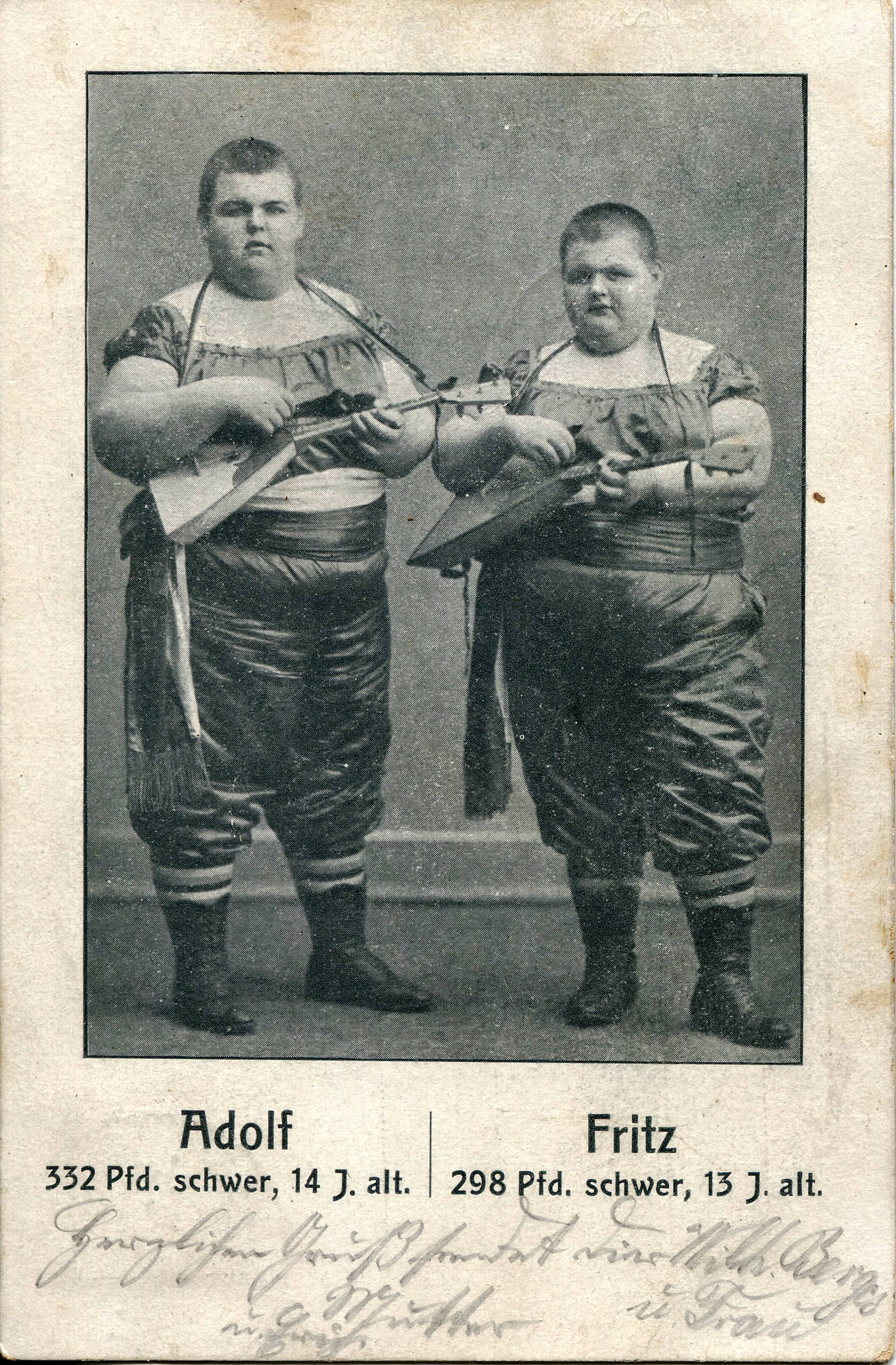
My third duo of boys are definitely brothers and who were evidently proficient professional mandolinists. They are Adolf, 332 lbs. heavy, 14 years old and Fritz, 298 lbs., 13 years old as printed on their postcard. These stout young fellows wear matching satin/silk costumes and hold mandolins. Presumably they also sang, too. They were clearly from a circus sideshow troupe or maybe a music hall act. It's sad that Adolf and Fritz's large size and not their musical talent was the source of their entertainment value. But that appeal to mankind's baser curiosity has always been what exploitive show business is all about. 

They are from Germany as their postcard was a cancellation of 5 February 1906 from Lüdenscheid, a city in the Märkischer Kreis district, of North Rhine-Westphalia, Germany.


As many of my readers know, I live in Asheville, North Carolina which was devastated by Hurricane Helene on September 27th. It's been nearly 30 days and today my landline phone was 
finally reconnected, the last of several interrupted systems brought down by Helene's powerful wind and rain. In the past week electricity was restored and water, too, though it's still not suitable to drink. And the internet came back on Wednesday this week which has allowed me to restart my blog. 

Fortunately my home is situated near the higher elevation of downtown Asheville and is about 2/3 mile(1 km) above the French Broad River. We lost some large trees that did some damage to the house and left a big mess but the structure is still sound and can be repaired. But we were very lucky as other parts of our city and Western North Carolina suffered terrible destruction from the storm's torrential rain and violent winds. Just a short walk from my home is an outdoor concert park on the river where my orchestra played a pops concert this past season. It was obliterated by the force of the rushing river which rose 24.7 feet above its usual height. Asheville's River Arts district and Biltmore Village area were largely destroyed. The powerful current took away cars, trucks, buildings, homes, and anything not secured. Higher up many mountain slopes gave way and landslides have destroyed numerous roads, bridges, businesses, and homes. Freak tornado winds violently wiped out many acres of woodlands that will dramatically change our mountain forests. And most tragic is that our county reports over 96 people died as a result of Hurricane Helene's fury.

The devastation from natural disasters like this is difficult to describe. The videos on YouTube are heartbreaking to watch. Very few homeowners and businesses in this area have flood insurance and many people have lost everything. Recovery will take a long time. It seems there is too much sorrow and grief in the world now.


All I can think to offer for a consolation is some music.
Here is a performance of Czech composer Bedřich Smetana's
2nd movement Vltava (River Moldau)
from his tone poem Má Vlast—My Fatherland.
It is performed by the Wiener Philharmoniker
under the direction of conductor Daniel Barenboim.
Smetana's music describes the great force of nature 
and the strong resilience of the human spirit. 


This is my contribution to Sepia Saturday
where every kid has wheels. 


Comrades in Music

09 March 2024


Best of buddies.
Real pals.


Close chums.
Favorite mates.


Comrades in arms.
Brothers in wartime.


The friendships made by soldiers
can last a lifetime. 
Photographs of that bond
were common enough
for regular soldiers
in World War One,
but it was just as true
for army musicians too.


Today I present a small sample 
of private photos
of unknown soldiers
who were bandsmen in
the Imperial German Army.


This pair of bandsmen, a hornist and a trombonist, posed for a relaxing moment outdoors while enjoying a smoke. The photographers, Gebrüderen Spahn were a professional studio in Hammelburg, a city in Bayern/Bavaria. They probably arranged to take photos of soldiers who were doing their army training at the Lager-Hammelburg ~ army barracks which were south of the city. Soldiers bought the postcards to send to friends and family back home. The Waffen, the ornate brass plate affixed to the front of their distinctive Pickelhaube helmets matches the pattern used by the Bavarian army. 

The postcard was sent from the Hammelburg Barracks on 13 June/July (?) 1907 to Wohlgeboren (i.e. well born, a title for a minor nobility) J---(?)  F. Müller, a Kaufman ~ merchant in Neustadt, a very common city name in Germany. The addition of "on S." means Neustadt in Sachsen, I think. The Spahn brothers also helpfully included the year 1907 with their printed business name on the back. It's interesting that cigarettes are a favorite prop featured in many similar photos of French soldiers from this era, while German soldiers, especially those from Bavaria, are often depicted smoking pipes.


***


This next duo also stand outdoors wearing proper German Pickelhaube but dressed in less formal uniforms with ordinary shoes instead of boots. I think this was the attire worn for indoor concerts which required no marching or ceremonial precision from a band. The tall trumpet player even has a short bandsman's sword attached to his belt, though his companion, a tenor hornist, is missing his sword. The back of the card is blank, so the only clues for identification are their helmet plates. Unfortunately the sunlight glare makes it difficult to see the full design but I think it matches the regimental pattern for Württemberg.


***


This next pair of German bandsmen were photographed in a studio standing in front of a painted backdrop of a dramatic cloudy landscape. One soldier holds a tuba and the other a clarinet. They wear dark wool overcoats, boots, and Pickelhauben. On their belts are pouches for their sheet music. Their helmet plates have the Prussian eagle gripping the royal scepter and orb which is a design used by several Prussian infantry regiments.

The postcard is blank except for a stamp of the photographer's studio, H. Kalinke, of Gotha, a large city in Thuringia, Germany,  northeast of Frankfurt and west of Leipzig. However one soldier has left his mark. The clarinetist drew a cross over himself, just in case his parents might not recognize him in uniform. 


***


My last photo is not a duo but a quartet of bandsmen in dress uniforms performing outside on tuba, trumpet, horn, and bassoon. Next to them a stout non-commissioned soldier wearing a white fatigue uniform appears to interrupt their concert. He carries a beer keg under one arm and  seems to be offering them a box of cigars, as he is smoking one too. 

Leaning on the horn player's legs is a slate-board sign which has a message written in chalk. The first line, "Albert lebe hoch" is "Albert lives long", but I can't make out the next words to translate them. Presumably it's a humorous comment about the soldier with the beer and cigars.  However the last line is clear, "Schießplatz Jüterbog" translates as "Jüterbog shooting range". Jüterbog is a town in northeastern Germany, in the Teltow-Fläming district of Brandenburg, about 65 km (40 mi) southwest of Berlin. The helmet plate pattern is a Prussian infantry or Garde regiment, similar to those of the bandsmen from Gotha. Notice that they wave short swords too. 

The postcard was never posted but it does have a message on the back. However the handwriting is too broad for me to make out any of the letters. Maybe it's part of the joke. :—)


Since only one postcard has a date, which was from 1907, I can't say that the other photos were taken in that pre-war decade or later during the Great War from 1914-1918. What I can say is that Germans were very fond of band music, uniforms, and cameras. I have found far more personal photos of soldiers in the Imperial German Army than of British, French, Belgian, or American servicemen from the same era. 

The little leather Pickelhauben look silly and impractical to our modern eyes, but at the beginning of the 20th century the spiked Prussian helmet was an important symbol of German military heritage, especially because it was still new as a unified Germany empire did not exist until 1871. These men wore it with pride and were respected for their military music traditions, many of which were borrowed by military bands in France, Britain, and the United States. 

But what I like best about these photos of anonymous bandsmen is that they reveal close personal friendships that come from making music together while serving your country. These musicians genuinely belonged to a band of brothers.


This is my contribution to Sepia Saturday
where your only choice
is to fish or cut bait. 


Two Tales of Pointy Hats

10 June 2023


Clothes supposedly make the man, and once upon a time, a musician's wardrobe made a particular fashion statement. An extravagant formal uniform was a visible mark of a bandsman's special occupation and a measure of his group's success and popularity. Today I present some old photos of well-dressed bandsmen who wear tall pointy hats, once considered the elite headgear for a musician. They all have a story to tell.


My first tale begins with a small ferrotype, i.e. tintype, of a piccolo player wearing a tall hat with a top spike about 4 inches long and a light color frock coat with three rows of brass buttons. As his white shirt collar is visible and contrasts with the coat's material, I think his uniform has a cream or yellow pastel color. Though the image is not very clear, his instrument appears to be a wooden piccolo, though it is also the same length as a simple fife.


The photo is unusual because it's been preserved in its original paper envelope frame. On the back is a date, Sep. 9. 1889 and a stamp of the photographer:

Quartley's 
Baltimore
Photograph
Gallery
11 E. Baltimore St.


Baltimore Sun
19 October 1889

The photographer advertised in the Baltimore Sun newspaper, but for cabinet photographs, not tintypes. The price was $1 for 6 "nice cabinet photographs" or $2 for 13 "finely finished ones." Though ferrotypes required some time for developing, they were not mounted on card stock but simply inserted into paper matte envelopes. I suspect since the quality was not as sophisticated the  photographer charged much less than for fine cabinets. Each image is unique as the ferrotype metal sheet becomes its own "positive" photo, no duplicates can be made. Usually they are a mirror image but some cameras had lens adaptors with prisms or mirrors to correct the image as a realistic view. That is the case here, as the musician holds his piccolo in the proper manner and the center button seam on his coat is oriented to the right side. 


The young man looks maybe age 18 to 24, though the hat makes him appear older. The bright emblem on his spiked hat could be the eagle with shield pattern used in the U.S.  Army and State Militias, but it is too blurred to see more than a shape. His tall hat was an American style introduced in the 1880s that borrowed its design from the British custodian hat and added a Prussian spike and helmet plate. 

Germany did not become a unified nation until 1871, but Prussian military uniforms were  admired and imitated by many countries around the world. Bands in particular chose this hat style because when plumes were attached it caught the attention of the public as the band marched. 

Though we don't know his name, the penciled date on the envelope of September 9, 1889 is the clue to the occasion that caused this musician to be in a dress uniform. It was on this day that the city of Baltimore opened the Maryland Exposition in celebration of the anniversary of the successful defense of Baltimore during America's second war with Great Britain, the War of 1812-15.


Raleigh NC News and Observer
3 September 1889

The festival lasted six days and began on September 9th with a "Baltimore Industrial and Civic Procession "of "200 floats and 50,000 uniformed men in line."  Latter on the 13th 5,000 troops of the U.S. Army and State Militias staged a reenactment of the Battle of North Point along with a mock bombardment of Fort McHenry by eight U.S. Navy warships. 500 Floating Torpedoes! 500 Bomb Shells" 3,000 Rockets! 100 Search Lights! Visitors even got to watch a ship on fire and a munitions magazine explode at the fortress! 

And amidst all the bombs and rockets there were "50 Bands of Music and a Grand Vocal Concert of 5,000 Voices" to add some musical culture to the spectacle. 

One of the tunes surely sung by that gigantic chorus was "The Star Spangled Banner." Its lyrics were written by a Maryland lawyer and amateur poet, Francis Scott Key. who witnessed the 25 hour long bombardment of Fort McHenry by Royal Navy ships during the Battle of Baltimore on 14 September 1814. But Key's words would never have become famous without the musical inspiration of his brother-in-law, Joseph H. Nicholson. After Key showed him the poem, Nicholson recognized that its metre pattern fit a melody used in "The Anacreontic Song" by English composer John Stafford Smith. This tune was composed in about 1783 for the Anacreontic Society, an 18th-century gentlemen's club of amateur musicians in London. Several versions of the "Banner" were already well-known in 19th century America, and in 1889, perhaps for this event, one was adopted as the national anthem of the U.S. Navy. In 1916 President Woodrow Wilson ordered a special committee of five eminent musicians and composers to standardize the musical arrangement, (It is notoriously difficult to sing), but "The Star Spangled Banner" did not become the official anthem of the United States until 1931.

The Baltimore festival/exposition had numerous events planned with many speakers including the newly-elected President of the United Sates, Benjamin Harrison, who traveled up from Washington, D. C. to review the gala parade which opened the festival. A few days before, the paper published a long list of every person and organization that would participate in the parade. 


Baltimore Sun
9 September 1889

There were six "divisions" in the parade beginning with the entry of various dignitaries and grand marshals, descendants of veterans of the War of 1812, and numerous delegations of the Grand Army of the Republic who were union army veterans of the Civil War of 1861-1865. Interspersed in this enormous parade were hundreds of floats, many depicting the battle for Baltimore in 1814. The second division followed with companies of volunteer firemen from around the region which connected to the third division of even more firemen from the city of Baltimore, all of them marching in formation with their uniforms, hooks, ladders, and water pumps. The fourth division featured dozens of secret and benevolent societies with illustrative floats and  long companies of "knights" in fancy uniforms and with ceremonial swords. In the fifth division came Baltimore's German-American community represented by German singing societies, German athletic groups, German breweries, and German-American business groups. Finally the sixth division finished the parade with sundry trade unions and workers associations who would return a few days later for another parade of Baltimore laborers.  

And since you can't have a parade without music, there were bands. Lots and lots of bands. In the newspaper's list I counted over 23 bands and 11 drum corps but I feel certain there were many more. Some were attached to "state militia" or national guard regiments. Several fraternal societies had professional quality bands and often included a drum corps just to set the march cadence. 

The premier ensemble was the Unites States Marine Band which in 1889 was led by an up-and-coming composer named John Philip Sousa. Only the year before in 1888 his famous march for the U.S. Marine Corps, "Semper Fidelis", was first introduced to the public and in 1889 two of his greatest marches, "The Thunderer" and "The Washington Post" had their first performances earlier in the year. So surely thousands of Baltimoreans and President Harrison got to hear these toe-tappers in the parade. 

To his credit the President gamely stood on the Baltimore grandstand for over four hours until the last parade unit had passed. Reportedly he returned a salute to every man, woman, and child that presented honors to him that day. Later that night Harrison returned to Washington as he probably had better things to do that week than visit industrial exhibits or watch mock battles with fireworks. I bet he fell asleep on the train dreaming of piccolos and drums. 


Baltimore Sun
6 September 1889


* * *


My second tale comes from two cabinet card portraits of two well-dressed clarinet players. They were companions purchased separately from a dealer who did not recognize that both bandsmen were wearing identical uniforms. The first man holds a little E-flat clarinet, the high treble voice of early brass and wind bands. He wears a dark color frock coat  with contrasting cuffs and frilly epaulets. On a faux studio pedestal is his tall spiked hat with a white horsehair plume. The  painted backdrop behind him depicts a Moorish garden with palm trees. There is no mark for a photographer on this photo but there is on his companion's portrait.


This bandsman stands with his clarinet at the ready, dressed in the same dark uniform, perhaps scarlet or green, with a the tall spiked hat on his head. His instrument is longer than the other clarinetist's E-flat, but I think it is shorter than a standard B-flat, which would make it a C clarinet. Based on the style of their uniforms, the two bandsmen are probably members of an Illinois National Guard band. In this era the number of regular soldiers in the United States Army was quite small. States were responsible for maintaining guard regiments which often employed professional bands to accompany the guard soldiers in parades or during their annual training duty.

The photographer was McCure of Dixon, Illinois, a small city on the Rock River about 100 miles west of Chicago. In the 1880s when this cabinet card photo was likely taken, Dixon had a population that was growing rapidly from 3,658 residents in the 1880 census to 5,161 in 1890, a 41.1% increase.  However this clarinet player ended up on the deficit side of the town's demographic statistics. Written in ink on the back of his photograph is a name and a fate.

Sam Legge
                           dead


Its an odd epithet to find on a photo. Sam obviously didn't write it himself but who did? A family descendant would likely add a relationship, i.e. "Uncle Sam Legge, grandma's brother" and maybe a full date of death. "Dead" seems too blunt for a family member. I think it was added by one of Sam's friends, a contemporary who was maybe another bandsman who possessed a full set of individual photos of each band member and annotated this man's name and earthly status as an aid to posterity.   

In any case, it didn't take long to find Sam Legge's name in the Dixon newspaper published on 7 January 1890.


Dixon IL Evening Telegraph
7 January 1890

               —Samuel W. Legge, died at the Keystone house in this  city last night at 9:20.  He was born twenty-four years ago in London.  He came to this city from Chicago last June  and being by trade a plumber has been employed by Appleford & Manard.  His parents, Mr. and Mrs. James Legge, have arrived from Chicago.  Death was caused by pneumonia.  Funeral to-morrow at two p.m. from St. Lukes' church.


That might have been the end of this sad tale except that this young Englishman's name appeared in several newspapers around the country that week, from Kansas to New York to Mississippi. The brief report noted that "Samuel (W.) Legge from London" died in Dixon, Illinois on 6 January 1890 of "la grippe", i.e. influenza. "This was the first fatal case in this city, although over 300 people are afflicted with the disease at present."

Samuel Legge was a victim of the 1889–1890 pandemic of a respiratory viral disease, sometimes called the "Asiatic flu" or "Russian flu" which killed about 1 million people worldwide. The pandemic was initially described in the 19th century as an influenza pathogen but more recent studies in the 21st century suggest it may have been caused by a human coronavirus. 

Rochester NY Democrat and Chronicle
9 January 1890


It supposedly began in May 1889 in the Central Asian city of Bukhara in the Russian Empire , now in modern Uzbekistan. The first case in North American was reported on 18 December 1889. Within days it quickly spread along the East Coast and westward to Chicago and Kansas. The first American death was reported on 25 December in Canton, Massachusetts. Before the end of the year cases were reported in San Francisco and other U.S. cities and from California this deadly virus spread to Mexico and South America, reaching Buenos Aires by 2 February 1890. The total death toll in the United States was around 13,000. 


St. Louis, MO Globe-Democrat
10 January 1890

Over the winter of 1889-90, newspapers reported on the surge of this virulent influenza, "la grippe" around the country and the world, regularly including the full names of individuals who succumbed to it. In the 19th century medical science did not yet understand how most diseases were transmitted, and epidemics of tropical diseases like malaria and yellow fever were common. Viruses did not begin to be identified until 1898 and wasn't until several decades later that scientists isolated them and determined their behavior in animals and humans. 


Chicago Tribune
8 January 1890

Young Sam Legge's death at age 24 was an exception, as the pandemic of 1889-90 killed a disproportionate number of elderly people. At the time there was no treatment or preventative for influenza and many doctors mistakenly believed it was caused by "bad air" rather than by an infectious contagion. It was disturbing to read in several reports on the pandemic that a number of people allegedly resorted to suicide to seek relief. Of course the standards of living, hygiene, and access to medical care in 1889-90 were very poor which increased the risk for vulnerable people.  Further outbreaks of "La grippe" occurred in March to June 1891; November 1891 to June 1892; the northern hemisphere winter of 1893–1894; and finally in early 1895.


I believe, based on Sam Legge's short obituary, that he and his fellow clarinetist had their portrait taken in 1889, coincidently the same year as the Baltimore piccolo player's ferrotype. By themselves the images of these bandsmen in their flashy uniforms and silly pointed hats seem quaint mementos. But by the addition of a date or a name these photos are transformed into remembrances of a larger cultural history of America. They connect us to an era of patriotism and a time of great suffering too that is not that different from our modern era. What will future generations think of our photos? 


This is my contribution to Sepia Saturday
where everyone knows that helmets
make a sensible fashion statement.


nolitbx

  © Blogger template Shush by Ourblogtemplates.com 2009

Back to TOP