This is a blog about music, photography, history, and culture.
These are photographs from my collection that tell a story about lost time and forgotten music.

Mike Brubaker
{ Click on the image to expand the photo }
Showing posts with label orphans. Show all posts

Notes from a Time Traveler

16 November 2024


I am a time traveler. Nearly every day I set off on a journey to meet people in some far-off place in the infinite dimensions of history. However my span of infinity is actually pretty narrow as modern time transport technology has strict limitations. Generally it's some date between 1845 and 1945, though occasionally I'll end up somewhere during my lifetime. 

Most of my encounters with people of the past are very brief, only lasting a split second really. Sometimes we might be properly introduced, but typically they remain nameless. And, due to the fleeting brevity of this moment, I am invisible to their eyes, so they never know that I can see them. I tend to seek out musicians, though once in a while I'll be attracted to other showbiz occupations like dancers, singers, or comedians. Lately I've become fascinated by aviators and artists. 

When I do learn who these vintage people are I like to ask questions about their life, their family, and in the case of musicians, their instruments and musical ensembles. Unfortunately in that blink of an eye that we connect they don't talk much, so it's a real challenge to get answers. In fact the time goes by so fast that I'm lucky if I can determine a location or a decade of when I first make their acquaintance. 

Today, in honor of the special 750th weekend of the Sepia Saturday Club (more about that later), I thought I would present a few of my antique friends whom I've renewed contact with on my time travel adventures in just the last few weeks. They should be familiar to longtime readers as I have already featured  them  in previous stories here on my blog. One is the gentleman that begins this post. He is the celebrated Norwegian violinist Ole Bull. I've grown so found of him that I often set the controls on my time machine to go visit him. But first I'll bring back a new souvenir of one of my favorite child performers.


I first introduced these three boys in July 2022 in my story The Little Vernon Brothers. They are Sidney Clyde Vernon, the tallest boy holding a violin, born 1878 in Elgin, Ontario, Canada; Howard Alexander Vernon, the boy with a piccolo, born 1881 in Marshalltown, Iowa; and Percival Lessington Vernon, the youngest with the long blond hair and a cello, born 1884, also in Marshalltown.  The three brothers are accompanied in this picture by their mother, Mary Jerusha Vernon, who is seated at a reed organ.  

This cabinet card was produced by the Holdridge studio of Trenton, New Jersey, at 223 East  State Street. The other four photos I have of the "little" Vernon brothers were taken by photographers in Marshalltown, Iowa; Beloit, Wisconsin; and Philadelphia, Pennsylvania. That photo is of the whole family with their mother Mary and their father, Edward H. Vernon, an accountant who evidently was successful enough to support moving his family around the country. 

This photo from New Jersey shows Sidney at his tallest so based on my previous research I think it was taken around 1895-96. This photo was also the only one that came with a caption for the "Little Vernon Brothers" so it was clearly intended to be a promotional photo for their performances. Unlike a troupe of vaudeville theater entertainers, the Vernon family played at churches and society halls. Their repertoire was designed to appeal to a family audience with an emphasis on Christian songs, hymn tunes, and wholesome folk tunes, interspersed with recitations of poetry. This review from 1895 describes one of their concerts in Goshen, New York.


Goshen NY Democrat
14 March 1895


The entertainment in the Presbyterian church last Friday evening was a success.  It was well attended, considering the condition of the roads.  The Little Vernon Brothers are all they are recommended to be.  Sidney, the eldest, who plays the violin, has a very fine touch; Howard, the next, plays the piccolo well; and Percy, the child who plays the violincello, is a prodigy, is natural and homelike on the stage, plays his part perfectly and sings just as well.  His childish movements on the stage are a strong hold on the public. 


_ _ _

The Vernon brothers began performing in 1889 in Marshalltown, Iowa and continued giving regular concerts around the country until about 1899 when they were not so little anymore. By the turn of the century the Vernon family was living in Detroit and the boys were beginning higher education. What I find remarkable is that all three brothers entered seminaries and became ordained ministers, two in Baptist churches and one in a Presbyterian. Reader's can find out more in my original story of the Vernon brothers


* * *


One genre of postcards that I regularly search for is "orphan bands". I few weeks ago I spotted this one and recognized it as a picture of a children's band that I featured on this blog back in 2018. There are 14 boys and girls holding musical instruments, mostly brass, and dressed in nice Sunday best. They called themselves "The Jolly Entertainers". I told their story in two parts, The Children's Home Band of Des Moines, Washington and Mr. Draper's Children's Home Band of of Des Moines, Washington. This "Children's Industrial Home" was established and run by Mr. Herman M. Draper, seen here seated center holding a cornet. A native of Canada, Draper was born in Ontario in 1857, but immigrated to the United States in 1882. As a young man he pursued a career as a music teacher, specifically for chorus and voice using a music education technique called Solfège which uses syllables for the musical scale pitches, i.e. Do, Re, Mi, Fa, So, La, Ti. 

In 1887 he taught music in several Nebraska public schools where he developed his own methods for teaching elementary music. Ten years later in 1897 he moved to Calumet, Michigan where he was employed as a superintendent of an orphanage of about 50 children. In 1906 after a dispute with the orphanage's board of governors Draper and his wife left Calumet and "took" six children with them to Seattle where he decided they could operate a smaller but more compassionate orphanage in the Pacific Northwest. After a couple of years in Seattle, in 1908 the orphanage moved to Des Moines, a small village on Puget Sound named by its first settlers after the much larger Des Moines, Iowa.

Draper wanted it to be a self-supported private orphanage so he trained his young charges in various practical trades including music and printing. I have two other postcards with the same image that date from the summer of 1910, but this one has a notice on the back that is not on the others. It reads:

Help us pay for
OUR HOME

We own a complete printing outfit and
our boys are printers;  send us an order
for cards, letter heads, bill heads, etc.
We guarantee satisfaction   and
We need your help.

But there is a message too, which cliched the sale for me. 


Geo. saw these
children as he
came from     
Seattle the    
other day.     
He wanted the
little girl marked
X  but they would
not let her      
go.               


The message is a bit ambiguous since the writer is not identified and we don't know if Geo(rge) is age six or sixty.  So it is both charming or creepy depending on ones interpretation. But the X mark is actually on the back just above the U in OUR. It corresponds to the little girl seated right with an alto horn. 


This postcard was produced at a time when Mr. Draper was beginning to take his children on short tours in the region. He had some success so purchased a small bus and organized more trips to Oregon and California. In 1925 he undertook the biggest adventure taking 22 children on a year-long tour of the United States playing benefit concerts everywhere they could. It made the pages of newspapers all across the nation.

Sadly Mrs. Annie Draper died on 13 April 1927. Four days later just before her funeral, her husband followed her, tragically succumbing to a heart condition. Herman M. "Daddy" Draper was 70 years old. He and his wife had cared for over 300 children at their orphanage. It's an inspiring story of perseverance, dedication, and love. Here's the link to part one.


* * *


We met this handsome violinist in my three part series Ole Bull, Adventures in America, part 1, part 2, part 3. He is Ole Bornemann Bull (1810–1880) a Norwegian violin virtuoso who was one of the first violinists in the early 19th century to create a successful career as a concert soloist. By 1837 Ole Bull was performing hundreds of concerts each season in Europe that established him as the equal of other Romantic musical artists like his contemporaries: Felix Mendelssohn (1809–1847), Frédéric Chopin (1810–1849), Robert Schumann (1810–1856), Franz Liszt (1811–1886) and the great Italian violinist  Niccolò Paganini (1782–1840), whom he tried to emulate as a violinist and composer,  too. But no concert artist of his time ever covered as much distance in traveling the world as Ole Bull. 

My series on Ole Bull focused on a set of carte de visite photos that were produced by a Chicago photographer in the winter of 1867-68. This was during his third tour of America just after the end of the Civil War. He made his first tour in 1843-45 and his second tour in 1852-57. This happened to be when photography was just becoming popular as a new portrait art form. However early photographs like daguerreotypes and ferrotypes of the 1840s and 1850s were each singular positive images and could not be easily duplicated. In the 1860s when the carte de visite, or cdv, were introduced the process used a negative image on a glass plate which allowed multiple copies to be printed quickly and cheaply. It was the perfect medium for an entertainer who wanted pictures to promote themselves. In 1867 Ole Bull clearly recognized the value of cdvs as souvenirs for devoted fans. 

Since publishing my Ole Bull series in January 2021, I've acquired even more photos of him, including more cdvs from Chicago, a ferrotype–tintype, and recently last month a couple of larger cabinet card photographs. The first one shows Ole Bull seated in a relaxed pose. His hair is long but now quite white. The photographer was S. W. Felt of Chicago, a different photographer than the one who made the cdvs in 1867-68. This photograph could have been taken during Ole Bull's fourth appearance in America in 1871-72 when he played Chicago in March 1872. That was just  five months after the Great Chicago Fire destroyed the city center's theater district where he had last performed. But I think this image fits better with his fifth tour from 1876-77 when reviewers took note of the "snow in his hair." The photograph print is a bit soiled and abraded but I like that his name is written in pencil on the front. I'm not certain yet, as the simplicity of his name makes it easy to reproduce, but I think it might be Ole Bull's real signature. 
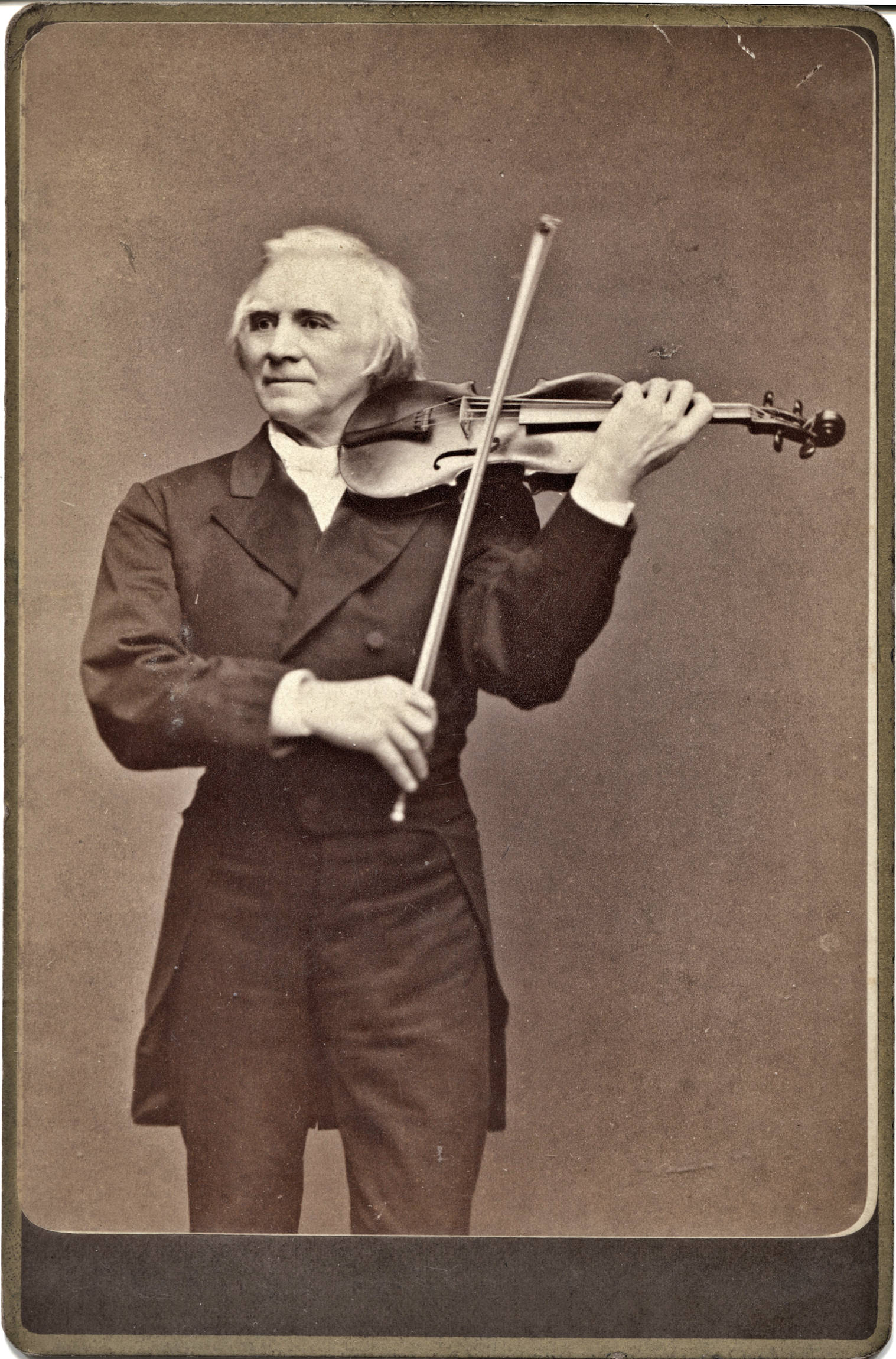


This second cabinet card of Ole Bull is very clear and well preserved, requiring little correction of contrast. It shows a 3/4 view of him with his violin and bow in playing position. The photographer was J. P. Moore of Meriden, Connecticut. Ole Bull's face and expression resembles his other photo, so I think this may date from 1876-77 too. 

Bull returned to America once more in 1878 but reports describe him as diminished,  no longer fit as a fiddle as some might say. He did play a final concert in Chicago in May 1880, but concern over his poor health forced him to return to his home in Bergen, Norway where he died on 17 August 1880. Readers can read about the exciting adventures of Ole Bull's 1867-68 tour by starting at this link.

Most of the musicians I meet in my time machine are mute, their stories and biographies locked away in the secret vaults of history. Ole Bull is a rare exception as there are literally thousands of newspaper reports, letters, and books on his life. It makes it much easier to know the man, but more difficult to puzzle out exactly when his photos were taken. I'm planning a reprise story on Ole Bull so I can display these two photos alongside the other new photos I've found. Stay tuned.


* * *


My final photo is a postcard that just arrived in the post a few days ago. It's obviously not a picture of a musical group but, as the caption says. it's a track team from E.P.H.S. Those initials stand for East Palestine High School and some of these boys appeared in my three part series The Glee Club of East Palestine, Ohio - part 1, part 2, part 3

East Palestine, Ohio is another place I frequently check out in my time machine, specifically during the period from 1906 to 1910 when one young man in particular was a student there. Here he is seated on the floor in front, one of ten members of the track team and the only one with a dark African complexion. His name is James Aaron Washington and I'm rather proud to have figured out who he was, as he did not grow up in Ohio but in Asheville, North Carolina, the city where I now live. 

This photo was taken in 1909, either in the spring or maybe the previous fall of 1908. In 2024 this picture is not unlike thousands of similar high school team photos. But in 1909 it was exceptionally rare to see a Black student sitting as an equal with fellow White students. America's terrible legacy of slavery continued in the post-Civil War era with society strictly divided by race using countless harsh laws to enforce racial segregation. How James Washington came to be in eastern Ohio was the first question I asked in part 1 of his story.  Certainly in 1909 North Carolina a young African-American man would never be accepted as a member of a high school athletic team, much less photographed with one. There are still many questions I want to ask but may never get an answer. 

This postcard is also an example of when I get to hear someone from the past speak across the vastness of the spacetime continuum. It was sent to Mrs. C. E. Oliver of Pittsburg, Pa. on 19 May 1909, perhaps care of Mercy Hospital.

Will be up Saturday
if my head gets
well.  I will have to
jump against the
same fellows that I
jumped against Saturday


The boys competed in springtime track meets against other high school teams in the region. A year later in May 1910 there was an all-county contest with four schools and the East Palestine Reveille Echo reported that Washington placed second in the 220 yard dash and Oliver got third in the running broad jump. But their rivals as Lisbon High still took the most points to win the championship leaving East Palestine to settle for a 2nd place. 


If you look closely some of the boys have medals pinned to their shirts. James has one and the boy behind  him on the right has six. The boy to the left is the same boy in the E.P.H.S. Glee Club photos wearing a top hat. I believe his name is Cecil Oliver. He and James sang duets in the Glee Club concerts. Could he be the son of Mrs. Oliver writing for some sympathy on this postcard? Yet another question that may go unanswered. 


This is actually the second photo postcard I've found of the E.P,H.S. track team with young James Washington. The other one is dated 1908 and is even more remarkable because James is not the only Black athlete in the group. That photo is in the Postscript at the end of  part 3.   

James Aaron Washington's story took another surprising turn when I discovered that after high school he returned to North Carolina; attended Shaw College in Raleigh; got married in Asheville, raised a family there; and then in the 1920s moved to Washington, D. C. where he worked for the U. S. Post Office. That's all explained in part 2.  

But the biggest surprise was to learn that his son, James Aaron Washington Jr. became a noted civil rights attorney, a law professor and dean at  Howard University in D. C., and later a judge to the Superior Court of the District of Columbia appointed in 1971 by President Richard Nixon. But more significant was that Professor James Washington Jr., the son of the young man in East Palestine High School's Glee Club and track team, was also one of the advisors who helped to craft the 1954 case of Brown vs. Board of Education of Topeka which became a landmark decision of the U.S. Supreme Court ruling that U. S. state laws establishing racial segregation in public schools were unconstitutional, even if the segregated schools were otherwise equal in quality. That's a real story of bending the arc of justice.


I am a time traveler.
Even just a glimpse of a moment in time
can contain millions of threads of history.
Some lead backwards and some forward,
but they all weave into an amazing fabric of time.
That's why I keep alert when I'm in my time machine.
You never know when you might meet an old friend.


This is my contribution to Sepia Saturday
where everyone is celebrating
the art of vintage photos.


This is my 724th post on my blog TempoSenzaTempo — Time Without Time. I first joined the Sepia Saturday club hub pub on January 8, 2011, number 56. I submitted A Mystery Band which seems incredibly brief compared to my usual output (like this one) in 2024. It took me a few more weekends before I settled into the idea of following Alan's theme image, but since February 2011 I have participated in nearly every Sepia Saturday, which makes about 690 weekends. That's a lot of postcards and photos.

I never expected that my hobby of collecting vintage musician photos would become the passion it is today. (Some people, like my dear wife, think it might be an illness.) But the inspiration really came from meeting fellow time travelers who shared my interest in telling stories about old photographs. It's sad to say that many of those bloggers have faded away into the Sepia Mists. But I am very grateful for all that I learned from reading each blogger's stories and gaining a different perspective on writing, collecting, analyzing, research, and presentation on this wonderful medium of the internet. I continue to delight in every blogger's contribution to Sepia Saturday. Thank you, Alan, for keeping the Sepia Saturday club pub going and offering up a fascinating image every week. I look forward to Number 1000. I'm pretty sure I'll still have enough photos in my collection to make a good match.

The Boys' Brass Band of Jacksonville, Florida

23 April 2022


 The first postcards
were a medium made for tourism.
After arriving at an exotic vacation destination
travelers always felt a need to write to the folks back home.
"Weather is too wet/dry/cold/hot as Hades."
"Place is incredibly beautiful/horrible/dull as dirt."
"Having a wonderful/okay/miserable time."
"Here's a picture of something funny/pretty/unusual that we saw!"


For many far-off places its local street musicians
served as suitable scenic subjects for a vacation postcard.
Musicians like the Italian bagpiper player on an 1898 card,
or the postcard set of Parisian ballad singers from 1901.

And on the streets of Jacksonville, Florida in 1913
it was a brass band of twelve African-American boys.

They may have had their picture taken
for a holiday visitor's postcard
but it's quite possible they were tourists too.

This is a story about a postcard photo puzzle.


The group of young black musicians stand outside the veranda of a large stuccoed house or hotel. Behind them are a few white children and adults partly hidden in the shade from the porch. It's a typical 12 piece brass band with cornets, slide trombones, alto horns, and tubas and two drummers. The boys' ages range from around 8 to 16. An older man, perhaps 30ish and wearing a bowler hat, stands at the back along with a younger man in cap and bow tie who holds a cornet. The boys are dressed in blousey knee pants, and most have uniform coats trimmed with fancy button braid. All wear either caps or cadet hats. The people on the veranda are smiling but the boys in the band mostly show a serious expression.
 
 
It's a small photo printed on standard postcard stock with a wide border where someone has written a caption in ink.

Scott's Dixie Band  Jacksonville Fla
 
In the upper right in faded ink is Mr & Mrs Scott with a slash directed into the photo. In the upper left corner is a date 1913 written with a ballpoint pen, probably by the dealer I bought it from. The back of the card shows that it is correct as the postmark is from Jacksonville, Fl on February 11, 1913 at 5:30 PM.  The card is addressed to Mr. Frank Longman of Packard St., Ann Arbor, Mich.


Still on deck
but waiting for
the clouds to
roll by.  Best wishes
to your wife & Mr
& Mrs. Eberbach in
which Mrs Scott joins
Yours  Evart


With so many dates, names, and places this postcard doesn't seem like much of a puzzle. Except that the writer gave the boys' group a name, Scott's Dixie Band, which was actually not their real name. To prove that will require some photo detective analysis.   
 
I'll begin with the recipient of the postcard.
 
In the 1910 US Census, Frank C. Longman, age 27, was living with his wife Edythe N. Longman, 28, on Packard Street in Ann Arbor, Michigan. It was the home of Edythe's parents, Edward H. Eberbach, age 61, and his wife, Mattie Eberbach, 60. Mr. Eberbach's occupation was listed as Retail Merchant in Hardware. In the Ann Arbor city directory this proved to be a large firm dealing with brass, copper, and galvanized iron sheet metal work. His son-in-law, Frank Longman, worked as an Attorney-at-law in General Practice.

 
1910 US Census, Ann Arbor, Michigan

Ordinarily that might be all the research needed, but postcards like this get saved for a reason so I was curious if there was anything more to connect Frank to this postcard. It turned out that there was. 
 
Football.
 
 
Frank Chandler "Shorty" Longman
(December 7, 1882 – April 4, 1928)
1903 Michigan Wolverines football team photo
 Source: Wikipedia

Frank Chandler "Shorty" Longman was born 7 December 1882 in rural Kalamazoo County, Michigan. In 1903 he entered the University of Michigan in Ann Arbor and became a star fullback with the  Wolverines football team for three seasons. Following his graduation in 1906 Longman took up coaching, first at the University of Arkansas, then at the College of Wooster, Ohio where he accomplished the supposedly impossible by defeating Ohio State. In 1909 he became head coach at Notre Dame and in his two seasons there set a winning record which included an 11 to 3 victory by the Fighting Irish over his alma mater, the Michigan Wolverines, which was still led by his former coach, the celebrated Fielding H. Yost. The legendary Notre Dame football star Knute Rockne played as a freshman on Longman's 1910 team. Rockne would go on to coach the Fighting Irish from 1918 to 1930.
 
It seems unlikely that Frank Longman found time to get a law degree while at Notre Dame, so I suspect his occupation recorded in the 1910 census is an error. In later documents, like his 1918 draft card and the 1920 census, under employment he listed paving contractor which in this era probably paid much more than football coaching did. Tragically, Longman died in April 1928 of tuberculosis at the young age of 45.


1913 Ann Arbor, Michigan city directory

The sender of the postcard was a bit more challenging to identify, mainly due to bits of old black album paper stuck on the postcard covered his signature which required careful removal. The reason it was sent to someone in Ann Arbor was because he lived in Ann Arbor too. Evart Henry Scott was born in Ohio in August 1850 and married to Sarah E. Scott. In February 1913, Evart, not yet age 63, ran his own fruit farm in Ann Arbor. His name was associated with a local Ann Arbor agricultural association, which in 1910 may have sent him to Tampa, Florida acting as a representative for Michigan's fruit growers. In the 1913 city directory for Ann Arbor his business is listed as Real Estate, but his occupation in the census was Farmer. Evidently his fruit did alright as his name appeared in reports on civic activities in Ann Arbor and at the University of Michigan.


Detroit Free Press
3 November 1902


The reason Mr. Scott was sending a postcard to Frank Longman was that Evart was a BIG fan of football. Specifically his hometown team, the Michigan Wolverines.  In November 1902, the year before Frank started his freshman year at the University of Michigan, Evart captured some unexpected fame reported in newspapers around the country from Los Angeles to Boston. 
 
Following an important game with Michigan's rival, the Wisconsin Badgers, Evart was celebrating the Michigan victory at swank Chicago hotel. Challenged or inspired by his companions, Evart suddenly dove into a large Italianate water fountain. After a futile effort to swim in the three-foot deep pool and catch goldfish in his hat, he began to sing "Oh, ain't it great, just simply great. To wipe Wisconsin off the slate."  Pulled from the water by his brother and several friends, he was promptly taken off to bed.


_ _ _


With that level of enthusiasm for football, it's no surprise that Evart would have a friendship with a college football star like Frank Longman. I bet after returning to Ann Arbor he even brought back a couple cases of oranges for Frank and his wife. And the story also suggests Evart Scott enjoyed a good joke on himself which I think explains his fanciful caption on the postcard, Scott's Dixie Band. In the context of a traveler writing to a close friend, it's clear he was using an old minstrel show phrase to make a little jest and show friends back home a bit of Florida's peculiar attractions.


My collection has dozens of postcards and photographs of boys' brass bands. Most are from the United States but many come from around the world too. Beginning from the 1870s teaching boys a musical instrument was promoted as a way to focus their attention, keep them pointed toward a positive lifestyle, and give them training at a useful trade—music making. Many communities considered it a valuable social assistance for disadvantaged youth. However for orphaned or abandoned children membership in a band was beneficial as a refuge from hardship and as a pathway to an education and a better life. This was especially true for African-American children in the shameful Jim Crow era of the late 19th and early 20th centuries.   

The boys pictured in this small postcard from Jacksonville were clearly not from rich families if they had any family at all. Their deadpan demeanor is, I think, the result of living at a time when American society, particularly in a southern state like Florida, operated under racist rules and oppressive laws that were very different than those applied to the white folk standing behind them. These boys were not allowed to come onto the porch. No one gave them a glass of lemonade or snack from the hotel's kitchen. After their concert, Evart Scott got a souvenir picture of them, but the boys in the band likely never saw a copy of their photo.  They were very aware of that invisible red line that bigotry and discrimination drew between their performance on the pavement and the white folk listening on the shady veranda.
 
It is because of this harsh history and much more that photographs of African-American culture from this period are very rare. Mr. Scott made up a name for the boys' band probably because he never learned what they called themselves, so even with a date and location they remain anonymous. 
 
Or do they?


The postcard photo was taken in February 1913. In the following summer of 1914, I believe that a few of these boys were members of a larger band that traveled from Charleston, South Carolina to London, England. A century later I featured their postcard in my story entitled The Jenkins Orphanage Band.


This was not a British navy band but an American boys' band from Charleston, South Carolina. They were all inmates, as the census labeled them, of the Jenkins Orphanage. It was founded by the Reverend Daniel J. Jenkins (1862-1937), a Baptist preacher and native of South Carolina. One cold winter in 1891 while collecting wood at the train yard in Charleston, he encountered a group of destitute boys huddled in a boxcar. Hungry and homeless, these small orphans inspired Jenkins to take them into his own family. His simple act of charity became his calling in life and brought forth such a boundless compassion for the homeless black children of his community that it led him to create an institution that could provide for their welfare and education.

According to census records, by 1900 there were nearly 70 negro boys and girls in Rev. Jenkins' orphanage. Like many children's homes of this era there was a school band, as music was considered a standard requirement for a proper education and learning a musical instrument offered a practical trade skill. An orphans' band also proved very helpful in soliciting donations for an institution so very low on Charleston's list of charitable organizations in the 1890s. Rev. Jenkins was a tireless fundraiser, making countless speeches and appeals for funds to support his work. He recognized that patrons outside of Charleston enjoyed hearing his talented charges, so he shrewdly arranged for the band to accompany him on his campaigns around the country, particularly in the North where there were many more sympathetic benefactors for negro charities than in the South.


In 1914 Rev. Jenkins arranged for his orphanage's boys' band, called "The Famous Piccaninny Band", to perform in London at the Anglo-American Exposition. In May 1914 Rev. Jenkins, his wife, and a band of 23 young men and boys booked 3rd class passage to Liverpool and arrived just in time for the exposition's opening on May 14th. The show promised spectacular exhibits about the Grand Canyon, the new Panama Canal, and a "six acre realistic replica of Greater New York City with its hundreds of skyscrapers". There was also the 101 Ranch Wild West Show from Oklahoma and "hordes of other startling novelties" of which the Jenkins Orphanage Band would play a small part. The exposition was expected to run all summer and draw large crowds at its park located in Shepard's Bush. 
 
Unfortunately, a war intervened. At the beginning of August, when Austria mobilized its army against Serbia, which mobilized Russia's military, which set Germany to invade Belgium , which activated the allied forces of France and Britain, the public's attention shifted away from world fairs to warfare. Rev. Jenkins and his family managed to quickly secure a return ticket, but his boys' band was stuck and was unable to get back to Charleston until mid-September. My full story about them is at The Jenkins Orphanage Band so I won't repeat it here.


What's important to this story on the Jacksonville boys' band is that by 1913 the Jenkins Orphanage Band was already a veteran touring act. For many years, mainly during the summer months, the boys band regularly traveled to events at large cities like New York, Washington, and Philadelphia. They appeared at the 1901 Pan-American Exposition in Buffalo, NY; the 1904 Louisiana Purchase Exposition, also known as the St. Louis World's Fair; and supposedly marched in President Taft's 1909 inauguration parade. The proceeds from their band concerts became a major source of income for the orphanage, so Rev. Jenkins soon hired another band leader for a second band. Eventually there would be as many as four musical groups on tour. They would often stay at the YMCA, the Young Men's Christian Association, like the one pictured above in St. Petersburg, Florida - The Sunshine City which date from the 1920s.

For much of the early 20th century, St. Petersburg was the most popular tourist destination in Florida, and the height of its season was during the wintertime when people from up north, like Michigan, traveled south for the relative warmer climate. Since the Jenkins Orphanage had a connection with Florida, I wondered if I could find any reference to a tour in February 1913.


Miami FL News
28 February 1913

The Daytona Beach Daily News reported that the Jenkins Orphanage Band was in the city on 13 February 1913. This is only 90 miles south from Jacksonville. Then in the 28 February edition of the Miami News, a society column from the Hotel Halcyon made note that "A band of youngsters from the Jenkins Orphanage in Charleston, S.C., entertained the guests of the Halcyon for a time last evening, the program consisting of instrumental music, negro melodies and dancing." Mr. and Mrs. Scott are not mentioned in the list of guests, but everyone is identified with their hometown and there are several people from Massachusetts, Minnesota, Pennsylvania, Ohio, and West Virginia. Miami was, of course, the shipping port used for travelers going to Cuba, Puerto Rico, and other tropical places in the Caribbean. What went unmentioned in the report is that the colored boys of the Jenkins Orphanage Band were not allowed to stay at the Hotel Halcyon.


Indianapolis IN Freeman
30 August 1913

Later that year in August 1913, the The Freeman, an Illustrated Colored Newspaper, published in Indianapolis for a national African-American readership, ran a short notice about a vaudeville trio called the Whitman Sisters. The report mentioned "Prof. Eugene Mikell formerly leader of the Globe Theater orchestra in Jacksonville, Florida and his band of thirty-five orphan boys ... known as (the) Jenkins Orphan Band." This was an exciting connection because Eugene Mikell was once the star musician of the first band organized by Rev. Jenkins.


1913 Jacksonville FL city directory

The 1913 city directory for Jacksonville, FL lists a "*Eugene F. Mikell (m), musician, h 1218 E Duval". {The asterisk* before his name denotes "colored" and was applied not just to names but to all the businesses, churches, societies, and city parks in Jacksonville.}


New York Age
30 January 1932


Francis Eugene Mikell, (1880-1932) was a very talented musician who played both violin and cornet. In 1917 he was appointed bandmaster to the 15th New York National Guard and later lead the 369th Infantry Regiment Band during and after World War One. He and his fellow bandleader,  James Reese Europe (1881–1919) are credited with helping to first introduce America's jazz music to Europe through this extraordinary band which was made up of the best black musicians in America. Lt. Eugene Mikell died in 1932 at age 51.

Mikell's background is not yet in Wikipedia, though it deserves to be, as he organized or played in dozens of bands for vaudeville theaters, minstrel shows, schools, and most importantly in the Jenkins Orphanage Band as both a young musician and later as a leader. Since he was living and working in Jacksonville, Florida in 1913 it seems very likely that a traveling unit of Rev. Jenkins' orphan band would stop there to play and maybe collect donations from the nice people of Michigan. 
 
 
_ _ _


Jenkins Orphanage Band
circa 1930s
Source: The Internet

 
After Rev. Jenkins' death in 1937 his orphanage closed the facility at 20 Franklin Street in Charleston in 1939 and moved to North Charleston where his work continues today as the Jenkins Institute for Children. Recently I discovered a photo taken in the 1930s which shows the band in sharp modern band uniforms. On the left is a pastor, not Rev. Daniel Jenkins but a different man, who looks very like the man in the bowler hat in Mr. Scott's postcard. On the right another man holds a dark banner that reads "Jenkins Orphanage Band representing a Worthy Home for Children". 


Until a day ago I had not noticed that the man in the bowler hat is holding a furled banner which has lettering. Could this be a banner of the Jenkins Orphanage Band?
 
It's all very circumstantial evidence. At this distance in time there is no one alive who was there that day. All we have is Mr. Scott's wiseguy caption, and I think I've proved Evart was making a joke. I won't belabor this story with how many false trails I've followed searching for a black man in Jacksonville named Scott who might have led a boys' brass band. Suffice it to say, there isn't one.
 
Maybe the band's banner was not opened when Mr. Scott first heard the boys play. Maybe it says something else. Maybe I have it wrong and this is another boys' band unconnected to either Rev. Daniel Jenkins or Prof. Eugene Mikell. Maybe it's all just conjecture.
 
 
But then again maybe it's right. 


Over the many years Rev. Jenkins that campaigned for his foster children, boys and girls, he developed the talents of thousands of young musicians, both amateur and professional. In 1913 the term "Jazz" or "Jass" was not yet recognized as a musical term. However the music that the Jenkins Orphan Band played was a Charleston synthesis of ragtime, blues, and older African forms that had a strong influence on other centers of African-American music like New Orleans and Chicago. Many scholars of music believe Charleston's Jenkins Orphanage deserves a place as one of the originators of jazz music. Several of its "alumni", like trumpeters William "Cat" Anderson and Jabbo Smith; pianist and singer, Tom Delaney; and guitarist, Freddie Green, became celebrated jazz artists.

In November 1928 Fox Movietone News produced a short sound film of the Jenkins Orphanage Band to play at its movie theaters. The Moving Image Research Collection at the University of South Carolina has restored the film as the Jenkins Orphanage Band - Outtakes . The full 11 minute video has several out-takes of the band repeating one tune. Skip to about 3:07 and the camera moves for some great closeups of the individual musicians. There is even some dancing at the end to demonstrate the origins of the Charleston dance craze. It's not sophisticated or even polished music, just raw youthful energy, but it's still authentic entertainment. It's a band worthy enough to be on a picture postcard to send to the folks back home.
 

* * *


* * *


This is my contribution to Sepia Saturday
where the street fair is on all weekend.


The Odd Fellows Home Girl's Orchestra of Lexington, KY

03 July 2021


Though the pavement is covered with rain,
the young ladies are not wearing rain slickers
but sailor suits in a female dress version
complete with collar tie and service stripes on the sleeves.
As noted on the bass drumhead the 14 girls are members 
of the Odd Fellows Home Band of Lexington, Kentucky.


However most of their instruments are not suitable
for a marching band, but for a seated orchestra.


A few years earlier, to judge by the director's face,
they sat on a platform constructed in front
of the same portico to celebrate a patriotic day,
perhaps Flag Day or July 4th.
The sailor dresses are in summer white
and about half of the musicians, 12 girls and one boy,
hold string instruments. In the back is an upright piano.
The director is the same man,
but all the girls are different
from those in the first photo.
The drum is the same. 


This next postcard is a half-tone newsprint image captioned:
Kentucky Odd Fellows Home Orchestra.
Prof. Ellis Kidd, Director. Lexington, KY

The ensemble of fourteen girls pose on the same steps
with five violins, viola, cello, and double bass,
two clarinets, two cornets, trombone and percussion.
The director, Prof. Kidd, standing on the left
is the same man in the other postcards.
The other man on the right is unidentified.
The poor print makes face matching more challenging
but I think the cellist is the same girl in the previous photo.
Here the young ladies, ages 13 to 18, are not in uniform
but wear an assortment of fashions.
Their high button shoes suggest a time before 1920.


Three vintage postcards of what looks like a girl's school orchestra.
In a way it was an institution for children, but it wasn't a school.
The string instruments made it definitely a kind of orchestra,
but there were boys too who played in a band.

 
They were all residents of
the Odd Fellows Home for Widows and Orphans of Lexington, KY


The first postcard of the Lexington girl's orchestra
was the only one sent through the mail,
though somehow it never had a stamp.
It was sent to Miss N. J. Hines of Florence, Alabama
from Benham, Kentucky and dated August 26, 1924.


This is those
girls that played
at the theatar to
night  they sure do
make good music
Write soon and the
Best of wishes  Yours
                             Elmer


Evidently Elmer had heard the girls' orchestra and picked up their postcard at a concert they gave near his home in Kentucky's coal mining region, Harlan County, 165 miles southeast of Lexington.


Lexington KY Herald
7 June 1925

In June 1925 the girls' orchestra performed at a luncheon for a conference of the United Commercial Travelers, another national benevolent organization like the Odd Fellows but established for traveling salesmen. The event was held in the banquet room of a Lexington hotel, and about 225  "knights of the grip" with "their ladies" were entertained by the 14 piece orchestra in a program which included a number of solos. A vocal solo was rendered by Miss Irene Crooks, with a cornet solo by Miss Marie Minter and a trombone solo by Miss Etta Brewer. The other members of the orchestra were Misses Nellie Gross, Ruth Burchett, Margaret Schnitzler, Oggie Raynes, Thelma Showalter, Emily Spencer, Minnie Wood, Eva Fugate, Bessie Raynes, and Kemp Cline. Surely some of the names belong to the girls in Elmer's 1924 postcard.


I.O.O.F. Home, Lexington, KY
Source:  University of Kentucky Library Archives

In this postcard view of the home we can see on the left the main administration building with the four  column portico where the orchestras photos were taken. In the foreground is a band stand, a centerpiece in this era seen in many postcards of American institutions.
 
The Order of Odd Fellows was founded in London in 1730 as a non-political and non-sectarian international fraternal order. The first American lodge of the Independent Order of Odd Fellows was established in Baltimore in 1819. It became the first national fraternity to accept both men and women when in 1851 it allowed women to join, forming a separate order called the Daughters of Rebekah. By 1896 it was considered the largest fraternal organization in America reporting in 1922 that it had 2,676,582 members.
 
Around the country many I.O.O.F. lodges built institutional homes for widows and orphans as a benefit for their members. The one in Lexington opened in October 1898 on about 30 acres of farmland in the north corner of the city. By 1920 it could boast of several large buildings with separate dormitories for boys and girls. Though from the beginning the Lexington home served as a haven for both widows and orphans, it never took in many widows, and in 1916 they were transferred to another facility in Eminence, KY, about 50 miles northwest of Lexington.
 
Not all the children who lived at the home were there because both parents had died. In many cases the loss of one parent forced the surviving spouse to place their children in the care of the orphanage. For fathers it was usually their work that prevented them from having any time to properly raise their children. For mothers it was a different kind of financial burden as in this era women had very limited job opportunities and poverty compelled them to resort to a charitable institution like the Odd Fellows Home. In one personal story I found online, a woman wrote a novel based on her  grandmother's decision after the death of her husband to abandon her five children at the Odd Fellow's Home. The grandmother went on to remarry a man widowed with five children and then produced another five children. Such heartbreaking stories were sadly more common then because communities offered few if any social assistance programs.


I.O.O.F. Home, Lexington, KY
Source:  University of Kentucky Library Archives

In the 1920 census the orphanage was home to 121 children, with 66 females. The orphanage's population was smaller in 1910 with 110, and larger in 1930 with 155. The staff numbered about 15. The average age of an orphan at the home in 1920 was 12.6 years. Though several girls were listed as 17 or 18, there were no boys that age. The residents were released into the world when they reached a majority age, so this may have been earlier for boys at 16 when they had more employment opportunities than girls. There seemed to be more children 12 or older than younger children. It was sad to read a few ages carefully marked as 4 7/12, 3 11/12, and 3 10/12.  

In the 1920 census, siblings at the orphanage were listed together under their surnames. Of the 121 children living at the home, 80 were there with another sibling, recorded under 27 family names, several in a family group of 4 and one with 5. Another interesting bit of detail recorded by the census taker was in annotations along side the sheet columns. "All in school. All over 6 years old can read and write. All born in Kentucky, (for child, father, and mother) All over 10 years old can speak English. All that are old enough worked at the Home."

The older children attended public schools in Lexington, but the home hired a teacher for the primary education of the youngest kids, and provided the older ones training in domestic skills and farm trades. On the property the home also maintained a large garden farm which was reported to have a harvest in 1919 that, when canned, produced 328 gallons of corn, 600 gallons of tomatoes, 524 gallons of of green beans, 320 gallons of sorghum, 51 gallons of jellies and preserves, 108 gallons assorted pickles, 55 gallons of catsup, and 38 gallons of peas, for total of 2,024 gallons. That's a lot of jars to fill.


I.O.O.F. Home, Lexington, KY
Source:  University of Kentucky Library Archives

This next postcard image of the Odd Fellows Home, provided by the University of Kentucky Library Archives, shows Prof. Ellis O. Kidd standing in the center of both the girls' orchestra and the boys' band. Not surprisingly the location is on the same portico as the other postcards. The boys' band was organized by Prof. Kidd in 1914 and the girls' orchestra a year later.

Though the Odd Fellows had financial responsibility to support the orphanage, the home still needed money for numerous extra expenses like summer activities for the children. Like many other orphanages I have written about on this blog, the Lexington Odd Fellows Home used their boys' band and girls' orchestra as a way to raise funds from the general public, either through private event programs or with ticketed public concerts. Every summer Prof. Kidd arranged to take one of his ensembles on a tour of Kentucky. In June 1920 the girls' orchestra traveled 735 miles over 10 days to towns near Lexington with a concert every day. A tour by the boys' band in 1921 raised over $20,000 in pledges for a $200,000 endowment. Postcards of the band and orchestra were a useful medium to promote the home and collect money from the sale of souvenir cards.


When Ellis O. Kidd was hired in 1914-15 to teach the Odd Fellows Home's band and orchestra, he had already established himself in Lexington as a talented and versatile musician. A Kentucky native born in 1865, since the late 1880s he had made his principal occupation in the city as a notable church organist and also played cornet and trombone in several Lexington bands and theater orchestras. Over his long career performing and teaching music he held the position of choir leader/organist at a Baptist, Episcopal, and three Methodist churches. When Ellis O. Kidd died on 25 July 1941 after a long illness, the Lexington newspapers ran very appreciative obituaries. One noted that his mother had been a music teacher and that Ellis and his siblings had performed in a traveling family orchestra. 
 
A few months before his death, Prof. E. O. Kidd conducted the Odd Fellows Home boys' band in a concert in March 1941. The boys' band would continue to be active at the Odd Fellows Home for another decade, but quietly vanished from newspaper reports after 1950.  The girls' orchestra had a much shorter run of only 13 years with the last newspaper report in May 1928. Perhaps the children found other activities of conflicting interest. This was about the time that school systems began to add band and orchestra programs to the curriculum. Teaching string instruments is more difficult and labor intensive than with a band's wind instruments. Keeping up with the two ensembles may have been too much work even for Prof. Kidd.
 
The Odd Fellows Home was not the only fraternal society orphanage in Lexington, as the Knights of Pythias also maintained a large institution there. In the early 1930's it had a girls' orchestra too which played public concerts. However there was no mention of the orchestra's director, so I don't know if Prof. Kidd had any connection to it.

Teaching children a musical instrument is a labor of love, both of children and music. Prof. Kidd's musical upbringing matches that of many directors of children's bands that I have featured here on my blog, as in his era music was often an intimate part of family heritage. It is remarkable that he passed on his own family's love of music to children who had tragically suffered the loss of their parents. That required a special level of devotion. 


Alumni of the I.O.O.F. Home, Lexington, KY
20 June 1941
Source:  University of Kentucky Library Archives

By the 1940 census the population of the Odd Fellows orphanage had declined to 61 from the 1930 count of 155 boys and girls. I could not find any newspaper reports on the number of orphans in the 50s and 60s but it likely continued to decline. The Odd Fellows closed the Lexington Home in about 1970 and a few years later the property was used by the city for an urban renewal project. As far as I can determine none of the buildings have been preserved. 

An orphanage was one way that communities in past times responded to personal tragedy with moral obligation. No doubt some children found life in the orphanage a troubling, if not abusive, experience. For some orphans the shame and pain of abandonment left marks that were difficult to heal. But in several modern reports in the Lexington newspapers, the alumni of the Odd Fellows Home, now seniors with grandchildren of their own, talked of the friendships, the kindness, and education they received in this institution that became their home.

The Odd Fellows in Kentucky regularly celebrated a homecoming for their lodges, and in the summer of 1941 the convention was held in Lexington. To commemorate the occasion, a large group of alumni residents assembled on the portico for a photo. Undoubtedly many there that day spoke fondly of Prof. Kidd and remembered the music they played together as children. It's a typical homecoming photo, but it's a photo of a family too. 


* * *


The address of the Odd Fellows Home in Lexington was at 511 west Sixth street. Ellis O. Kidd and his family lived at 611 Price Avenue, about 350 yards from the orphanage. It was close enough that he probably could hear his young musicians practicing their instruments as he walked to the rehearsal room.


Less than two miles north from the Odd Fellows Home
was another orphanage,
the Colored Orphans Industrial Home.


Colored Orphans Industrial Home, Lexington, KY
now the Robert H. Williams Cultural Center.
Photo by Danny Mayer.
Source: noclexington.com

The NKAA, Notable Kentucky African Americans Database
provides the following history of Lexington's Colored Orphan Industrial Home:

The Colored Orphan Home in Lexington, KY, was incorporated with E. Belle Mitchell Jackson as president; Emma O.Warfield, vice president; Ida W. Bate [wife of John W. Bate] secretary, Priscilla Lacey, treasurer, and 11 other women members of the Ladies Orphans Home Society. Captain Robert H. Fitzhugh, who was white, was a professional philanthropist for the home.

Support for the home came from bequests, fund-raising, and donations. The home was located on Georgetown Pike [Georgetown Street] in Lexington. The board members served as matrons of the home and donated food and supplies. The home took in orphaned and abandoned children, a few elderly women, and half orphans (children with one parent). The parent of a half orphan was charged for the child's board at the home.

Board members determined when a child would be returned to its parents; there were a few adoptions and foster care placements, but the goal was to educate the children and teach them an industrial trade in preparation for adulthood. In addition to classwork, house chores, and gardening, the children were taught kitchen duties, cooking, carpentry, chair-caning, laundry, and sewing. The  children made all of the clothes and linen at the home and did shoe-making and repairs; shoes were made for the children and also sold to the community.

The home continued in operation until 1988 when the facility became the Robert H. Williams Cultural Center.

Eliza or Isabelle (Belle) Mitchell Jackson (1848–1942), the home's first president, was born in Perryville, KY and raised in Danville, KY. Her parents, Mary and Monroe Mitchell, purchased their freedom. Belle became an abolitionist and was the first African American teacher at Camp Nelson, a supply depot and hospital used by the U.S. Army during the Civil War. Camp Nelson was a large recruitment and training center for African American soldiers and refugee camp for their wives and children. Mrs. E. Belle Mitchell Jackson later became a prominent teacher in Fayette County, KY and was one of the founders of the African American Orphan Industrial Home. She was actively involved with the Colored Women's Club movement. She was married to Jordan Jackson, an African American attorney, undertaker, newspaper editor and Republican leader in Kentucky.

In 1931 the children at the Colored Orphan Home of Lexington
posed on their home's portico steps for a photo.


Colored Orphan Industrial Home
Lexington, KY, 10 July 1931
Source: Source: University of Kentucky Library Archives


In the 1910 census 52 children lived at the colored orphanage. In 1920 only 23 names were listed. I was unable to find any reference to a band or orchestra at the Colored Orphan Industrial Home. The contrast with the Odd Fellows Home is striking. Everything was separate. Nothing was equal. It would be a long time before the balance began to shift, and even now, a century later, our nation still struggles to address inequity and injustice.


For more history on orphanage bands and orchestras in my collection
I recommend these stories from my blog.
The Iowa I.O.O.F. Orphans Home Orchestra,
Music Long Ago and Far Away,
The New York Orphan Boys' Band,
The Jenkins Orphanage Band,


This is my contribution to Sepia Saturday
where every weekend
good stories are delivered
right to your doorstep.


nolitbx

  © Blogger template Shush by Ourblogtemplates.com 2009

Back to TOP