This is a blog about music, photography, history, and culture.
These are photographs from my collection that tell a story about lost time and forgotten music.

Mike Brubaker
{ Click on the image to expand the photo }
Showing posts with label winter sports. Show all posts

Skating on Ice for the New Year

22 December 2024

 
In some parts of the world
winter has a magic that can warm the heart,
if not the body, too.

One of those places is Wien ~ Vienna, Austria,
where the season's cold weather
never seems to stop its people
from enjoying the best Gemütlichkeit,
 that German sentiment of comfortable friendliness and good cheer.

This postcard of happy couples
skating, dancing, and slipping on an ice rink
to the music of a brass band
offers a suitable caption for the season.

Glückliches Neujahr
~
Happy New Year


The illustration is the work of one of my favorite postcard artists, Fritz Schönpflug ( 1873 – 1951), an Austrian artist who created hundreds of clever, humorous caricatures of Viennese and Austrian life in the early 1900s.  This card was sent as a new year's greeting on 1 January 1915.


* * *


Schönpflug published his cards in series on a theme, in this case numbered B.K.W.I. 556. This next card belongs to that same series and shows a typical showoff skater zipping by other less agile skaters. The artist's deft hand lets us recognize who will stay upright and who will fall. The card was never posted. 

 I've only tried ice skating a few times when I was much younger and never acquired any competence in balancing myself on narrow metal blades. However it was enough to convince me that on skates I am unstable at any speed faster than being completely stationary with a firm grip on a handrail. Maybe better holding on with both hands. 


* * *


Fritz Schönpflug captured that worried feeling very neatly in his characters where he paints skaters of different skill levels. Here a young woman's face has an expression of apprehension as she loses hold of her partner's hand. What will happen next? A youngster speeding past knows!

This postcard was mailed in the imperial era with an impressive red 10 heller stamp of the kaiserliche-königliche österreichische post, but the postmark was smudged. I think the series actually dates from the winter of 1909-1910. What makes this card fun is that the writer begins their greeting/message with a date AND time. 31/12  11½ h   nacht ~ night. The Imperial Austrian Postal Service must have been very dedicated to work so late.


* * *


In this next card a large woman is listing to one side and requires the assistance of two men to keep her upright on her skates, but they are fighting a losing battle. Everyone can foresee the outcome of this icy escapade. At least she seems to have good padding. 

This card was sent from Weimar, Germany on 31 December 1910. 


* * *


My last postcard shows people ice skating at night with the ice rink illuminated by street lamps, which in this era were gas flames. Behind the rink in a covered pavilion is a band or orchestra providing suitable music for everyone gliding around on the ice. I must admit, it looks like fun. 

This card was never used, but someone wrote the series number on the lower corner, 556/7. This means that my collection is still missing two of Schönpflug's ice skating series. Perhaps I will get lucky this new year and find them. Stay tuned. I have a lot more of Fritz Schönpflug's delightful postcards to feature on this blog.


I've only been to Wien twice. Once for a week long summer music festival, and then several years later for a very brief day when I was a member of an American chamber orchestra that performed at the famous Wiener Konzerthaus. It was February and the city was covered in snow that day. Though it was very cold walking around to see a few famous sites I instantly fell in love with Wien's winter charm and beautiful culture. 

I've since learned that Fritz Schonpflug was illustrating a tradition of ice skating in Wien that has long been part of its winter lifestyle. Every year the city opens the Wiener Eistraum at Vienna's City Hall on the Rathausplatz. It is the largest ice skating park in the world with over 9,000 m² of ice covered landscape stretching between the Rathaus and Burgtheater. Here is a YouTube video that was taken during the Wiener Eistraum 2023. I think it best captures that magic of Vienna's winter season. And I like the music, too, even if it isn't exactly a brass band.


This is my contribution to Sepia Saturday.
I wish everyone good health,
much joy, 
and great fortune
in the new year.


The Slippery Slopes of Austria

07 September 2024

 
What's so attractive about snow?

Okay, it's pretty enough when it starts to fall.
And snowflakes can be interesting, I suppose,
after you've seen a few dozen.

But mainly snow is just really, really cold rainwater,
rendered into a frosty froth that gets crushed and compressed,
until it becomes hard as a rock, being frozen an' all,
which makes it even slicker.
Put
snow on a mountainside and
it looks magical from a distance.
But try slogging through heaps of it
when it's three feet deep or more.
And when tramping down a hill
it doesn't take much melting snow
before your feet start a'sliding
as the white stuff shifts
like a rug's been pulled from underneath
and next thing you know you are tumbling
down a slope out of control, a danger to yourself
and menace to everyone in your way.


That's the way I felt a few years ago when I was reluctantly persuaded to put on a pair of skis at a local ski resort. I lasted maybe 10 minutes on the bunny slope, terrified that I was either going to injury myself or crash into one of dozens of small children gleefully flying past me. The moment  I stopped shuffling I suddenly recognized that I was a menace at any speed. So I unbuckled my skis, turned them into the hire station, and for the rest of the day sat in a warmish cafe chugging hot chocolate watching more agile folk slide down the mountain.
 
I have a hunch that the artist of this cartoon image of three skiers schloosing over a snow-covered precipice knew how I felt. His name is Fritz Schönpflug (1873–1951), one of my favorite postcard illustrators that I've featured many times on this blog. Fritz was a native of Wien (Vienna), Austria where during the last decades of the Hapsburg Empire he painted hundreds of mischievous pictures like this one that lampooned Viennese society. Evidently he knew something about this new craze for recreational skiing in the Alps.
 
This postcard was sent to Dr. Hans Lentel of Wien on 29 December 1911, which explains the card's printed caption: Glückliches NeuJahr ~ Happy New Year.


* * *


Fritz also took notice that for a young lady on the ski slopes there were more dangers than just a tumble on slippery snow. This poor woman has crossed skis with a rather boorish fellow and may have to use her pole to extricate herself from his mitts.
 
This card was sent on 22 January 1911 from Jena, Germany to someone in Berlin. Jena is a large city in Thuringia, about 50 miles southwest of Leipzig, situated between the Harz mountains in the north, the Thuringian Forest in the southwest, and the Ore Mountains in the southeast. The sender of this postcard kept their pen, and pencil too, at an exceptionally fine point. 


* * *


Before the invention of four-wheel drive vehicles, people traversed snow covered roads using genuine four-footed steeds to get around in wintertime. Here a sleigh drawn by two horses has had a mishap, no doubt caused by operator error from the looks of the horses, resulting in a spill of the driver and his passengers into the snow. 

This card was never posted but it shares the same series number B. K. W. I. 560 with the previous postcards, all published by Brüder Kohn Wien whose business was established in 1898 by Salomon Kohn (1873–1944†). Schönpflug's signature includes the number 909 which stands for 1909, the year when he created this set of watercolor paintings.


* * *


This next postcard shows how very popular skiing had become in the first decade of the 20th century. Here we see hundreds of energetic people marching up a snowy slope as an old man heading downhill looks mystified at such an exuberant crowd. I believe he is a postman as he carries a large sack on his back as well as his own skis, which for him are used for work, not recreation.

This postcard was sent on 23 December 1910 from Germany, where Schönpflug was also popular. Many of his colorful pictures appealed to tourists visiting the mountain resorts of Austria, Hungary, Germany, Switzerland, Italy, and France, too.


* * *


My last skiing postcard is a good example of how an artist can rework material by just changing the perspective. Schönpflug's talent for depicting movement sometimes puts the viewer in an unusual position. Here a quartet of skiers, just like the group of skiers in the first picture, are about to fly off a hidden cliff face. But here the viewer is floating in the air slightly above and ahead of the skiers, whereas in the other picture the viewer is below the overhang. Which is more thrilling?

Schönpflug's signature has 904 for 1904 which makes this the earlier image of the two pictures. However it was sent long after the end of WWI when Austria dismissed its Hapsburg Empire monarch, and just after the end of WWII when it got rid of a more malevolent dictator, as the Republik Osterreich 8g stamp is from a landscape series printed in 1946. There is no postmark and the writer's date on the message uses only two digits for the year: 20.12.46 for 20 December 1946. It's an example of how Schönpflug's witty artwork remained relevant and appealing even after the fall of two empires.


 I finish with some short newsreels of skiing in Austria
from the British Pathé archives.
This one is from 1934 entitled Ski Experts Of Tomorrow.


This next one has the title
Austrian Winter Sports (1936).
There is a horse drawn sleigh, too.


It's easy to see where Fritz Schönpflug got his inspiration,
probably while sitting in the ski chalet's cafe sipping hot chocolate.


This last video is from 1946
taken on the slopes of the Schneefernerkopf
at Zugspitzplatt, Germany.
It's titled:
First Ski Races Of Season (1946)


This is my contribution to Sepia Saturday
where once you reach the top
everything else is all downhill.


Season's Greetings from Old Wien

27 December 2022

 
For a holiday treat I present
best wishes of the winter season
from old Wien ~ Vienna
courtesy of my favorite Austrian postcard artist
Fritz Schönpflug (1873-1951).


May your favorite horse win every race next year!

fröhliche Weihnachten. 

postmarked 24 XII 1910 from Wien, Austria


* * *


Hoping you stay sure footed throughout the year. 
Glückliches Neujahr
 
Postmarked 1 December 1915 from Wien.


* * *


  Best wishes on those slippery slopes.

Glückliches Neujahr!

Postmarked 2 December 1910
(?) from Wien


* * * 


Wishing you festive fun and frolics to end the year!

Glückliches Neujahr
 
Never posted but stamped with the name
of a postcard dealer in Wien.


* * *


Let your dreams take flight in the new year!
 
Glückliches Neujahr!
 
postmarked 31 XII 1910 from Wien


* * *


 Remember to count your blessings
because then you'll never have reason to complain.

 
Postmarked 10 XII 1909 from Teplitz-Schönau,
now known as Teplice in the Czech Republic.


This is my contribution to Sepia Saturday
where cold is just a state of mind.
Let us hope 2023
brings our world
real peace, hope, and love.


Winter Sports in old Austria

21 January 2022


 It's a universal trait
that humans like to go fast.
And sliding down an ice covered track
in a bobsled is certainly one way to achieve it.


This colorful postcard of a four man & one woman bobsleigh taking a dramatic downhill curve was produced by one of my favorite postcard artists, Fritz Schönpflug ( 1873 – 1951), an Austrian artist who created hundreds of clever, humorous caricatures of Viennese and Austrian life. Despite the wintry scene this card was mailed in the spring on 31 MAJ (May) 1920 from Hungary, and the writing is, I believe, in Hungarian. Notice that the fellow on the right is taking a picture of the sled with a box camera.


* * *


Schönpflug painted a similar picture of another bobsled with three men and a woman going to the other side. Again he has a man to one side trying to take a photo. I wouldn't expect that co-ed crews were very common in early 20th century Austria, but the woman's purple head scarf adds an appealing touch of excitement. Under Schönpflug's signature is 909, meaning 1909, which followed a common Austrian/Hungarian convention of leaving off the first numeral.

The postmark is dated 27 November 1910 from Bayreuth in northern Bavaria, Germany. It is the city best known for its annual Bayreuth Festival where the operas of German composer Richard Wagner are performed in its grand Festspielhaus.


* * *


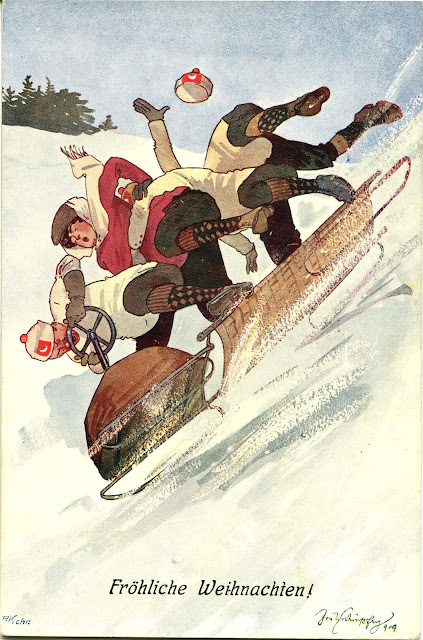
Risking a tumble in a bobsled like the quartet in this next postcard is part of the thrill of going fast. But I'm not sure what it has to do with wishing someone Fröhliche Weihnachten! ~ Happy Christmas! Some things are best left lost in translation. 
 
This card was never mailed, but Schönpflug's distinctive crazy signature has (1)909 at the end. 


* * *


No matter the vehicle or sport, drinking and driving are never a good idea. But that rule doesn't seem to apply it you are just a passenger like the backseat rider on this two-man bobsled. The poor hapless driver, on the other hand, may need a drink when the two finally get down the slope.  

I can't work out where the card was sent from, as the postmark ROTTACH-E doesn't match any modern or old German place name, but it was posted to Berlin on 26 November 1908. I think the writer's language is French.


I first added Fritz Schönpflug's postcards to my collection because of his lighthearted depiction of Viennese musicians. But I've since acquired many more because, unlike the photographers of his time, his artist's eye could capture color, movement, and other peculiarities of the people of his time. Though he continued painting into the 1930s, the best of Schönpflug's postcards preserve a unique record of Austrian society just before the collapse of the Hapsburg royal dynasty in 1918. 
 
Click the following link to see more of my Schönpflug collection.


To demonstrate the thrill of bobsled speed,
here is a 1932 video
from the British Pathé archives.
 
It's entitled:
"America. The Sport ... Dangerous! 
Germany's crack Bobsled Team crashes at 65 mph
during tryout for Olympic Games."


This is my contribution to Sepia Saturday
where winter in a city park
can be fun too.


nolitbx

  © Blogger template Shush by Ourblogtemplates.com 2009

Back to TOP