This is a blog about music, photography, history, and culture.
These are photographs from my collection that tell a story about lost time and forgotten music.

Mike Brubaker
{ Click on the image to expand the photo }
Showing posts with label saxophone. Show all posts

Where the Deer and the Saxophones Play

17 May 2025

 
In any photo of a line of people
most photographers like to put them in order,
typically arranging everyone short to tall.
The same thing applies
to musical instruments
which 
come in different sizes. 

For example,
in a photo of saxophones
one would start the line
with the cute little soprano sax
followed by its larger sister/brother the alto.


Then comes the tenor saxophones
a 
bigger if overbearing sibling,
that likes to hang out with its own kind.


And then finally at the other end
there is the sturdy baritone sax
and its uncommon partner
the massive bass saxophone.


This lineup of ten saxophonists appear on a large format black & white photo, 9" x 8", neatly mounted on grey cardstock. The nine men and one woman are dressed in a kind of nautical uniform of white shoes and trousers (skirt), darkish suit jacket, maybe blue, and white peaked hats. Even though they are standing literally shoulder to shoulder their line is longer that the backdrop  in the photographer's studio.  

There are no annotations on the photo but in the lower corner there is a printed caption:

MᶜMurray's Saxophone Band
MᶜPherson – Kan(sas)


It did not take long to find them in the 21 August 1914 edition of the McPherson Weekly Republican. The report had the same photograph and included all the names of the musicians. 


McPherson KS Weekly Republican
21 August 1914

McMurray's Saxophone Band
(left to right)
F. R. Hapgood, bb-flat bass; R. C. Wright, e-flat bass (baritone); L. C. Hubbell, b-flat tenor; Mrs. L. D. McMurray, b-flat tenor; J. L. Galle, b-flat tenor; A. Robertson, b-flat tenor; C. R. Hapgood, e-flat alto; L. D. McMurray, Jr., e-flat alto; C. R. Bomberger, b-flat soprano; L. D. McMurray, b-flat soprano. 

This organization is undertaking to do big things musically.  They are preparing themselves for Chautauqua, Lyceum and Vaudeville work.  They have played once each week at  the Airdome or Cozy theater since March 1st, this year, giving a new and varied program each time.  Their reportoire (sic) is quite extensive.  This organization is very unique and pleasing to listen to.  They specialize on straight military band arrangements adapting the Saxophones to the various parts.  Mr. L. D. McMurray, the manager and conductor, has just closed a contract for two days playing in Salina in September and the organization is being much sought after at other places.


McPherson is a small city in central Kansas with a current population just shy of 14,000. It's located about 55 miles northwest of Wichita and 200 miles west of Kansas City, Kansas/Missouri. In 1914 when this photograph of McMurray's Saxophone Band was taken McPherson was a thriving community of around 4,000 residents due partly to its railway connections to all points east/west and north/south. It was also the county seat and could boast of several hotels, banks, a private college, and a new public high school. 

Like many small western towns in this era McPherson also had a "opera house", an impressive  three-story civic theater with ornate brickwork that hosted traveling theatrical shows as well as local concerts of McPherson's town band and civic orchestra. There were also two smaller theatres—the Cozy and the Airdrome—which featured motion pictures and live performances of local talent like McMurray's Saxophone Band.  
  

McPherson KS Daily Republican
23 March 1914


On 23 March 1914 the Cozy Theater advertised a program headlined by the McMurray Saxophone Band followed by a two reel drama "Justice of the Wild" and a comedy "His Pal's Bequest". Tickets cost 5¢ and 10¢. The band's program began with a march "Boston Commandery" by Carter, featuring a Clarionet solo in the trio to an air "Onward Christian Soldier" by A. E. Hapgood. This was followed by a serenade "mingling Harmonies" by Wheeler and another march, by request, "War Easgle" by Berry. The band finished with the "Star Spangled Banner" which in 1914 was not yet officially recognized as our national anthem and usually played only by military bands on ceremonial occasions.


The band's director and lead soprano saxophonist was Leon Dallas McMurray. Born in Washington, Iowa in 1873, Leon moved to McPherson, Kansas in 1885, just a few years after the city was first platted. His father worked there as county clerk and later city postmaster. As a young man Leon was employed as private secretary for the congressman of the Kansas seventh district. When the congressman left office Leon moved back to McPherson where he began working as an assistant to his father at the post office. In 1892 he married Mary Gertrude Bonney and together the couple had two children, a son, Loren Dallas McMurray, born in 1897, and a daughter, Bonnie Dee McMurray, born in 1907. Upon the death of his father in 1910, L. D. McMurray succeeded him as postmaster.  

But Leon's true passion was for music and especially the saxophone. McPherson was a very musical town and Leon played in both McPherson's town band and civic orchestra, often substituting for a cello on tenor sax. Evidently his wife also learned to play saxophone and their son Leon took to it as well. In 1911 the McMurrays began performing around McPherson as a saxophone trio, sometimes including even little Bonnie to make it a quartet. 

But Leon had a bigger dream.


McPherson KS Daily Republican
10 October 1913


In October 1913 local newspapers in McPherson, there were two—one Democrat  and the other Republican, ran reports on McMurray's grand scheme to create a band made entirely of saxophone players. He wanted at least fifteen instruments for his "well proportioned band of this family of instruments...four sopranos, four altos, four tenors, two baritones, one bass and one contra-bass." 

He had already secured six Buffet-Crampton saxophones delivered all the way from Paris, France. The latest one was a "very fine low pitch tenor saxophone, triple silverplated with gold burnished bell." It would be played by Louie Hubbell. The qualifier "low pitch" refers to the way many band instruments in this era were designed for military bands that still tuned to a high pitch of A=452Hz or A=457Hz instead of the now standard low pitch of A=440Hz. A high pitch wind instrument is constructed shorter than one in a low pitch, and therefore will never be able to play in tune with lower pitched instruments. 

McMurray chose to order saxophones from Paris because this was where the saxophone was first invented by Adolph Sax, who was actually from Belgium. There were American-made saxophones but Leon seems to have been a real connoisseur of the saxophone and wanted only the very best. 


_ _ _


The instruments were relatively expensive though it's difficult to measure cost after a century of inflation. In 1904 a set of five saxophones—soprano, alto, tenor, baritone, and contrabass—made by the American band instrument company C. G. Conn in Elkhart, Indiana would have cost about $670 total in a deluxe premium finish. A soprano was priced $30<$85; alto - $55<$115; tenor - $65<$120; baritone - $80<$150; and contrabass - $105<$200 in four different levels of finish. Gold plate cost extra. (Check out this company's history in my story How to Make a Saxophone). So the same instruments made in France, what with tariffs and shipping, must have cost significantly more. An inflation calculator for total value of five saxophones estimates that $670 in 1913 is worth $21,710 in 2025.  And McMurray wanted fifteen! 

For another comparison, in 2025 a set of high quality French saxophones in five sizes might cost somewhere around $58,000. The price for the largest sax, the bass can range from $12,000 to $30,000+. 


McPherson KS Daily Republican
30 January 1914


Most of the players in his band were already accomplished musicians on woodwind instruments, mainly clarinet or clarionet as it was sometimes called. It's unclear if each musician purchased their new saxophone from McMurray or instead rented them from him. But it was a surprisingly large investment in any case. In January 1914 the McPherson Daily Republican reported that McMurray had received another "novel instrument" for his band, an alto clarinet to be played by Art Robertson, a young clarinet player who lived in the little village of Galva 8 miles east of McPherson. This instrument is longer than a regular B-flat clarinet and has an upturned silver bell similar to a saxophone's bell but smaller. It's usually used as an intermediate voice between the B-flat and the bass clarinet in a band and is never played in orchestras. 

The report noted a worrying delayed delivery of the bass saxophone which was ordered by Frank Hopgood. When it arrived the band would start full rehearsals. The paper also helpfully noted the names of all the musicians with most of their forenames too. Only one name, A. E. Hapgood, clarionet, was not present in the photo of the band, possibly because his instrument would have stood out in the lineup and contradicted the notion of a all-saxophone band. 

Another member of the Hapgood family, Clarence Hapgood, was listed with an alto sax and an oboe, a double reed instrument that was most uncommon to find in bands of this era. One musician, Clifford Bomberger, who in the lineup holds a soprano sax, second from right, is listed here as playing a Melody saxophone,  an intermediate saxophone pitched in C, one whole-tone above the B-flat tenor. Clearly McMurray's Saxophone Band had musicians who were proficient at doubling on other instruments.  

McMurray made his own arrangements for the group. The range of a full saxophone section covers all the notes of a full orchestra or band. He likely borrowed music scores for military bands, church hymns, popular songs, and even some ragtime hits.  

_ _ _


It's rare for me to get a definitive contemporary confirmation of the names of people in a photograph. So I feel obliged to offer their names again in the order (left to right) of this photo.

  • F. R. Hapgood, bb-flat bass was Frank R. Hapgood. Born in Kansas in 1876, he was a laundryman (also fireman. i.e. boiler stoker) at the steam laundry owned by his brother.
  • R. C. Wright, e-flat bass (baritone) was Ralph C. Wright. Born in Illinois in 1876, he was a merchant for a harness store.
  • L. C. Hubbell, b-flat tenor was Louie C. Hubbell. Born in Kansas in 1892, he was a salesman at a drugstore.
  • Mrs. L. D. McMurray, b-flat tenor was Mary Gertrude McMurray. Born in Kansas in 1873, Mary could provide no information on her parent's birthplace. 
  • J. L. Galle, b-flat tenor was  James L. Galle. Born in Kansas in 1894, he was the son of lawyer and later by 1930 became a lawyer himself.
  • A. Robertson, b-flat tenor was Arthur Chester Robertson. Born in Kansas in 1884, he was a farm laborer who lived in Galva, a village east of McPherson. Arthur died in December 1916 after being accidently struck by a tree he was cutting down.
  • C. R. Hapgood, e-flat alto was Clarence E. Hapgood. Born in 1895 he was the son of an owner of a laundry. By 1920 he was working as a mail carrier. There were a number of accomplished musicians in the Hapgood family as its patriarch was leader of McPherson's town band. 
  • L. D. McMurray, Jr., e-flat alto was Loren Dallas McMurray. Born in Kansas in 1897, in the 1910 census he listed his occupation as "agent, music" though he was only twelve years old.
  • C. R. Bomberger, b-flat soprano was Clifford R. Bomberger. Born in Kansas in 1888, he was a mail carrier.  
  • L. D. McMurray, b-flat soprano was Leon Dallas McMurray. Born in Iowa in 1873, the the 1900 U.S. census he listed his occupation as "clerk, Post Office" and in 1910 as "Assistant Postmaster".


Leon McMurray's position as postmaster in McPherson, an appointment then made by the President of the United States, expired in 1914. After 17 years in federal service he needed to find a new occupation. He took over the operation of a Marble and Granite company producing  memorial gravestones and markers for buildings. 


McPherson KS Weekly Republican
29 January 1915

I don't know whether Leon chiseled out the stonework himself, but evidently it still provided him time to devote to his saxophone band. Newspaper reports of the band were ambitious with planned bookings at a Chautauqua event, a May Day fair, as well as their regular performances at McPherson's movie theaters.

But that spring, Leon became seriously ill and was reported as suffering from some undisclosed ailment and being bedridden. On Thursday morning, 20 May 1915, Leon Dallas McMurray died at his home. According to his obituary, which was published that same day, he had been laid up for almost two months. He was "41 years, 7 months, and 25 days old". 


McPherson KS Daily Republican
20 May 1914


I include Leon McMurray's obituary here partly because it outlines his life much better than I can do. But it also shows how in earlier times a newspaper functioned as the main social media for a community. When I checked out the McMurray family in the 1900 census records I noticed that their next door neighbor then was William Krehbiel, the editor of the McPherson Daily Republican. This surely accounts for the generous reporting on McMurray and the fulsome praise in this final notice. And undoubtedly Leon had many close friends from his work as postmaster, his associations with his church and masonic lodge, and, of course, with the many musical ensembles he played in. 


The saxophone band tried to continue in the months after Leon's death but the effort proved too much without the inspiration of its founder and director. It broke up around 1918, probably as a result of the United States joining the war in Europe. 

Leon's wife, Mary Gertrude McMurray, took over management of Leon's monument company and in July 1915 ran newspaper advertisements with her name as proprietor. However she continued to play saxophone was mentioned as leading a smaller saxophone ensemble in June 1922.

McPherson KS Weekly Republican
30 July 1915


The history of McMurray's Saxophone Band was, like his own life, lamentably too brief. However it represents an experiment in band instrumentation that would soon revolutionize music. The sound of a full saxophone section covers an enormous range and produces many musical colors from sweet and soulful to loud and brash. In the 1900s composers of serious music for both bands and orchestras had mostly ignored the saxophone and were only beginning to understand its great potential. One reason for its new popularity was because more musicians like Leon McMurray were demonstrating a passion for the saxophone sound.    

Beginning in about this same time before World War One, many saxophone ensembles were performing on the vaudeville circuit. I've featured several of them in my stories on this blog. Check out these: 
             The Darling Saxophone Four
                 Bicycles and Saxophones, The Elliott~Savonas Troupe
                     Sax Appeal
                        Send in the Clowns!
                             The Novelty Musical Artists


I've also written many stories about photos of family bands in my collection. This kind of semi-professional ensemble has always been a popular idea for a musically skilled father or, less often, a mother, to form a "band" or "orchestra" from their children at hand. It was a kind of entrepreneurial notion that involved both a love of music and of family. But time forces a special limitation on these ensembles as children don't stay young forever and inevitably grow-up and chose their own direction in life. Whether Leon McMurray ever wanted to produce a professional family band is unknown but he surely had the opportunity with both his wife and son taking up the saxophone. What he would tragically never learn is that his son did choose to make his career in music. And he did it in a new form of music that was very suited for the saxophone.  Jazz!


Loren McMurray was recognized as a real talent while his father was alive and he was still a student in McPherson schools. In 1917 he left McPherson for Kansas City, Missouri (the larger metropolis of the two Kansas Cities) and joined Eddie Kuhn's band, what might be called a society orchestra. Loren got married in April 1920 and moved to New York City where he found work as a session player in numerous pop bands that were recording music for the new post-war dance craze. He became the lead saxophonist in Paul Whiteman's first "jazz" orchestra and was considered one of the most talented young saxophonists in New York.

But in the fall of 1922, Loren was suddenly stricken with tonsilitis, once a very dangerous condition. Despite medical efforts, Loren Dallas McMurray died on 29 October 1922. He was 25 years old.  

McPherson KS Daily Republican
30 October 1922


I've included Loren McMurray's obituary, published in the McPherson Daily Republican the very next day after his death, because, despite the tragic loss of a young promising talent, it demonstrates how music evolves. Loren was part of a new 20th century age of syncopated jazz. His father was part of an older 19th century age of military marches. The notes and rhythms may have been different but the love of making music was the same. I wish we could have heard father and son play together. Leon would have been very proud of his son.

But amazingly we can still hear Loren play!


To conclude, here is a recording
performed by Bailey's Lucky Seven
the studio band at Gennett Recording Laboratories,
located on East 37th Street in New York City.
It was recorded on 29 May 1922.

 The alto saxophonist was Loren McMurray.


That was so good, let's have an encore!

Here is "Toot Toot Tootsie (Goo'by)"
performed by Bailey's Lucky Seven
at the Gennett Recording Laboratories,
on East 37th Street in New York City.
 The alto saxophonist is again Loren McMurray.


The recording was made on 5 October 1922.

Loren McMurray died two weeks later.


[ For more information on Loren McMurray,
check out the GRAMMY Nominated album
 “The Moaninest Moan of Them All,”
available from Archeophone Records. ]


And if you are wondering
what an all-saxophone band
might sound like,
here is an excerpt of Gershwin's
"An American in Paris"
played by the Mi-Bémol Saxophone Ensemble of Japan. 
They wear some pretty sharp uniforms too.
Check out the bass sax on the back right.


This is my contribution to Sepia Saturday
where everyone gets to be
at the front of the line.


Double the Fun with the Beverly Twins' Orchestra

27 April 2024

 
To the Hannon Twins
Dorothy & Margaret
cute
identical
smart
shapely
18
not conceited
swell

W. B.
S. B.

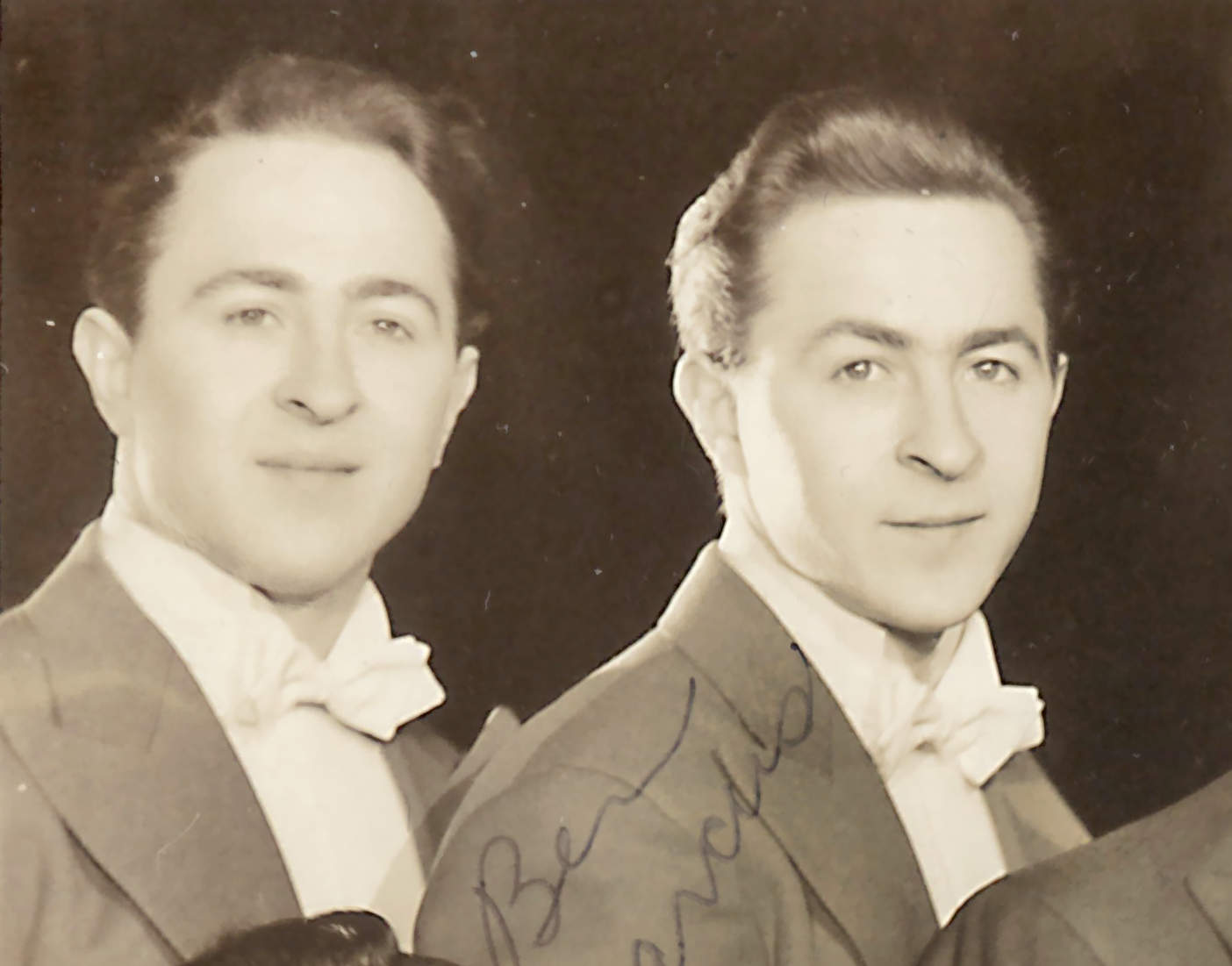
I don't usually collect this type of photograph. The two young saxophonists have beautifully engraved instruments, alto and tenor saxes made by the C. G. Conn Company. They are quite debonair young men with wild wavy hair. But it's still a common 8" x 10" glossy photo that was usually reproduced by the thousands to promote a pop star. Their name printed on the bottom border was unfamiliar. At a casual glance they looked like a pair of sidemen for a big band that probably no one ever heard of.  

But then I spotted their inscription and signatures to Dorothy and Margaret. That attracted my attention and made me curious about their band. These guys certainly looked like identical brothers. What was that all about?


Then I found this next photograph from the same dealer.
Walter and Sol were in it but without their instrument.
They had signed this photo, too,
along with nearly everyone else.
That gave the photos a unique quality
worthy of my collection.

Today I'm going to tell the story 
of Walter and Sol Brudno
featured in
The Beverly Twins and the All Twin Orchestra.


Both photos have the official logo for the band's management agency, MCA – Music Corporation of America. Founded in 1924 as a booking agency by Jules Stein and William R. Goodheart, Jr., by the end of the 1930s this company was the largest talent agency in the world. In addition to musical artists, it represented hundreds of celebrities working on Broadway, in Hollywood, and on radio. From its early years MCA quickly developed an aggressive business model that bought out the competition and expanded into so many other areas of the entertainment industry that it earned a nickname "The Octopus". Today its successor company is Universal Pictures now known as Comcast NBCUniversal. 

But back in the 1930s and 40s the biggest live acts in America were dance bands playing swing  jazz and MCA promoted dozens of big bands, or "orchestras" as they were often called, like those of Xavier Cugat, Gene Krupa, Tommy Dorsey and Kay Kyser. These two photographs were taken at the studio of James J. Kriegsmann (1909–1994), in his day one of the foremost photographers of entertainers in New York City. Photos like his don't come cheap. Someone at the MCA agency thought this unusual ensemble merited a serious investment.   

In February 1941 MCA made a contract to book dates for the Beverly Twin's All Twins Orchestra. Their first major venue was in New York City at the Arcadia "million dollar ballroom" on Broadway and 53rd Street. Entrance was 55¢ for ladies and 65¢ for gentlemen, no extra charge for dancing. And as a special attraction for this band, "All twins admitted free before 9 P. M."


New York City Daily News
26 March 1941

As the MCA publicity machine went to work, the Beverly Twins Orchestra's appearance in New York was reported in newspapers all across the country. Among many hooks that followed the twin concept was their theme song cover of "Exactly Like You" a song from the 1930 Broadway show Lew Leslie's International Revue with music by Jimmy McHugh and lyrics by Dorothy Fields. 

This tune remains a dance band standard and has been recorded many times by different artists, even as recently as 2021. Here's a version recorded in New York on 26 March 1937 for Decca Records and played by the Count Basie Orchestra with Count Basie on piano and Jimmy Rushing doing the vocals. The video has no film or pictures, so press play for some music to listen to as you continue reading the story. 


The Arcadia Ballroom in New York City doesn't seem to have any history online that I could find, so its timeline is unknown. It seems to have opened in the 1920s and was still in operation in the 1950s, but other than that I can't offer much more. It was located right in the heart of Broadway's theater district and is now the site of the Broadway Theatre and just a short walk from the Ed Sullivan Theater. 

But I did find this colorful vintage postcard of the Arcadia ballroom interior which gives an idea of how a band would set up. The description on the back notes that it is "the most spacious dance floor in all New York ... is not obstructed by pillars or posts; air conditioned; new scientific ventilating system assures purity of air at all times."   "Matinee Dansants (sic) Sunday, Wednesday, Saturday, and Holidays."

The postcard was sent on 8 November 1941 by a soldier from Fort Bragg, North Carolina to Miss Edith Butti of Woodside, Long Island.


 Hello Edith                             
 Guess you heard I'm
on maneuvers.  It's a nice place
for beauty.  Hope your feeling fine.
Regards to all.   Harry —       
May be home in a      
month.  

One month latter, America was at war,
so it was probably some time before Harry made it back home. 


The Billboard
19 April 1941

In April 1941 the Beverly Twins' performance at the Arcadia got reviewed in The Billboard, the national magazine for the entertainment industry. The writer uses a lot of showbiz lingo but gives the group a favorable critique noting that: 

    "Twins tootle a very commercial and danceable brand of stuff, and strive to please with a versatile library consisting of can-can congas, pop ballads, swinger-dingers, and waltzes.  Entire ork plays with youthful enthusiasm.  Arrangements, for the most part, are good; and the doubling of two of the sax men on brass, plus another switch of a brass man on sax, gives added flexibility.  At this point, band does its best job on the swing stuff, but some more months together will no doubt round them out.
    "Song department is handled solely by the Beverlys, whose voices are as much alike as their looks.  They do a good straight job on the vocal choruses.  Boys should loosen up more on their dual batoneering to dispel automaton-like impression. Biz of dressing the sets of twins in various colored jackets is smart showmanship, and the same motif is also carried out with the music stands, each bearing the respective color scheme plus the first name of each.  Exploitation possibilities, of course are infinite with an outfit such as this.
    "It's a co-op outfit thruout, each set of look-alikes having a hunk of the ork. Line-up includes, besides the Beverlys, Myron and Harry Robbins on trumpet and trombone;  Russ and Bill Whalen, trumpet and trombone;  Jim and Joe McCarthy, saxes;  Walter and Sol Brudno, saxes;  Rodger and Rodney Harmon, bass and guitar;  and Ben and Sol Marcus, piano and drums."

That last paragraph with the musicians' names was the kind of treasure I often seek but rarely find when doing research on photos in my collection. In this case it corroborated the signatures on the band's photo and, more importantly, identified each man's instrument which was absent in the formal studio photograph of the group.


The Beverly Twins, seated center, Don on the left and Gene on the right, were the duo co-leaders of the All Twins Orchestra band which they themselves originated. According to several reports their idea for a band of twin musicians came about as early as 1934, after they had dropped a notion of becoming Catholic priests. After searching the country for seven years they had supposedly hired the best musical twin brothers for this unique ensemble. 

Jacksonville FL Times-Union
28 June 1941

Gene and Don were identical twins who had won first prize at a New Jersey contest for "most identical twin." They oviously had musical talent but not as instrumentalists. In their orchestra/band they performed as either conductor or as a vocalist and hired a non-twin musician to make their arrangements.

The two Beverlys shared a mutual receding hairline and look older than they actually were. Their birthday was 25 June 1915, so in the winter 1940-41 when they secured a contract with MCA they were only age 25. 

Tracking down that "most identical twin" contest was not too difficult and paid off with a very thorough newspaper report and some photos too. The contest was held on 17 June 1939 in Camden, New Jersey, just across the Delaware River from Philadelphia, by the Camden Courier-Post newspaper. The Beverlys, the two young men "most alike", won a $25 prize and were pictured with a brother-sister duo, Leroy and Dorothy Garmen, who took home a prize for the "least alike twins."


Camden NJ Evening Courier
18 June 1939

The report revealed a lot about the ambitions of the Beverly Twins. Four years earlier they had  formed a band of seven twins, including themselves, but circumstances had forced them to break up the group. They had given up becoming priests and now hoped one day to marry twin sisters. Their latest dream was to get their pilots licenses, buy an airplane, and fly across the Atlantic,  becoming the first twins, if not brothers, to do so. 

But more revealing, but not explained, was that their surname was originally Barcik, not Beverly. They were "the sons of Mr. and Mrs. Andrew Barcik...born in Camden June 25, 1915." Using these very useful clues I determined that their first names, Don and Gene, were not original either. One brother was Andrew Method Barcik and the other Frank Cyrill Barcik. The twins were the youngest of six children of Andrew and Sophie Barcik, who immigrated in 1904 and 1903 respectively from  what was called Czechoslovakia in the 1930 Census. Both spoke Slovak as their native language. Around their home in N. Fourth St. their neighbors spoke German, Romanian, Russian, Polish, and Slovak. Andrew Senior worked as a freight loader at a railroad yard. 

In the 1940 Census the family had moved to Marsden St. in Philadelphia to live with a daughter and her husband. Andrew Senior and his twin sons worked at a butcher shop. However on their draft card, completed in October 1940, both Frank and Andrew Junior put down "Self" for employer .

The Beverly/Barcik brothers claimed to have written some songs and clearly had talent as singers, but no report described them as instrumentalists. How they learned to be suave band leaders in white tie and tails after laboring at a butcher shop was never explained. And I've been unable to discover why they changed their names. Sometimes ambition alone can make its own luck.  


The two saxophonists with the amazing wavy hair, Walter and Sol Brudno, stand on the right in the group photo with their autographs written across their light color tailcoats. They were born on 22 January 1921 in Cleveland, Ohio, so in this photo they are age 20. They were the twin sons of Phillip and Lillian Brudno, both identified as Russian-Jewish immigrants in the 1930 Census. Phillip listed his occupation as an egg dealer. On their draft cards completed in February 1942, both brothers listed no middle name and gave their father's name as their employer.


Standing to the left of the Brudno twins, was Rodney and Roger Harmon, who played bass and guitar in the All-Twin Orchestra. They were from Cincinnati, Ohio where they were born on 21 July 1918 to  Frank and Clara Harmon. In the 1930 census Frank worked as a mail clerk for a railroad and he and his wife also had a daughter and son older than their twins. But like the Beverly/Barcik twins, the Harmon twins had an alternative name. According to their draft cards, completed in October 1941, Rodney was actually Alfred Earl Harmon and his brother was Rodger Clark Harmon. 


The fourth set of twins, seated right in the photo was Russell and Bill Whalen, who played trumpet and trombone. They were from Superior, Wisconsin where they were born on 18 March 1920. They were the sons of Edna and George W. Whalen. George worked as an electrician in Superior, which is located on Lake Superior across the St Louis River from Duluth, Minnesota.   


The Whalen brothers filled out their draft card on 1 July 1941, earlier than the other men, and the form is different with a box for occupation. Both Russell August Whalen and his brother William Robert Whalen listed their occupation as Musician and their employer as The Beverly Twins or Gene and Don Beverly, Music Corp. of America. 


Lowell MA Sun
18 April 1941

On the day of the Beverly Twins' All-Twin Orchestra photo shoot, Mr. Kriegsmann's studio must stayed pretty busy sorting out the pairs of musicians. In April 1941 the newspaper in Lowell, Massachusetts ran a variation of their group photo. The band's formal outfits were colored-coded, of course, though unfortunately Kriegsmann's camera only recorded sepia tones. Having some of the twins sign their names on the photo was very helpful as otherwise I might never have figured out who was who. The Billboard review proved crucial in making certain I got all their identities straight. However some names still remain hidden.


Seated left of the Beverly twins is Harry and Myron Robbins, who filled out the brass section on trombone and trumpet respectively. In the photo only Myron Robbins signed his name and his brother Harry on the far left did not. My investigation on their names hit the most common obstacle in family research: too many people who share the same name. I tried several methods in both civil records and in newspaper archives and still failed to find a pair of brothers who fit. My best hope was a survey of WW2 draft cards which include date of birth, but none of the dozens of Myrons and Harrys shared the same birthday. Nonetheless I still hope to track them down.


On the back left are Sol and Ben Marcus, part of the rhythm section with Ben on piano and Sol on drums. Only Ben signed his name. Like the Robbins twins, the Marcus twins turned out to have too many duplicates in the archives and I've been unable to properly identify them. Without clues for their hometown or family background they remain partly concealed with a name only. 

The Beverly twins were reported to be active in the International Twins Association. This organization was established by and for twins in 1932 as a way to promote the spiritual, intellectual, and social welfare of twins and multiples throughout the world. I suspect Don/Andrew Gene/Frank used their connection in this social organization to recruit musicians for their orchestra. It's quite likely that none of the twins knew anyone else when they started their first rehearsal. 


Standing left of center are twins who did not add their autographs to the photo. By the process of elimination, they must be Jim and Joe McCarthy, the other two saxophone players in the band. Their names are arguably two of the most common names in America and I didn't expect I would  be able to track them down. But I discovered a photo of the Beverly Twins Orchestra on Flickr that had comments from descendants of both the Harmon twins and the McCarthy twins. One relation wrote that the McCarthy's were from Des Moines, Iowa. That was all I needed.


James Anthony McCarthy and Joseph Thomas McCarthy were born in Des Moines on 2 January 1917. When they registered for the draft in October 1940 they both listed the "Beverly Twins" as their employer located at the same Marsden St. address in Philadelphia which Andrew and Frank Barcik  listed as their home. Both cards for the McCarthy twins also had a penciled address added on 8/5/1941 of the "Hotel Roosevelt, Jacksonville, Florida."  

The dates suggest that the Beverly twins were working on their idea of this new all-twin band at least from the fall of 1940, maybe earlier. Putting together a band of any kind, much less one restricted to identical twins, requires careful recruitment to get good talent. Don and Gene must have traveled a lot to audition all these musicians and probably even more for those that didn't measure up.


Jacksonville FL Times-Union
18 August 1941

After the Beverly Twins Orchestra had played New York for a few weeks and polished up their  show they were sent out on concert tour. The MCA agency booked them in dancehall parks in Dayton, Ohio; Hershey, Pennsylvania; Patterson, New Jersey and possibly a few other smaller venues in between. By July 1941 they were on the bill of the Hotel Roosevelt in Jacksonville, Florida. Written on the back of both my photos of the All-Twin Orchestra and the Brudno brothers is "1941 Roosevelt Hotel."

Originally named the Carling Hotel, this 13 story deluxe hotel opened in 1926 and was described as: "300 rooms with bath, running ice water, fans and the latest equipment in the rooms. The three lower stories are faced with Indiana limestone above which is a shaft of red brick. The upper stories are trimmed with terra-cotta, and surmounted by a balustrade with limestone coping. The building is of completely fireproof construction." That last claim would get challenged a few decades later. 

In 1936 the name was changed to Hotel Roosevelt and it became a popular lodging with visitors to Jacksonville which was then the principal gateway to Florida's resorts. No doubt the Beverly Twins Orchestra traveled there by train as did most people in the decades before the interstate roadways were built in the 1960s. However playing a concert in Jacksonville in July was literally a hot date, as in this era it was the mild winters without snow that brought northern tourists to Florida, not the sweltering summer sunshine.  Fortunately the Hotel Roosevelt dance patio was indoors with air conditioning. 


Jacksonville FL Times-Union
9 July 1941

The Beverly Twins really pushed the novelty of their all-twins orchestra. One of the reasons each pair wore formal suits in same color was that during their show each twin would switch instruments making the audience guess who was who. In New York, and probably for other shows, admission was advertised as free for twins. During their two weeks at the Arcadia ballroom it was reported that 350 sets of twins came to see them play. And in Jacksonville they added a Twin Contest, open to all. This was the event that the Hannon twins, Dorothy and Margaret entered when they caught the eye of the Brudno brothers. 


Jacksonville FL Times-Union
11 July 1941

I couldn't find a report of who won the contest for most identical twin, but judging from the Hannon twins' graduation picture in the Jacksonville newspaper they look hard to beat. I wonder if Dorothy and Margaret wore their caps and gowns for the contest. Even in the grainy scan the sisters have winning smiles. 


Providence RI Evening Bulletin
12 August 1941

In August 1941, the Beverly Twins Orchestra got a big break when they were invited to play on a popular Sunday evening radio show, The Bandwagon, over NBC Radio's Red Network. The location of their half-hour concert is not clear, but I think it's possible it was picked up from the Hotel Roosevelt in Jacksonville. For Don and Gene Beverly this must have been a fantastic prize, bigger even than winning a "most identical twin" contest. 

But their showbiz success was marred by a new concern which was affecting every young man in America in the summer of 1941. It was the military draft. This law, the Selective Training and Service Act, signed by President Roosevelt on September 16, 1940, started the first peacetime conscription in the history of the United States. It required all men between 21 and 35 to register with the Selective Service System. After the German army had defeated French and British forces in Hitler's invasion of France in the summer of 1940, America was reluctantly realizing that it would soon need to join the war against European fascism. In August 1941 many men were already being called up for basic training. This was an obligation of 12 months military service, which by October was to be extended by another 18 months. 

The Beverly brothers believed their band faced a very difficult hardship should one or more of their musicians, including themselves, be called up. Replacing twins was not easy. They decided to apply for a deferment for the band, and it seems from the publicity that they were supported by the MCA agency. This concern was shared by many groups in the entertainment industry, from orchestras to circuses, who recognized that their acts would be in serious jeopardy if they lost team members with special talents and skills.  

Whether the Beverlys were ever granted a deferment was not reported in the newspapers, and by December 7th, 1941 with the Japanese attack on Pearl Harbor, Americans suddenly had far more important things to think about. The All-Twins Orchestra seems to have played their last show in early September 1941 and then disbanded. In the 31 January 1942 edition of Billboard magazine it was noted that many dance bands like that of the Dorsey brothers (not twins) were losing their sidemen. "The Beverly Twins' orchestra, composed of seven sets of twins, has already been wrecked, with seven of the 14 now in the armed forces." Even band leaders were close to being called up. 

By the winter of 1941-42, all the twins returned to their hometowns, scattered around the country. Most, if not all, (since I don't know the full history for two of the seven twins) would enter military service for the duration of the war. Again I am not certain, but I believe, that all of the men completed their duty without harm and with an honorable discharge. Whether any of them pursued a music career after 1945 is unknown. I do know that the Beverly/Barcik brothers returned to their original names and chose different paths in life. I don't think they ever got to fly an airplane across the Atlantic Ocean. But for a few months in 1941 they and six other talented twin brothers got to have double the fun playing music. 


One of the consequences of the war for America's entertainment industry was the dramatic change in the public's taste for popular music. Dance bands like the Beverly Twins' Orchestra did not disappear entirely after 1945 but swing music now competed with a much wider variety of music styles that included jazz, blues, western, country, and soon rock & roll. The competition for the public's ear was fierce, and was now largely driven by Americans listening to music through recordings and radio broadcasts instead of at live concerts. When a radio broadcast allowed young people in Nebraska to hear the latest club music from New York, Chicago, or Los Angeles just by turning a dial of their radio set, their enthusiasm for live music naturally was diminished a bit. By the 1950s the novelty of seeing seven sets of twins perform music of the 1930s had worn off. As the music and songs changed everyone began dancing to the beat of a new and different drummer. 


  Footnote:  

On the morning of 29 December 1963 a fire broke out in the Hotel Roosevelt, supposedly a fireproof structure. Some time before, during renovations to the hotel, its ballroom's old wooden ceiling, which had been deemed a fire hazard, was covered with a new ceiling without removing the old one. An electrical fault sparked a fire there which quickly spread through the building. Though many people were rescued, some saved from the rooftop by the use of Navy helicopters, 22 people perished in the fire, mostly from carbon monoxide poisoning. It became the worst disaster in the city of Jacksonville's history. While I can't be certain, I believe the ballroom was the same danceroom where the Beverly Twins' Orchestra played in 1941. 


This is my contribution to Sepia Saturday
where sometimes one pair will beat a full house.


nolitbx

  © Blogger template Shush by Ourblogtemplates.com 2009

Back to TOP