This is a blog about music, photography, history, and culture.
These are photographs from my collection that tell a story about lost time and forgotten music.

Mike Brubaker
{ Click on the image to expand the photo }
Showing posts with label drum. Show all posts

Four Portraits of Drummers

15 August 2026


A bass drum is the heartbeat of any musical ensemble. In a military band its beat sets the stride cadence for marching soldiers. In a pop band its thumping accents mark the step turns for dancers. In an orchestra it thunders at every crescendo and always strikes the last wallop in a finale. It's an essential instrument for a wide variety of rhythmic music but it's often underappreciated for how it synchronizes the pulse of an ensemble's musicians. 

This bass drummer certainly knew his worth as he wrote a note on his postcard photo. 

Let this do Your Drumming  

He is a young man, late teens or early twenties, dressed in dark trousers, a bright white uniform jacket with white bowtie, and a white hat with his band's name — ELLINGTON. He is actually holding two instruments—a bass drum and a set of cymbals. His drum uses old-fashioned rope tensioning for the heads. Bits of leather called ears tighten the rope loops to make the heads taunt for a ringing thud. One cymbal is attached to the drum shell while the other is held in the drummer's left hand. It's a traditional coupling for a percussionist which lets the bass drum sound strong beats while cymbals mark weaker afterbeats as in BOOM-pah, BOOM-pah, BOOM-pah, etc. And so he doesn't lose count there is a music lyre attached to the top of the drum to hold his part.

Unfortunately his postcard is not marked and I can only guess that it was taken in the United States sometime around 1906-1916. There are eight towns named Ellington in the U.S. and it's likely that each one had a band in the early 20th century. And of course the band might be named for its band leader, too. However I don't think Duke Ellington's band, which was formed a few decades later, every did much marching. 


* * *


My second drummer stands in front of a photographer's studio backdrop, a painted scene of a bucolic landscape. At his waist hangs a snare drum which has threaded rod tensioners and possibly a metal shell. The drum is tilted so that his drumsticks are positioned in a characteristic grip that puts more power to the dominant right hand. Notice that he has his music held in a lyre which is pinned to his coat. This man looks to be in his late twenties or thirties. He wears a bandsman's uniform and kepi hat in a dark color, typical of those worn by bands in the late 19th century. His long twisty mustache likely dates him to the 1890s. 

This cabinet card photograph was taken at the Photographic Art Studio of C. Numa in Halstein, Iowa. At sometime in the distant past the photo was mounted on a wall as it has four holes punched through the cardstock.  

Halstein is situated in west central Iowa about 46 miles east of Sioux City. In 1890, on its first census, it had just 539 inhabitants. A decade later in 1900 it could boast of a 61.4% increase to 870. Its current population is about 1,500.   


* * *


My third percussionist is a cymbals player, technically not a drum, but still a vital part of a drum section. The flashy clash of brass cymbals has always been an important sound color in music dating back to the ancient cultures of China, Egypt, and India. European music adopted cymbals from the Ottoman Empire's Janissary military bands. In the late 18th century both Wolfgang Amadeus Mozart and Joseph Haydn used cymbals to add an exotic Turkish flavor to their music.  

This young man stands in front of another photographer's faux wooded glen but with extra 3-D shrubbery, grass, and stumps to add realism. He keeps a tight grip on his pair of cymbals as the most embarassing moment for any percussionist is to unwittingly initiate an accidental cymbal crash. His bandsman's uniform is similar to the previous drummer but I think it dates from the 1880s. The white belt across his left shoulder is for his music satchel, hidden by his right hand. I don't know that I've ever seen a cymbalist use a music lyre. Maybe they just memorize the score. His kepi hat has large badge that in neat lettering reads Seventh Ward Band,  which relates to a neighborhood section of his hometown of Johnstown, Pennsylvania.

The photo was taken by photographer G. M. Greene of No 127 Franklin Steet, opposite the M. E. Stone Church, in Johnstown, Pennsylvania. Johnstown. His full name was George Miles Greene. Born in 1835 he set up a successful studio in downtown Johnstown which was tragically destroyed in the Great Johnstown Flood of 1889. 

This horrendous catastrophe occurred on Friday, 31 May 1889, after the South Fork Dam, located on the Little Conemaugh River, 14 miles (23 km) upstream of Johnstown, ruptured after several days of extremely heavy rainfall. Over 14.55 million cubic meters of water was suddenly released and the resulting flood killed 2,208 people. The damage cost to the city and environs was estimated at $17 million (equivalent to $536 million in 2024).

Mr. Greene was able to restart his business but in 1894 poor health forced him to sell it. He died the following year at age 65. 

Because of this terrible calamity this photo must date prior to May 1889. It also begs a question, did the young man survive? We can never know but it adds a special back story to the photo.


* * *


My fourth drummer is a handsome young man with arguably the best mustache. He leans against a faux plinth with a dramatic natural scene behind him, not a landscape, I think, but either a seascape or river/lake view. His arms and legs are casually crossed with his shako hat and music satchel placed atop the plinth and his snare drum lying at his feet. He wears a very impressive military style uniform with striped trousers, cutaway jacket, white belt, and fringed epaulets. It very like a state militia/nation guardsman's uniform. On his white music satchel is a name: Chelsea.  

Chelsea is a small city in Washtenaw County, Michigan, about 53 miles west of Detroit, in between Ann Arbor and Jackson, Michigan. In 1880 Chelsea had 1,160 residents and in 140+ years its population has grown to around 5,500. 

The photographer was E. E. Shaver of Chelsea whose cardstock back has an nice illustration of a camera and artist's palette illuminated by the sun. Just above is a wonderful clear note with names and a date. 


Mr. G. A. Lacey
Original member of the
Excelsior Cornet Band
organzed (sic) Feb. 19 - 1878
Presented by Lillie Wackenhut


The snare drummer was George A. Lacey. In the 1880 U. S. census for Chelsea village he was listed, age 29, next to his wife, Phebe Lacey, age 27, with no children. George's occupation was "Watch Tinker", i.e. watch repairer. Unfortunately I was unable to find any more references to him in any official records or newspapers. So he will remain lost in time.

The photographer was Ernest Ebenizer Shaver. He was also listed in Chelsea's 1880 census, at age 30 living with his wife, Martha Shaver, age 22, but without children. Ernest's occupation was "Deguerian (sic) Artist."  According to another short history on Chelsea, Ernest Shaver, like George Lacey, was also a founding member of Chelsea's Excelsior Cornet Band. I found just one reference to the band in an 1881 report about a county band contest where it won 2nd prize. It was described as having just 13 musicians. In other reports it played for local dances and patriotic events but does not seem to have lasted more than a decade. Shaver died in 1917.

 Lillie Wackenhut was also in the 1880 census. She was the youngest of two daughters of George and Martha Wackenhut. Her older sister Letta was 3 and Lillie was just 1 year of age. George Wackenhut was 29 and worked as a "Clerk in Store". Since he was the same age as George, I suspect they both played together with Ernest in the Excelsior Cornet Band. I'd bet anything that Ernest made portraits of all the band's members, too, especially as I think George Lacey is posing in a splendid new uniform. 

The bottom phrase in the annotation: "Presented by Lillie Wackenhut" sounds to me like it was a gift from Lillie, and not to Lillie, especially as she was not yet born when the Excelsior Cornet Band was established. I suspect that when she was much older she gave this photo to someone or some historical society as a memento of Chelsea's cultural history. I also think it's possible that she had copies of the other portraits of the band's members and may have donated them too. Lillie May Wackenhut died in 1965 at age 86 and is buried with her parents in a cemetery in Chelsea, Michigan. I could not find any information that she ever married or had children. 


***


Nearly every antique photograph in my collection of a band has drummers. A band's name was often stenciled onto the head of a bass drum which serves to identify the band and its location. Bass drums, snare drums and cymbals are not complicated instruments and, of course, never get to play a melody. But to keep a musical group together, drums require a player who has a fine sense of rhythm and impeccable timing. For some inexplicable reason portraits of drummers are surprising rare. I have hundreds of cdv and cabinet photos of individual musicians with their cornet, clarinet, trombone, tuba, violin, cello, and the like, but hardly any percussion musicians pictured with their drum. The cymbal player from Johnstown is the first one I have acquired like that. I'll keep my eye out for more.      


To finish with some drum noise
here is a short YouTube video
from the Marching.com channel
of the U.S. Marine Drum & Bugle Corps Percussion
playing their warmup drill just before the closing ceremony
of the World Association of Marching Show Bands (WAMSB)
2023 World Championships held in Buckhannon, West Virginia.
It's a good demonstration of how drummers
think differently than other musicians.


Did you know the U.S. military issued cow bells?


And here is another YouTube video
from the Marching.com channel
of the Euroband Rotterdam (Netherlands)
in the 2025 Corso Zundert flower parade.
The cameraman is positioned at the front
of the band as it marches
giving a great viewpoint of the drummers
and the drum major.


This is my contribution to Sepia Saturday
where no one ever keeps score.


Musical Fashions for Women - The Puffy Sleeves Edition

06 December 2025

 
According to sources more knowledgeable than me,
the rise of female shoulders began in 1891,
though dates of fashion trends are never strict. 


The length and shape of garment sleeves
changed, of course, with the seasons,
the locale, and personal taste.
But generally ladies' sleeve fabrics 
began to inflate in the 1890s 


In my photograph collection of female musicians
the size and shape of sleeves
usefully serve to date a photo to a decade
when other clues for a more accurate year are absent.


The fashions of the 1890s were quite changeable 
as younger women began to reject older fashions
like the crinoline dresses of the 1850s and 1860s,
and the bustles of the 1870s and 1880s.
Women were also indulging in new outdoor pursuits
like bicycle riding which required new garments
suitable for a vigorous activity.


In a way music was a similar undertaking
that needed freedom of movement
for arms, hands, and even head.


Today I present five elegant young women,
names unknown,
who posed for the camera
in the puffy sleeve fashion of the 1890s.


My first young lady is a violinist pictured on a cabinet card by Harlow studio of Ware, Massachusetts, a city in central Massachusetts between Springfield and Worcester. Her dress is a dark fabric, not, I think, black, as it seems in this sepia tone print, but perhaps a dark red or navy blue color. It is fastened down her right front with 12 pairs of buttons. Her long sleeves are not too tight at the wrist, something a violinist would find restrictive, and gradually expand to a  sharp peak at her shoulder. Her collar is neatly tied with a wide bow in matching dark color. I'm not certain about her age, as her dress and hair give her a look that may be more mature than her actual years. However she does wear a ring on her left hand, perhaps a wedding band or engagement ring. 


* * *


My second musician is violinist from Butler, Indiana photographed by A. Newman on a "superior finish" cabinet card. This woman's dress is of a lighter summertime color, perhaps white, cream, or a pale yellow. It has short sleeves with a puffy effect, not unlike a footballer's shoulder pads, and framed with a contrasting dark lace trim. Here hair is pulled up into a topknot swirl that was another popular fashion for young women of the mid-1890s. Guessing her age is equally as challenging as with the other violinist. Maybe somewhere between 18 and 25? She has a pleasant smile.


* * *


This young lady is also a violinist but from the Pacific Northwest. Her cabinet photo was taken at the studio of C. Lindahl in the California Bld'g. in Tacoma, Washington. She is seated on an upholstered rococo style bench and wears a light color dress, likely white this time, with voluminous sleeves large enough to hide a few squirrels and a cat or two. There is ornate lacework on the cuffs and collar. She is definitely still in her teens, maybe even just 13 or 14. I like how she has a small heart locket tied around her neck. 


* * *


My next young musician plays the mandolin and the photo studio of Seigel Cooper Co. of Chicago has artfully posed her in a classic wooden armchair as if she is about to sing a song for us. Her dress is also a light color with a subtle small printed floral pattern. It has generous sized sleeves that look partly inflated but without some of the structural engineering used in other puffy sleeve designs. The tuning of a mandolin is the same as a violin but with doubled strings so many violinists also played this instrument. She has rings on fingers of both hands but she looks younger than the previous women, perhaps age 15-19.

On the back of this cabinet card is a large printed illustration that oddly left out any text about the photographer's studio. It shows three cherubs flying in  billowy clouds. One cherb holds two laurel wreaths and the other two have a target with an arrow piercing the heart in the center. Could this be a valentine day gift? 


* * *


My final example of a stylish musician is a rare photo of a female snare drummer. She, too, wears a light color dress, but this looks more white to me than any other color. It complements her hair which seems blonde or perhaps auburn. Her instrument rests on a side table with a pair of drumsticks propped across the drumhead. The photographer is Putnam studio of 198 Broadway in  Chelsea, Massachusetts, part of the Boston metropolitan area. I have several photos of young ladies by this photographer which I believe were all taken when they played in the same all-female orchestra in Boston. Based on the other photos I think this dates to 1897-1899.   


The effect of this 1890s fashion gave the photos of these five young women a statuesque quality of cultivated sophistication. But of course, they were not mannequins,  and during a performance the interaction of arms, torso, and shoulders with their instruments must have given their concerts a spirited animation of sinuous fabric. I regret not having enough understanding of fashion nomenclature to properly describe the material, trim, and craftwork in ladies' garments. But even my unschooled eye can recognize that the fine stitching on these gowns took countless hours of skilled needlework. It can't believe any of these women ever wore off-the-rack clothing. 


For more history on garments of the 19th century I recommend Wikipedia's entries: Victorian fashion which covers British styles, and 1890s in Western fashion. Both links include a lot of example images for both men and women. I also found this history blog, Recollections, very helpful. Click "Victorian Fashions" on its title bar. It was the knowledgeable "source" I referenced at the beginning of this story. 


This is my contribution to Sepia Saturday
where finding a needle is easier than stacking hay.


The Cadet Band of Augusta, Maine

29 January 2022


It's always the drum head.
 
Whenever I first look at a vintage photo of a band
I always check the bass drum
for a place and name of the musical group.
It was such a common advertisement for a band
that it's unusual when it is missing,
which would have been the case
with this particular photograph
except that someone helpfully wrote
the band's name
in big block letters
onto the otherwise blank space of the drum head.
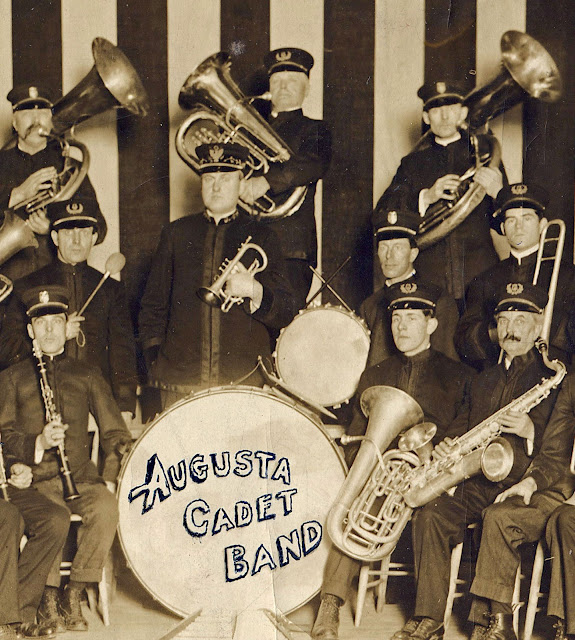
Augusta Cadet Band


There are 15 towns or cities named Augusta scattered around the United States, so a proper identification might have taken longer to discover except that when I purchased this photo it came with a few other photos from a family estate in Augusta, Maine. With this information it was easy to find the band in the Augusta and Kennebec County directories. The director and manager of the Augusta Cadet Band was Frank A. Dennis. He is the man holding a cornet who stands behind the drum.
 
1905 Kennebec County, Maine
Resident and Business Directory

Frank A. Dennis ran an business advertisement for his music store at 233 Water Street in Augusta where he bought, sold, exchanged and rented musical instruments. Besides the Cadet Band, he also directed the Dennis' Orchestra. Both had twenty-five men, which is the count we see in the full photograph.


It's a large 9½ x 7 inch photograph, unmounted on thin photo paper, and marked on the lower left with just the photographer's name, Mansur. Posed on a small indoor stage, the 25 bandsmen are all dressed in modest military cadet uniforms and hats, though two have fancier embroidered tunics. Two men have hat badges that read Augusta, but most are simple music lyres. However Mr. Dennis' hat badge is an eagle with an gold leaf trim, a suitable insignia for a band leader. Other than the name written in ink on the drum, there are no other marks, except for a little eye shadow and lip gloss applied to one clarinetist's face. To judge from their uniforms the photo might have been taken any time from 1900 to 1930, or even 1950.   
 
If only there was a good clue to date the photo.
 
 Surprisingly it is right there
in the good old star and stripes.

 
46 star flag of the United States of America
4 July 1908 – 3 July 1912
Source: Wikimedia


Hanging on the wall behind the Augusta Cadet Band is a large American flag. Though not all of it is visible, there are enough stars showing to see that it is not the pattern of our present day 50 star flag, or the preceding 49 and 48 star flags. It's the 46 star banner issued on 4 July 1908 after the admittance of the state of Oklahoma. It lasted just four years until July 1912 when New Mexico and Arizona joined the union. That puts the photo of the Augusta Cadet Band in a relatively small window of time between 1908 and 1912. My suspicion is that the band was preparing for a concert on Memorial Day, Flag Day (June 14), or the 4th of July.
 
Augusta is the state capital of Maine, situated on the Kennebec River about 109 miles inland from the Atlantic coast. In 1910 its population was 13,211 citizens, which is pretty small for a capital city. Over the past century that number has changed very little, as Augusta's 2020 census count is now just 18,899. In comparison, Portland, the largest city in Maine, had 58,571 people in 1910. We saw a few of them in my story about a 1870's photo of another Maine band, Before the Parade.          
 
Like the Portland brass band in that cabinet photo,  of the Augusta Cadet Band was a band of professional musicians engaged to provide concerts for all kinds of events like parades, political rallies, fraternal society conventions, and county fairs. For indoor events like balls and graduations, Mr. Dennis could produce an orchestra, hiring string players to augment his best wind soloists. But the Cadet Band was likely the best known group in a capital city like Augusta.

 
Source: Smithsonian Online Virtual Archives
Hazen Collection of Band Photographs and Ephemera
Augusta Cadet Band, Maine

The Smithsonian archives has two photos of the Augusta Cadet Band, found in the Hazen Collection of Band Photographs and Ephemera. Both are taken outdoors at some park and both are undated. The first has 25 musicians and a bass drum with lettering very like the handwritten name on my photo, which suggests they were both taken about the same time. Perhaps the drum was a new acquisition for the band and had not yet been painted. Several faces find a match between the photos. Mr. Dennis stands at the back, left center, behind two trombones. His distinctive eagle hat badge is clear. In the background are several men wearing fez caps eating at tall plank tables, so I think this is an oyster roast for a Masonic lodge. 
 
 
The second photo of the Cadent Band is at a similar, if not the same, park location but there are only 20 bandsmen. This time the bass drum has different lettering. Perhaps the drummer struck a bit too hard and busted the drum head, requiring a replacement. That would be another reason for the blank drum head in my photo. Again there are several musicians who appear in all three photos. The horn player with the handlebar mustache is one, as is the tenor saxophonist. Here the band's leader, Frank A. Dennis, is standing to the right of the bass drum and clearly is the tallest man in the group.
 
 
Source: Smithsonian Online Virtual Archives
Hazen Collection of Band Photographs and Ephemera
Augusta Cadet Band, Maine

From the 1870s to the 1920s, the cornet was the premier solo instrument in America. Many talented cornet players like Frank Dennis built successful careers by performing and teaching their instrument. Born in 1868, the second youngest of a farming family of seven children, Frank Arthur Dennis was only 20 years old when his name was listed in the 1888 Augusta city directory as leading three different ensembles: the August Concert Band, the Dennis Orchestra, and the St. Joseph's Brass Band. Forty years later he was still listed as leading his orchestra and the band. 
 
It was not uncommon for a band leader/cornetist to set up a music store. A music shop on a city's main street that offered music lessons, sheet music, and musical instruments provided a cultural hub for meeting fellow musicians and clients looking to book a band or a music teacher. In many ways, Frank Dennis' life follows Ralph L. Reinewald, a cornet player in nearby Portsmouth, New Hampshire, whose story I wrote about in The Leader of the Dover Cornet Band. 
 
That 2014 story was also based on a small collection of antique photos I found listed from an estate. For the Augusta Cadet Band, I acquired several photos that I believe came from one of Frank A. Dennis' descendants. It included this handsome photograph of a young trombonist. 


It's a very nice 3/4 portrait in an oval mount cabinet card. The camera lens caught the fine detail of the trombonist's fancy embroidered tunic, the engraved pattern on his trombone, and even the music notation on the music stand beside him. His name is written on the back:
 
 Chas. Pike
played in
father's band
and orchestra.


Charles Albert Pike was born in 1886, and his portrait has the look of a graduation picture. The photographer, E. E. Bond, operated a studio in Augusta only from 1901 to 1904, so judging from Charles' fresh mustache I think the photo was taken in about 1903-04 when he was about age 18-20. The studio at 239 Waters St. was in the same block, if not the same building, as Mr. Dennis' music shop at No. 233. Curiously Bond's studio was taken over in 1905 by Clarence B. Pike, so there may be a family connection. Charles Pike  appears in all three photos of the Augusta Cadet Band and may have been the principal player. According to his draft card and the U.S. consulate registration papers  papers, Charles chose dentistry as a career and for a time lived in Winnipeg, Canada with his wife Sarah Ingalls Pike. 


The Augusta band could boast of a formidable low brass section with four trombones, two helicons, and a tuba. It also had three French horns which were not common in small town bands, and usually found only in larger so-called "military" or "marine" bands. Military bands typically included a bassoon which the Augusta does not have, but its tenor saxophonist was a good substitute for that musical color.
 
Sharp-eyed readers may have spotted an unusual brass instrument next to the drum. It's a double-bell euphonium, similar to the instrument I featured my story of The Citizen's Band of South New Berlin, New York back in May 2021. In the 1900-1920 era, the double-bell euphonium was not uncommon to find in large bands like the Augusta band or even small brass bands like in South New Berlin. Its musical function was as a novelty solo instrument where the valve configuration allowed the player to instantly change the sound from the larger baritone bell to the smaller treble bell. But the euphonium in Augusta has a contrary twist to its plumbing design which positions the little bell on the player's left side, the mirror opposite of the euphonium in South New Berlin.


The Augusta euphonium appears in the first photo from the Smithsonian's Hazen collection but not in the second which adds another clue that suggests my photo was contemporary to the time of that first park photo. Taken all together, the musical life of Frank Dennis and his Augusta Cadet Band was not much different from other American bands of this era. Except for one thing.

 
There was one instrument that set the Augusta Cadet Band apart, not only from other town bands, but from every professional and amateur musical group too. It was a musical oddity that I have never seen in any photo of an American wind ensemble. It was so unusual that Frank Dennis took a photo of it all by itself.
 
 It is called an Ophicleide.
 

The ophicleide is a keyed brass instrument invented in 1817 by a French instrument maker, Jean Hilaire Asté, (also known as Halary or Haleri) with a patent date of 1821. Its sound is produced just like other brass instruments by the player vibrating their lips into a cupped mouthpiece. But instead of an assembly of tubing linked by valves, the ophicleide is a fully conical instrument, not unlike a folded-up alphorn, with 9 or sometimes 11 holes covered by keyed pads that open to change its pitch. The name ophicliede comes from the Greek words for keyed serpent. Though it superficially resembles a saxophone, the key mechanism of an ophicleide does not follow the principles of woodwind instruments and has an entirely different fingering system.


On the back of the small photo, written in ink, is a note. "Backroom (looking out on Kennebec River) as Dennis' Music Store - 233 Water St., Augusta, used for Augusta Cadet Band rehearsals."  The note is a bit confusing since the river is not pictured, but the connection to Mr. Dennis and the Augusta Cadet Band it clear. But why would Frank Dennis have such a thing in his band?
 
The 1817 ophicleide of Jean Hilaire Asté, predates the first piston valve tuba, which received a Prussian patent in 1835. The Belgian instrument maker, Adolphe Sax (1814 – 1894) did not get a  patent on his piston valve saxhorns until 1845, and his saxophones a year later in 1846. In the 1820s the ophicleide added a new baritone or bass voice to a band, at time when only the bassoon could play notes in the lower register. Though the ophicleide was designed as a complete instrument family of different sizes from soprano to contrabass, it was the bass model, like this instrument in the Augusta band, that found favor with opera composers like Berlioz, Mendelssohn, Meyerbeer, Verdi, and even Wagner, who scored their instrumentation to include a part for ophicleide. However as tubas, tenorhorns, and euphoniums soon proved to be more versatile, and easier to play well, they became the dominant low brass instruments and by the 1890s the ophicleide was rarely found outside of France, Belgium and England and then only occasionally in opera orchestras and church bands. To see a British example of an ophicleide from the 1870s, check out my story from May 2019, The Happy Couple.
 
Certainly in America the ophicleide never took hold in brass bands or orchestra, so that's what makes this photo so special. The ophicleide's tone color is similar to the French horn which is why this bandsman stands on that side of the band. But how did he find one and learn to play it?


A few French music instrument companies continued to manufacture the ophicleide in the 1900s, though it seemed to be marketed for church choirboys. I would expect Frank Dennis had a number of their catalogs in his music store, as French-made piston valve cornets, tubas, and assorted other brass were still popular in American bands. Dennis also seemed to have a connection to England too, as there was a cabinet photo of a British army bandsman which came with the Augusta Cadet Band photos. And of course, Quebec, Canada is not too far from Maine. So it is not impossible that Dennis ordered an ophicleide for a French-Canadian or English musician who lived in Augusta. Or maybe he just liked the sound of it from hearing it in a British military band. 


Frank Arthur Dennis died in 1930, aged 62, as did his wife Minnie M. (Dyer) Dennis a few months before, also at the same age. They had two children, Ruby and Raymond. Their son, Raymond Dennis, died in 1928 and is buried next to his parents at the Mount Pleasant cemetery in Augusta. The reference to "Father's band and orchestra" on Charles Pike's photo leads me to believe the annotations were made by Frank's daughter, Ruby M. Dennis Marquardt, with whom Frank was living at the time of his death in the 1930 census. But as usual there are gaps in my research that prevent me from being certain I have all the family history correct. 


The sound of an ophicleide is surprisingly more mellow than its size and shape would suggest. I think the tone color is less brassy and more woodwind-like emphasizing a bit more treble than bass. Here is a splendid demonstration of an ophicleide quartet cleverly performed by Francesco Gibellini on an ophicleide in C.  Extra points if you can sing the words to the tune.     In the original French.


This is my contribution to Sepia Saturday
where time is not measured in calendars 
but in photographs.


Four Musical Jokers

04 September 2021


What makes a clarinet funny?
By itself, nothing,
as it's not really an odd looking instrument.
But placed in the wrong hands
it is capable of making the most distressing noises.
Especially if it's the smaller variety of clarinet
designed to squeal like a small animal.

That can be funny.


For a moment or two.


If you are ten. 


What about the bass drum?
Is that a funny instrument too?
Again, it depends.
It's 
not difficult to master,
but it does require a steady pulse.
Which for some drummers can be pretty variable
if they can't count to four or walk in a straight line.
When a bass drum's boom skips a cadence
and lands on the wrong beat
that usually provokes a guffaw.
But it's always the same punchline.


Now the trumpet is not an especially funny instrument.
It's more likely to annoy than charm.
But 
trumpet players do tend to be pranksters
who amuse themselves
by inventing childish tricks and silly gags.
A good reason to never sit in front of one.


But for shear entertainment value,
nothing beats a bassoon for buffoonery. 
This woodiest of woodwinds
seems designed in both shape and sound
to be played as one continuous musical farce
of funny stories and slapstick comedy.
It's always good for a laugh.


Today I introduce four maestros
of instrumental humor.


My first musical joker is Adam Wenk, der originelle Komiker ~ the original comedian. Dressed in formal white tie and tails, Herr Wenk is pictured in the center of a postcard triptych with his two comical characters on either side. The fellow on the left is playing a little E-flat clarinet, an instrument often added to brass bands to play the high melody line instead of a piccolo. His coat has decorative braid embroidered on the cuff so I think he is supposed to be a member of a town band. On the right, Wenk is costumed as a Tyrolean country bumpkin with leather breeches, vest, and feathered cap. He is holding a fishing pole or a livestock whip. I've found numerous examples of this type of theatrical character in German and Austrian postcards sometimes labeled as "Seppl" which, I think, translates to English as "rube" or "dope".  

The back of the postcard has a postmark of 9 July 1913 from Altenburg, a town in Thuringia, Germany, south of Leipzig. The printer was Nordische Kunstanstant Ernst Schmidt & Co. of Lübeck, a German port on the Baltic Sea.


* * *


The second joker is Artur Heidenreich, Komiker whose postcard's design is identical to Adam Wenk's card. Herr Heidenreich stands in the center of three photos wearing a long wool coat and bowler hat. On the left he plays a goofy-looking German soldier carrying a marching bass drum. On the right he is dressed as a Feuerwehrmann or  fireman with a water/sand bucket and fireman's hard hat. It would appear that in the center photo his mustache is trimmed in the upturned Prussian style, but that was actually penciled in by the writer who added initials on the other characters' drum and bucket. 
 
This postcard was sent from Saarbrücken dated by the writer 12 November 1912. Saarbrücken, which translates as Saar bridges, is located on the Saar River and is the capital of the state of Saarland, Germany. Today Germany's border with France, which does not follow the river, is about 2.7 miles (4.35 km) west of the city. But in 1912, the border was officially about 40 miles (60 km) further west, as Germany claimed the Alsace-Lorraine region of France, now called Alsace-Moselle, as part of the German Empire after capturing it from the Second French Empire in the Franco-Prussian War of 1871. In 1914 this area would be hotly contested during the Great War.


* * *


The third musical joker is Carl Bergelt, Sächsischer Komiker, whose name is captioned on the top photo in a quartet of images from his act. Herr Bergelt appears a young sophisticate posed with his smoky cigarette. But on stage he played a dejected looking dolt who is pictured making hapless faces and playing a cornet. It's interesting that his instrument has piston valves instead of rotary valves which were the standard for brass instruments in Germany. 

For some reason the Free State of Saxony was noted for its Sächsischer comics, as this was a common regional appellation used by German comedians. This postcard was never mailed but bears the imprint of a Berlin photographer's studio on the back. The printing style resembles other German entertainer's postcards from the 1910-1920 decade. 


* * *


The fourth jester is Hans Meppe, Original Instrumental Humorist und Charakter Komiker from Leipzig, the largest city in Saxony. Herr Meppe's smiling portrait is shown in a group of six photos of his act. One photo shows him portraying a fireman climbing a brick wall and another as a raggedy tramp trying to hang himself. The others demonstrate his versatility as an instrumentalist with wacky characters playing a bassoon, a clarinet, and an oboe. In the image with bassoon, Meppe seems to be inflating a balloon attached to the end of the instrument. While this seems a perfectly funny concept, as a practical matter it must have been very hard to do. A bassoon is about 8 feet long and it would require superhuman air pressure to make a sound through the little double reed and also blow up a balloon.

The postcard has a postmark from Essen of 22 February 1918 or maybe 1919, but I believe it is the earlier date. By coincidence this Sächsischer comic's postcard was sent to Saarbrücken.


* * *


Humor is possibly the most ephemeral of human emotions. A joke has a shelf life that depends entirely on current events, fashion trends, and a comedian's insight into the public's fickle emotions of the day. Unlike music which can gain merit on repetition, a joke usually loses laughs the more it is repeated. Humor easily goes stale. 

Back in February, I devoted a post to this subject in Two Wise Guys. When we see pictures of comedians from earlier times like these four musical jokers, we are forced to imagine their funny jokes,  their inevitable puns, and their clever double entendre humor. Sadly, no one wrote down their wisecracks, transcribed their 10 minute stage act, or recorded their droll stories for posterity. All we have left of the laughter they produced are little images displayed on old faded postcards. They don't seem very funny now. 

Except for one thing, their musical instruments. These comical props featured music, the universal language, as a way to tell a joke. We may be unable to ever hear their funny stories or clever wisecracks, but seeing their instruments at least lets us imagine the awkward tunes, the silly mannerisms, and the ridiculous sounds that these Komickers made. That's entertainment.


Here is a performance of Sid Millward & The Nitwits,
a British comedy act which appeared in 1970
on a popular German television show
hosted by Rudi Carrell, a Dutch presenter.
I think everyone will recognize that this band of looney musicians
follows in the footsteps of the jokers I've featured today.


Another band of crazy musicians,
Spike Jones and his City Slickers band,
is better known in America where 
their madcap music 
became a big hit on radio, film, and television.
In this so-called Tchaikovsky Medley from The Spike Jones Show,
which ran on CBS in the summers of 1957, 1960 and 1961,
Spike Jones and his band masterfully demonstrate
how any 
squeak, bang, or squawk
will work as a joke's punchline.  


This is my contribution to Sepia Saturday
where old family photo albums are a dime a dozen.


nolitbx

  © Blogger template Shush by Ourblogtemplates.com 2009

Back to TOP