This is a blog about music, photography, history, and culture. These are photographs from my collection that tell a story about lost time and forgotten music. Mike Brubaker
Some call it a life ring or a lifebuoy. Other names better describe its purpose, a life-preserver or a life-saver.
But no matter what you call it, everyone onboard a boat or ship should know where it is and when to use it.
Your life may depend on it.
Royal Navy Protected cruiser H.M.S. Doris, circa 1910 Source: Wikimedia
This lifebuoy came from the H.M.S. Doris, one of nine second-class protected cruisers of the Eclipse-class built for Britain's Royal Navy in the mid-1890s. A protected cruiser had only an armored deck and was a lighter version of an armored cruiser which was protected by armored plate on both the deck and the ship's belt, i.e. the hull sides. I'll skip over the distinction between the other battlecruisers, heavy cruisers, light cruisers, and scout cruisers.
Construction of the Doris, the fourth ship of the Eclipse-class, began on 29 August 1894 at the naval shipyard at Barrow-in-Furness in Cumbria, England and was completed on 18 November 1897. Six of the nine Eclipse protected cruisers were finished that same year.
Royal Navy Eclipse class cruiser diagrams from "Brassey's Naval Annual" 1896 Source: Wikimedia
The ship was 350 ft (106.7 m) long with a beam of 53 ft 6 in (16.3 m) and displaced 5,600 long tons (5,690 t). Its twin propellers were powered by two triple-cylinder vertical engines which used steam supplied by 8 coal-fired boilers. The engines were capable of 8000 horsepower, giving the Doris a top speed of 18.5 knots. Its normal stockpile of coal was 550 tons, but there was reserve capacity for almost twice as much fuel at 1075 tons. The ship also had two masts for sail rigging, though I don't know how often, if at all, sails were used. Perhaps it was insurance for an emergency if the steam engines should fail.
As seen in this schematic of Eclipse-class cruisers, H.M.S. Doris positively bristled with guns on all sides of the ship. As originally built it had five 6-inch (152 mm) quick-firing guns, six 4.7-inch guns, six 3-pounder guns, and three 18-inch torpedo tubes. In 1905 it was refitted with six more 6-inch guns and nine 12-pounder guns in order to reduce the number of different size munitions.
The ship's complement originally consisted of 393 officers and sailors, though, like most ships, this varied over time depending on its assignments. The reason for my interest in the H.M.S. Doris is that I found a postcard featuring just one serviceman from the cruiser. He was described as the ship's musician.
His instrument is not one usually associated with a navy, or the sea, for that matter.
He is a Scottish piper wearing full highland dress with feathered Glengarry hat, jacket, cross belt, plaid, kilt, dirk, sporran, stockings, and buckled brogues, not to mention a set of bagpipes too. The piper stands on the bottom step of a removable set of stairs that lead to a very odd, short doorway on the ship.
From what little I have been able to discover, it was not uncommon in earlier times to have a piper assigned to a warship in the British Navy. It was likely a choice of the captain, who was presumably Scottish, to add musical color to the ship's daily rituals. Usually bugle players and drummers were used on warships as their sound could carry in the heat of battle and convey orders from the commander. In the age of sail a ship's musicians was often a fiddler who played tunes that helped the sailors toiling at a capstan while pulling lines or weighing anchor. I imagine a piper could do the same on a battleship whenever the crew was hauling coal or heavy rigging.
But compared to bugle calls I'm not sure the sound of bagpipes triggers the same level of warrior zeal in sailors, though its squeal can be pretty bloodcurdling. At least when played with gusto.
This colorful postcard of the H.M.S. Doris, 2nd Class Cruiser shows the ship on a placid teal sea. The Doris did service during the Second Boer War (1899 – 1902) and later joined the Channel Fleet. In WW1 it was sent to the Mediterranean as part of the Allied forces opposing Turkey. In 1915 it was part of the naval support for the attack on the Gallipoli peninsula. From March 1917 to November 1918, the Doris was stationed in India, where she served as a hulk–a floating troops barracks. Following the end of the war, in February 1919 she was sold for scrap in Mumbai.
This postcard was sent from Weymouth, England to Mr. A. Slade, a Porter (?) in Chipping, Sodbury, England. The postmark is unclear but the green, half-penny stamp of King Edward VII puts it sometime pre- WW1.
2 Charles St
Dear A. Many thanks for P.C I was surprised to hear of your being at C. Sodbury, and am glad you are on alright. Are you going to have a trip down here in the summer. No doubt you have heard I am back at Weymouth again. Hoping you are quite well I remain yours truly Jezlipr (?)
As I was preparing this short post I discovered a colorized version of the Ship's Musician from H.M.S. Doris, so I bought it. An unknown artist has given the piper's uniform beautiful detail, bringing out his tartan's color. But I can't decide which unit he is from, the two black tassels and green plaid are either the Gordon Highlanders or the Seaforth Highlanders. Or maybe some other clan. To be honest, Scottish plaids look like camouflage to me as it makes my eyes blur. However until I saw this colorized image I had not noticed the photo bombers in the picture.
So what did the piper play on H.M.S. Doris? Did he perform regular hours or only on special occasions? Where did he practice? The sound of the pipes likely could be heard from ship's bilge to its crows nest. And how did he keep his kit clean? I don't think wool and seawater are a good mix.
But unlike the other sailors who needed to keep track of all the lifebuoys on the ship, a piper had the benefit of carrying his own personal flotation device.
To best demonstrate Scottish bagpipes here are two young Scots playing pipes and drum at a farmers market in Perth, Perthshire.
The player blows air into the pipe bag through a mouthpipe that has a small flap valve where it connects to the bag.
It is the pressure from the left arm on the bag that propels the air to vibrate the reeds of the chanter and drones.
I don't know his name but I do know where he was sitting. He is poised on the deck of a warship in Great Britain's Royal Navy, the H.M.S. Royal Arthur.
His affable face was easy to spot when he turned up in several photos taken onboard this ship.
Here he is again with two of his shipmates, all dressed as seamen of the Royal Navy.
But what set him apart from an ordinary sailor is that he played a violin in the ship's orchestra. That's generally not a standard rating in any navy.
Today I present a small collection of photo postcards taken at a time when Britannia ruled the waves.
The H.M.S. Royal Arthur was a first class protected cruiser built at the Portsmouth Dockyard in south England and launched on 26 February 1891. It was 387.5 ft (118.1 m) long with a beam of 60.75 ft (18.52 m) and it displaced 7,700 tons. It was the fourth of nine ships built to the same Edgar-class design for a "protected cruiser", so-called because of an internal protective deck that shielded the magazines and machinery spaces within the ship's structure with a layer of 5 in (130 mm) thick steel armor.
British Edgar class protected cruiser. Brassey's Naval Annual, 1897. Plate 13. Source: Wikipedia
The main armament for the Royal Arthur consisted of one 9.2-inch gun mounted aft and twelve 6-inch guns, with one pair replacing another 9.2-inch gun usually mounted at the bow in other ships of this class. The ship was also armed with a dozen smaller guns and four 18-inch torpedo tubes. Power for its twin propellers came from steam expansion engines fueled by coal and producing 12,000 ihp. And for extra insurance there were two masts for rigging sails.
Engines of the First-Class Protected Cruisers Theseus and Royal Arthur Source: The Engineer, 23 March 1894
A cruiser ship in the Edgar class typically carried a complement of 544 officers and seamen. After being fitted out and passing its sea trials, in 1893 the Royal Arthur was first assigned to the Pacific Station in the British fleet which then operated on the eastern side of Pacific Ocean. In this era a voyage to the west coast of South America might take anywhere between 4 to 6 weeks depending on weather.
My trio of sailors stand on an upper deck of the ship in front of a cowl ventilator which channeled air to the lower decks. Their dark blue uniforms and caps are a classic style that distinguishes sailors of the Royal Navy. The navy's tradition of putting a ship's name on its sailors' caps makes it much easier to identify them compared to soldiers in army uniforms. They have the look of three comrades pleased to pose for a photo that they could send home to their families.
HMS Royal Arthur, stern view Source: Wikimedia
In 1897 the Royal Arthur transferred to the Australian Station where it served as a flagship for that fleet from 1897 to 1904. Steamships of this era might make an Atlantic crossing from England to America in about 7 to 10 days. But a voyage to Australia covered a distance of roughly 24,000 km or 15,000 miles and took between 40 to 70 days depending on whether the route went via the Cape of Good Hope at the bottom of Africa or took a manmade shortcut through the Suez Canal.
What first caught my attention was finding this postcard of a small orchestra of sailors who posed in front of an outdoor stage backdrop. There are 13 musicians with eight violins, cello, clarinet, trombone, and two drums, and all wear caps branded with the badge of HMS ROYAL ARTHUR. The sailor who I've focused on stands second from right in the backrow. Historically the Royal Navy has always used bands of the Royal Marines, but these men are clearly in navy uniforms and, with the exception of the clarinetist, trombonist, and drummers, they are not bandsmen.
Sydney NSW Morning Herald 16 February 1901
It was during its time in Australia that the HMS Royal Arthur received the most attention in newspaper reports. As flagship of a fleet the Royal Arthur was the resident vessel of the fleet's commanding officer, a vice admiral, who had numerous social and diplomatic duties while the ship was in port. Having a small orchestra onboard offered a useful cultural asset to promote the navy when in port as well as provide a diversion to officers and crew during long voyages. In February 1901 a Sydney newspaper carried a short report of an entertainment at the Seamen's Institute performed by singers, instrumentalists, and orchestra from H.M.S. Royal Arthur. "A selection of patriotic, descriptive, and humorous songs and recitations was rendered by Messrs. Smeaton, Baker, Judge, Parnell, Heald, and Thompson Mr. Cornfoot (violin), Mr. J. Doust and Mr. Howe (mandolin duet), with the orchestra, viz., Miss Evans, Messrs. Collins, Cornfoot, Doust, and Prangley, provided the instrumental items. The 251 seamen present appreciated the entertainment, and responded heartily to the call for three cheers, made by the chaplain, Rev. T. H. Distan Morgan."
A month earlier the sailors put on a minstrel show at the Temperance Hall in Hobart, Tasmania. A review of this event reported that "the most interesting feature of the evening was the sword bayonet display by the Royal Marine Artillery, the wrist play and movements of the six performers engaged being exceptionally clean and active. The cutlass display by the blue-jackets was also creditable, and the performance concluded with a farce entitled "Touched".
In February 1902 the Royal Arthur was in Adelaide, South Australia where a group of its sailors gave a concert at the Institute Hall. A short review gave tactful praise: "The String Band Orchestra delighted the audience by the way in which it rendered the selections and accompaniments." Even wrong notes and gimpy rhythms can be entertaining.
The HMS Royal Arthur returned to Britain via the Mediterranean in May 1904 for another refitment at Portsmouth's Dockyards. In 1905 was assigned to the North America and West Indies Station for a short service before returning to England in 1906.
In this photo the Royal Arthur's string ensemble is a bit larger with 16 musicians posed onboard the ship. Seated on the deck in the center is my guy holding a round life saver with the name HMS ROYAL ARTHUR stenciled on it. Seated right behind him is an officer, perhaps the ship's captain. Standing in the back row, far right, is an older man with a violin who wears a different uniform and cap. He was also in the previous photo. I'm not certain, but he may be dressed in a marine uniform. It's possible he is the leader of this little orchestra.
In 1906 the Royal Navy added a new battleship to its fleet, the H.M.S. Dreadnought. This huge ship started a revolution in naval power with its size, increased armor, and firepower. It was 527 ft (160.6 m) in length and 82 ft (25 m) across the beam. There was thick steel armor along the belt of the hull, on the decks, around the guns, and between the bulkheads. It was also powered by new steam turbine engines which made it very fast for its size. But it was its powerful armament which made it a new threat to battleships of other navies. The Dreadnought carried 5 x twin 12-in guns, 27 × single 12-pdr guns, and 5 × 18-in torpedo tubes. Its heavy-caliber guns were capable of a very long fire, a range much longer than other battleships of the time. Soon all the first-order nations began building bigger battleship fleets with more big guns. It was an expensive and jingoistic rivalry that started a naval armament race which in a few years would set up political conditions that led to the First World War.
This musical group from the Royal Arthur is reduced to 9 musicians with all strings except a clarinetist and a keyboardist on the right. That man sit by a small harmonium that uses foot pedals to inflate its organ bellows. Seated center is an older gentleman not dressed as a sailor but instead a black suit coat with clerical collar. I believe he is the ship's chaplain and that this ensemble was performing a worship service on the ship's deck. Could he be the Rev. T. H. Distan Morgan mentioned in the Sydney Morning Herald?
The photographer must have thought the sailors' caps were too much for the occasion and took this second photo with their hats off. Even the padre has removed his hat. For me it's a rare treat to get a variation on a group photo.
After returning to Britain, the HMS Royal Arthur was placed in reserve for three years. By 1909 advances in naval design had made cruisers of this type practically obsolete so it was reassigned to the Home Fleet just for training purposes. I don't believe it was ever used again as a flagship, so it seems unlikely that the Royal Arthur orchestra continued after 1906.
All the postcards were never posted and only one has an imprint: W. Charles. 29 Rhodes St., Holloway, London which might be the name of a photographer or a collector. So it is difficult to date or place a location on my little collection of the Royal Arthur's orchestra. The postcards do have a divided back for message and address, so that means the photo paper is later than 1902 when Britain first allowed postcards to have messages. But beyond that, time and place are just a guess. I think they likely were taken around 1903 to 1904 when the ship was stationed in Australia.
This photo of the Royal Arthur's aft 9 inch gun with a seaman and officer standing on deck came from the archives of the University of Melbourne. It and the previous photo of ship at anchor came from a private album of photographs taken in 1898. I like how it gives a better perspective of how compact this warship was when every element had to serve several functions to keep the ship safe and still maintain its military purpose.
My last postcard of from the HMS Royal Arthur is a grainy photo of twenty men posed formally on a small stage. Several men are dressed as clowns. One man in the back row is showing off his muscular arms. A string band of mandolins, violin, and guitar wear young boys' school uniforms and caps. Behind them is a painted backdrop of a fantasy courtyard with a sign at the top: North Sea College. Seated second right of center is the officer seen in the photo with the life ring. And seated left of center is the same chaplain seen in the other photos. It's obviously a variety show troupe, most dressed in silly costume for an entertainment. On either side is a navy seaman and a Royal marine standing at attention with rifles fixed with bayonets. It's the only photo where I can't spot the sailor who appears in all the other photos.
During its time of service the HMS Royal Arthur never participated in any great naval battle but it is an example of how Britain's Royal Navy embraced a formidable sea power to defend the British Empire. That empire, and several others too, would be challenged in 1914 with the start of World War One.
During the war the Royal Arthur served as a guardship at Scapa Flow and later as a submarine depot ship. It was decommissioned after the war and sold for scrap in August 1921.
The era of HMS Royal Arthur bridges a time between a modern navy powered by steam engines and an older tradition of warships under sail. Close quarter action between ships was still considered possible so sailors trained with hand weapons. Here is a postcard captioned: Life in the Navy, Cutlass Drill showing two long lines of Royal Navy sailors practicing their swordsmanship. The ship is not identified but the postcard was printed in Great Britain, probably around 1902-03.
A life at sea required diligent work for every seaman in the Queen's/King's Navy. Their ship was their home and it protected them only so long as they obeyed orders and followed countless rules and regulations. I believe most men inevitably formed strong bonds of comradery through their navy service. But it's fascinating to think that some sailors got to enjoy another level of friendship through making music. I would have loved to see one of their shows.
Now I will close with a rendition of "When I Was a Lad" a song from HMS PINAFORE, an operetta composed by Arthur Sullivan from a libretto by W. S. Gilbert. This is a 2017 preview from the Stratford Festival.
I bet the orchestra from HMS Royal Arthur did a passable version of this song.
Soldiers develop a habit of standing in formation, even when they are supposedly at ease. Unlike civilians, they easily follow orders, too, like when a photographer shouts, "Everyone look at the camera!"
That was certainly the case for this large group photo of over 50 French soldiers, most of whom were members of the band with their brass instruments and drums stacked precariously in front. Behind them along a small rise is a line of civilians who likely just heard the band perform.
The postcard has no date but it was addressed to Monsieur & Madame X. Pichon of Duclair, a commune on the Seine River northwest of Paris in the Normandy region of northern France. A penciled note is not a date, I think, and doesn't look contemporary with a message in ink written underneath. I can't be certain, but I think the photo was taken during World War I or possibly a year or two before.
C'est ma premiere photo en musicien. J'ai marque d'une X mon petit intrument Nous sommet photographied au bord de la Seine a Bayatelle dans le bois de Boulogne. ~ This is my first photo as a musician. I marked my little instrument with an X We were photographed on the banks of the Seine at Bayatelle in the Bois de Boulogne.
The number 183 probably refers to the bandsman's infantry regiment. His X is on the bell of a tuba that leans on a bass drum in the center of the heap of instruments. (For some reason a very common habit in photos of French military bands)
One more X . . . .marks his face looking expectantly from the back of the group. It must have made his parents very proud.
* * *
Sailors were trained to march in formation, too. And doubtless paid more attention to orders than soldiers since in the navy keeping everything ship shape was a matter of sink or swim.
Here a navy band of over 50 musicians are lined up on a dirt parade ground in front of a row of navy barracks. All wear a the traditional white uniform and cap of the U. S. Navy. Except for one man standing left.
His name is Bob.
You notice, second rows – all Trombone Instruments. You doubtless will recog- nize the Officer in dark blue Uniform, your recent boarder.
Though there is no postmark or other clues as to the location and date, I
think this photo was taken at a navy training base sometime in the 1910–1920 decade. A navy Band Master was a First Class Petty Officer rank. This band is
much too large a complement for a battleship, so Bob is preparing recruits who will
soon be individually assigned to a ship's band.
* * *
Whenever possible, photographers preferred to set a group of servicemen on bleachers so that the tiers exposed every face to a clear view of the camera. Each bandsmen knew how to carry his instrument in military readiness just as if it was a rifle.
In this postcard photo the group is identified in a caption as the Band of the 2nd U. S. Infantry Camp Stotsenberg (sic), P. I.
The postcard was sent from the Philippine Islands on 6 September 1906 to Miss Lulu Kahrmann (?) of Denver, Colorado. Notice that the postcard is labeled as officially approved for 13 international postal services.
Dear Friend Lester – going to move on the 20th for Mindaanao. (sic) Hope you are well just got over the Malaria fever feel good now. Write a letter soon Your truly George Hutchinson This is our band the best in the Islands With the X on top is George.
This photo postcard is a relic from a largely forgotten and tragic period of American history that began with the Spanish–American War of 1898. As the victor in that very brief war, the United States acquired several foreign territories from the Spanish and suddenly became a colonial empire with new possessions all over the world. In the Philippine Islands the promise of independence for its native people was rejected by the American government which resulted in a very bloody and devastating long conflict, the Philippine–American War (1899–1902) followed by the Moro Rebellion (1902–1913). By the time this photograph of the 2nd U. S. Infantry Band was taken in 1906, the United States military had over 25,000 troops stationed at 20 camps around the Philippine Islands which included at least 5 regimental bands. If you look closely there are two Filipino musicians in this band of 33 musicians, a clarinetist and a soprano saxophonist.
Camp Stotsenburg (the correct spelling) was situated in Sapang Bato, Angeles City, approximately 50 miles north of Manila. It was named after Colonel John M. Stotsenburg, a Captain of the Sixth U.S. Cavalry, and a Colonel of the First Nebraska Volunteers who was killed on April 23, 1899 while leading his regiment in action near Quingua, Bulacan, the Philippines. The camp later became known as Fort Stotsenburg and was expanded into an important air force station during the long American occupation of the Philippines. The base was destroyed in WWII during the Japanese occupation.
Private George Hutchinson stands in the back row left holding a flugelhorn. According to army records George was from Denver, Colorado and first enlisted in January 1906. He remained in the Philippines through 1907 and then re-enlisted in 1909 at Fort Thomas, Kentucky.
It's not hard to pick out the band leader, the drum major, the chief musician, and even the commandant (the tall fellow center in jodhpurs and cavalry boots.)
But who was the most important member of this band?
The chef of musicians.
This is my contribution to Sepia Saturday where it's never too late to appreciate postcards from the past.
It was a tough crowd to please. They were tired of marches and grumbled at anything that sounded like a German waltz or polka. Some wanted more of that raggedy jazz stuff they'd heard from the colored bands of the 369th or 372nd regiments which, sad to say, we didn't know. But most didn't care what we played as long as it had a good beat and a tune you could whistle. Quite a few fellas anyway were distracted by the deck's constant rolling motion and chose to stay close to the rails.
Mainly they were just tired and bored. After almost a year over there, the talk was less about what everyone feared and more about what each one hoped for back in the States. This last voyage couldn't go fast enough. These boys had seen the elephant their grandads had met on the battlefields of Antietam and Gettysburg, and no one wanted to cross paths with it ever again. So they all crowded around to listen and maybe for a few minutes forget those dark memories best left behind.
Our reed section sounded pretty strong despite being outside in the bright sun. Our chief had doubled up two bands into one and some guys had to share a folio. But over the past few months we'd played most of the dots enough times to know them by heart, even with our eyes closed and marching backwards.
With so many packed onto this little ship there wasn't much space for us to stand, much less avoid whacking someone with a trombone slide or a drumstick. But nobody complained. We churned out the music like the steam engines rumbling below our feet. Louder and faster was what was everyone wanted.
We were going home.
This postcard photo of a U.S. Army band performing on the crowded deck of a ship has no caption or other note to identify it or give it a date. The ratlines and mast rigging look more suited for a cargo ship or old passenger liner than a warship. The men on the left are seated on ventilation pipes or some other ship structure, not on artillery cannons. But the soldiers and sailors are so numerous and pressed close together that I'm pretty sure it is a picture taken of a U. S. troopship returning to America, most likely in 1919. Back in 1917-18 their officers would not have allowed this kind of liberty on a ship during the voyage to France. And their uniforms would have been a lot more fresh and crisp than they look now.
Back in July 2017 I wrote a story, Going Home about a similar postcard that had a handwritten caption "Band on the USS Seattle." Like that photo, this one was probably taken by the ship's photographer and printed up as a souvenir for the servicemen onboard.
The men's uniforms and especially the flat campaign caps match that of the American Expeditionary Force which was formed by order of President Woodrow Wilson in May 1917 when the United States joined its European allies then fighting a war against Germany. After nearly three years of furious battles the British, French, Russian, Belgium, and Italian forces had been unable to prevail over the Imperial German, Austrian, and Turkish aggressors. The AEF promised to be a crucial power that would finally defeat the enemy. But first they had to get there.
The logistics of moving men, armament, and equipment across the Atlantic ocean to France was a major obstacle for the U. S. military command. Hundreds of transport ships had to be hastily requisitioned from American passenger liners, seized German ships, and borrowed Allied ships. The facilities in New York and New Jersey at the Hoboken Port of Embarkation and in Virginia at the Newport News Port of Embarkation had to be rapidly developed for connection to existing railroad lines. Multiple supply depots and troop housing had to be constructed in order to efficiently load the overseas transport ships. Coordination with the U. S. Navy was equally important as it was the naval warships that would guard the troopship convoys across the Atlantic.
Likewise major improvements were needed on the other side of the Atlantic at the French entry ports of Bordeaux, La Pallice, Saint Nazaire, and Brest where American troops and their supplies would be taken eastward to the front. In preparation American military engineers went to France to help build 82 new ship berths, nearly 1,000 miles (1,600 km) of railway tracks, and over 100,000 miles (160,000 km) of telephone and telegraph lines.
Though General John J. Pershing insisted that some American soldiers would soon join the British and French forces as quickly as possible, by June 1917 only a token number of 14,000 had reached France. It was not until the spring of 1918 that the system for mobilizing, training, and transporting the AEF was fully operational. The result was a gigantic wave of over two million American troops who had reached Europe by May 1918, with around half of them on the front lines.
However, this transport system by sea was not without chilling risks and grim hazards.
Long Beach CA Daily Telegram 7 February 1918
On 5 February 1918, a convoy of American troopships enroute to Liverpool had reached the northern coast of the British Isles and was about to turn south into the Northern Channel that separates Scotland and Northern Ireland. Earlier in the day a German submarine, UB-77, spotted the convoy and began shadowing the line of ships. As darkness fell, the submarine's commander, Korvettenkapitän Wilhelm Meyer, focused his attention on the SS Tuscania, a former luxury passenger liner of the Anchor Line, a subsidiary of the Cunard Line.
At about 6:40 p.m. the submarine fired two torpedoes at the Tuscania and the second of these successfully hit its target inflicting severe damage. Within about four hours the Tuscania sank beneath the sea. It was then about 7 nautical miles (13 km) north of Northern Ireland′s Rathlin Island where the depth is 100 m (330 ft).
When the Tuscania left Hoboken on 24 January it carried 2,013 U. S. military personnel with a crew of 384. Two Royal Navy destroyers and an Irish fishing boat were able to rescue most of the men. But around 210 officers, soldiers and crew were lost. It was the eighth American ship damaged or destroyed since the U. S. had entered the war, making a total of 392 lives loss including those on the Tuscania.
The SS Tuscania was built in 1914 to work the route between New York and Glasgow and when war broke out it was converted into a troopship. In September 1915 it help rescue passengers and crew of the SS Athinai, a Greek passenger steamer whose cargo had caught fire, later proven to be the work of German secret agents intent on sabotage. Then in March 1917 the Tuscania evaded an attack by both a German submarine and an armed merchant ship. Four other sister ships of the Tuscania, built with the same design for the Anchor Line, had previously been sunk by German U-boats.
Contrary to reports that the Tuscania's U-boat attacker was detected and destroyed by British warships, UB-77 survived to continue raiding shipping lanes. After the war ended the submarine was delivered to Britain under the terms of the Armistice and broken up for scrap in 1921.
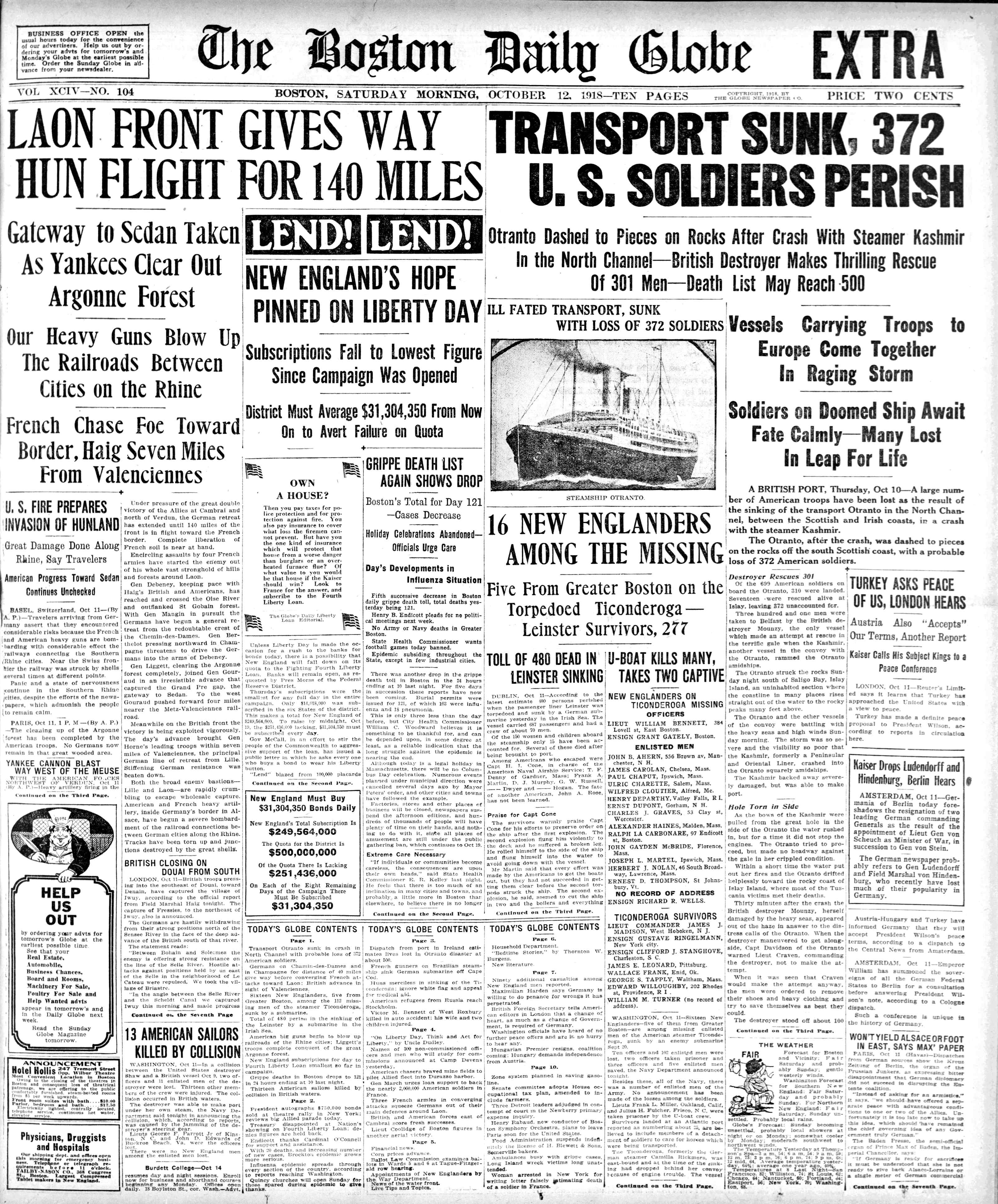
Boston Globe 12 October 1918
Germany's U-boats deserved their formidable reputation as a destroyer of the high seas. Before the war began all the major world powers had placed their money on building great battleships armed with enormous guns capable of firing huge shells a very long distance. But it was the submarine's sly subterfuge of being able to hide beneath the ocean's surface that made it more devastating force for the Imperial German Navy. In March 2023 I wrote a story, Terror on the High Seas, about a set of German picture postcards that promoted the bravery of the U-boat sailors who fought for their fatherland. The perspective of war always depends which end of a telescope you look through.
Even as the war was reaching an end in late September 1918, the German submarines were still posing a major impediment to transporting American troops to France. But there was a force even stronger than any warship that threatened all ships with destruction—storms. At the end of September 1918, HMS Otranto, an armed merchant cruiser requisitioned by the British Admiralty at the start of the war, was serving as the flagship of a large convoy leaving New York for Britain. On board were nearly 700 American soldiers.
The start of the Otranto's voyage was marred by an accident six days out when it collied with a French fishing schooner off the coast of Newfoundland. There was some damage to the Otranto's portside life boats but the schooner was broken apart and the Otranto was delayed while rescuing its crew. It managed to catch up to the convoy but three days later they encountered a terrible North Atlantic storm. On 6 October the storm had reached Force 11 on the Beaufort scale, one down from hurricane winds, with huge monstrous waves. The weather was so bad that the British navy's escort destroyers went back to their home ports.
Unable to stay together, the convoy's ships separated and had to resort to dead reckoning. When they finally sighted a coastline, the Otranto's officer of the watch mistakenly thought it was Ireland's western coast and turned north. The other ships correctly reckoned it was the coast of western Scotland and turned south towards the Northern Channel. The Ontanto was now steering north towards the HMS Kashmir, another liner turned troopship, which was going south. Because of poor visibility caused by the storm the two ships could not avoid a collision, and the Kashmir rammed Otranto on the port side amidships, a few miles off the rocky coast of Islay, Scotland.
The impact punctured a huge hole in the port side of the Otranto from below the waterline to the boat deck. Suddenly the boiler rooms and then the engine rooms flooded. The ship began to list badly but it had lost its remaining lifeboats on that side. Fortunately the destroyer HMS Mounsey appeared shortly after the accident and was able to position itself to remove some of the troops and crew. Tragically it was not enough. Waves had driven the ship onto a reef near Islay and it was soon broken. The final casualty list recorded that 470 men perished: 12 officers and 84 crewmen from Otranto, 1 officer and 357 American enlisted men, and 6 French fishermen.
San Francisco Chronicle 12 October 1918
But that was not the end of the tragic news for that day. In the newspapers it was reported that on 30 September 1918, the USS Ticonderoga, a former German steamship converted to a cargo ship for the U. S. Navy, was sunk by a U-boat attack after it had become separated from its convoy. Of the 237 sailors and soldiers who were on the ship when it left Norfolk,Virginia, only 24 survived, including Ticonderoga's executive officer and the first assistant engineer, who were taken from the water by the U-boat and eventually held as prisoners of war after the submarine returned to port at Kiel, Germany. I believe the ship was also carrying a cargo of livestock, probably horses and mules, who also perished.
There were so many similar tragedies that week that newspaper editors were hard pressed to find space on the front page. On 10 October 1918, RMS Leinster, a packet ship in the Royal Mail Service, was torpedoed and sunk by a German submarine while crossing the Irish Seas from Dublin to Holyhead. At least 564 people, mostly civilians, perished.
Tampa Daily Times 3 October 1918
On the evening of 26 September 1918, the USCGC Tampa, a Miami-class cutter in the United States Coast Guard, was returning to Milford Haven, Wales, after finishing its escort duty with a large ship convoy that had arrived in the Irish Sea from Gibraltar. As the Tampa crossed the Bristol Channel it was seen by a waiting U-boat that quickly dived and maneuvered into attack position, firing one torpedo at the Tamp from a range of about 550 meters (600 yd). The torpedo struck amidship on the portside and caused a huge explosion.
The cutter went down with all hands, 131 men: 111 Coast Guardsmen, 4 U.S. Navy sailors, and 16 passengers consisting of 11 British Navy personnel and 5 civilians. It was the U. S. Navy's largest loss of life during combat in World War I.
My postcard photo records a small moment of recreation enjoyed by men on a troopship returning home. I don't know the band's regiment or the ship's name. But I believe we can understand their shared experience and feelings. It was a relief that their war was over; a satisfaction with their victory; a concern for their future; and a sadness for their comrades lost.
What often gets lost in history is the deep emotional stress caused by war. In 1914-18 the German U-boat became another new mechanical menace that changed the nature of warfare forever. Submarines, just like heavy artillery, tanks, machine guns, airplanes, and zeppelins became frightful weapons of terror. It produced a dreadful anxiety over the unseen death machines that had never been imagined before. Sadly, many people in our world today are suffering terribly from a similar distress of the hidden weapons of war. I wanted to explain this stress by showing newspaper reports on how troopships were at great risk from a submarine concealed below the ocean's surface. The trip overseas in 1918 was not a holiday cruise so I think the soldiers and sailors in my photo knew firsthand what it was all about and were very glad to see an end to it on their return home. I hope the band's music helped.
Earlier this week, Monday, May 27th, was Memorial Day, once known as Decoration Day and celebrated on May 30th. It was originally established to honor the Union soldiers who had died in the American Civil War but it has since become a day of remembrance for all members of the U.S. military who fought and died in service. The mind numbing number of casualties in World War One are often now reduced to a picture of an orderly military cemetery somewhere on the pastoral fields of France. But we should also remember the other graves too, the ones that have no marker for those lost at sea. We should cherish the memory of those brave men and do our duty to seek an end to all war.
One of the best ways to honor and remember the service of all our military men and women is with music. Here is the West Point Band and West Point Cadet Glee Club performing "Mansions of the Lord" from the 2002 film We Were Soldiers at Lincoln Center in New York City on 29 October 2017. This beautiful hymn was composed by Nick Glennie-Smith to words by Randall Wallace. The conductor of this concert was Constance Chase.
This is a web gallery of antique photographs of musicians. Most are of people whose names are now lost in time but they represent the many kinds of players, instruments, and ensembles that once defined musical culture. But these photographs also capture a moment in the history of people and places, so I write about that too.
All the photos shown here are in my personal collection.
For Best Effect Click on the Images for a Larger View
For information on my music for horn - go to the bottom of this column.




.jpg)


