This is a blog about music, photography, history, and culture.
These are photographs from my collection that tell a story about lost time and forgotten music.

Mike Brubaker
{ Click on the image to expand the photo }
Showing posts with label submarines. Show all posts

Swimming with the Fishes

13 July 2024

 
Left and right. Forward or backward. East, west, north, and south. Once upon a time the world was defined in just two dimensions because no matter where you went, your feet were always firmly affixed to the ground. Climbing a tree or digging a hole didn't count as basically you were always standing on a substitute floor. Even on a boat you were still floating on a ship's deck more or less at sea level.
 
It wasn't until the 19th century that a few clever and determined aeronauts discovered ways to defy gravity with balloons, gliders, and airships. Then in the 1900s powered aeroplanes opened the sky into a new dimension for mankind. People could finally experience flying like a bird.
 
In the same decade another invention unlocked the opposite direction. Nautical engineers figured out how to control buoyancy in marvelous submarine vessels that could dive beneath the sea. Now people could imagine swimming like a fish. It turned out that exploring the world underwater was just as complicated, and dangerous, as flying above it.

The idea of flying inspired countless men to build machines, both lighter and heavier than air, that would carry people up into the skyward dimension. But far fewer inventors had a passion to untangle the myriad difficult challenges of propelling a watercraft down below the sea. These pioneers of submersible vessels had a different motivation than the early aeronauts. Their goal was not to explore the ocean's mysteries, but to develop a stealthy warship that could hide beneath its surface. By 1900 advancements in marine engineering and manufacturing of ships, electrical motors, petrol engines, and military armament reached a level that made a powered submersible watercraft a viable reality. Just as the 1900s introduced a new age of aeroplanes, it also became a new age for the submarine boat. Mankind now had reasons to think both downward and upward.

This colorized picture postcard shows a naval officer standing half out of a turret on a vessel that is mostly concealed below water.  The caption reads:
U. S. Submarine Boat Plunger
 
The USS Plunger (SS-2) was the second submarine commissioned in the United States Navy. Her keel was laid down on 21 May 1901 at the Crescent Shipyard in Elizabeth, New Jersey. She was launched on 1 February 1902 and commissioned in 9 September 1903. The USS Plunger shared a name with an earlier experimental submarine that was powered by a steam engine. It was designed by inventor and submarine pioneer John P. Holland (1841–1914). His boat, (all submarines are called boats, not ships.) was evaluated by the U.S. Navy from 1898 to 1900, but was never accepted or commissioned. This second Plunger was the lead boat in her Plunger ship-class which resulted in seven submarine boats built on the same design.

The postcard was sent from Waterbury, Connecticut on 16 October 1906 to Miss Sophie Johnson of New Sweden Station, a tiny village way up in the northwoods of Maine, about 200 miles inland from the Atlantic Ocean.
Along the side is a message:
                                Dear  Sophie
                    Will write you soon  got the Book
                    also the letter  Johanna.


The USS Plunger was not intended for long voyages over deep water. It was a submarine torpedo boat meant for defending harbors. It was a similar concept to the ironclad monitor warships used in the 1860s that were armed with large naval cannons to guard ports, essentially as floating fortresses. The Plunger submarine was furnished with single torpedo tube, but unlike the monitor it could sink below the water to conceal its position from enemy ships.


USS Plunger (SS-2)
Source: Wikipedia
 
This photo of the USS Plunger shows it underway in the New York Navy Yard around 1908-09. At the time it was assigned to the First Submarine Flotilla which included its sister-ships USS Porpoise (SS-7), and Shark (SS-8). By January 1905 the other Plunger-class submarine torpedo boats, USS Grampus and Pike were on the Pacific coast at the Mare Island Navy Yard in Vallejo, California and the USS Adder and Moccasin were assigned to the Reserve Torpedo Flotilla in Norfolk, Virginia. 


In this colorized photo postcard, captioned: U. S. Submarine Boat "Plunger" , Brooklyn Navy Yard, the Plunger lies propped up in dry dock in front of another submarine. Both boats are dwarfed inside the gigantic basin that was built to support maintenance on great battleships.
 
 A message on the border reads:

                            You are a man of peace so I
                            thought you'd enjoy seeing this
                            deadly machine.   Almina Lictner
(?)
 
The card was sent from New York City on 8 July 1907 to Mr. Harry Woodard, of Bartow, Florida which is near Winter Haven in between the state's Gulf Coast and Atlantic Coast. Harry was born in 1887 and in the 1900 census was the son of an "Engineer, Ice Factory" and then a student "at school". Later in 1910 Harry worked as a railroad "freight agent", so the writer's reference to a "man of peace" may be about the young man's professed feelings on war or the writer's joke. 


A Plunger class submarine was 63' 10" long with a beam of 11' 11". Most of the boat was submerged when it was at the surface so its draft 10' 7" was much deeper that a regular boat of the same size.  The boat's single screw propeller was powered by a 160 HP gasoline engine at the surface and by a 150 HP electric motor powered by 60 battery cells when submerged. This gave it a speed of 8 knots surfaced and 8 knots underwater. A Plunger submarine was capable of reaching a depth of 150' feet, but 100' was the tested limit. It was armed with one 18" torpedo tube and carried 5 torpedoes. Normal operation of the boat required a complement of 1 officer and 6 enlisted men.  


Diagram for USS Plunger
Source: Navsource.org

These two diagrams of the USS Plunger's construction plans reveal that this boat was very unsophisticated. Compared to modern submarines it was as primitive in design as the Wright brothers' airplane was to a jet plane. Shaped like a sausage the sub was stuffed with just the necessary marine requirements. The gasoline engine and electric motor were aft next to the prop and rudder. The torpedo tube was fixed in the bow. Arranged in the center was the large battery box, and several tanks for air, ballast, and fuel. The torpedoes were fastened to the inside. One writer of the time noted that

There was no accommodation or facilities for the crew. Food was cooked over a portable stove. A bucket served as a latrine. The engine fumes, battery acid, stale air, noise, and pervasive saltwater damp made life aboard this vessel particularly uncomfortable. Even by navy standards of the time it was considered very unhealthy and extremely hazardous to its sailors.
 
 
Plans for USS Plunger
Source: Navsource.org

A section view shows the cylindrical design of the USS Plunger with a radius of just 5' 10". When submerged the commander stood on a raised box in the short conning tower to operate both the steering and diving plane controls. There was no periscope, his only viewpoint was to look through small deadlight windows in the tower and try to blindly aim the vessel towards its quarry. Failure to secure the craft's single hatch before diving was a harsh lesson that several early submariners had to learn the hard way. 

 
San Francisco Call
26 August 1905

On 25 August 1905 the USS Plunger was towed to Oyster Bay on the north coast of Long Island, New York. Situated on the bay was Sagamore Hill, the home of Theodore Roosevelt who was then in his fourth year as president of the United States. In great secrecy the navy had arranged a private test of its new submersible torpedo boat for the president's personal inspection. On the day Roosevelt only decided to accompany the Plunger's commander, Lieutenant Charles H. Nelson at the last moment. Even his family didn't know about it.

The president squeezed through the hatch and was given a short tour of the boat. It then dived to a depth of 40 feet staying submerged for half an hour. This was followed by an exhibition of "porpoise diving" which "consists of dashing through the water a t high speed, alternately appearing and disappearing along the surface after the manner of a porpoise [i.e. dolphin]." 


New York World
26 August 1905
The Plunger then dove at an angle of forty-five degrees. stopped at a depth of 20 feet, reversed engines and popped back to the surface. It did two more dives, once remaining motionless with all lights extinguished to demonstrate how the crew was trained to work in total darkness. The president stayed on the submarine for almost three hours and several times was given control of the vessel.

In this front page from the New York World, a cartoon Roosevelt is drawn scrambling all over the boat which is depicted as much larger than it really was. Newspapers around the country had covered the movements of the submarine earlier in the week and reported on a possible inspection, generally presuming that the president would watch from the safety of a ship or at the Sagamore Hill dock. When it was revealed that he actually went down underwater the news went to the front page with many photos and illustrations. Most reports chastised the president's audacity at putting himself at deadly risk of an accident. But by the point in his term it only served to increase Roosevelt's reputation for courage and daring.
 
Later the next month, Roosevelt wrote about his inspection of the Plunger to Hermann Speck von Sternburg (1852–1908), a German diplomat.
 
        "I myself am both amused and interested as to what you say about the interest excited about my
        trip in the Plunger. I went down in it chiefly because I did not like to have the officers and enlisted
        men think I wanted them to try things I was reluctant to try myself. I believe a good deal can be
        done with these submarines, although there is always the danger of people getting carried away
        with the idea and thinking that they can be of more use than they possibly could be."
        To another correspondent he declared that never in his life had he experienced "such a diverting
        day ... nor so much enjoyment in so few hours."

Ironically this was written to a diplomat of Imperial Germany which in less than ten years would build a fleet of over 350 long range Unterseeboots (under-sea boats), or U-boats. These German submarines terrorized shipping lanes from 1914 to 1918 resulting in a loss to the Allied forces of 10 battleships, 18 cruisers, and numerous smaller navy vessels, as well as 12,850,815 gross tons in merchant ships. More than 3000 British civilian ships were sunk and almost 15,000 British merchant sailors killed. I featured a small collection of postcard artwork on these German submarines back in my story from March 2023, Terror on the High Seas


USS Moccasin, View forward of single torpedo tube, 1912
Source: Wikipedia

At the time of his inspection of the Plunger President Roosevelt was seeking an end to the Russo-Japanese War which was a conflict waged between the Japanese Empire and the Russian Empire over the acquisition of Manchuria and the Korean Empire. His diplomatic effort succeeded in a peace treaty signed by the imperial rivals on 5 September 1905 at the Portsmouth Naval Shipyard in Kittery, Maine. During this war the Imperial Russian Navy ordered a small flotilla of seven submarines built similar to the Plunger. These submarines were designed by American naval engineers for harbor defense, though they were stationed mainly on Russia's Baltic Coast. 
 
In August 1914 Japan joined Britain and France as an ally against the empires of Germany and Austria-Hungary. In return it acquired several of Germany's Asian colonial outposts. Japan's military planners paid close attention to the power of a submarine fleet as during WW1 its navy performed escort duty in the Pacific and Mediterranean and lost ships to submarine attacks. Two decades later Japan's submarines would prove a dangerous force in the Second World War.
 
The Plunger was decommissioned a few months after Roosevelt's inspection on 3 November 1905 and put into storage. It remained inactive until 23 February 1907 when it was recommissioned with a new commander, Ensign Chester Nimitz, who would later become a celebrated fleet admiral in WW2. Nimitz later recalled the Plunger as "a cross between a Jules Verne fantasy and a humpbacked whale".
 
The Plunger was stricken from the Naval Vessel Register on 24 February 1913 and in 1916 it was designated as an "experimental target" for gunnery training and in March 1918 she was sank off New Suffolk, Massachusetts. In 1921 the sunken hulk was raised but the Salvage Diving School at New London, Connecticut and sold for scrap.


Whether you are up in an airplane
or below the sea in a submarine,
it's the safe return to the ground
or to the surface that is the happy goal.


 I can not resist including
the one song about submarines
that everyone knows.
Feel free to join in the chorus.


This is my contribution to Sepia Saturday
where the one thing fishing teaches you
is that you've got to have hope.


Terror on the High Seas

11 March 2023

 
At first glance it doesn't look like a boat. Two men stand in a small tower structure teetering just a few feet above turbulent waves of a rough sea. In the dark background a large ship bears down upon the men. But a closer look reveals they are sailors and on the short mast behind them flies the flag of the Imperial German Navy. It is a German U-boat, an Unterseeboot or submarine. But it is not a photograph. It's a postcard print of a painting.

On the back is an explanation in German. This was a Wohlfahrts-Karte, a welfare card of the "Reich Association for the support of German veterans". The painting's title was "Auf der Wacht" or "On Guard". The postmark date is 8 March 1916 sent from Zerbst, a town in Saxony-Anhalt, Germany.


Also printed is the artist's name, Willy Stöwer. Born in 1864 at Wolgast, Germany on the Baltic coast, Stöwer was the son of a ship captain, and initially trained as a shipyard metalworker. While employed as an engineering draftsman he started a sideline making maritime illustrations and paintings on commission. After his marriage in 1892 to a young woman from a wealthy family he was able to devote his life exclusively to art. He was also fortunate to find an enthusiastic patron in Kaiser Wilhelm II who commissioned several paintings and invited Stöwer to accompany him on several voyages on the Imperial yacht.  
 
 
Willy Stöwer (1864–1931)
Source: Wikipedia

Despite the honorific of Prof., i.e. Professor, Willy Stöwer (sometimes spelt as Stoewer in English to replace the pesky umlaut) had no art school degree and was entirely a self-taught artist. During his long career he created over 1,200 illustrations for 57 books, as well as numerous posters, postcards, trading-cards, labels, brochures and calendars. His principal form was in maritime subjects, particularly navy ships. Stöwer's works became very popular during the prewar years, partly due to the patronage of the Kaiser, but more because he had a real talent for capturing the excitement of seafaring.


His next postcard is more dramatic as it depicts a U-boat next to a sail-rigged ship. The three masted ship is sinking at the bow and flies a French flag. Its crew are on a lifeboat, perhaps rowing toward the German submarine.
 
The back has a printed description, "U-BOOT-SPENDE 1917" ~ "U-boat donation 1917". Another caption identifies the artist as Prof. Willy Stöwer, and the painting's title: "Französische Bark wird durch deutsches U-boot im Atlantik versenkt." ~ "French bark is sunk by a German U-boat in the Atlantic." The message is dated 18 June 1917.


By June of 1917 every nation at war in Europe was struggling to gain some advantage over their adversaries. Just after the start of the war in 1914 Britain imposed a tight naval blockade on Germany which was so restrictive on food imports that Germany felt its people risked starvation. Responding to this cruel provocation the German Imperial Navy unleashed its submarine fleet to encircle the British Isles and destroy all navy and commercial shipping, no matter whether it was British or neutral.   


In this painting a U-boat has disabled a merchant ship that sharply lists to port. The captain has brought his submarine quite close to the sinking ship and he seems to be directing the ship's crew in their lifeboats towards a safe direction.

This postcard was sent by free military post and the writer dated it 20 April 1916. The captions are printed in Fraktur, an old German typeface that can be quite challenging to decipher. The first word is "Kolonialkriegerdank" ~ "Colonial warrior thanks", which makes this a postcard sold for a veteran's charity. The lower caption identifies Willy Stöwer as the artist and the painting is described as "Notice is given to an English commercial steamer by a German submarine."


At the beginning of the 20th century most navies considered a submarine as an experimental vessel which might be useful only for harbor defense in shallow waters. But with the introduction of diesel engines, double-hull construction, and self-propelled torpedoes a submarine became a much more seaworthy and dangerous naval warship. When war was declared in 1914 Germany had 48 submarines of 13 classes in service or under construction. Eventually as the terrible conflict continued the Imperial Navy counted 373 U-boats in its fleet.


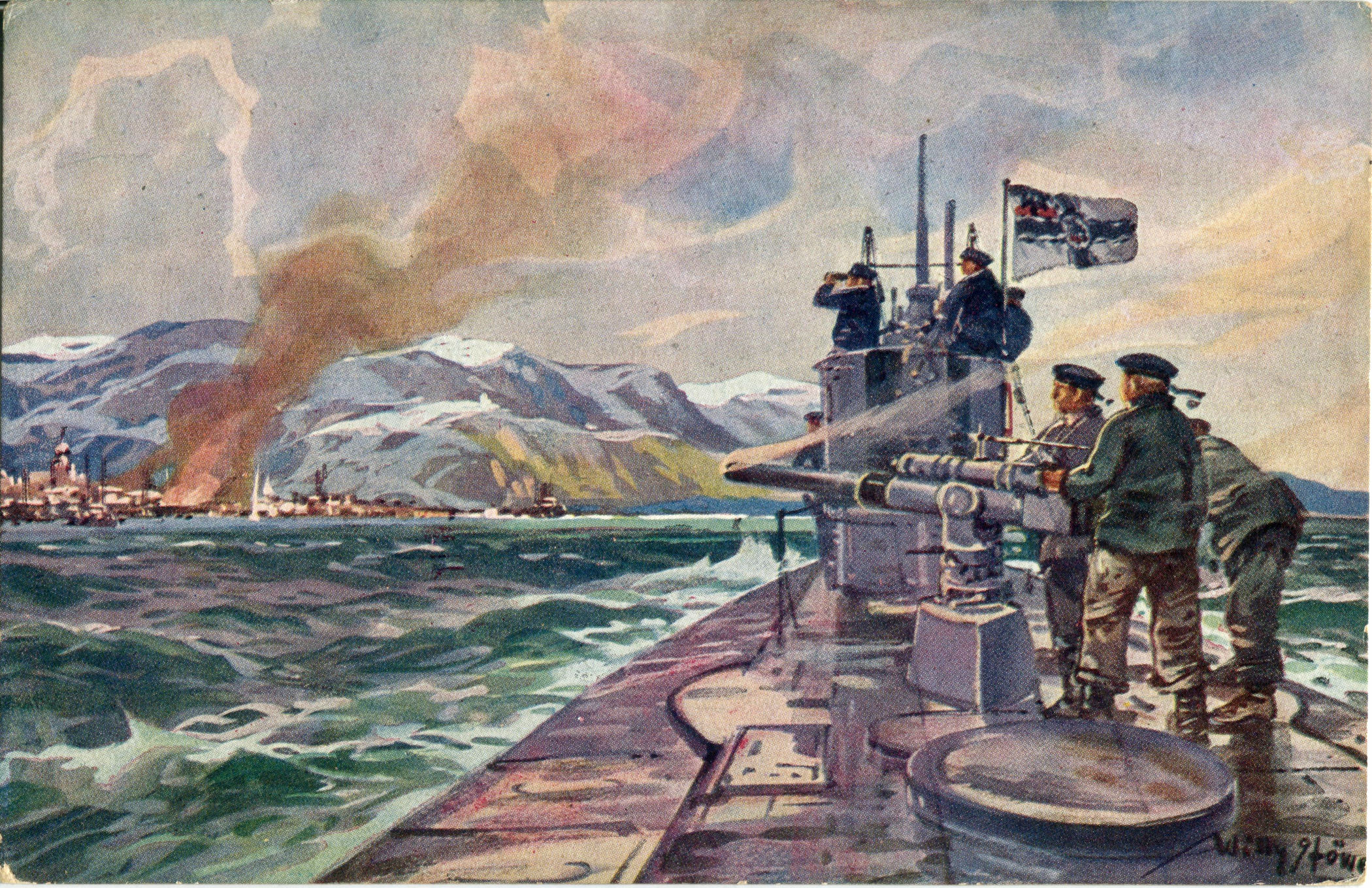
In this next painting Willy Stöwer moves the perspective to the deck of a U-boat looking toward a seaside town situated on a snow-capped mountainous coast. Sailors stand next to a smoking gun as the town burns. The back has Stöwer's printed title: "Deutsches U-Boot im Eismeer Beschießung von Alexandrowsk." ~ "German submarine shelling of Alexandrovsk in the Arctic Ocean." Alexandrovsk is now called Polyarny and is located in the Murmansk Oblast of Russia on the northeast side of the Scandinavian Peninsula.  

The card was probably never intended for mailing as there is no place for an address. Instead there is a large notice that translates as: "This submarine donation is for our heroes on submarines, minesweepers and other security vessels from 1 to 7 June 1917."


Early in the war the U-boats in the German navy and the Austro-Hungarian Navy, too*, which took on older German class submarines, made several successful attacks on British and French warships. This fame came at a great cost as the U-boat fleets suffered many losses too. These early submarines could stay underwater only for a small amount of time and were then unable to observe what was happening above on the surface. They were also much slower than regular warships and had limited firepower. Their real threat was to commercial shipping and during the war years this became the target of the German U-boat fleet. 
 
*Musically minded readers may remember a bit of trivia from the film, The Sound of Music. The father of the Trapp Family Singers was Georg Ludwig Ritter von Trapp (1880– 1947) who was an officer in the Austro-Hungarian Navy. During World War I, Trapp was the most successful Austro-Hungarian submarine commander sinking 11 Allied merchant ships totaling 47,653 tons (GRT) and two Allied warships of 12,641 tons total. 


On this next U-boat postcard Stöwer moves the perspective forward showing officers and sailors on the submarine's distinctive sail or conning tower. Waves splash over the deck as the helmsman steers the vessel through choppy water. The artist instantly conveys the great bravery and extreme endurance that set U-boat sailors apart from other navy servicemen. Though it's difficult to see enough of the submarine's design to identify its class, I suspect Willy Stöwer with his draftsman's eye always painted his submarines and ships very carefully to include accurate details. The next image shows him in his studio working on a huge painting. Around the room are examples of ship designs and sail rigging that he used to as models. 
 
 
Willy Stöwer in his studio, 1903
Source: Wikipedia


What made a U-boat such a serious menace was, of course, it's ability to submerge. This power to hide beneath the ocean surface and lie in wait for enemy ships was a stealthy quality that no warship had ever possessed. Many people thought this was unfair and contrary to the so-called "rules of war". So before attacking a merchant ship a U-boat captain supposedly had to stop it and allow its crew to safely abandon the ship before sinking it. But when Germany announced unrestricted submarine attacks without warnings or any protection for ships from neutral countries, the "rules" were discarded with terrible consequences. Eventually as the war dragged on, the Allied navies developed defensive tactics of dazzle paint to disguise ship movement; zig-zag maneuvers for convoys; aerial reconnaissance with blimps and dirigibles; and ultimately explosive depth charges.     


Here a U-boat moves along a calmer sea as its crew watches a very large passenger steamship slowly sink. Surrounding it are several lifeboats and dots of people floating in the water. The black lines in the sky are not seagulls but marks left by the postal service.

This Stöwer postcard was another in the series for the U-Boot-Spende 1917 veteran's charity. Presumably the money collected was turned into a benefit paid to wives and children of sailors killed in the war. The postmark is 18 June 1917. The caption gives the picture's title: "Versenkung eines feindlichen bewaffneten Truppentransport Dampfers durch deutsches U-Boot in Mittlemeer" ~ "Sinking of an enemy armed troop transport steamer by a German U-boat in the Mediterranean."


On 7 May 1915, the passenger liner RMS Lusitania, out of New York and bound for Liverpool, was torpedoed by U-20, off the southern coast of Ireland. It took only 18 minutes to sink, killing 1,198 of the 1,959 people aboard, including 128 American citizens. The outrage in America came close to forcing the United States to declare war on Germany, but President Wilson knew that America was not yet ready to fully engage in this kind of conflict. The world would have to suffer through two more years before the US joined the Allied powers in France.


Once again in this next painting, Stöwer devises an unexpected angle for the viewer, something that at the time a photographer could not achieve. A cargo ship steams toward us as puffs of explosive shells hit the water ahead of it. In the distance a U-boat is firing its gun while receiving a barrage too. Though torpedoes were a powerful weapon, they were not reliable and had uncertain accuracy. And a submarine could only carry a limited number of them. For merchant shipping it was more effective for a U-boat to surface and fire its gun.

This  card was another in that same veteran's charity series. The writer has covered the caption but it translates as: "German U-boat fires on an armed commercial steamer". The postmark is dated 4 June 1917 from Charlottenburg, a locality in Berlin famous for its grand royal palace.


The various classes of German U-boats in service during WW1 were less sophisticated that the submarines of WW2 and, of course, nothing like the modern versions which are now nuclear powered. For an example SM U-20 that sank the RMS Lusitania was 64m (210 ft) long with a beam of 6.10m (20 ft), a height or 7.30 m (23 ft 11 in),  and draught when at the surface of 3.58 m (11 ft 9 in). It was powered by two 8-cylinder diesel engines when surfaced and by two electric motors when submerged which gave it a speed of 15.4 knots (28.5 km/h; 17.7 mph) and 9.5 knots (17.6 km/h; 10.9 mph) respectively. It carried a ship's complement of 4 officers and 25 enlisted men.

The U-20 was armed with just six torpedoes, two small guns and, after 1916, sometimes carried 12 mines. Surprisingly it had a very long range of 9,700 nautical miles (18,000 km; 11,200 mi) using the diesel engines, but only 80 nautical miles (150 km; 92 mi) when submerged. This submarine was capable of descending to 50m (164 ft) which was the limit for most submarines then, though a few could reach 75 m (246 ft).  But all the U-boats lacked any technology for sonar, radar, quiet running, and long range radio which would come in later decades.


This final postcard of Willy Stöwer depicts the heroic welcome given to the crew of the SM U-9 on its return to Wilhelmshaven on 23 September 1914. On the day before, while on patrol in the southern North Sea, the U-9 encountered a squadron of three British armored cruisers, the HMS Aboukir, HMS Hogue, and HMS Cressy which were guarding the eastern end of the English Channel against German warships and shipping. The U-9 fired four torpedoes, reloading while submerged, and sank all three warships in less than an hour, killing 1,459 British sailors. It is considered the first major submarine action of the war and it demonstrated how deadly this new warship could be.

The postcard was sent using military post from the SMS Berlin, a Bremen class light cruiser. The sailor or officer wrote a date of 7/3 15, 7 March 1915.


In November 1918 Willy Stöwer lost his principal patron when Kaiser Wilhelm was forced to abdicate and move to Holland as a condition for ending the war. I doubt Kaiser Bill ever went yachting after that. Stöwer continued working in commercial art, and I've started a collection of his postcard paintings of ocean liners, but his fortune changed as the public's taste for maritime paintings drastically declined. Willy Stöwer died at his home in Berlin on 31 May 1931, nine days after his 67th birthday. 


This last image is not a postcard by Stöwer but it is probably one that he knew. It has a forbidding title: "Englands Not." ~ "England's distress" over a map of the British Isles and the Atlantic coast of France shaded mustard yellow. The caption reads: "12 Monate uneingeschränkten U-Bootskrieges auf dem nördlichen Seekriegsschauplatz" ~ "12 months of unrestricted U-boat boat warfare in the northern naval theater". Scattered across the blue ocean  are hundreds of small symbols that the map's legend identifies as "a ship sunk by the activity of our submarines, regardless of its size." 
 
Undeneath is a list of 12 months from February 1917 to January 1918 giving an estimate of ship tonnage lost to German submarines. This overt propaganda is frighteningly impressive for its statistics and hideously appalling in its casual disregard for the lives lost, both of the enemy and of Germany. 

The death toll caused by four years of submarine warfare was horrendous. The U-Boat entry on Wikipedia describes it best.

Of the 373 German submarines that had been built, 178 were lost by enemy action. Of these, 40 were sunk by mines, 30 by depth charges, and 13 by Q-ships; 512 officers and 4894 enlisted men were killed. They sank 10 battleships, 18 cruisers, and several smaller naval vessels. They further destroyed 5,708 merchant and fishing vessels for a total of 11,108,865 tons and the loss of about 15,000 sailors. The Pour le Mérite, the highest decoration for gallantry for officers, was awarded to 29 U-boat commanders. Twelve U-boat crewmen were decorated with the Goldene Militär-Verdienst-Kreuz, the highest bravery award for non-commissioned officers and enlisted men. The most successful U-boat commanders of World War I were Lothar von Arnauld de la Perière (189 merchant vessels and two gunboats with 446,708 tons), followed by Walter Forstmann (149 ships with 391,607 tons), and Max Valentiner (144 ships with 299,482 tons). Their records have not been surpassed in any subsequent conflict.
 
 
As I wrote in last week's post, The Sky Watchers, about early aviators, I'm fascinated by the way humankind's collective imagination was suddenly inspired by the sight of airplanes and zeppelins carrying people through the sky. The invention of flying machines added a new direction to the human perspective of UP. 
 
Similarly beginning in 1914, but with less public spectacle, the submarine, especially the Unterseeboot, turned our perspective in the opposite direction—DOWN. Unlike the airplane which was initially developed by civilian inventors, the evolution of the submarine began as a naval warship. Yet what the U-boat demonstrated by submerging was that sea level was only the midpoint for our human experience. Not only could we go up into a sky seemingly without limit, but we could now descend down into ocean depths unmeasured, though that would require decades more science and engineering to achieve. Even a century later there is less known about our ocean world than is understood about our atmosphere, but what is known comes from the invention of the submarine.
 
The appeal of Willy Stöwer's artwork is also about the power of imagination. In his time photography and cinematography had made great advances but were still very constrained and could not show real colors and genuine action. But an artist like Stöwer could do that and more, like capture the sense of adventure on a U-boat. I can easily believe that many a young German boy was inspired by Stöwer's postcard art to enlist in the German Navy of 1939-1945.
 
Putting aside the global politics and gross misjudgements that led to World War One, Stöwer was trying to depict the heroism and bravery of U-boat sailors. I think he presented their courageous efforts in an honorable manner because as navy servicemen they had pledged their life to protect their nation and fellow countrymen. The great tragedy is that so had their adversaries and they became the victors. 


This is my contribution to Sepia Saturday
where no one is ever down when they're up.


nolitbx

  © Blogger template Shush by Ourblogtemplates.com 2009

Back to TOP