This is a blog about music, photography, history, and culture.
These are photographs from my collection that tell a story about lost time and forgotten music.

Mike Brubaker
{ Click on the image to expand the photo }
Showing posts with label euphonium. Show all posts

Three Brass Duos

30 August 2025

 
Sometimes it's not the instruments
but the hats and mustaches that persuade
me to add a musician's photo to my collection.


Likewise band uniforms
more than individual instruments
can affect my decision to buy a photo.


And then when I realize
I've acquired musical photos 
that share some attribute
like an instrument combination
or a mix of hats and uniforms
I start looking for similar photos.


Today I present three photos
of pairs of vintage bandsmen
who played cornet and euphonium. 


My first duo are two men wearing dapper bowler hats and sporting tightly twisted mustaches, which, I believe, required a lot of wax. Both have long suit coats though of different lengths. On the left the cornet player's coat is cut at standard business length but has an elegant velvet collar which must have cost extra. The coat on the euphonium player is longer, hemmed at his ankles, and comes with a short cape for foul weather. They have a style that suggests they are members of a professional band like a minstrel show troupe as those ensembles favored long duster style coats. But minstrel  band musicians usually wore top hats not bowlers, so these fellows may just be mates in a local town band.

The photographer of this cabinet card photograph was C. Anson Goodhart of 16 South Railroad St. in Shippensburg, Pennsylvania. On the back is written: 
 B. N. Palmer on Right 

In the Ancestry.com archive I found a Bernard N. Palmer, born 1868, living in Belfast, Pennsylvania, a small township roughly 50 miles west of Shippensburg. In the 1900 census Bernard listed his occupation as "school teacher" and I found his name mentioned as B. N. Palmer in  several county newspapers. However none connected him to a band, much less a euphonium, so this identification is still speculation until I find more clues. Yet I do think the man on the right does look like a teacher.   


* * *


My second cornet euphonium duo are definitely bandsmen as they wear proper uniforms with fancy embroidery. The cornet player on the right seems to have suffered a wardrobe malfunction as his jacket is missing some braid. They are standing outside in front of a heavy canvas wall, presumably a tent. Their caps have a name that unfortunately is too blurred to decipher the letters. It looks like the last three letters are STO which looks Italian and the euphonium player's mustache certainly has an Italian curl. So I can easily imagine they are members of an Italian band featured in a traveling circus or carnival show.  The postcard was not posted but is printed on American paper so I believe it dates from around 1910-1920. 


* * *


My third and final cornet and euphonium duo are the most interesting pair. Two men in formal military dress uniforms pose outdoors at the front of  a canvas tent. Across their chests is a braided cord fastened at the left shoulder with two knotted circular tassels that, I believe, is called a fourragère, not to be confused with a similar cord with metal tips called an aiguillette. I'm not sure why this cord accoutrement appear on military band uniforms but it's a feature that appears in a lot of my photos. (Perhaps one day I'll put together a special story just on uniform ornaments.) In any case these two bandsmen look overdressed for sitting around a campfire. 

The peak of the tent has letters N. G. which are a clue that this is a national guard tent and presumably the men are members of a guard band. But that does not mean they were enlisted soldiers. In earlier times state guard units would go to their annual two week encampment with a hired professional band to play parade marches and provide entertainment. Check out my story from February 2019 The Band at the Old Campground about photos of another euphonium player who was a member of the Washington National Guard band. (Looking back at that story reminds me that I could do a story just on musicians standing in front of tents, too.) 


The back of this unmailed photo postcard are two notes: 
Herb? Long on left
2nd Regiment Marine
Band
A.Town

At first I thought they might actually be bandsmen in the United States Marine Corps. But national guard units in this era were not marines. It took a little more digging in the internet mines to learn they were actually members of the Marine Band of Allentown, Pennsylvania. The band was first organized by local "A.Town" Allentown musicians in January 1903 as a "military" style band, influenced by the popularity of the U. S. Marine Band, the President's Own, and its famous leader John Philip Sousa (1854–1932). In its first year the band presented 131 concerts, almost one every other day, and established a reputation in the region for superior music. In 1907 it formed a connection to a fraternal society The Sons of Veterans Reserve, now known as the Sons of Union Veterans of the Civil War, and became the 2nd Regiment Band, S.V.R. 

I'm not sure how this national society functioned as a state guard, but before the First World War the Allentown S.V.R. along with the Marine Band went to annual "encampments" like in 1907, Scranton; 1908, Walnutport; 1910, Wilkes-Barre; 1911, Mauch Chunk; 1912, Reading; 1913, Gettysburg; 1914, Sunbury; 1915, Gloucester, N. J.; and 1916, Lehighton. 

After the United States joined the war in 1917, the Allentown Marine Band performed for recruiting drives and promotion for war bonds. By the end of the year 22 members of the band enlisted, most joining army bands. According to a history of the Allentown Marine Band published 20 January 1924 by the Allentown Morning Call, one musician "paid the supreme sacrifice.  Henry Herlickler, known as 'Happy', was killed while trumpeting a charge before Sedan in France the day before the armistice, November 10, 1918. He was a member of the 79th Division.  Four other members of the band were gassed or wounded:  Harry Nitz, wounded;  Arthur Stoneback, gassed; Earl Hersh, gassed;  Irwin Boyer, gassed." 

Today the Allentown Marine Band is still in operation and performing concerts in Allentown, though with a new generation of musicians, of course. In March 1972 the Allentown Morning Call published another piece on the organization and included an old undated  photo of the band. Here the Marine Band stands in front of a building, I'm guessing either the city armory or maybe the Sons of Veterans lodge. The band's uniforms are different from what my cornet euphonium duo wear, more military like with jodhpurs and leggings. There are around 40 or more musicians, and I think my cornet player is standing in the front row, fifth from left. I don't see the euphonium player's face, but he might be in the group cut off on the right.


The Allentown Marine Band
Allentown PA Morning Call
11 March 1972

The earlier 1924 history of the Allentown Marine Band included some individual photos of its bandsmen. This picture of Solon Boyer, valve trombonist, charter member, and treasurer of the organization, shows him wearing a uniform identical to that of my cornet and euphonium players. With luck I may be able to track down their names and learn the date and location of my photo. 


Allentown PA Morning Call
20 January 1924


What is remarkable about Allentown's musical heritage is that the 2nd Regiment Marine Band was just one ensemble in a long list of the city's concert bands. Today in 2025 Allentown still enjoys concerts by the Allentown Band, established in 1828; the Pioneer Band of Allentown, established in 1889; the Municipal Band of Allentown, established as a police band in 1923; as well as the Allentown Marine Band, established in 1903. And I've also written two stories about Allentown's Young America boys' band, Two Brothers in Music;  and its Good Shepherd Home for Children orphanage band, Clover the Horse and the Boys Band.  I can't think of any place in North America that can beat a louder drum for music. I wonder, do they ever perform together? 


In earlier times the brilliant sound of a cornet
made it the premier solo instrument of a brass band.
But the sonorous euphonium is equally
a solo instrument in the tenor/baritone range.

So demonstrate the beautiful musical quality
of a cornet and euphonium combination
here is David Koch (Cookie's Music)
playing both instruments, (though not simultaneous!)
 in "A Londonderry Jig" a duet that might easily have been played
by the bandsmen in my three photos.


And as a treat for my Sepia Saturday friends
here is photo of my maternal grandmother,
Blanche Dobbin, before she was married
and was just Blanche Shaw,
sitting on a motorcycle with her cousin Robbie
in Washington, D.C. sometime around 1922.


And yours truly, Mister Mike
sitting on my Yamaha SR500 thumper
in Virginia Beach, circa 1979.


This is my contribution to Sepia Saturday
where some folk have pretty sweet rides.


The Elegant Tuba

16 September 2022

 
 For most women a tuba
is not a common fashion accessory.
It's generally too big
to fit into a lady's handbag
and tuba slide grease can leave
unsightly stains on a white blouse.


 But for a few select women
a tuba's gleaming sensuous curves
add a touch of classy refinement
that sparkles more than any gilded jewelry.


The tuba's understated but elegant form
enhances a woman's figure
as well as any violin or flute.
Which is why clever fashionable women
know that a tuba will always complement 
their choice of evening gown or teatime frock.


Today I present a curated selection of portraits
of female tuba players.


We begin with a cabinet card photograph of young woman dressed in a long dark gown and holding a silvery tuba. Her skirt is made of a very textured fabric and her bodice is a matching satin, I think. It is difficult to be certain of the color, but it looks more black than the sepia tones of dark blue or deep red. Her blouse has a high collar and long sleeves in an interesting geometric pattern. She gazes direct into the camera lens of S. P. Eggan of 251-3 Cedar Ave. in Minneapolis, Minnesota.


The photographer's stylized embossed logo looks like the initials S. A. Eggan, but the first letter has a larger swirl that makes the letter P. This matches the name Sever P. Eggans who was a photographer in Minneapolis. Born in Norway in 1869, Sever's name first appears as a photographer at 251 Cedar Ave. in the 1888 Minneapolis city directory working with Ole P. Eggan, who I believe was his brother. Yet by the 1892 directory Sever P. Eggan listed his occupation as retoucher for the A. B. Rugg studio. However in the 1897 city directory, Sever P. Eggan returned to 251 Cedar Ave. with his own photography studio, though without Ole P. Eggan who seems to have left Minneapolis. Sever maintained a studio at that location in Minneapolis through the 1920s until his death in 1929. (Many names, including my own, have trouble with alternate spellings, but the directory listing for Eggan included a warning to also check Eagan, Egan, Eggen.)
 
With this business history, and since the studio marked does not read Eggan Brothers, it seems fair to date this photo as no earlier than 1897.  It's curious that the S in the logo resembles the musical symbol for a treble clef. Perhaps Mr. Eggan had an interest in music too. His studio certainly catered to musicians as the second portrait was taken there too.


This young woman poses with a slightly smaller tuba, which I believe is a euphonium and not a baritone horn. She wears a dark gown of the same material as the previous woman and cut in similar style. Clearly both women are wearing a coordinated formal dress, a style better suited for an orchestra rather than a band concert. 
 
Their two instruments are a similar conical design but of different sizes, the smaller euphonium in B-flat and the larger tuba in E-flat. There are tubas made in larger sizes typically with 4 valves for lower bass notes, but these three valve models would have been the more common bass instruments in bands of the 1890s, with the higher voice of the euphonium assigned the more melodic solo lines. It's interesting that both instruments are polished to a lustrous shine that required the photographer to pay special attention to the studio lighting. I suspect they may even be brand new instruments for the two ladies and might have been the reason they had their photo taken.


* * *


The third tubist's portrait is a young woman in a dark dress, maybe blue or green, that is made of ordinary matte fabric ornamented with a high collar and some pearl beads on her chest. She holds her tuba securely with an arm through the upper tubing and gazes off to the camera's right. She wears a soft cap, almost boyish with only a hint of brim, if any. It's very like the homemade uniforms worn by many of the "ladies' bands" in my collection.


The photographer's mark reads: R. A. Ewing, Oklahoma City. There was a photographer named Robert A. Ewing in the 1902 Oklahoma City directory, which was the oldest directory available, and he operated a studio until at least 1942. But I was only able to find him in one census record from 1950 that showed he was born in Virginia in 1872. By that time he was retired, so I don't know when he established his photography studio in Oklahoma City. This style of cabinet card might be late 1890s but the grey card stock feels more like early 1900 to me. Oklahoma achieved statehood in 1907 and Oklahoma City is its state capital. In 1890 the city's population was 4,151 and by 1900 it grew 142% to 10,037. During the next decade it jumped an astounding 540% taking the population to 64,205. 

Her instrument is similar to the euphonium, but it may have more cylindrical tubing, in which case it would be a baritone or tenor horn. The nomenclature of the low brass family is very confusing and I'm only a horn player so I won't try to explain it. Basically it's all about the plumbing.


* * *


I can't resist including one more tuba player from about the same era, roughly 1895 to 1905, that I featured in a story from November 1917, The Elegant Low Brass of Philadelphia. She is seated in the studio of Franz Meynen, a German photographer who emigrated to Philadelphia in 1874. It's one of my favorite portraits with the tubist seated and resting her arm thoughtfully on her upturned tuba, almost as if she was a Grecian or Roman marble sculpture. Her instrument is another E-flat tuba like the one in Minneapolis, but not as shiny. Follow the link to see her trombone companions.

 
Minneapolis and Oklahoma City, not to mention Philadelphia, were becoming major centers for culture when these photos were produced. Beginning around 1885 both Minneapolis and Oklahoma City had female bands and orchestras that performed in their city's parks and theaters, either as touring companies or organized by local talent. Unfortunately tuba players, male or female, do not get much notice in newspapers so I am unable to offer a name for any of these four women. And because there were so many different groups I can't presume to identify their musical group either.
 
All we are left to admire
is their beauty, poise, charm,
and good fashion sense
to include a tuba in their portrait.


This is my contribution to Sepia Saturday
where mothers always know best.


The Unknown Orchestra

03 September 2022


Lacking any marks for who, when, or where
the fate of most vintage photographs
is reduced to basic curiosity.
Who are these people?

In my collection there are hundreds
of such anonymous photographs of musical groups.
Small clues in this grainy 10" x 8" print suggest
these musicians
posed for a camera
at some vague time in the late 19th century

somewhere in the United States.
But finding their personal details
are regrettably impossible.
Were some of the men brothers?
Father and son?


A cello and a snare drum
are not out of place in an orchestra.
But what kind of orchestra would include
a double-bell euphonium?
A novelty solo instrument
usually found in brass bands. 


And what about the dog
lying down in front like a sack of potatoes?
What position did this canine
hold in the orchestra?


 Yet for sheer humor of the human condition
nothing beats a photo with funny face.
Any flutist with such a schnoz and mustache
must have been a remarkable character
even if it was a theatrical fake disguise.


 It's proof that even a photograph
of an unknown orchestra
can be a priceless artifact of music history.


This is my contribution to Sepia Saturday
where everything has gone to the dogs this weekend.


The Cadet Band of Augusta, Maine

29 January 2022


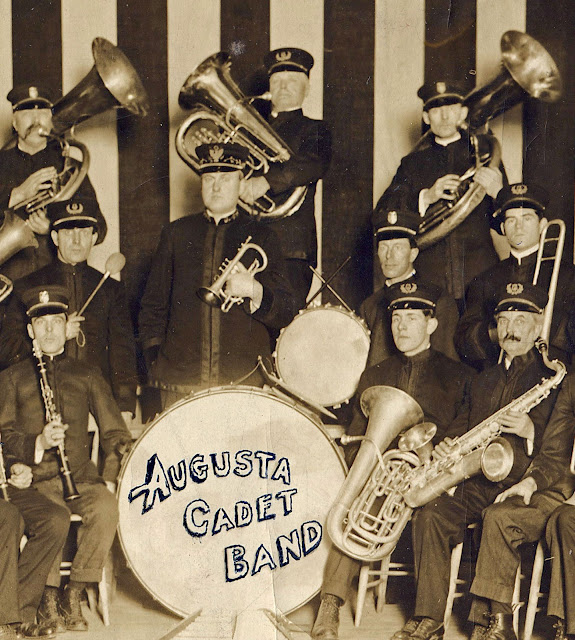
It's always the drum head.
 
Whenever I first look at a vintage photo of a band
I always check the bass drum
for a place and name of the musical group.
It was such a common advertisement for a band
that it's unusual when it is missing,
which would have been the case
with this particular photograph
except that someone helpfully wrote
the band's name
in big block letters
onto the otherwise blank space of the drum head.
Augusta Cadet Band


There are 15 towns or cities named Augusta scattered around the United States, so a proper identification might have taken longer to discover except that when I purchased this photo it came with a few other photos from a family estate in Augusta, Maine. With this information it was easy to find the band in the Augusta and Kennebec County directories. The director and manager of the Augusta Cadet Band was Frank A. Dennis. He is the man holding a cornet who stands behind the drum.
 
1905 Kennebec County, Maine
Resident and Business Directory

Frank A. Dennis ran an business advertisement for his music store at 233 Water Street in Augusta where he bought, sold, exchanged and rented musical instruments. Besides the Cadet Band, he also directed the Dennis' Orchestra. Both had twenty-five men, which is the count we see in the full photograph.


It's a large 9½ x 7 inch photograph, unmounted on thin photo paper, and marked on the lower left with just the photographer's name, Mansur. Posed on a small indoor stage, the 25 bandsmen are all dressed in modest military cadet uniforms and hats, though two have fancier embroidered tunics. Two men have hat badges that read Augusta, but most are simple music lyres. However Mr. Dennis' hat badge is an eagle with an gold leaf trim, a suitable insignia for a band leader. Other than the name written in ink on the drum, there are no other marks, except for a little eye shadow and lip gloss applied to one clarinetist's face. To judge from their uniforms the photo might have been taken any time from 1900 to 1930, or even 1950.   
 
If only there was a good clue to date the photo.
 
 Surprisingly it is right there
in the good old star and stripes.

 
46 star flag of the United States of America
4 July 1908 – 3 July 1912
Source: Wikimedia


Hanging on the wall behind the Augusta Cadet Band is a large American flag. Though not all of it is visible, there are enough stars showing to see that it is not the pattern of our present day 50 star flag, or the preceding 49 and 48 star flags. It's the 46 star banner issued on 4 July 1908 after the admittance of the state of Oklahoma. It lasted just four years until July 1912 when New Mexico and Arizona joined the union. That puts the photo of the Augusta Cadet Band in a relatively small window of time between 1908 and 1912. My suspicion is that the band was preparing for a concert on Memorial Day, Flag Day (June 14), or the 4th of July.
 
Augusta is the state capital of Maine, situated on the Kennebec River about 109 miles inland from the Atlantic coast. In 1910 its population was 13,211 citizens, which is pretty small for a capital city. Over the past century that number has changed very little, as Augusta's 2020 census count is now just 18,899. In comparison, Portland, the largest city in Maine, had 58,571 people in 1910. We saw a few of them in my story about a 1870's photo of another Maine band, Before the Parade.          
 
Like the Portland brass band in that cabinet photo,  of the Augusta Cadet Band was a band of professional musicians engaged to provide concerts for all kinds of events like parades, political rallies, fraternal society conventions, and county fairs. For indoor events like balls and graduations, Mr. Dennis could produce an orchestra, hiring string players to augment his best wind soloists. But the Cadet Band was likely the best known group in a capital city like Augusta.

 
Source: Smithsonian Online Virtual Archives
Hazen Collection of Band Photographs and Ephemera
Augusta Cadet Band, Maine

The Smithsonian archives has two photos of the Augusta Cadet Band, found in the Hazen Collection of Band Photographs and Ephemera. Both are taken outdoors at some park and both are undated. The first has 25 musicians and a bass drum with lettering very like the handwritten name on my photo, which suggests they were both taken about the same time. Perhaps the drum was a new acquisition for the band and had not yet been painted. Several faces find a match between the photos. Mr. Dennis stands at the back, left center, behind two trombones. His distinctive eagle hat badge is clear. In the background are several men wearing fez caps eating at tall plank tables, so I think this is an oyster roast for a Masonic lodge. 
 
 
The second photo of the Cadent Band is at a similar, if not the same, park location but there are only 20 bandsmen. This time the bass drum has different lettering. Perhaps the drummer struck a bit too hard and busted the drum head, requiring a replacement. That would be another reason for the blank drum head in my photo. Again there are several musicians who appear in all three photos. The horn player with the handlebar mustache is one, as is the tenor saxophonist. Here the band's leader, Frank A. Dennis, is standing to the right of the bass drum and clearly is the tallest man in the group.
 
 
Source: Smithsonian Online Virtual Archives
Hazen Collection of Band Photographs and Ephemera
Augusta Cadet Band, Maine

From the 1870s to the 1920s, the cornet was the premier solo instrument in America. Many talented cornet players like Frank Dennis built successful careers by performing and teaching their instrument. Born in 1868, the second youngest of a farming family of seven children, Frank Arthur Dennis was only 20 years old when his name was listed in the 1888 Augusta city directory as leading three different ensembles: the August Concert Band, the Dennis Orchestra, and the St. Joseph's Brass Band. Forty years later he was still listed as leading his orchestra and the band. 
 
It was not uncommon for a band leader/cornetist to set up a music store. A music shop on a city's main street that offered music lessons, sheet music, and musical instruments provided a cultural hub for meeting fellow musicians and clients looking to book a band or a music teacher. In many ways, Frank Dennis' life follows Ralph L. Reinewald, a cornet player in nearby Portsmouth, New Hampshire, whose story I wrote about in The Leader of the Dover Cornet Band. 
 
That 2014 story was also based on a small collection of antique photos I found listed from an estate. For the Augusta Cadet Band, I acquired several photos that I believe came from one of Frank A. Dennis' descendants. It included this handsome photograph of a young trombonist. 


It's a very nice 3/4 portrait in an oval mount cabinet card. The camera lens caught the fine detail of the trombonist's fancy embroidered tunic, the engraved pattern on his trombone, and even the music notation on the music stand beside him. His name is written on the back:
 
 Chas. Pike
played in
father's band
and orchestra.


Charles Albert Pike was born in 1886, and his portrait has the look of a graduation picture. The photographer, E. E. Bond, operated a studio in Augusta only from 1901 to 1904, so judging from Charles' fresh mustache I think the photo was taken in about 1903-04 when he was about age 18-20. The studio at 239 Waters St. was in the same block, if not the same building, as Mr. Dennis' music shop at No. 233. Curiously Bond's studio was taken over in 1905 by Clarence B. Pike, so there may be a family connection. Charles Pike  appears in all three photos of the Augusta Cadet Band and may have been the principal player. According to his draft card and the U.S. consulate registration papers  papers, Charles chose dentistry as a career and for a time lived in Winnipeg, Canada with his wife Sarah Ingalls Pike. 


The Augusta band could boast of a formidable low brass section with four trombones, two helicons, and a tuba. It also had three French horns which were not common in small town bands, and usually found only in larger so-called "military" or "marine" bands. Military bands typically included a bassoon which the Augusta does not have, but its tenor saxophonist was a good substitute for that musical color.
 
Sharp-eyed readers may have spotted an unusual brass instrument next to the drum. It's a double-bell euphonium, similar to the instrument I featured my story of The Citizen's Band of South New Berlin, New York back in May 2021. In the 1900-1920 era, the double-bell euphonium was not uncommon to find in large bands like the Augusta band or even small brass bands like in South New Berlin. Its musical function was as a novelty solo instrument where the valve configuration allowed the player to instantly change the sound from the larger baritone bell to the smaller treble bell. But the euphonium in Augusta has a contrary twist to its plumbing design which positions the little bell on the player's left side, the mirror opposite of the euphonium in South New Berlin.


The Augusta euphonium appears in the first photo from the Smithsonian's Hazen collection but not in the second which adds another clue that suggests my photo was contemporary to the time of that first park photo. Taken all together, the musical life of Frank Dennis and his Augusta Cadet Band was not much different from other American bands of this era. Except for one thing.

 
There was one instrument that set the Augusta Cadet Band apart, not only from other town bands, but from every professional and amateur musical group too. It was a musical oddity that I have never seen in any photo of an American wind ensemble. It was so unusual that Frank Dennis took a photo of it all by itself.
 
 It is called an Ophicleide.
 

The ophicleide is a keyed brass instrument invented in 1817 by a French instrument maker, Jean Hilaire Asté, (also known as Halary or Haleri) with a patent date of 1821. Its sound is produced just like other brass instruments by the player vibrating their lips into a cupped mouthpiece. But instead of an assembly of tubing linked by valves, the ophicleide is a fully conical instrument, not unlike a folded-up alphorn, with 9 or sometimes 11 holes covered by keyed pads that open to change its pitch. The name ophicliede comes from the Greek words for keyed serpent. Though it superficially resembles a saxophone, the key mechanism of an ophicleide does not follow the principles of woodwind instruments and has an entirely different fingering system.


On the back of the small photo, written in ink, is a note. "Backroom (looking out on Kennebec River) as Dennis' Music Store - 233 Water St., Augusta, used for Augusta Cadet Band rehearsals."  The note is a bit confusing since the river is not pictured, but the connection to Mr. Dennis and the Augusta Cadet Band it clear. But why would Frank Dennis have such a thing in his band?
 
The 1817 ophicleide of Jean Hilaire AstĂ©, predates the first piston valve tuba, which received a Prussian patent in 1835. The Belgian instrument maker, Adolphe Sax (1814 – 1894) did not get a  patent on his piston valve saxhorns until 1845, and his saxophones a year later in 1846. In the 1820s the ophicleide added a new baritone or bass voice to a band, at time when only the bassoon could play notes in the lower register. Though the ophicleide was designed as a complete instrument family of different sizes from soprano to contrabass, it was the bass model, like this instrument in the Augusta band, that found favor with opera composers like Berlioz, Mendelssohn, Meyerbeer, Verdi, and even Wagner, who scored their instrumentation to include a part for ophicleide. However as tubas, tenorhorns, and euphoniums soon proved to be more versatile, and easier to play well, they became the dominant low brass instruments and by the 1890s the ophicleide was rarely found outside of France, Belgium and England and then only occasionally in opera orchestras and church bands. To see a British example of an ophicleide from the 1870s, check out my story from May 2019, The Happy Couple.
 
Certainly in America the ophicleide never took hold in brass bands or orchestra, so that's what makes this photo so special. The ophicleide's tone color is similar to the French horn which is why this bandsman stands on that side of the band. But how did he find one and learn to play it?


A few French music instrument companies continued to manufacture the ophicleide in the 1900s, though it seemed to be marketed for church choirboys. I would expect Frank Dennis had a number of their catalogs in his music store, as French-made piston valve cornets, tubas, and assorted other brass were still popular in American bands. Dennis also seemed to have a connection to England too, as there was a cabinet photo of a British army bandsman which came with the Augusta Cadet Band photos. And of course, Quebec, Canada is not too far from Maine. So it is not impossible that Dennis ordered an ophicleide for a French-Canadian or English musician who lived in Augusta. Or maybe he just liked the sound of it from hearing it in a British military band. 


Frank Arthur Dennis died in 1930, aged 62, as did his wife Minnie M. (Dyer) Dennis a few months before, also at the same age. They had two children, Ruby and Raymond. Their son, Raymond Dennis, died in 1928 and is buried next to his parents at the Mount Pleasant cemetery in Augusta. The reference to "Father's band and orchestra" on Charles Pike's photo leads me to believe the annotations were made by Frank's daughter, Ruby M. Dennis Marquardt, with whom Frank was living at the time of his death in the 1930 census. But as usual there are gaps in my research that prevent me from being certain I have all the family history correct. 


The sound of an ophicleide is surprisingly more mellow than its size and shape would suggest. I think the tone color is less brassy and more woodwind-like emphasizing a bit more treble than bass. Here is a splendid demonstration of an ophicleide quartet cleverly performed by Francesco Gibellini on an ophicleide in C.  Extra points if you can sing the words to the tune.     In the original French.


This is my contribution to Sepia Saturday
where time is not measured in calendars 
but in photographs.


The Citizen's Band of South New Berlin, New York

01 May 2021


Childhood is the small town
everyone came from.
~ Garrison Keillor 

 
Small town life.
It's a universal theme
shared by every culture
in every age.
 
This is a story
about the cultural center of one small town,
  the Citizen's Band of South New Berlin, New York.


We will start with a brief introduction to the 13½ bandsmen. At the back on left, was Lynn B. Parker on euphonium. He was a salesman at his cousin's dry goods store. Next to him on valve trombone was Jay Manwaring. He was just 19 years old and worked as a bartender at his father's hotel. The slide trombonist was Mr. Luther C. Gage the band's instructor and leader. L.C. kept a barbershop at a hotel and had a side job as a photographer. Standing at the right, Will Coy played the tuba. He worked at the creamery where every day between 35,000 and 40,000 lbs. of milk was churned into 1,400 lbs of butter.

Seated in the middle row on left, was the snare drummer, Mr. Linn Gage. He was the undertaker in South New Berlin, and he probably got to know most folks in town better than anyone. Moving right, George Coss and Arthur Hayes played alto horns. Sometimes Arthur played brass trios at the church with Lynn Parker and Will Coy. On the mellophone was Edwin Gage. In a few months he would go up to the Normal School in Oneonta to get his teaching degree. At the far right on bass drum was Ernest Tillapaugh. He worked as a fireman at the creamery.

Seated on the grass lawn at left, was Truman B. Parker. He was Lynn Parker's cousin and the proprietor of the T. B. Parker & Co. store in South New Berlin where he kept a large stock of clothing for children, ladies, and gentlemen. No doubt he helped the band get their fine uniforms at wholesale price. To the right is Mr. Frank G. Dixon on solo cornet. Mr. Dixon was the postmaster of South New Berlin, and for a time the leader of the band. Beside him on right were the two clarionets, Ed Ten Eyck on B-flat, and Walter J. McIntire on the little E-flat. Walter also worked at the creamery, but later went on to run his own green grocery in South New Berlin.
 
Hidden in the center is a young boy holding a drum major's baton. I believe this is Frank G. Dixon's son, Edwin Dixon, born February 1898. Several men were married, but only F. G. Dixon had a son that matched that lad's age.
 
This is not a photo postcard or even a cabinet card photo. It's very large format print, nearly 8" x 10", and Mr. L. C. Gage mounted it on an extra-size board. It's quite possible that he hides in his right hand a pneumatic squeeze bulb to operate the shutter.


It's a wonderful portrait of a small band typical of those found in thousands of communities in America at the turn of the 19th to the 20th century. Usually it might be called a "cornet band", a term for a brass instrument ensemble that often included a clarinet (or clarionet as it was then spelled) or maybe a piccolo for the high descant tunes. But here in South New Berlin, the boys in this band preferred a much more democratic term, a Citizen's Band. 

The photo's card mount shows that it was pinned to a wall for many years instead of being in a frame. Still it's survived without too much damage, though I have digitally fixed a scrape line in the center and corrected it's faded sepia tone. But unfortunately there are no notations on the back for a date or a  name. In fact, until this past week I did not know any of the names of these 13½ bandsmen.
 
But with a little detective work, I found them.

On the the front page of their local newspaper. 
 
The Saturday, March 1, 1902 edition of the South New Berlin Bee, of Chenango County, N.Y. gave a full report on the short history of the band. It included all their names and more.
 
 
South New Berlin Bee
1 March 1902
 
 The headline says it better than I can.

The Citizen's Band one of the
Leading Organizations in this
Community***A Factor in the
Life of the Village.


South New Berlin Bee
1 March 1902
The band was organized in May 1899 and the report lists its original membership of 17 men, several of whom were still with the group. Previously the village of South New Berlin had supported a band for its local post of the Grand Army of the Republic (G.A.R.) for Union veterans. Over time this band changed its name to Citizen's Band, and the report gives their names too, with several musicians now members of the new Citizen's Band. The report adds:

Since its organization it has been ably managed, for, had it not been, it could not have existed so long. So much for those who have had the management of it, and the balance of the credit to the citizens for their liberal support. Many dollars have been expended for new instruments and handsome uniforms and today no band in any country village is better equipped than is this one; new music is also constantly being purchased. The band does not consist of a large membership—14 or 15—but it is better to have collected together a small number of talented musicians than to have a large number who furnish volume, but no music. During the Summer months our Band has attracted many to the village by their evening concerts, which .proved to be very enjoyable.
 
We think we but truthfully state the matter when we say the Band has been a success all the way along, thus showing the public’s appreciation of a helpful and worthy organization. It is generally a hard matter to keep an organization of this kind together long at a time, owing to death among its number, removal of members to other villages and lastly by dissension and strife which too often plays an important part in causing a disbandment; although some of these features have entered into this organization, it has not materially interfered with it and today its outlook is bright.


* * *


As my readers know, I don't like to leave any stone unturned when researching a subject. But this contemporaneous identification in the South New Berlin Bee of the exact same photo is unlike anything I've encountered before. It was like a finding a lost key in the digital sands of the internet. A key that could open the lock binding the chains of history on this photo. I found it in the archive FultonHistory.com, a private collection of primarily New York historic newspapers that is free and open to anyone. If this was a photo of a brass band in Idaho, I'd likely never find this kind of information, but as fortune sometimes goes, because South New Berlin is in New York, (and not Germany) this wonderful archive has digitized its weekly newspaper for posterity.


Today, South New Berlin is unofficially classified in New York state as a hamlet, the smallest of its unincorporated communities. In 1902 the hamlet had a population estimated at 217 citizens. It was on the N.Y., Ontario & West Rail Road which linked it, 8 miles north, to New Berlin, NY, which then boasted a population nearly six times larger of 1,156. Both communities were located along the Unadilla River which winds its way southward through the hills and dales of central New York to join the Susquehanna River, eventually reaching the Chesapeake Bay. South New Berlin was, and remains, a crossroads in a region of farmlands mixed with forests. In this bird's eye view, which looks westward I think, we can't actually see the Unadilla, but it is beneath the bridge in the center of the photo. The bridge links the separate parts of the hamlet, the west in Chenango County, and the east in Otsego County.
 
This postcard photo was sent from South New Berlin to Mrs. Susie Root of New Berlin on 3 August 1931, but I suspect the photo is a decade older or more. It was published by the Eastern Illustrating Co. of Belfast, Maine, another small town on Maine's Atlantic coast. This company, established in 1909 by R. Herman Cassens, specialized in producing photo postcards of America's small towns for distribution to the thousands of small town shops. The Eastern Illustrating Co. became one of the largest publishers of postcards and at its peak printed over a million cards a year.


The short message reads:
Just got word
Otis was
worse so
dont see how
I can get
back until wednes-
day some time
Best Wishes
Sarah


In 1902 the South New Berlin Bee was one of several newspapers available to subscribers in the Unadilla valley. Six miles to the southeast, Gilbertsville, population 476, had the Otsego Journal. Eight miles east, the town of Morris, population 553, had the weekly Chronicle. To the north, New Berlin had the weekly Gazette. And nine miles west was Norwich, the county seat with a population of 5,766. This little city boasted of three newspapers, the Chenango Telegraph, (Republican), the Chenango Union, (Democrat), and the Morning Sun, (Independent). 

These papers were the social network hubs of their time, with news about everyone and everything. Alongside the band's report on the front page of the Bee were short paragraphs on events and people in the county and vicinity. "John Roban of Oxford winters 140 cows." – "The pay of the rural mail delivery carriers is to be increased from $500 to $600 a year." – "Miss Maggie Waldorf of Richmondville, has a lemon tree which is 14 years old, and has on its branches nearly 50 lemons." – "A piece of lead pencil an inch long was removed from the side of Frank Larkin a Cortland lad. He had fallen down and broke off a pencil in his pocket which pierced his side. It was thought for a time he had been shot." 
 
And most of the advertisements were for local business. Mr. L. C. Gage printed offers for photography studio. His brother Linn Gage advertised his funeral home. And Truman B. Parker placed ads for his clothing store.

Discovering the names of all the bandsmen in this small town paper opened up a rare opportunity to research their personal lives. I especially wanted to learn about one musician in particular, the euphonium player standing left in the photograph.


His full name is Lynn Bradley Parker. Like almost everyone in South New Berlin, he was born in New York, as were his parents. (It's amazing how carefully the census taker dutifully repeated "New York" line after line, page after page. Not a single ditto " or abbreviation.) According to the report in the Bee, this photo of the band was taken in the summer of 1901, when Lynn would have then been living at the home of his cousin and employer, Truman Parker and his wife Harriet.  The couple were both nine years older than Lynn and, as recorded in the 1900 census, had been married for 5 years but without children. Curiously the marriage box for Lynn Parker had a W for widower. He was only 20 years old.

Census records do not reveal the drama of individual lives, merely the facts, and usually only a very few of those. But newspapers tell stories. According to the Bee, in June 1898 Lynn Parker married Miss Margaret Robinson of Garrattsville in a home ceremony in South New Berlin.  "The bride was very prettily gowned in a traveling dress of light tan cloth trimmed  with light bine sarin, while the maid of honor was tastily attired in white mulle. Mr. Parker is the genial and gentlemanly clerk in Mr. Babcock’s store and his friends are legion. Miss Robinson has been a teacher at the primary department of the school here for at least four years where she has given the best of satisfaction and is in every way an accomplished lady."
 
Tragically only a few months later, just before Christmas on 20 December 1898, Margaret Robinson Parker collapsed in the bedroom of her new home and died. For years she had suffered from a heart condition, but her end came suddenly without warning. The funeral service was conducted by the same pastor who had performed her marriage ceremony six months earlier. Her casket was carried by husband, brother and two cousins. Lynn Parker was only 18 years old.
 
The reason for my interest in this young man is that I have a companion photo to the South New Berlin Citizen's Band photograph. It is a large portrait of Mr. Lynn B. Parker in his band uniform and with his shiny double-bell euphonium.


This 8" x 10" print was also the work of Lynn's fellow trombonist, band leader, and probably his barber too, Mr. L. C. Gage. It's a handsome photo taken in a studio in front of a painted garden backdrop. According to the Bee, Lynn was one of the original members of the citizen's band when it was formed in May 1899. Lynn played tuba and was chosen to be the band's secretary and treasurer. The band met twice a week, on Monday and Friday nights, and aspired to become a first-class band. They were soon performing at county fairs, church socials, and giving regular summer concerts in the hamlet.
 
Less than a year later, on 28 April 1900, the Bee reported that, "Mr. Lynn Parker has just received a new $110 Euphonium horn. It is silver plated and a beautiful specimen, and the owner has a right to be proud of it ."
 
The double-bell euphonium is an odd novelty of the brass instrument family. It has a complicated plumbing with a separate valve, visible next to Lynn's left hand, that lets a player instantly change from the large baritone voice bell to the small tenor bell. It's an instrument intended for a soloist who can use this feature to create a dual vocal effect for a melody line. In 1900 it was a new fad to add one to a band, and a big investment for the citizen's band of South new Berlin. It also marks Lynn Parker as a talented and versatile musician.


Besides tuba and euphonium, Lynn also played trombone, and in February 1901, he played one in a sextet that they called an "orchestra". L.C. and Ernest Gage played violins, Walter McIntire was on clarionet, postmaster F. G. Dixon on cornet. and T. B. Parker played double bass. In this era it was very common for musicians to be proficient on multiple instruments, and many bands put together softer ensembles for fall and winter when it was too cold for outdoor concerts.


South New Berlin Bee
11 April 1901


In the 1902 report on the band, there is an unusual sentence that sticks out. "It is generally a hard matter to keep an organization of this kind together long at a time, owing to death among its number, removal of members to other villages and lastly by dissension and strife..." It's a very frank admission of the difficulties in keeping any volunteer organization going. Since Lynn Parker was the band's secretary, he might have been the author of this report. Was there some meaning between the lines that only fellow citizens of South New Berlin would recognize?

One local news item in the Bee from November 1900 said that Lynn Parker would be taking over as the band leader after the resignation of Mr. F. G. Dixon, the cornetist. Dixon was praised as an efficient leader since the organization had started two year before. "New music is being purchased and the boys propose to be in better shape than ever the coming year. Few villages of this size, or even larger, can boast of as good a band as we have right here in South New Berlin."

But this was a transition that many musical groups experienced. Was there another event that caused "dissension and strife"?

There was.
Something dark and never found in census records.


South New Berlin Bee
5 January 1901

In 1901, on the first Friday in January, there was a large party given in honor of Lynn Parker by his aunt, Mrs. Randolph J. Butts. Over 70 people were invited, including one young couple, Frank Follett and Miss Blanche Sargent who had been "keeping company" together for the past two years. The party was progressing nicely and everyone seemed to be having an enjoyable time, when Frank disappeared. When it was time for their turn at table, Blanche could not find him and Jay Manwaring, Lynn's fellow trombonist in the band, offered to escort her. 

Just then, Frank returned, acting oddly. When Blanche spoke to him, he asked her to go upstairs for a private conversation. Once alone, he accused her of changing her affection to Jay. When Blanche denied it, he pulled out a revolver and threatened her with it. Suddenly he turned the gun on himself, fired, and fell dead at her feet. Frank Follett was just a week short of his 19th birthday. He was also a member of the South New Berlin Citizen's Band.

 
I include the full sad story from the Bee to remind us of how newspapers once reported on all the aspects of life, from joy to sorrow. Even 120 years later we can recognize how shocking this tragedy was to the people of South New Berlin. But there was a detail missing in the Bee's account because everyone who lived there already knew it. Strangely enough it is found in the census records. 
 
On the same census page where Lynn Parker's name is listed living in his cousin's home, just six houses up the street is the residence of the Sargent family home where Blanch Sargent, age 20, is listed. Mr. and Mrs. Sargent had three children, but Blanche is not listed as a daughter but as a boarder, occupation - Servant. Two houses above is the Follett family, home to Frank Follett, occupation - Laborer, Creamery. And in between the two families is the home of Mr. and Mrs. Randolph Butts, Lynn Parker's aunt and uncle. It was on their lawn that Mr. Gage took the photograph of the Citizen's Band later that summer of 1901.


Here is a vintage postcard of N. Main St., South New Berlin, New York produced for T. B. Parker & Co. Though never posted, it has an undivided back for just the address which dates it to before 1907. The half-tone photo shows, I think, a horse watering fountain in the center of this little hamlet. The large building on the right is the F. Van Valkenburg Cash Store for Clothing and Dry Goods. I'm not certain but I think this may be where T. B. Parker and Lynn Parker worked. Mr. and Mrs. Frank Van Valkenburg were their next-door neighbors.
 
In the 21st century, the fountain at the crossroads of South New Berlin, NY has been replaced by traffic lights. Mr. Van Valkenburg's store still stands, though it's now called Toby's Auction Center. It's missing the tall roof pediment, but the window caps and fancy cornices are still there. In the postcard the smaller building between the trees is now the museum and library of South New Berlin. It appears that the hamlet's better days were in the 1900s.
 
 
* * *


* * *


South New Berlin Bee
23 December 1905


In 1902, Lynn Parker, the double-bell euphoniumist of the South New Berlin Citizen's Band was reported as having left the group for Albany to try out business school. It evidently didn't suit him and he soon returned to South New Berlin. In March 1903 he was playing brass trios at a church social with a Miss Ada Sherman on piano. By the end of September she and Lynn were wed. 
 

In December 1905, Mrs. Ada Parker and several women of South New Berlin formed a ladies musical ensemble, the Berlinian Symphony Orchestra. She was joined on violin by Mrs. Jay Manwaring, and on cornet by Mrs. F. G. Dixon. Mrs. T, B. Parker played bass. There was music, singing, and recitations so it sounds like a proper entertainment, but as it was Christmas time this  may have been a more farcical turn-about for the ladies and its humor does not translate a century later. 
 
 
_ _ _ 


In 1904, Lynn passed his federal service examination and was appointed postmaster of nearby Holmesville, 2 miles south. Soon afterwards in 1907 Lynn and Ada moved to the big city of Binghamton, New York, about 50 miles southwest of South New Berlin. Lynn had  secured a position there as a letter carrier. His fellow bandsman, Walter J. McIntire succeeded him as postmaster in Holmesville. 
 
In Binghamton, Lynn and Ada Parker settled into big city life there, though without children. Both were active in their Baptist church and Lynn transferred his membership in the International Order of Odd Fellows to the Binghamton I.O.O.F. lodge. Lynn's name shows up numerous times in the Binghamton papers as playing trombone in his church band. 
 
On 10 July 1931, Lynn Bradley Parker died in the city hospital. No cause of death was reported. He was age 51. Only a few month earlier in March he led a special program at his Baptist church entitled "The Life of Christ in Music."
 
  
Binghamton NY Press
14 July 1931


Most of the vintage photographs and postcards in my collection are of musicians whose names are unknown. And the greater portion played in small town bands, just like the South New Berlin Citizen's Band, made up of amateur musicians whose names are usually unknown. So when I found the newspaper's key to all their names it didn't feel right to pass over a rare chance to write about a more personal side to their lives in the small town of South New Berlin. 

The Citizen's Band serves as an example of how music making was once an important focal point for small town communities in America. These were close-knit places where everyone knew everyone else's business. Knew their families, their history, their skills and quirks. In a small town like South New Berlin, people shared joy and sorrow. And they shared music. In this time before radio and recorded music, it was a culture that required active participants, either playing music or listening to it. It created a bond of shared experience that is sadly not so common anymore.
 
There is another reason that I write this story of Lynn Parker. Over the past several years, and as recently as this past week, I've been contacted by someone who wishes to thank me for featuring their musical ancestor in my blog. It's a special privilege to be able to reconnect descendants with forgotten family stories and images. It's something I've learned to appreciate from my many blogging friends on Sepia Saturday, whose blogs are filled with wonderful family stories and beautiful photographs of their ancestors. It makes me proud to say after so many years, "Thank you for sharing!"


This is my contribution to Sepia Saturday
where the band plays on,
and on, and on,
and on.


nolitbx

  © Blogger template Shush by Ourblogtemplates.com 2009

Back to TOP