This is a blog about music, photography, history, and culture.
These are photographs from my collection that tell a story about lost time and forgotten music.

Mike Brubaker
{ Click on the image to expand the photo }
Showing posts with label ophicleide. Show all posts

A Circus in Cuba

23 November 2024

 
Waiting for a train
is an activity everyone should appreciate.
Maybe not children, but at least most adults
know that it's a test of patience and often stoicism.
You can never trust a railway clock or timetable.
A train will leave only when it wants to. 
It pays no attention to a passenger's watch or schedule.

This group of people appear to have given up on their train
as they are not even on the platform anymore
but literally sitting/standing on the tracks.
They don't look like a random throng
but seem more organized and orderly
as they've brought along a brass band for entertainment.

Perhaps their composure is because
they all operate on the most reliable of all timetables.
For when that band plays they know for sure—

It's Showtime at the Circus! 


The full photo postcard has a handwritten caption.

Circo Canaries - Season 1922-23
CUBA

This odd mix of people are members of a traveling circus in Cuba. On the railway carriage behind them are stenciled letters "Ferrocarril de C" which is Spanish for "Railway of Cuba". And below the carriage windows, partly blocked by the people, is a poster that spells "Circo Canaries". This postcard was mailed from Habana–Havana, Cuba on 3 May 1925 to Maude Bernard of Limestone, Florida. 


Havana  May 1st
Dear Maude
We are off to
States  Sunday
Tatsie
(?)

{The kindly old fellow pictured on the red stamp is Máximo Gómez (1836–1905), who, according to his Wikipedia entry, was "a Cuban-Dominican Generalissimo in Cuba's War of Independence (1895–1898). He was known for his controversial scorched-earth policy, which entailed dynamiting passenger trains and torching the Spanish loyalists' property and sugar plantations—including many owned by Americans."}

I was attracted to the picture for several reasons, obviously for the brass band on the left, and also the writer's endorsement that this was a circus troupe. But it's also from Cuba and I rarely come across musician/entertainer photos from that part of the world. Since Cuba in our time remains behind a political wall, I did not expect to find any Cuban online libraries or digital archives, but with internet research I've learned you'll never find anything unless you go looking for it. Amazingly I easily found not only a perfect reference to this circus, but a photograph that was in an American periodical, too. 


Circus Report
25 February 1974

Fifty-one years after these people had their picture taken waiting for the train, Circus Report, "America's Favorite Circus Weekly", ran a picture supplement in the 25 February 1974 issue of its newsletter. It included a grainy photo of the "Gran Circo Canaires, a Cuban show, was snapped season of 1923-'24.  Among acts appearing above are the Arley Duo, Original Three Bernards, Great Frederic and Company, Koch Tam Kia Trroupe; May and Cherry, bar act, and a Mr. Gordon, who presented a boxing kangaroo."

It's interesting that this photo is not identical to my postcard but still shows the same people rearranged in front of the passenger carriage. The camera has not moved but the women in white previously seated are now standing. Even the parasol is in the same position. What more could I find about the Circo Canaries? Well, for one thing, it could also be spelled Circo Canarias.  


Gran Circo Canarias herald circa 1910-1929
Source: Milner Library Digital Collections,
Illinois State University, 

One of the useful archives for circus related ephemera is the Milner Library of Illinois State University. They have a huge collection of circus route books, photos, ephemera and handbills. And as luck would have it, they have a handbill of the Gran Circo Canarias that fits with the performers in my postcard and named in the Circus Report. It's a single double-sided page (which I've combined here in one image) that has no date. The Milner Library archivists have given it a date range from 1910 to 1929, but looking closely at the faces, I think it dates from around 1923-24. Pictured on the front is a trio of Chinese acrobats, two men and a woman, from Hong Kong who were given top billing. In the center of the postcard's photo are three Chinese faces and the woman seated left is a very good match for the woman on the playbill. 

However the real star is unfortunately not in my photo. He's probably relaxing inside a crate in the baggage carriage.


A boxing kangaroo or Kanguro Boxeador must have been a primo act for the Circo Canarias since in Cuba boxing has always been a popular sport. I wonder if the kangaroo ever lost a bout. With only a couple dozen performers the Circo Canairas was a small outfit, essentially a one-ring circus. It probably managed to tour the island using just a few rail cars. A troupe like this would have got to know each other better than in the gigantic American circuses which traveled on long special trains with several hundred workers and performers.

For any circus, large or small, a band was the most important component to the show. It announced the beginning and end of the performances, provided appropriate music and sound effects to accompany each act, and in general set a festive tone for the spectacle that is a circus. 

Technically the band of the Circo Canaries was a bit of a hybrid ensemble with a clarinet and a violin. But there was one unusual instrument that caught my attention when I first saw the postcard listing on eBay. It's called an ophicleide. And in this context it's like seeing a kangaroo in a brass band.


The ophicleide is an odd brass instrument that I have featured several times on my blog. Check out:  The Cadet Band of Augusta, MaineThe Happy Couple; or  Monsieur le Curé and his Ophicleide. It is basically a long conical brass tube with a mouthpiece at one end for the player to buzz into and a large flared bell at the other for the sound to come out. But instead of using valves and extra bits of plumbing to lengthen the instrument like on a tuba or horn, the ophicleide has instead several large holes along its twisted-up length that are covered by keyed pads similar to those on a saxophone. Except that on a saxophone pressing a key closes the hole but on an ophicleide it opens them. 

It was invented in the early 19th century as a louder brass instrument family designed to come in several sizes from soprano to contrabass like the saxophone. It's name means "serpent with keys" The one used in the Circo Canarias band looks like the more common bass ophicleide. It became obsolete when the tuba was invented and by the 1870s was rarely found in European or North American bands or orchestras. But in South America, especially in Brazilian choro bands, the ophicleide found enough enthusiasts to keep it an accepted part of their musical ensembles.  


The handbill for the Circo Canarias had short descriptions for the different acts. Two paragraphs were devoted to the lead clown, Robertini and the Gran Orquesta or grand orchestra.


Robertini 
Clown Excéntrico Musical; el idolo de los Niños; Robertini Cómico; con sus chistes mantendra en constante hilaridad al público; Robertini Excéntrico Musical: deleitara la concurrencia con l'rozos de Opera. Operetas y asuntos cubanos, para lo cual presentará una completa colección de instrumentos raros.

Gran Orquesta Villarena, compuesta de once Profesores, con un extenso repertorio, todo moderno, desde el danzón Cubiche hasta el Fox-Trot Americano, y los aplaudidos Potpourrits, que tanto dicen del sentir cubano.

>>>>>>>>>
Robertini 
Musical Eccentric Clown; the idol of the Children; Robertini Comic; with his jokes he will keep the public in constant hilarity; Robertini Musical Eccentric: he will delight the audience with touches of Opera, Operettas and Cuban affairs, for which he will present a complete collection of rare instruments.

Great Villarena Orchestra, composed of eleven Professors, with an extensive repertoire, all modern, from the Cubiche danzón to the American Fox-Trot, and the applauded Potpourrits, which say so much about the Cuban feeling.


Robertini's clowning specialty sounds like he played multiple musical instruments in a humous way. I think he might be the man seated on the rail next to the tuba. If he used novelty instruments that might explain the presence of the ophicleide in the Villarena Orchestra. Certainly in the ophicleide photos and images that I've collected, the ophicleide was thought to be pretty funny. But that may be due to clumsy unmusical players. When it is played well, the ophicleide actually deserves full credit as a solo instrument every bit as capable and agile as a euphonium.


Here is a terrific group from Brazil
which features Everson Moraes on Ophicleide,
Thiago Osório - Bombardino
Paula Borghi - Violão
Lucas Oliveira - Cavaquinho
Gabriel Leite - Pandeiro
performing a tune entitled


Looking at the people gathered on the train tracks in my postcard, you would not immediately think they were circus performers since they are not in costume. Without their uniforms of sequins, spangles, and bright colors they look, well, just like normal folk. I don't think this was a photo intended to be sold as a souvenir of the Circo Canarias. It looks like a private photo one would share with a friend. The message on the card is also too simple to be from an American tourist. "We are off to States Sunday." Who would send that to an auntie, a neighbor, or a sweetheart? This was a brief note to a friend. Someone who would understand the group and location. Probably a  member of the Canarias troupe who was finishing out its winter season. But who exactly was Maude Bernard of Limestone, Florida? Was she a member of the "Original Three Bernards" who, according to the 1974 report in Circus Report, played with the Circo Canairas in 1923-24?

The answer is yes, she was.


The Billboard
1 December 1923

The Original Bernards left today for Tampa, Fla., from where they sail December 8 for Cuba, opening their second season there with the Circo Canarias.  The Bernards have only the highest praise for the Cuban circus and look forward to another pleasant season.

In the 1920 census for Limestone, Florida, a tiny rural community about 50 miles east of Sarasota, I found Maude Bernard, age 30, living with her husband Floyd Bernard, 35, a Merchint (sic), Drugstore Retail, with their son, Howard, age 12. That didn't seem like a place that a circus performer would live. However it was odd was that their respective birth places, Floyd - Iowa; Maude - Indiana; and Howard - Illinoise (sic)  made them the only Yankee family from Northern states that their neighbors in this very Southern state would know.

But with a little more research on the "Original Bernards" I discovered that this act was a pair of Equilibrists who had a great talent for balancing on thin wires and doing thrilling stunts. The act had started around 1906 and played fairs, parks, carnivals, and circuses. At one point they tured with the Great Ringling Bros. Circus before it merged with Barnum and Bailey. Their early notices described them as "America's Peerless Equilibrists. Magnificent wardrobe and elaborate paraphernalia, combined with youth, personality and ability." From other brief reports, it seemed they lived near St. Louis but had a farm in Florida, where they rested in the winter.

Then in 1912 the "Original Bernards" took out a large advert in The Billboard, the trade newspaper  for entertainers, and it included both addresses in St. Louis, Missouri and Limestone, Desoto County, Florida.

The Billboard
14 December 1912

The pictures showed that these equilibrists balanced on each other as well as on wires and ropes. The advert stated, "This act is strictly arranged for out-door amusement and Strictly Independent. No agent is authorized to book this act. We will not contract through an agency." The warnings and use of "Original" suggest that the Bernards had competitors that either mis-booked them or used their name in some shady show business fraud.


Cooksville IL Enterprise
12 September 1913

The next year another notice in a smalltown Illinois newspaper printed a full portrait of the "Original Bernards" and gave their forenames, Floyd and Maude. Looking at the Circo Canarias handbill's list of artists, the top act is Floy Bernald (a.k.a. Floyd Bernard) Trio. 1 senorita v 2 caballeros.  Acrobatas de Salon, ccontorsionistas y Alambristas. On the flip side is an illustration of the Bernards' act with little vignettes of Floyd and Maude Bernard in the lower corners.


That settled it. Ten years after their picture appeared in an Illinois newspaper, in the winter of 1922-23 Maude and Floyd were booked for a tour of Cuba with the Circo Canaries. They were just one of a surprising  number of acrobatic/balancing acts on that tour, too. A year later, one of their friends, Tatsie, sent a picture of the troupe along with a note about the end of that circus's season.  I think Maude Bernard is the woman seated right in that photo by the train and Floyd Bernard is behind her right shoulder wearing the straw boater hat. 


The Original Berards' act involved balancing on high tension wire ropes and walking along slack or "swinging" lines. They jumped or tumbled off barrels and each other. Their risky and daring stunts gave audiences a thrill in an age before television and film would make such feats commonplace. 


Darlington WS Democrat
15 August 1915

In this 1915 notice for the Big White Fair in Darlington, Wisconsin, Floyd and Maude are pictured in two of their stunts. Floyd on the left is balanced on a wooden barrel and on the right Maude is stepping along a tight rope. Both are holding a large parasol umbrella for balance. A parasol very like the one in front of Maude in the photo.


Herman MO Advertiser-Courier
26 July 1916

Some of their notices included more illustrations of their act. In this one from a carnival in Herman, Missouri, Floyd and Maude are positioned standing on each other up in a way one might if you didn't have a ladder to reach a ceiling light fixture. There is also a detailed sketch of figures tumbling off barrels that weirdly resembles an early computer arcade game.


Desoto County News
21 June 1923

In the summer of 1923 the Original Bernards were now the Three Original Bernards, I think because their son Howard, now age 15, had become a regular member of the act. In a carnival notice published in their Florida county newsweekly, various figures are doing handstands and splits on slack wire, balancing on a pole, or climbing stairs on their hands. In the center is a vignette photo of the Bernard trio. It's an unsophisticated illustration that has the look of a child's drawing. Perhaps Howard was the artist.

The last newspaper reference that I found for the Original Bernards was in the summer of 1931. They seemed to have played fairs, carnivals, and circuses all over the United States and evidently Cuba and maybe other places south of the border in the wintertime when American circuses retired to rest and restore.

On 14 July 1956, Floyd and Maude Bernard celebrated their 50th wedding anniversary. The Tampa Tribune ran a nice report for the occasion. 


Tampa FL Tribune
15 July 1956

Floyd and Maude originally planned their wedding for July 13, but in 1906 the 13th was on a Friday, and besides they were then on tour with the Ringling Circus and on Friday there was a show to do. So they waited a day and good fortune blessed them. Their son Howard had continued as a circus artist and like his parents had married a circus performer, too. Now his two daughters were part of the show as well. The were called the "Bernadinos.

"Mrs. Bernard admits jokingly that she has made her husband 'walk a tight rope' for a half-century, but both say they never have lost the sense of balance that has kept the act together."

The report included two closeup portraits which are what I've used to compare to the 1923 postcard photo. Maude's thin face and gentle smile seems a very close match to me, but I could be completely wrong. Though the men on the far right in the photo have similar square jaw and eyes as Floyd in 1956 does, I think he would likely stand near his partner and wife. The only question remaining is who is the third Bernard? Is it the young man in dark coat and white hat standing just behind  Maude? Maybe. But I think I will leave this mystery a question for Bernard descendants to answer. 

In May 1966 the Tampa Tribune ran another story on the Bernards. Floyd had just been inducted a few weeks before into the Circus Hall of Fame to honor his contribution to the art of equilibrists and recognizing his long circus career since first walking a tight wire at age 14. The reporter asked Floyd, "Will the circus survive and come back?"

"Yes," thinks the old circus veteran. "But never in its big gaudy three-ring version.  There will always be small tent shows, one ring shows like 70 years ago.  One act at a time and with real clown acts."  In spite of TV, the circus won't die, Bernard said, as he rubbed that aching knee.

The Original Bernards led a full life that surely had more thrills and spills than ten married couples could ever count.  Floyd Merril Bernard died in December 1976 at the age of 91. Maude Quayle Bernard passed away in March 1989 at the age of 100. 


It's rare to find so many newspaper references from so few details on a postcard. What startles me is that this postcard must have come from the estate of Maude Bernard. It was a small memento from a friend of a shared adventure in beautiful Cuba. The bonds of friendship in the circus world must have been close. Who wouldn't want to listen to the stories of the Circo Canarias they could tell? The the tears, the mishaps, the laughs, the frustration waiting for a train. We can only imagine. Time machines don't pick up that kind of detail. 

The Original Bernards and their fellow circus performers of the Circo Canarias were some of the hardest working people in show business. They developed special talents and skills that were strange and wonderous at the same time. But unlike other ordinary jobs, an acrobat or equilibrist must maintain supreme concentration to be successful in their field. You got to keep your balance on the tight rope of life. Otherwise it's one step too far and that's the end of the show. Permanently.   


And for an extra bonus,
I can't resist including another video
of the same ophicleide soloist, Everson Neves de Moraes,
performing a catchy tune called Polca Coisa 
in his own brass quintet where he plays all the parts himself!
It has all the best qualities of circus music
that I'm sure the musicians of the Gran Circo Canarias
would have been eager to add it to their repertoire
just for the Original Bernards's act.


This is my contribution to Sepia Saturday
where climbing a mountain
can be as easy as taking a train.




The Cadet Band of Augusta, Maine

29 January 2022


It's always the drum head.
 
Whenever I first look at a vintage photo of a band
I always check the bass drum
for a place and name of the musical group.
It was such a common advertisement for a band
that it's unusual when it is missing,
which would have been the case
with this particular photograph
except that someone helpfully wrote
the band's name
in big block letters
onto the otherwise blank space of the drum head.
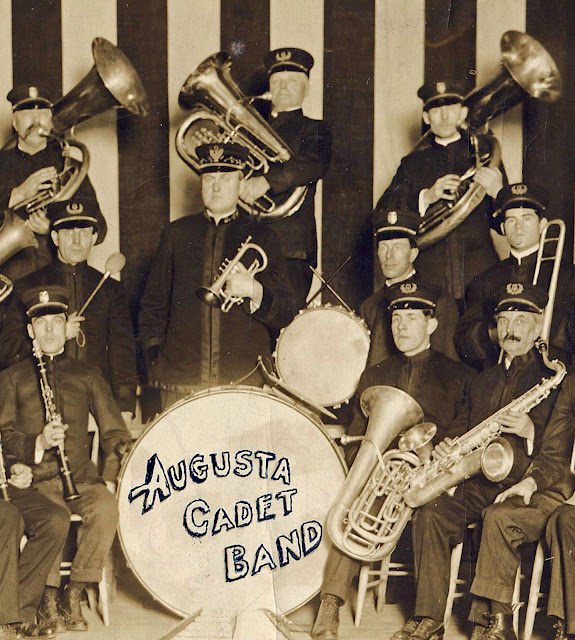
Augusta Cadet Band


There are 15 towns or cities named Augusta scattered around the United States, so a proper identification might have taken longer to discover except that when I purchased this photo it came with a few other photos from a family estate in Augusta, Maine. With this information it was easy to find the band in the Augusta and Kennebec County directories. The director and manager of the Augusta Cadet Band was Frank A. Dennis. He is the man holding a cornet who stands behind the drum.
 
1905 Kennebec County, Maine
Resident and Business Directory

Frank A. Dennis ran an business advertisement for his music store at 233 Water Street in Augusta where he bought, sold, exchanged and rented musical instruments. Besides the Cadet Band, he also directed the Dennis' Orchestra. Both had twenty-five men, which is the count we see in the full photograph.


It's a large 9½ x 7 inch photograph, unmounted on thin photo paper, and marked on the lower left with just the photographer's name, Mansur. Posed on a small indoor stage, the 25 bandsmen are all dressed in modest military cadet uniforms and hats, though two have fancier embroidered tunics. Two men have hat badges that read Augusta, but most are simple music lyres. However Mr. Dennis' hat badge is an eagle with an gold leaf trim, a suitable insignia for a band leader. Other than the name written in ink on the drum, there are no other marks, except for a little eye shadow and lip gloss applied to one clarinetist's face. To judge from their uniforms the photo might have been taken any time from 1900 to 1930, or even 1950.   
 
If only there was a good clue to date the photo.
 
 Surprisingly it is right there
in the good old star and stripes.

 
46 star flag of the United States of America
4 July 1908 – 3 July 1912
Source: Wikimedia


Hanging on the wall behind the Augusta Cadet Band is a large American flag. Though not all of it is visible, there are enough stars showing to see that it is not the pattern of our present day 50 star flag, or the preceding 49 and 48 star flags. It's the 46 star banner issued on 4 July 1908 after the admittance of the state of Oklahoma. It lasted just four years until July 1912 when New Mexico and Arizona joined the union. That puts the photo of the Augusta Cadet Band in a relatively small window of time between 1908 and 1912. My suspicion is that the band was preparing for a concert on Memorial Day, Flag Day (June 14), or the 4th of July.
 
Augusta is the state capital of Maine, situated on the Kennebec River about 109 miles inland from the Atlantic coast. In 1910 its population was 13,211 citizens, which is pretty small for a capital city. Over the past century that number has changed very little, as Augusta's 2020 census count is now just 18,899. In comparison, Portland, the largest city in Maine, had 58,571 people in 1910. We saw a few of them in my story about a 1870's photo of another Maine band, Before the Parade.          
 
Like the Portland brass band in that cabinet photo,  of the Augusta Cadet Band was a band of professional musicians engaged to provide concerts for all kinds of events like parades, political rallies, fraternal society conventions, and county fairs. For indoor events like balls and graduations, Mr. Dennis could produce an orchestra, hiring string players to augment his best wind soloists. But the Cadet Band was likely the best known group in a capital city like Augusta.

 
Source: Smithsonian Online Virtual Archives
Hazen Collection of Band Photographs and Ephemera
Augusta Cadet Band, Maine

The Smithsonian archives has two photos of the Augusta Cadet Band, found in the Hazen Collection of Band Photographs and Ephemera. Both are taken outdoors at some park and both are undated. The first has 25 musicians and a bass drum with lettering very like the handwritten name on my photo, which suggests they were both taken about the same time. Perhaps the drum was a new acquisition for the band and had not yet been painted. Several faces find a match between the photos. Mr. Dennis stands at the back, left center, behind two trombones. His distinctive eagle hat badge is clear. In the background are several men wearing fez caps eating at tall plank tables, so I think this is an oyster roast for a Masonic lodge. 
 
 
The second photo of the Cadent Band is at a similar, if not the same, park location but there are only 20 bandsmen. This time the bass drum has different lettering. Perhaps the drummer struck a bit too hard and busted the drum head, requiring a replacement. That would be another reason for the blank drum head in my photo. Again there are several musicians who appear in all three photos. The horn player with the handlebar mustache is one, as is the tenor saxophonist. Here the band's leader, Frank A. Dennis, is standing to the right of the bass drum and clearly is the tallest man in the group.
 
 
Source: Smithsonian Online Virtual Archives
Hazen Collection of Band Photographs and Ephemera
Augusta Cadet Band, Maine

From the 1870s to the 1920s, the cornet was the premier solo instrument in America. Many talented cornet players like Frank Dennis built successful careers by performing and teaching their instrument. Born in 1868, the second youngest of a farming family of seven children, Frank Arthur Dennis was only 20 years old when his name was listed in the 1888 Augusta city directory as leading three different ensembles: the August Concert Band, the Dennis Orchestra, and the St. Joseph's Brass Band. Forty years later he was still listed as leading his orchestra and the band. 
 
It was not uncommon for a band leader/cornetist to set up a music store. A music shop on a city's main street that offered music lessons, sheet music, and musical instruments provided a cultural hub for meeting fellow musicians and clients looking to book a band or a music teacher. In many ways, Frank Dennis' life follows Ralph L. Reinewald, a cornet player in nearby Portsmouth, New Hampshire, whose story I wrote about in The Leader of the Dover Cornet Band
 
That 2014 story was also based on a small collection of antique photos I found listed from an estate. For the Augusta Cadet Band, I acquired several photos that I believe came from one of Frank A. Dennis' descendants. It included this handsome photograph of a young trombonist. 


It's a very nice 3/4 portrait in an oval mount cabinet card. The camera lens caught the fine detail of the trombonist's fancy embroidered tunic, the engraved pattern on his trombone, and even the music notation on the music stand beside him. His name is written on the back:
 
 Chas. Pike
played in
father's band
and orchestra.


Charles Albert Pike was born in 1886, and his portrait has the look of a graduation picture. The photographer, E. E. Bond, operated a studio in Augusta only from 1901 to 1904, so judging from Charles' fresh mustache I think the photo was taken in about 1903-04 when he was about age 18-20. The studio at 239 Waters St. was in the same block, if not the same building, as Mr. Dennis' music shop at No. 233. Curiously Bond's studio was taken over in 1905 by Clarence B. Pike, so there may be a family connection. Charles Pike  appears in all three photos of the Augusta Cadet Band and may have been the principal player. According to his draft card and the U.S. consulate registration papers  papers, Charles chose dentistry as a career and for a time lived in Winnipeg, Canada with his wife Sarah Ingalls Pike. 


The Augusta band could boast of a formidable low brass section with four trombones, two helicons, and a tuba. It also had three French horns which were not common in small town bands, and usually found only in larger so-called "military" or "marine" bands. Military bands typically included a bassoon which the Augusta does not have, but its tenor saxophonist was a good substitute for that musical color.
 
Sharp-eyed readers may have spotted an unusual brass instrument next to the drum. It's a double-bell euphonium, similar to the instrument I featured my story of The Citizen's Band of South New Berlin, New York back in May 2021. In the 1900-1920 era, the double-bell euphonium was not uncommon to find in large bands like the Augusta band or even small brass bands like in South New Berlin. Its musical function was as a novelty solo instrument where the valve configuration allowed the player to instantly change the sound from the larger baritone bell to the smaller treble bell. But the euphonium in Augusta has a contrary twist to its plumbing design which positions the little bell on the player's left side, the mirror opposite of the euphonium in South New Berlin.


The Augusta euphonium appears in the first photo from the Smithsonian's Hazen collection but not in the second which adds another clue that suggests my photo was contemporary to the time of that first park photo. Taken all together, the musical life of Frank Dennis and his Augusta Cadet Band was not much different from other American bands of this era. Except for one thing.

 
There was one instrument that set the Augusta Cadet Band apart, not only from other town bands, but from every professional and amateur musical group too. It was a musical oddity that I have never seen in any photo of an American wind ensemble. It was so unusual that Frank Dennis took a photo of it all by itself.
 
 It is called an Ophicleide.
 

The ophicleide is a keyed brass instrument invented in 1817 by a French instrument maker, Jean Hilaire Asté, (also known as Halary or Haleri) with a patent date of 1821. Its sound is produced just like other brass instruments by the player vibrating their lips into a cupped mouthpiece. But instead of an assembly of tubing linked by valves, the ophicleide is a fully conical instrument, not unlike a folded-up alphorn, with 9 or sometimes 11 holes covered by keyed pads that open to change its pitch. The name ophicliede comes from the Greek words for keyed serpent. Though it superficially resembles a saxophone, the key mechanism of an ophicleide does not follow the principles of woodwind instruments and has an entirely different fingering system.


On the back of the small photo, written in ink, is a note. "Backroom (looking out on Kennebec River) as Dennis' Music Store - 233 Water St., Augusta, used for Augusta Cadet Band rehearsals."  The note is a bit confusing since the river is not pictured, but the connection to Mr. Dennis and the Augusta Cadet Band it clear. But why would Frank Dennis have such a thing in his band?
 
The 1817 ophicleide of Jean Hilaire Asté, predates the first piston valve tuba, which received a Prussian patent in 1835. The Belgian instrument maker, Adolphe Sax (1814 – 1894) did not get a  patent on his piston valve saxhorns until 1845, and his saxophones a year later in 1846. In the 1820s the ophicleide added a new baritone or bass voice to a band, at time when only the bassoon could play notes in the lower register. Though the ophicleide was designed as a complete instrument family of different sizes from soprano to contrabass, it was the bass model, like this instrument in the Augusta band, that found favor with opera composers like Berlioz, Mendelssohn, Meyerbeer, Verdi, and even Wagner, who scored their instrumentation to include a part for ophicleide. However as tubas, tenorhorns, and euphoniums soon proved to be more versatile, and easier to play well, they became the dominant low brass instruments and by the 1890s the ophicleide was rarely found outside of France, Belgium and England and then only occasionally in opera orchestras and church bands. To see a British example of an ophicleide from the 1870s, check out my story from May 2019, The Happy Couple.
 
Certainly in America the ophicleide never took hold in brass bands or orchestra, so that's what makes this photo so special. The ophicleide's tone color is similar to the French horn which is why this bandsman stands on that side of the band. But how did he find one and learn to play it?


A few French music instrument companies continued to manufacture the ophicleide in the 1900s, though it seemed to be marketed for church choirboys. I would expect Frank Dennis had a number of their catalogs in his music store, as French-made piston valve cornets, tubas, and assorted other brass were still popular in American bands. Dennis also seemed to have a connection to England too, as there was a cabinet photo of a British army bandsman which came with the Augusta Cadet Band photos. And of course, Quebec, Canada is not too far from Maine. So it is not impossible that Dennis ordered an ophicleide for a French-Canadian or English musician who lived in Augusta. Or maybe he just liked the sound of it from hearing it in a British military band. 


Frank Arthur Dennis died in 1930, aged 62, as did his wife Minnie M. (Dyer) Dennis a few months before, also at the same age. They had two children, Ruby and Raymond. Their son, Raymond Dennis, died in 1928 and is buried next to his parents at the Mount Pleasant cemetery in Augusta. The reference to "Father's band and orchestra" on Charles Pike's photo leads me to believe the annotations were made by Frank's daughter, Ruby M. Dennis Marquardt, with whom Frank was living at the time of his death in the 1930 census. But as usual there are gaps in my research that prevent me from being certain I have all the family history correct. 


The sound of an ophicleide is surprisingly more mellow than its size and shape would suggest. I think the tone color is less brassy and more woodwind-like emphasizing a bit more treble than bass. Here is a splendid demonstration of an ophicleide quartet cleverly performed by Francesco Gibellini on an ophicleide in C.  Extra points if you can sing the words to the tune.     In the original French.


This is my contribution to Sepia Saturday
where time is not measured in calendars 
but in photographs.


The Happy Couple

11 May 2019


Husband and wife,
 side by side.
It's a classic pose
in art and photography.
However in this small carte de visite photo
one half of the happy couple sits
while the other stands.


In the 1860s-1870s when this type photo was popular
usually it was the woman who stood
in order to show off her fine dress.
But here the husband is on display
in a sharp military-style bandsman's uniform


A horsehair plume and star-shaped badge adorns his shako.
Eight shiny buttons and a twisted belt buckle fasten his coat.
The photographer has carefully painted
the collar, sleeve braid, and coat piping red,
and added some gentle rouge to the man's lips and cheeks.
His face, framed by a ribbon of fuzzy beard under his throat,
shows a hint of a smile and a twinkle in his eye
as he looks into the camera,.

It's a fine photograph
but regrettably the bandsman, his wife,
the photographer, and the location is unknown.
Since it was purchased from a dealer in Britain
it is reasonable to assume he is English
but he could easily be Scottish or French too.
In any case this is an early CdV from about 1860-1868.

There is a third subject in the photo to balance the couple's pose.
The bandsman's left hand holds tight to a large brass instrument.
It looks a bit like a saxophone
but is in fact an Ophicleide,
an obsolete instrument that is
no longer played in modern wind bands and orchestras.
It is uncommon to see
an Ophicleide
pictured in early photos of bands,
and even more rare to find a portrait of a musician with one.


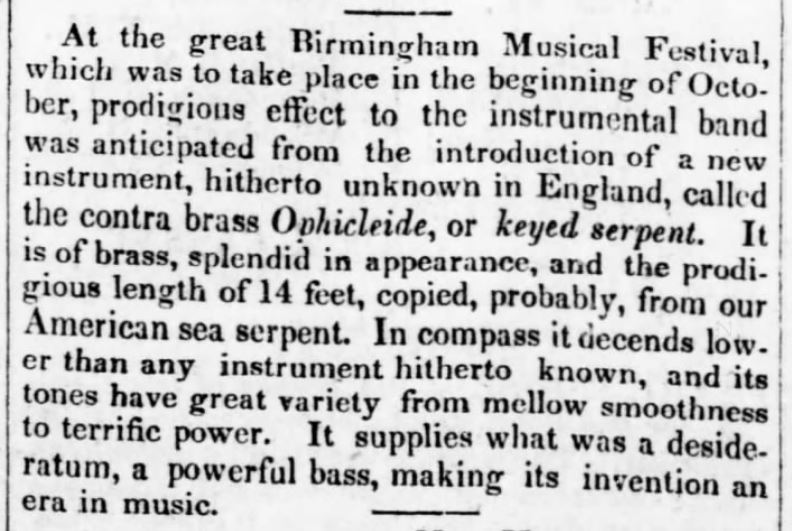
In October 1834, the city of Birmingham, England put on a music festival to showcase its new town hall. The interior concert hall space was reported as 145 feet long, 65 feet high, and 65 feet wide. At one end was placed a pipe organ that was said to rival the organ in York Cathedral in magnificence and power. The musical highlight of the festival was an oratorio entitled David by the now forgotten Austrian composer, Sigismond von Neukomm (1778–1858). This mammoth production had almost a dozen vocal soloists, a choir of 200 from the Birmingham Choral Society, and an orchestra of 400 with 50 violins, 24 viola, 16 violoncellos, and 10 double-basses; "with wind-instruments, etc. in proportion." This instrumental band included a new brass instrument, "hitherto unknown in England, the contra-bass Ophicléide, or keyed serpent." This musical novelty even crossed the Atlantic to appear in the pages of the Pittsburgh Gazette in November 1834.


Pittsburgh PA Gazette
18 November 1834
In the early 19th century, the rapid advances in industrial metalworking and machine tool technology allowed enterprising craftsmen to improve the manufacture of musical instruments. Though brass instruments like trumpets, horns, and trombones had established a place in the bands and orchestra of the early 1800s, there was still one deficiency. There was no horn-type instrument that could sound true bass tones. So in order to add that particular low sonority to the brass family, in 1817 a French instrument maker named Jean Hilaire Asté invented the Ophicléide.

A metal cupped mouthpiece, into which the player buzzes their lips, is inserted in a very long twisted conical tube. Rather than changing the length of the instrument with valves that add more tubing, the ophicleide uses an older method of tone holes covered by key operated pads. Similar to the key pads of a saxophone, the ophicleide keys are different in that they are normally closed and open only when the keys are pressed. Hence the meaning of its name which comes from the Greek for "serpent with keys."  In 2010 I posted a story called The Serpent and the Ophicleide which shows the older version of the serpent without keys. And in 2014 I wrote a story called Mr. Kellogg's Keyed Bugle about a CdV from the same era with a gentleman playing a keyed bugle, another member of the same brass family as the ophicleide.


An Ophicléide consort
Source: Wikipedia
The ophicleide has a full chromatic scale and its keys facilitate rapid note changes that were not possible on other early brass instruments. The tone is broad with good dynamics from soft to very loud. By the 1860s it was a common for them to be featured in orchestra and bands. Felix Mendelssohn and Hector Berlioz were two noted composers who added the bass sound of the ophicleide to their symphonic music. Today those parts are typically played on valved tubas instead.

From roughly 1820 to 1880 the ophicleide's bass sound enhanced the brass section of bands and orchestras. But by the 1880s it's dynamic texture did not match the big sound that the new rotary and piston valve instruments were capable of. The peculiar keyed fingering system of the ophicleide was also a problem as it required special skill that was unlike the other brass or even woodwind instruments. The tuba was just more versatile and easier to play. So by the 1890s the ophicleide became obsolete to composers, ensembles, and brass players.

Like saxophones, clarinets, and other wind instruments, the ophicleide was produced in several different sizes. In this image of an ophicleide consort, I believe my unknown bandsman's instrument is like the one second from left, which was a kind of alto or quinticlave ophicleide.


The bandsman's wife also stares direct into the camera lens.
The photographer tried to cheer up her sour countenance
with a smudge of rouge on her cheeks and lips,
and a dab of gold for her broach and watch.
But as the bandsman's hand presses down on her shoulder
she appears just about ready to scream
and bolt out of the photographer's studio.


If you look closely, her right hand holds the music lyre
that attaches to her husband's ophicleide to hold his sheet music.
 
A sign of marital fidelity? 
Or just a long suffering resignation
that she will always
take second place in her husband's heart? 


Back in July 2013 I posted a story
on a series of humorous French postcards entitled
Monsieur le Curé and his Ophicleide
To illustrate that story I used a short video
by Everson Moraes, a Brazilian Ophicleide player.
Here he is again with a demonstration of
 his alto or quinticlave Ophicleide,
which I believe is the same instrument
in my photo of the happy couple.


***


***

By a curious twist of musical history
the ophicleide never really disappeared in Brazil
but continued as the bass voice in Brazilian choro music.

Here is Everson Moraes's Group
in a terrific performance
a popular Brazilian choro dance tune
with rhythms that even a dour faced wife
could not resist tapping her foot to.

***


***


This is my contribution to Sepia Saturday
click the link to find more testimonials
on the joys of married life.

http://sepiasaturday.blogspot.com/2019/05/sepia-saturday-469-saturday-11th-may.html


Musical Trade Cards

26 October 2018


Darling I am Growing Old.

For Fine Teas, Coffees, and Spices
go to the
IMPERIAL TEA CO.
G. H. Coonrad & Co.
107 Dominick St.     Rome, N. Y.


***


Ah There !

Compliments of
Cluett & Sons,
265 River Street, Troy N. Y.
Pianos and Organs


***


When the Robins Nest Again.

Compliments of
Phil. P. Keil
Dealer in First Class
Pianos and Organs
McKeesport, PA


***


Not English You Know.

Emerson Piano Co.
146A Tremont Street,
Boston.


***


We Lead But Never Follow.


***


Ready For Action.

A. C. Yates & Co.
Sixth & Chestnut Sts.
Best Made Clothing
in Philadelphia


***


Oh You Little Darling!

Grant & Besse,
One Low Price Clothiers
Large, New, Fall Stock
At Lowest Prices,     Hats & Caps,
Opp. Central Hotel,   Westfield, Mass.


***


Oh George Tell Him to Stop!


J. H. Schurtz
—Dealer in—
Staple and Fancy Dry Goods.
Ladies' and Gents' Furnishing Goods,
Notions, Worsteds, German Wool, &c.
418 Atlantic Avenue
Near Bond Street,     Brooklyn, N. Y.


***


Have I Caught Your Eye?


Madame McCabe's
Sanative Corsets.
First Premium, St. Louis, 1887


    A corset to be perfect must support and give grace of outline to the form without constraining it. There cannot be perfect health if the body has not perfect freedom of movement in every part, and the lungs and other organs are not free to perform their functions.
    In Madame McCabe's Sanative Corset, it will be found that the foregoing points have been carefully studied, and the result is a corset in which beauty of shape, perfect and equal support of the body, with absolute freedom of movement to the wearer, are all secured whether the wearer sits, stoops, or reclines, the posture can be assumed with perfect ease and without injury to the corset; in fact, unconstrained movement of the body in exercise, with perfect shape and graceful figure are secured.
    The lungs are free to expand to their fullest capacity, as the expanding back responds to every respiration. The importance of the latter feature is plain, and all physicians will emphasize and endorse it.
    Ladies, who wear this corset are profuse in their praise in that they have found a corset that will give a beautiful and elegant contour to the form without sacrificing either their health or comfort.

Our Agent .................... will be pleased to call and show samples.
Manufactured by the St. Louis Corset Company,
St. Louis, MO


***


The preceding colorful musical images are trade cards
advertising American businesses in operation
from between 1875 to 1895.
These humorous illustrations of musicians,
just a bit larger than a carte de viste photograph at 3" x 4.5",
were printed in France
and sold as fancy stock paper to American printers
who then added the custom information of their local business clients.
I have duplicates of some of the cards
with different stores printed on the back.
The bandsmen are the best clue to the French origin
as their uniforms are in the French military style.
Also the instrument held by the bandsman in
the Grant & Besse clothier card is an ophicleide,
an unusual French bass brass instrument
that use keys like a saxophone rather than valves to change pitch.

Though these advertisements gently satirize the fashions of Paris
they were intended as familiar caricatures of musicians
that the American public of the time could recognize.
The French artists had two important advantages
over early photographers
which was one, the ability to use color,
and two, cheaply reproduce the cartoons in very large quantity.
In the 19th century, trade cards like these
were produced in thousands of charming designs
and collecting them became a popular fad.


This is my contribution to Sepia Saturday
where the writing's on the wall.

http://sepiasaturday.blogspot.com/2018/10/sepia-saturday-442-saturday-27-october.html


nolitbx

  © Blogger template Shush by Ourblogtemplates.com 2009

Back to TOP