It's a nice portrait of a musician,
made more interesting because this older gentleman
holds an unusual coiled brass instrument.
It may look like a French horn, but it really isn't.
Its shape has a superficial similarity
but it has a smaller bell, is only half the length of a horn,
and its three piston valves are played
with the right hand, not the left.
made more interesting because this older gentleman
holds an unusual coiled brass instrument.
It may look like a French horn, but it really isn't.
Its shape has a superficial similarity
but it has a smaller bell, is only half the length of a horn,
and its three piston valves are played
with the right hand, not the left.
Though instruments like this
are often mistaken for a French horn,
and once were even marketed as a replacement for one,
it is not a horn.
It's called a Mellophone,
sometimes known as a Concert or Circular Alto.
are often mistaken for a French horn,
and once were even marketed as a replacement for one,
it is not a horn.
It's called a Mellophone,
sometimes known as a Concert or Circular Alto.
In the early 20th century the mellophone was a popular brass instrument
that occupied a position in a band just above the voice of a trombone.
The way the bell twists sideways to the left
gave it a less strident sound than a euphonium or tenor horn,
and its wider mouthpiece and short cylindrical bore
made it easier to play than the horn.
that occupied a position in a band just above the voice of a trombone.
The way the bell twists sideways to the left
gave it a less strident sound than a euphonium or tenor horn,
and its wider mouthpiece and short cylindrical bore
made it easier to play than the horn.
 |
| 1901 Lyon & Healy Band Instrument Catalog |
The original mellophone design, illustrated here from two band instrument catalogs, followed the basic twist of a French horn but the orchestral horn has its valve keys arranged for the left hand while the bell rests on the knuckles of the right hand and send the sound behind the player giving the horn a characteristic veiled sound. A mellophone player didn't put their hand into the bell but instead held it by the tubing braces so the bell was pointed to the left. The horn is also over 12 feet long and in a lower key than the mellophone. Since brass band music of the late 19th century used a number of instruments pitched in different keys, the mellophone was fitted with extra plumbing bits so it could substitute for a variety of parts. Unfortunately this feature also made it terribly out-of-tune.
 |
| 1927 Sears Roebuck Co. catalog |
In the early 20th century this kind of mellophone was offered by hundreds of band instrument companies in a variety of finishes. Based on the pattern of plumbing in the photo, I believe this gentleman's engraved silver-plated mellophone was sold by the Carl Fischer Music Co. of New York City. Today it would be considered an old fashioned instrument and is now obsolete in bands. However a modern mellophone design was developed in the 1950-60s that bent the bell forward like a trumpet so it could be used in a marching band. Many high school and collegiate
horn students are forced to learn this instrument in order to play it just for outdoor football shows and parades. The new design gives the mellophone a small improvement in sound, but it is strictly a marching instrument that has found no place in concert bands or orchestras.
This concludes the esoteric musical section of my story.
This rather unassuming photo postcard of a mellophone player might have been relegated to the catchall category in my collection of "unknown musician" except that the man took the time to sign his name to his portrait.

"Music hath charms—"
but—?
Otis Dockstader
Nov. 28-1917
but—?
Otis Dockstader
Nov. 28-1917
There is nothing on the back of the postcard
and it seems very likely that this photo was a gift sent with a letter.
Fortunately the name is unique enough that it didn't take long
to find Mr. Dockstader living in Elmira, New York.
and it seems very likely that this photo was a gift sent with a letter.
Fortunately the name is unique enough that it didn't take long
to find Mr. Dockstader living in Elmira, New York.
His three-piece suit and neatly trimmed beard fit his occupation–architect.
 |
1890 Elmira NY city directory |
Born in September 1851, Otis Aldebert Dockstader was the son of a farmer living in Charleston, Pennsylvania. Evidently his parents recognized his potential to have a future beyond farming as Otis was educated at nearby Wellsboro Academy and then Michigan University Academy, followed by post-graduate courses at Cook Academy where he studied civil engineering. (All this information comes from his obituary.) As a young man after the Civil War, Otis worked for the U. S. Coast Survey, the official maritime and coastal chartmaker for the nation which in this era attracted a number of scientists and naturalists.
In 1877 Otis Dockstader secured a position as a draughtsman at an architect's office in Elmira, New York, about 40 miles northeast of Charleston, PA. Following a break of a few years when he was employed as a civil engineer on the Erie railroad, in 1883 Otis returned to Elmira and became a partner with architect Joseph H. Pierce.
In 1890 their architect firm of Pierce & Dockstader produced a brochure of their work called Modern Building which is stored at the Internet Archive. This was also the same year that the partners split up and by a curious coincidence the copy of the brochure found at the Internet Archive is the one Otis Dockstader used to promote his own work. It has Dockstader's rubberstamp on each page and his editorial changes handwritten on the forward material. The brochure is illustrated with plans, drawings, and photos of 21 residential houses, 8 churches, and two schools that Otis Dockstader claimed full or part credit for designing during this period of his career.
These were substantial structures that followed the new American arts & crafts style. Here are some examples of Otis Dockstader's early architectural work with descriptions taken from his brochure.

No. 21 Half-tone from Photo
Built in Elmira, N. Y. in 1886
Semi-detached or "double house." Each side has vestibule, hall, parlor, sitting-room, dining-room, pantry, kitchen, and store-room on first floor; three chambers, balcony and bath-room on second floor; two finished rooms in attic, furnace room, laundry and vegetable room in basement. Finish, oak and pine on grain. Plumbing, very good. Furnace heat. Brick-veneer, first story; frame shingled and sided above. Slate roof. Can be built for $5,500; might cost $7,000.
* * *
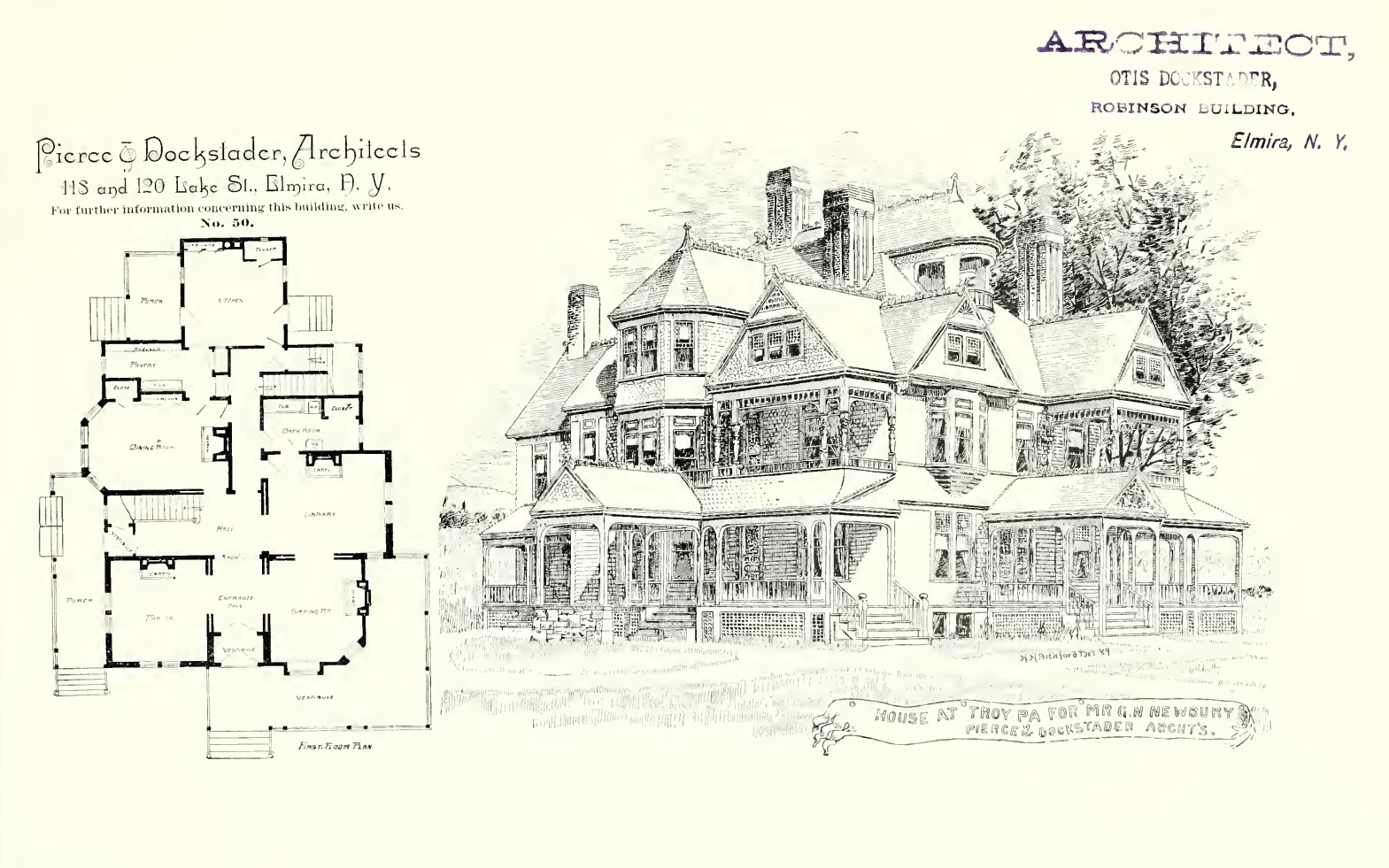
No. 50
Frame house built at Troy, Pa. in 1886
Frame house built at Troy, Pa. in 1886
Has port cochere, ample porches and balconies, vestibule, hall, parlor, sitting-room, library, bathroom, pantry, kitchen, six chambers and large attic. Finished in native woods on grain. $14,000. Reasonable limits of variation in cost, $10,000 to $14,000.
* * *

No. 33 “Half-tone” from Photo
Frame house built at Corning, N. Y.. in 1888.
Frame house built at Corning, N. Y.. in 1888.
Has same number of rooms on each floor as No. 32, and same accommodations, with billiard-room in attic, and laundry in basement. Cost, same as No. 32, $5,000 to $7,000.
 |
| 1889 Shingle Victorian – Corning, NY Otis Dockstader, architect Source: Oldhousedreams.com |
* * *

No. 121
Congregational church built at Berkshire, N. Y., in 1889. Parlors part of old church. Brick veneer with Warsaw bluestone sills, buttress blocks, etc. Ventilation special and very good. Finished in pine painted. Best modern oak pews. Interior and decorations unusually fine. Furniture complete, except organ. Cost to date, including carpets, cushions, etc., $8,200. New, would cost, complete, $9,000 to $12,000.
 |
| First Congregational Church, Berkshire, New York |
* * *

No. 124
Brick veneer church for Parkhurst memorial, Presbyterian church at Elkland, Pa., built in 1889-90. Auditorium seats 300. No gallery. Sunday-school rooms and library over parlors and kitchen, and open into auditorium same as parlors. Finish, native woods on grain. Furnace heat. Ventilation good. Cost not yet fully determined; between $10,000 and $14,000, including organ and all furnishings.
 |
| Parkhurst Memorial Presbyterian church, Elkland, Pennsylvania Source: Google Maps 2018 |
* * *

No. 122.
Stone church now building for Baptist church at Batavia, N. Y., 1890. Auditorium without gallery seats 450; with gallery would seat 600. Has four vestibules, choir and organ loft and choir-room, over two robing rooms and baptistry. The parlor has six Sunday-school rooms opening off, three on each floor, with gallery on second floor. Library over side vestibule, and infant department over pantry and kitchen. Parlor is lighted by clear story windows over dining-room, and will be used for Sunday-school assembly-room. All doors separating Sunday-school rooms and parlors, slide up into pockets, allowing the classes to take seats in their own rooms and take part in general exercises without change. The baptistry is arranged so as to conceal candidates except during the act of baptism. Parlors open into auditorium. Heating and ventilation not yet determined. Will cost complete, including carpets, organ fixtures, etc., about $28,000. Limits of variation in cost, $27,000 to $40,000.
 |
| First Baptist Church, Batavia, New York Source: Google Maps 2021 |
* * *
The other houses and churches in Otis Dockstader's 1890 brochure are equally interesting and handsome designs. They demonstrate an imaginative and detailed approach to creating functional buildings that fit naturally into their urban or suburban locations. [I should also add that I live in a large antique house in the historic district of Asheville, North Carolina which was designed by Richard Sharp Smith (1853–1924). He was an English architect who came to Asheville to work on the famous Biltmore House of George Washington Vanderbilt II. Smith stayed in Asheville and introduced an English Arts & Crafts style architecture to Western North Carolina.]
When this collection was made in 1890, Otis Dockstader had already established himself as a successful architect. Over the next few decades he would go on to design many residential, commercial, and civic buildings throughout New York, Pennsylvania and other Northeastern states.
In 1875 Otis married Olive Mary Kelley and together they had six children, two daughters and four sons. The third son, Ernest A. Dockstader, born in 1890, would join his father's firm as a partner sometime after 1914. Sadly Otis lost his wife Olive who died in 1902 and when he remarried in 1905, his second wife, Narcissa Eva Martinette , died just three years later in 1908. The following year in 1909 Otis married Helen M. Huntington who unfortunately died in 1924.
All of this family information was taken from two family trees found on genealogy websites.
On 25 February 1929, Otis A. Dockstader died at his daughter's home in Schenectady, New York. He was age 77.
One of the constant themes that runs through my stories on this blog is the nature of how an identification of a subject can change how we view a photograph. If Otis had sent his postcard portrait without his name, which would not really be required if it was sent to someone he knew well, then it would just be a picture of an old man with an odd musical instrument. But by signing his photo and adding a date we discover that Otis A. Dockstader, architect, was someone who earned the respect and admiration in his community and profession and clearly had a lasting impact on society.
Though I have been unable to find Otis's name directly connected to a musical group, I do know that in 1917 there were nine bands or orchestras performing in Elmira, NY, which then had a population of around 40,000. The Elmira theatre had a resident orchestra. There was also a women's orchestra; a so-called "colored brass band"; a band made up from Elmira's Polish immigrants; a band from the Elmira Masonic Lodge; and four professional ensembles named for their bandleaders. And of course not listed were numerous school and church music groups.
I don't believe that Otis would have posed for such a formal portrait with an instrument if it was not his own, and besides, a mellophone is not a typical photographer's studio prop. It's fascinating that this man wanted to be remembered for his music making, not for his knowledge of engineering and construction.
Another bit of good luck for this story is that Elmira's newspapers are all digitized on Newspapers.com. Otis regularly saw his name appear in the papers in regards to his building contracts and advertising. But there were personal reports that seem worthy of including in this short biography.
 |
| Elmira NY Star Gazette 4 December 1908 |
On an afternoon in December 1908, Otis Dockstader was leaving a shop in Elmira when he saw that a spirited team of horses driven by a farmer had run over his bicycle. Mr. Docksteader immediately jumped into the street and seized the horses' bridles. Even as they reared onto the sidewalk he maintained control. A woman who was just then about to get into the buggy was saved from injury, and another woman on the sidewalk with a baby carriage narrowly missed being trampled by the horses. Mr. Dockstader explained that the farmer was driving a half broken colt who became frightened by a passing street car. The rim on one of his bicycle wheels was cracked but there was no other damage.
It's not often that I find someone in a my photo collection who qualifies as a genuine hometown hero. Even more rare is finding someone who shares my passion for getting the best fuel economy possible.
 |
| Portland OR Oregonian 25 September 1921 |
In September 1921 it was reported in newspapers around the country that on a recent trip, Otis Dockstader, an architect in Elmira, NY had driven a long trip in his Maxwell automobile. Keeping careful records he determined that he had used 40 gallons of gasoline for the 1,055 mile journey which came out to 26.4 miles per gallon. This nearly matched a Maxwell salesman in Modesto, California who recorded 27 miles to the gallon over a shorter trip. This compared favorably to the Maxwell company's advertised claim of only 22 miles per gallon.
The Maxwell Motor Company was founded in 1904 in Tarrytown, NY and was one of the first car companies to market to women and promote women drivers. The company moved to Michigan in 1914 but was unable to meet expectations. By 1921 financial circumstances forced a sale to Walter P. Chrysler who stopped manufacturing Maxwell cars in 1925.
 |
| Woman's Home Companion October 1916 |
There is one last bit of context for this postcard photo that intrigues me. The short quotation Otis inscribes below his photo is part of a longer line written by the English playwright William Congreve (1670–1729) for his 1697 play "The Mourning Bride".
“Music has charms to soothe a savage breast, to soften rocks, or bend a knotted oak.”
The line appears in the opening part and is often misquoted as "Music hath charms to soothe the savage beast." This is incorrect though the meaning is roughly the same giving music a power to charm even the roughest of people. [Another famous misquoted line comes from the same play by Congreve. "Heav'n has no rage, like love to hatred turn'd, Nor hell a fury, like a woman scorn'd." This is frequently shortened and misquoted as "Hell hath no fury like a woman scorned."]
We can't be sure which way Otis remembered this line, but the empty dash "— but—?" actually says much more when we consider the date, November 28, 1917. It was a Wednesday and the next day was Thanksgiving, a traditional time for family gatherings and community thankfulness. It was also a time of terrible turmoil in the world as of April 1917 America had just joined the great war in Europe.
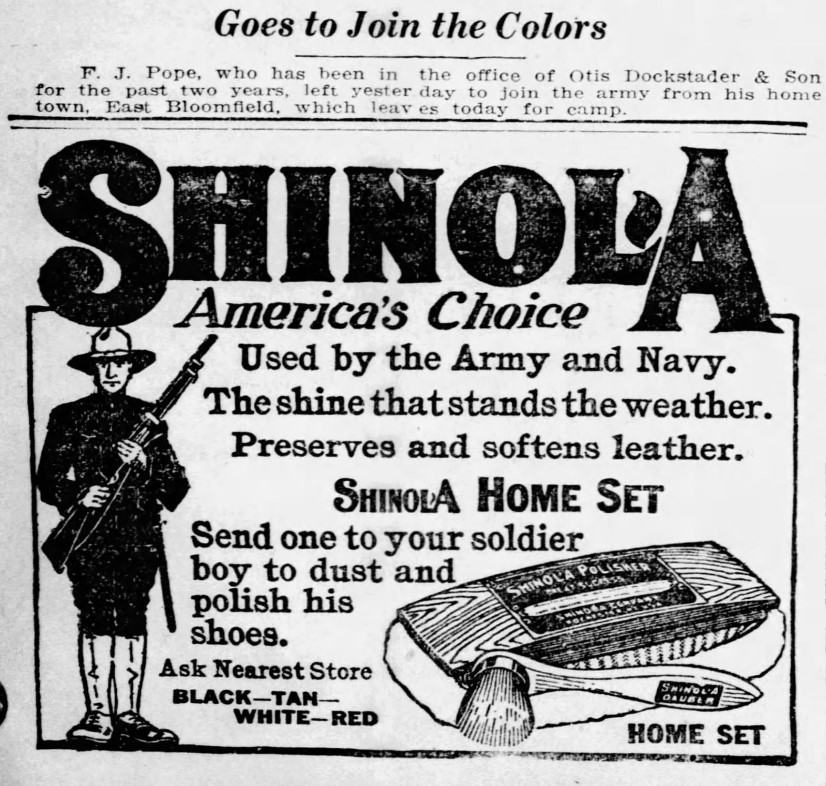
The Elmira newspapers that week were filled with news about the war. There were announcements about war bond drives; notices of soldiers called up; reports of suspected German sabotage; and detailed analysis of battle plans. Two months earlier in September, a short report said F. J. Pope, who worked at the office of Otis Dockstader & Son for the past two years, had been called up for army duty and left for camp.
 |
| Elmira NY Star Gazette 26 September 1917 |
Otis signed his full name, which is something a person would not usually do for a family member like a cousin or son. His abbreviated quote implies a question about the future, a question about music's ability to soothe a savage breast/heart or a beast/despot. Given that the next day was Thanksgiving, this small photo was surely intended as a thoughtful remembrance of the blessings of life and peace.
I've no reason to connect this photo to Mr. F. J. Pope, but Otis's photo and inscription would certainly make a fitting gift for a valued apprentice or close friend who was about to go off to war. Perhaps Otis sent it to a fellow musician who was joining a regimental band, or maybe a business client who enjoyed music. But I think there is purpose and meaning in his quote and date, either for Thanksgiving or for the impending war that so many American men would soon join. It's an expression for best wishes for an unknown tomorrow from a man who knew how to plan for the future.
This is my contribution to Sepia Saturday
where you can never judge a photo by its color.
where you can never judge a photo by its color.