This is a blog about music, photography, history, and culture.
These are photographs from my collection that tell a story about lost time and forgotten music.

Mike Brubaker
{ Click on the image to expand the photo }
Showing posts with label history. Show all posts

Music on the Streets of Paris

26 June 2021


1er Nov. 1901

If I haven't written to you earlier,
it is because there's
nothing new and I haven't yet
seen anyone.
A thousand kisses — Paul


It's a simple message written in French
on the bottom of a
picture postcard.
The caricature shows two scruffy looking street musicians
singing as they accompany themselves on guitar and fiddle.

The postcard was sent
from Belfort, France addressed to
Monsieur Jules Rémond, notaire
at 31 Grande Rue, Besançon, France.


Paul's note is very like the messages still written on millions of postcards today, but in his case he wrote it during the first great age of French cartes postales. The illustration depicts a typical Parisian scene of musical buskers performing outdoors on a public street. Unlike sepia tone photographs from this era, here the publisher is able to add color to the drawing to accentuate the novelty.

The artist was Lubin de Beauvais, (1873–1917), a native of Paris who did many illustrations for French newspapers, children's magazines, and sheet music covers. With his quick pencil he deftly recorded the bohemian life in Paris. He must have produced hundreds of postcard sketches and I have found ten, all sent to the same address during the winter of 1901-02.


The second postcard was posted a few days later on 4 November 1901. Paul writes, "Nothing new, everything is fine. I hope someone will reply to my interesting letter of yesterday."  This card shows a drawing of a trio, a cornetist, trombonist, and a bass drum/cymbal player, with a young boy listening.


The next postcard was sent five days later on 9 November 1901. Paul says, "I am swamped with work: circle (?), conference, confessions, sermon, etc. etc. And then I have no good news."  This card shows a man playing a valved trumpet or cornet while a stout woman blows a trombone. Two children look on from the side.


The next card is dated 12 Nov. 1901 and Paul replies to a telegram he received. The sketch shows three performers, at the front a singer wearing a busted top hat dances while a trombonist and a man with either a flute or clarinet play behind him. 


Two weeks pass and Paul sends another card on 26 November 1901. "Don't despair completely of seeing my prose (writing?). Truly, it's been impossible to find a minute. And however (much) I keep my resolutions, it may even be because of that, I will write later this evening." This caricature shows a man with a mandolin or lute-guitar accompanying an old woman who sings as she does a dance step.


The sixth postcard is dated 6 Xbr 1901, the postmark shows the month is December, not October. The message is the first to connect Paul to the addressee Jules Rémond. He begins, "Dear Parents. Your letter of the day before yesterday killed me. It's lucky that it crossed with another of mine which already replied [ ____ ]. But true, I haven't been able to keep my resolutions any more. I will give you a letter [to the Doctor?]"

The drawing is similar to the last card with another guitarist accompanying a stout woman who is clearly belting out a song in full voice.


On 15 December 1901 a different writer sends a postcard of Lubin de Beauvais's buskers to the Rémond household in Besançon. It is addressed to Madame Chamecin (?) and I think the writer is Paul's father writing to a housekeeper or governess. "We found snow here, but happily it's not been too cold. We're returning to Besançon at 9 o'clock Monday evening. Kisses to all. [ ?]" 

This card shows a trio of two singers, a man and a woman, who also plays guitar, and another man seated behind them with a small keyboard instrument, probably a portable reed organ with pump pedals. The man reads off a sheaf or papers. Beginning in the 16th century, English minstrels often sold printed lyrics of their ballads which told long stories in musical rhyme. This popular songs were called broadsides or broadsheets and were still common into the early 20th century, so I suspect French buskers did the same. In my collection I have found several French postcards from 1910-1930 with printed songs that include lyrics and musical notation.


Besançon is a modest sized city about 230 miles southeast of Paris in eastern France, very near the Swiss border. Belfort, France is a much smaller town, about 55 miles further to the northeast on the way to Mulhouse, France and Bern, Switzerland. Until 1871, it was part of the French département of Haut-Rhin, in Alsace. But during the Franco-Prussian war of 1870-71 Belfort successfully withstood a siege of 103 days against the Prussian army. At the end of the war in 1871 when the Treaty of Frankfurt was negotiated, Belfort was not annexed by Germany as was the rest of Alsace and Lorraine. Instead it was retained as part of France and called the administrative district Territoire de Belfort. 


At the end of December 1901, Paul sends a greeting in Italian to Mademoiselle Marguerite Rémond. "Happy holidays, my dear. I wish you every happiness for this new year." I believe this card was addressed to his sister.

This drawing has an unusual duo of a young boy on violin and an older man with a large harp. The boy holds his instrument like a cello. Their curly hair suggests that they are Italian, as this combination of instruments appears on numerous Italian picture postcards of folk musicians.   


A month later on 25 January 1902, Paul writes, "Dear Parents. No News. I wrote to you yesterday after the dining room of D'. I hope that my letter will have given you almost all the information asked for 19 times by Maman [mom]. Kisses to all."
 
This sketch depicts another duo. With arms akimbo, a large imposing woman sings with full throat while a swarthy man saws away on a violin. Though the loud mechanical noises of modern urban life did not exist in 1902, Paris was far from being a quiet city. Its streets must have echoed at all times of the day with the vibrant sounds of human voices calling, shouting, and singing. I imagine some buskers like this pair earned a good living by being paid to go sing somewhere else.


The tenth and final card was mailed on 30 January 1902, once again to Paul's parents. He reports no news but I think he sends arrangements to visit Besançon. The card displays another singing duo, this time with a male vocalist wearing a straw boater hat. He sings while holding his music or lyrics with more sheets clasped under his arm.


The ten postcards of Lubin de Beauvais are charming sketches demonstrating the lively musical nature of Paris. Beginning with the Exposition Universelle of 1889 when the Eiffel Tower became Paris's iconic symbol, Paris enjoyed a golden age of architecture, fine art, literature, and music. But not all music was high culture, and these buskers probably did more to define the image of the French people's Joie de vivre — Love of life. And 120 years later, the descendants of these buskers are still serenading the visitors and residents of Paris.


 * * *


 Special thanks go to my multi-talented wife, Charlotte,
for providing translations of these postcard messages.


Initially I wondered, who was Paul?
A student? A soldier?
A government worker?
Did his short notes leave any clues?
 
It was very helpful that he included a greeting to his parents,
whose home still stands at 31 Grande Rue in Besançon, France.
It's located on a narrow pedestrian-friendly street
where a chic shoe shop occupies the lower floor
of the four story building.


31 Grande Rue, Besançon, France

Jules Rémond's occupation of notaire
was the equivalent to a lawyer or solicitor
providing legal work in contracts and property estates.
 So yesterday after I found the street view of his address,
I decided to search for his son, Paul Rémond,
just to see if there was anything else
I might add to my story of these musical postcards.
 
Not only did I find Paul,
but I discovered that he was no ordinary man.

I'm very pleased to introduce Monseigneur Paul Rémond.


Monseigneur Paul Rémond
Source: Les Enfants & Amis Abadi

 
Paul Rémond was born in Salins, France on 24 September 1873, the eldest of a family of seven children. His father, Jules Rémond, born in Clairvaux-les-Lacs in 1841, settling in Besançon in 1880 to work as a notary. His mother, born in Salins in 1828, was a young cousin of Louis Pasteur.

After his secondary studies Paul went to the University of Besançon where he graduated in 1894 with a degree in letters. He spent another year studying in Germany at the University of Freiburg to improve his German. Then at the age of 22 he entered the French seminary in Rome where in 1899 he obtained the degree of Doctor of Philosophy.

On 30 July 1899, Paul Rémond was ordained a priest in Besançon and on August 3, he celebrated his first mass in the church of Salins where his parents were married, and where he was baptized. From August 1900 he was vicar of the parish of Saint Christophe in Belfort where he stayed for six years. In 1906, he took up the duties of chaplain of the Lycée Victor Hugo in Besançon where he distinguished himself in social actions with students of all faiths. In 1914 he was named an honorary canon of the cathedral of Besançon.


Paul Rémond (r), 1914-18
Source: Les Enfants & Amis Abadi

 
When France mobilized for war with Germany in August 1914, Paul Rémond took up another calling as a territorial infantry lieutenant with the 7th Army Corps. He saw his first combat in November at the Aisne front. By January 1916 he had been promoted to captain and was commanding a machine gun company at Verdun. From the end of 1916 to November 1918, he took part in the battles of Argonne, Champagne, Verdun (for the second time), Lorraine, and the Somme. For his heroic action in 1916, Rémond was awarded the rank of commander, an army citation of merit, and the Legion of Honor. Sadly the war took his youngest brother, Pierre, who was killed in April 1917 at the age of 25.
 
Following the war Monseigneur Rémond was assigned the post of bishop and chaplain inspector general of the French army occupying Germany's Rhineland. From 1923-24 he represented around forty French parishes, eight German bishoprics, and also had jurisdiction over Syria and Lebanon, then administered by France. In this next portrait of Monseigneur Rémond his military medals are pined to his cassock with the Legion of Honor next to his crucifix.


Monseigneur Paul Rémond
Source: Les Enfants & Amis Abadi
 
 
In 1930, following the evacuation of French forces in Germany, Pope Pius XI appointed Monsignor Rémond as the Bishop of Nice. In his first pastoral letter, (Religious Week, 13 July 1930), Rémond wrote, "I come to you ... with the sole desire to raise, to relieve, and to console those who toil and those who suffer, to instruct the ignorant, to defend the oppressed..."

From 1933 to 1939, he took public positions in numerous written interventions and homilies on international issues, both economically and morally, denouncing the desire of men to get rich quickly, their lack of scruples, and the progression of dishonesty and selfishness. But his deepest concern lay with the rise of Nazism. After Hitler came to power in January 1933, Monseigneur Rémond condemned the first anti-Jewish measures. In a sermon delivered on 9 April 1933 in the Church of the Sacred Heart, he denounced "persecutions on grounds of religion" and expressed his "painful sympathy" to the Jewish community, affirming "his desire to soften their sorrows and help them morally and materially". In radio speeches in 1939, Rémond called Germany “the sin of the world” and in 1940, he described Hitler and Stalin as “two gangsters”.

After the fall of France to the German army in June 1940, Monsignor Rémond, like many bishops, initially rallied to the side of Marshall Pétain who became France's prime minister during the time of German occupied France. However he never supported Pétain's collaboration with the Nazis and did not submit to the other leaders of the Vichy government. Strongly opposed to antisemitism in France. In May 1940 Rémond visited the internment camps for foreign Jews and obtained the release of a number of people. In November 1942 he condemned the Italian occupation of Nice, and when Italian troops entered the city in September 1943, he had the French flag raised over his bishopric residence.

During the summer of 1943, Monseigneur Rémond was approached by Moussa Abadi (1910–1997), a Syrian Jew who had taken refuge in Nice and was a member of the French Resistance. He asked Rémond for his help to save Jewish children who were in grave risk of capture and deportation to Nazi concentration camps. Rémond agreed to help, offering to hide the children in safe places at his bishopric residence and at other Catholic institutions in the diocese.  
 
After the German forces entered Nice on 9 September 1943, conditions became very dangerous for Moussa Abadi's secret network. One time the Gestapo arrested two Jewish boys who tried to evade the charge by claiming to be Catholic but they could not provide proof. Warned of the situation by a parish priest, Monsignor Rémond drew up Catholic baptismal and communion certificates for the two boys, along with a letter demanding their release and declaring himself ready, if necessary, to go to Gestapo headquarters in person.
 
With Monseigneur Rémond assistance, Moussa Abadi and Odette Rosenstock (1914–1999), his collaborator and future wife, succeeded in saving 527 Jewish children. For this act of bravery and compassion, on 2 December 1991 Monseigneur Paul Rémond was posthumously honored as one of the Righteous Among the Nations by the Yad Vashem, the World Holocaust Remembrance Center.

Monseigneur Paul Rémond remained bishop of Nice until his death on 24 April 1963 at the age of 90.
 
 
Monseigneur Paul Rémond
Righteous Among the Nations
2 December 1991
Source: Les Enfants & Amis Abadi


"Nothing new
and I haven't yet
seen anyone."
It's a simple message
from a young priest to his parents.

The future seemed bright, but like it is for all of us, it was unknown to Paul Rémond in the winter of 1901-02. He could not imagine the horrors yet to come in 1914 and 1940. Yet his steadfast faith and strength of character guided him to protect people threatened by a horrible evil.
 
It's not unusual that Paul's postcards were preserved. They are colorful happy images of funny musicians in a past age. So it's not surprising that I found them for sale on the internet and bought the lot, since it's eccentric collectors like myself who search for ephemera like this. What is rare is that hidden in these innocent postcards is an extraordinary personal history about a truly courageous and righteous man.

I don't pretend there is any profound connection between these postcards and Monseigneur Rémond's revered ecclesiastical or distinguished military career. The postcards are more like autographs of famous people,  small tokens of celebrity, little mementos of eminence. It's their tangible quality that makes them relics of a real hero worthy of memory.


This is my contribution to Sepia Saturday
where Paris is just
as beautiful in June as it is in April.


The Faceless Statistics of War

10 November 2018

Tomorrow, November 11, 2018 will mark the 100th year since the end of World War I. Here in the United States it was originally designated  in 1919 as Armistice Day by President Woodrow Wilson and ever since November 11 has become "a day to be dedicated to the cause of world peace." In 1954 it was changed to Veterans Day so it could honor the veterans of all wars. Since 1918 those veterans have served American in 30 foreign wars and conflicts. In truth the United States still remains a nation at war, with combat troops serving in many troubled places around the globe.

Yet the casualty statistics of the Great War of 1914-1918 were truly staggering numbers that rapidly exceeded the human cost of wars in previous decades. As the war progressed every nation at war formed special bureaucratic offices to handle the public relations  necessary to sustain the war effort through these difficult times. As victors the allied propaganda still remains part of our societal consciousness, but Germany has evolved much more dramatically through two great wars. So it was surprising to discover this small bit of German ephemera – a postcard with the Great War's statistics from the German perspective of 1917.


_ _ _


AlleRechte vorbehalten. Nachdruck nur mit Genehmigung des Verlags. Gesetzlich geschütz.
All rights reserved. Reproduction only with the permission of the publisher. Protected by law.

Deutschlands Erfolge zu Lande  am Ende des dritten Kriegsjahres
(Hinzu kommen die Erfloge sit August 1917.)

 Germany's successes on land at the end of the third year of the war
(Added to this are the accomplishments of August 1917)
 ______________________________________________________
Gefangene   (ausschließlich der seit August 1917 gemachten Gefangenen)
Prisoners   (excluding prisoners taken since August 1917)

Über 3 Millionen Mann
(darunter 28755 Offiziere, ungefähr die Gesamteinwohnerzahl der Schweiz.)
Over 3 million men
(including 28,755 officers, approximately the total population of Switzerland)

 ______________________________________________________
        Russen . .           9, 500,000  . . .   Russian
        Franzosen . .     4,400,000    . . .  French
        Engländer . .     1,600,000    . . .  English
        Italiener . . .      1,600, 000   . . .   Italian
       Belgier, Serben                                Belgian, Serbian
       und Rumänen 
   1,040,000    . . .  and Romanian
                                   18,140,000

(Ungefähr so viel wie die Gesamteinwohnerzahl Belgiens, Hollands, und der Schweiz.)
(about as much as the total population of Belgium, Holland, and Switzerland.)

Tote und Verwundete (ausschließlich der seit August 1917 hinzugekommenen Verluste):
Dead and wounded (excluding the losses added since August 1917):
 ______________________________________________________
12,156  Geschütze ~ Guns
8, 353 Maschinengewehre ~ machine guns

Geschütze (ausschließlich der seit August 1917 in Italien und Rußland
hinzugekommenen Geschützte und Maschinengewehre):

Guns (excluding guns and machine guns added in Italy and Russia
since August 1917)
 ______________________________________________________

Von Deutschland besetztes feindliches Gebiet am 17 August 1917:
555,500 qkm ~
sq km
Hostile territory occupied by Germany on 17 August 1917:
 
Hinzu kommt noch das seit dem 1 Aug 1917 besetzte Gebiet in Italien und Rußland
In addition there is the area occupied since 1 Aug 1917 in Italy and Russia

Das Deutsche Reich mißt: 540,800 qkm.
The German Reich measures 540,800 square kilometers.
Von den Feinden zur Zeit noch besetztes Gebiet in Europa:
900 qkm im Elsaß.

By the enemies at the time still occupied territory in Europe:
900 square kilometers in in Alsace

Die Gesamtzahl der erbeuteten Geschütze ist ungefähr 12 mal so groß
als die Zahl der gesamten amerik. Geschütze bei Ausbruch des Krieges.
The total number of captured guns is about 12 times greater
than the total number of American guns at the outbreak of war..


The numbers were doubtlessly intended to impress rather than horrify. Numbers to demonstrate the power of the military to protect a besieged people and defeat a multitude of enemies. Numbers of breathtaking size to quell any misapprehension of the German war effort.

This pocket guide to the war was prepared by author O. Schulze, and published by H. M. Hauschild, of Bremen.(The company was established in 1855 and endured the turbulent 20th century to succumb to bankruptcy in 2013)

In the message space on the back of the postcard is a note in purple pencil. I can't make out the first words, but the last are clear.

von Welt Kreig
~
from World War
1914 - 1918


_ _ _


Today the territory of the Federal Republic of Germany or Bundesrepublik Deutschland covers just 357,021 km² (137,847 sq mi) a consequence of both the first and second World Wars. But in 1917 when this postcard was published the German Empire was much larger. The static war of Germany's Western Front in France was not how the war was fought in the east against Russia where the Germans engaged in battles of mobility across what is now Poland and Ukraine. With Germany's ally, the Austrian-Hungarian Empire, the Eastern Front stretched roughly 1,600 miles from the Baltic to the Black Sea. By contrast the line of trenches on the Western Front covered only 440 miles from the North Sea to the Swiss border. And where the allied forces in France suffered a loss of 7,500,000 men between August 1914 and November 11, 1918, Russia and its ally Romania fighting in the East against the Germans, Austrians, and Turks sustained 9,900,000 casualties. It is disturbing that those numbers are frighteningly similar to the exaggerated statistics on this propaganda postcard.

The number that I found most incredible was 3,000,000 prisoners. Very soon after the start of the war, Germany's push through Belgium and early success on the Eastern Front produced huge numbers of captured Belgian and Russian soldiers. By the war's end in 1918 there were  2,415,000 prisoners held in camps all across Germany. This map shows the principal POW camps of WW1 scattered around Germany as small red dots.


Prisoner of War Camps
in Germany
(1914-1918)
Source: The Internet


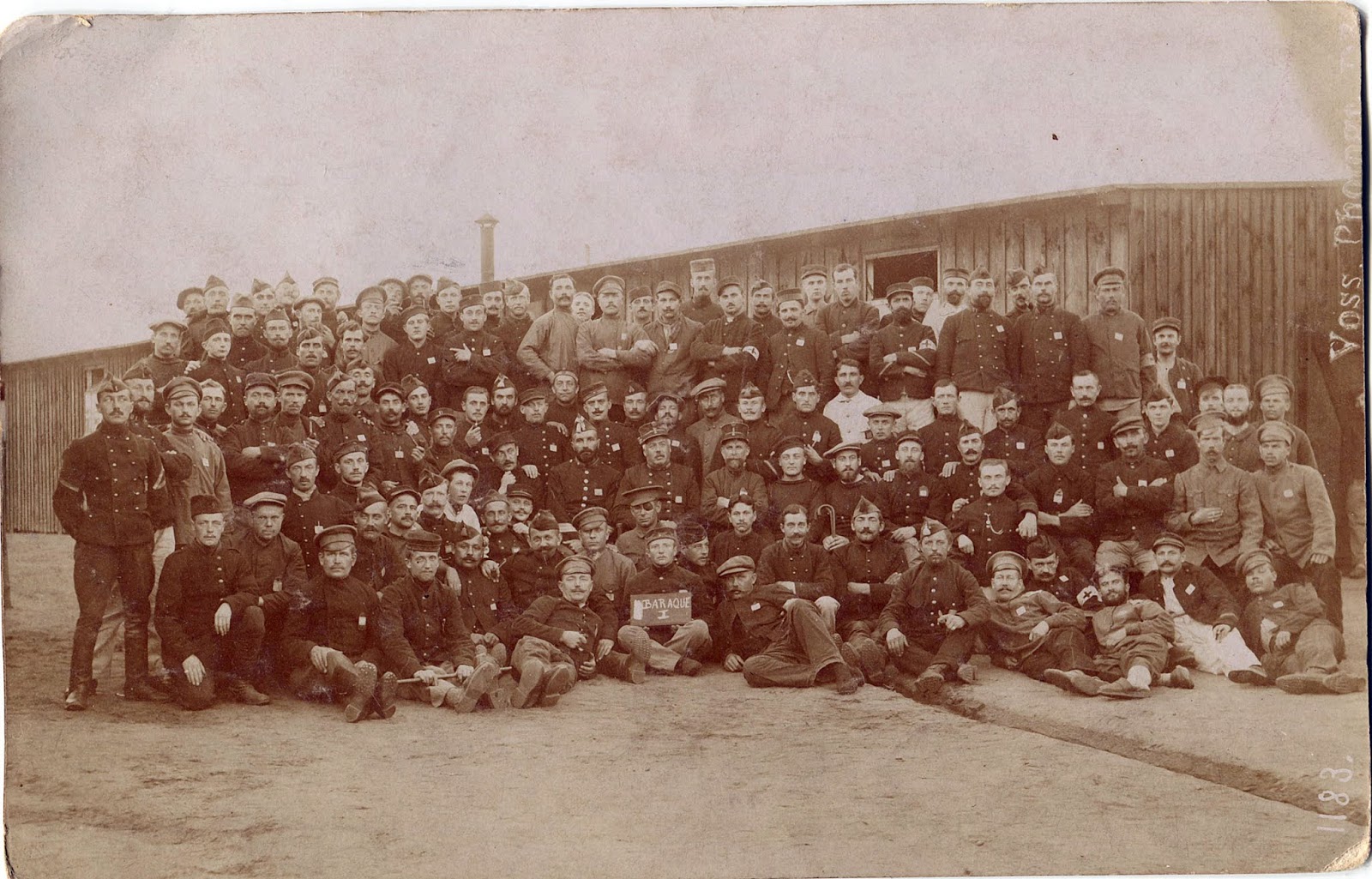
It is very difficult to comprehend just how large that number is within the much larger statistics of the Great War. By way of example here is a group photo of a single barrack at the POW Camp in Göttingen, a university town almost in the center of Germany. Pressed together shoulder to shoulder are ± 111 men, all soldiers of Belgium, France, and Russia. Removed from the war, they were at least safe from death in battle, but nevertheless they still endured guilt at their own survival; sorrow for their fallen comrades; and anger at their impotence to have any further purpose in the war.


It's important to have human faces to remember when we encounter numbers tragic beyond measure. To look into a soldier's eyes that have seen horrible things we can not know is perhaps one way to honor the sacrifice our veterans made for us.


This is my contribution to Sepia Saturday
where photos become monuments to history.

http://sepiasaturday.blogspot.com/2018/11/sepia-saturday-444-10th-november-2018.html


A Memorial Day for a Distant Time and Place

27 May 2016


A token, a souvenir, a memento, a memorial.
Some photographs are endowed
with extra powers of remembrance.
  This photo of grave markers for two soldiers
killed in the Great War of 1914-1918
has a special quality
that makes it
a talisman of memory.

 Smaller than a postcard,
almost wallet sized with creases and a torn corner,
it was once someone's keepsake.
It attracted my attention because the dealer
included a companion photograph.


It's a picture of the gate to a military cemetery.
The sign reads:

Ehren Friedhof

(Honored Cemetery) 
Der Division V. Campe
 
Situated on a flat open landscape,
several wooden grave markers are visible
behind a wooden picket fence
and carefully shaped shrubbery.
In the background is a line of trees
typical of a European country lane.
 

The photos have no message, no notes.
Only the names inscribed on the markers.


{click any image to enlarge}


Hier ruht - (Here lies)

Gefr. (Gefreiter - Corporal) Anton Bukowski
geb.
(geboren - born) 17.1. 1896   
gef.
(gefallener - killed in action) 1.6. 1918
1. M.G.K.
R.J.R. 265


Hier ruht - (Here lies)

Gefr. (Gefreiter - Corporal) Franz Doell
geb. (geboren - born) 12.8. 1885   
gef. (gefallener - killed in action) 1.6. 1918
1. M.G.K.
R.J.R. 265


Two German soldiers, Anton Bukowski, age 22, and Franz Doell, age 32, served together in the same unit and died on the same day, June 1, 1918. They both belonged to the 1. M.G.K. or 1. Maschinengewehrkompanie - 1st Machine Gun Company of the R.J.R. 265 or Reserveinfanterieregiment - Reserve Infantry Regiment No. 265. This regiment was part of the 108th Division of the Imperial Germany Army from 1916 to 1918. During the last months of the war, this division was commanded by General Friedrich von Campe, which explains the subtitle on the cemetery gate, Der Division V Campe or The Division of von Campe.


Composition of 108th Division of the German Army
265th Reserve Infantry Regiment
Source: Histories of Two Hundred and Fifty-One Divisions of the German Army
which Participated in the War (1914-1918)


When the war started in 1914, the machine gun was considered a secondary weapon by most armies involved in the conflict. It was still a relatively new weapon technology, as yet untested against modern military forces, whose commanders belonged to the old school of cavalry charges and attacks of massed riflemen. But Germany invested heavily in this ordnance, and in August 1914 it could field 12,000 machine guns, compared to only a few hundred available to the allied powers. Within weeks this deadly apparatus proved itself to be the dominant weapon of the war.  By 1918 the armament industry of both sides produced hundreds of thousands of machine guns.

Here is a postcard photo of 12 soldiers in a German machine gun company. Their date and unit is unknown but they pose proudly around a very imposing instrument of death, which I believe is the Maschinengewehr 08, or MG08, the standard German machine gun modeled after Hiram S. Maxim's original 1884 Maxim gun.


The internet website, Archive.org, provided a useful resource, published in the USA after the war, entitled Histories of Two Hundred and Fifty-One Divisions of the German Army which Participated in the War (1914-1918).  Page 596 outlines the history of the Reserve Infantry Regiment No. 265.


History of the German 265th Reserve Infantry Regiment
Source: Histories of Two Hundred and Fifty-One Divisions of the German Army
which Participated in the War (1914-1918)


The regiment was formed in 1915 by the merger of several existing but undermanned units. It was sent first to the Eastern Front in the vicinity of what is now Poland, where it fought against the Russian army. In December 1917 it was ordered to the Western Front in France. Most of the recruits were from the Hanseatic cities, principally the Mecklenburg province in North Germany on the Baltic Sea.


The early machine gun with its portable tripod mount was very heavy. When filled with water, the weapon weighed 69 kg (152.1 lb), requiring a crew of several men to operate it. The rapid rate of fire caused these guns to often overheat and jam, so maintaining the water filled jacket around the muzzle and the long belts of ammunition demanded a well trained platoon. This next photo postcard shows a larger group of 20 German soldiers posed with two MG08 machine guns.  Again the photo has no date or identification, but I suspect this unit with its smart, clean uniforms, has just finished its basic gunnery classes, and will soon be off to the front lines.  


***

In 1918 the R.I.R. No. 265 served first in Corbeny in the Aisne department of Picardy in northern France. In April it was reassigned to the Somme river area where it participated in last great German offensive, Operation Michael, also known as the second battle of the Somme. In May 1918, just east of the city of Amiens, France, the R.I.R. 265 relieved troops that had endured fierce combat around Villers-Bretonneux, which was the furthest point that the Germans were ever able to penetrate the British and French line.

A map of the campaign, courtesy of Wikipedia, shows how the front lines shifted as the battle progressed from March to May 1918. In this sector German forces were opposed by Australian, British, French, and Moroccan soldiers.  It was also the first battle to pit British and French tanks against the German's new A7V tank. During this engagement, called the Second Battle of Villers-Bretonneux, from April 24 to 27 the Australian brigades took 2,473 casualties, British casualties numbered 9,529, the French lost about 3,500, and German casualties were between 8,000 – 10,400 men.


It seems likely that Corporals Bukowski and Doell were killed in the support action a few weeks later during a retreat as the German forces withdrew eastwards to the old trench lines.


Operation Michael / Second Battle of the Somme
21 March – 5 April 1918
Source: Wikipedia


Centered on the map above is Proyart, a small village in Picardy between Amiens and Peronne. Just outside the village is a German military cemetery which holds the remains of soldiers killed in this area during the Great War of 1914-1918. It is also the resting place of Anton Bukowski and Franz Doell, as it is the location of the Ehren Friedhof, Der Division V. Campe pictured on my second photo.

By a curious coincidence, the website Findagrave.com, a catalog of cemeteries and grave stones compiled by volunteers from around the world, has just one entry for the Proyart German Military Cemetery. It includes a photograph of a soldier's grave marker that was taken not recently, but shortly after the war ended in November 1918.   


Grave marker of Paul von Kothen
Proyart German Military Cemetery, France
Source: FindaGrave.com

Es starb den Heldentod
fürs Vaterland

(He died a hero's death
for his Fatherland)

Schütze (Rifleman) Paul von Kothen
J.R. 137   3. M.G.K.
geb. 6.1. 1897   gef. 22.6.1918

644.


In the background are a line of trees
silhouetted against a featureless sky.
When compared to the set of trees in my two photographs,
there is a remarkably good match.


I do not know who contributed this photo or whether they are related to Paul von Kothen. By another coincidence, like the other soldiers, this rifleman belonged to a M.G.K. - machine gun company too, and was killed only a few weeks later on 22 June 1918.  His marker is more elaborate than the covered crosses for Bukowski and Doell, and when we look closely through the gate of the Ehren Friedhof photo, we can see both styles of markers. Paul von Kothen's may be one of the three graves centered in the cemetery entrance. The larger marker and inscription may be a tribute to his act of heroism in combat. The markers in all three photos are decorated with flowers with a turf cover that seems fresh, so I judge they were all taken shortly after internment, perhaps 1919. 


***


I acquired the cemetery photos from a dealer who also listed this next postcard photo of a German Army Band. The are dressed in typical field grey uniforms with cloth covers on their Pickelhaube helmets. The number is 265, the same as Bukowski's and Doell's R.I.R. No. 265.


The band leader sits on a sturdy wooden bench. He looks older than 55, maybe 60? Like several of the other musicians, he has a campaign medal ribbon tucked into his tunic. The 26 musicians hold their instruments in a semi-formal way under their arms. Most are seated in front of folding wire music stands, from which, for the benefit of the photographer, they have removed their music folios.


The hazy sepia-tone sky offers no clue as to where they are. It is very flat though, and crude telephone poles mark a distant line in the background. Perhaps they will play a concert for the officers at headquarters. A few men smile but most look very tired. I find it a grim picture, an image of the futility of music trying to withstand the monstrous noise of war.   


The postcard was sent by Feldpost on 4 February 1918, which by that date would be when the 265th regiment was in the Corbeny area, before it moved to the Somme. It was sent to Herr Thr. Binder of Schwiebus, then a part of the Brandenburg province of Prussia, and now a city called Świebodzin in western Poland.


The writer has left his name and address in the stamp box corner. 

Schütze (G?) Binder
P.. inft 265
1. M.G.K.


Rifleman Binder belonged to the same machine gun company
as Corporals Bukowski and Doell.
Together they heard
the band of the R.I.R. No. 265 perform,
sang along to its songs,
whistled its tunes,
and marched to
the rhythm of its drums.

***
   UPDATE 30 May 2016  
Courtesy of a generous reader who likes
the challenge of difficult puzzles, (see comments below)
we have an English translation of the message
on this postcard. Thank you very much, Susanna Rosalie.

4.2.1918
Liebe Eltern und Schwester.
Kann Euch mitteilen,
daß ich jetzt in [...] bin.
Sende Euch eine Ansichtskarte
von unserer Regts-
musik. Bin sonst immer
noch gesund. Wie sieht
es in der Heimat aus?
Die besten Grüße aus dem Felde
sendet Euch Euer Sohn Georg.


Dear parents and sister.
I want to let
you know that I am now at [...].
I am sending you this postcard
showing our Regiments-
Music. Otherwise I am
still healthy. How are
you doing back home?
The best regards from the battlefield
is sending you your son Georg.


From Susanna's information, we learn
that the soldier's name was Georg Binder.
In September 1918, his R.I.R. No. 265
was merged into Reserve Infantry Regiment No. 76.
where Gefreiter Georg Binder remained
in Machine Gun Company No. 2.


Tragically he did not survive to the end of the war,
as in February 1919 he was one of thousands of soldiers
reported missing in the official army casualty lists.

Born 7 February 1896, the same year as Anton Bukowski,
Georg sent the postcard of his regiment's band
to his parents and sister just a few days
before his 22nd birthday.


Binder Georg (Schwiebus, Züllichau)
Verlustlisten 1. Weltkrieg, page 29.399
Source: Der Verein für Computergenealogie


***


Today the Proyart German Military Cemetery is a peaceful place devoid of the horrible cacophony of bullets and artillery shells, where the only mechanical sound comes from tractors and lawn mowers. The wooden markers have been exchanged for more durable metal and concrete crosses set out in long orderly rows. With apologies and thanks to an unnamed photographer, I've borrowed this recent photo of the Proyart cemetery from the internet to show the contrast of its green serenity nearly one hundred years after its devastating turmoil.

German Military Cemetery, Proyart, France
Source: The Internet

Google Maps provides a road view of the gate to the Proyart military cemetery.
Take a moment to spin it around
for a view of the flat Picardy landscape
on the other side of the road.
Trees are a luxury.

***


***


Below is a map of northern France
overlaid by a large cluster of red balloons
scattered around the region of the Somme river.
 
Each one marks the location of a World War 1 military cemetery.
 
There are 280. 

(click this <link> to see zoom in for more detail.)


By the spring of 1918 the European nations reached a stalemate that offered no resolution to a seemingly interminable war. Each of the belligerents tried to outlast the others, hoping that the enemy's government would collapse when exhausted of men and resources. But with the United States joining Britain and France as an ally with very deep pockets, Germany knew it would confront a fresh adversary in the coming summer, so it made one last effort to break the British and French forces.

The casualty numbers for Operation Michael, which include the Second Battle of Villers-Bretonneux, are staggering. From 21 March to 30 April 1918, the British lost 177,739 men - killed, wounded, captured, and missing; the French lost 77,000 soldiers; and the Germans saw over 239,800 casualties. That's 494,539 men, nearly a half million, destroyed by war in one month. And the counting could never be precise, as many soldiers died without a grave, without any record of their death.

A study of history may bring explanations for war, uncover its mistakes, or clarify the thousands of reasons for its origin. But in the end it is always about people embroiled in a pandemonium. Human beings mutilated and sacrificed to an insanity that failed to be contained. There can be no better memorial to those lost lives than that we, their descendants, strive to never allow the madness to escape again.


***


Hidden to one side in the dark soft focus area
of the Ehren Friedhof cemetery photograph
is a figure of a man who appears to be in a military uniform.
He is holding something too.
It's unclear.
It might be just a garden spade.
But I think it is a camera.

A camera that records an image
of the burial place of a fallen soldier.
A small memorial to
a son, a husband, a father, a brother.


After the war, each government created organizations
to account for and tend to the grave sites
of hundreds of thousands of dead and missing soldiers. 
Grieving families were not permitted
or even able to visit these cemeteries
 for many years, even decades.
Their only solace might come
from a small photo of a grave marker.

A token, a souvenir, a memento, a memorial.


This is my contribution to Sepia Saturday
click the link for more bridges.


Music as Metaphor

17 January 2015


This is not a band. There are caricatures of cornets, saxophones, trombones, and tubas, but this is not a band. There is even a fancy French musical title, Concert Patriotique Francais, but this is not a band.

It is actually a joke.

None of the men pictured on this postcard were musicians. They were in fact prominent French politicians, journalists, and writers from the 1890s and 1900s. This postcard, printed in Paris but never posted, shows a satirical drawing of 21 members of the French political right arranged as musicians of a wind band. The title translates as French Patriotic Concert.

I must confess to being disappointed that they were not principal musicians of some grand band as I had originally thought when I purchased the card. Fortunately the artist provided some last names which made research somewhat easier, and I was able to find almost all of the men. The connecting link was that each was associated with the Ligue des Patriotes  or League of Patriots, a right wing society founded in 1882 by the nationalist author and politician Paul Déroulède (pictured in the top right corner). This society was established to demand revanche or revenge for the French defeat in the Franco-Prussian War of 1870-71. It also promoted military training which included gymnastics and rifle shooting.


Marcel Haber (1862 – 1937)
Source: Wikipedia
The man in the top left corner is Marcel Habert (1862 – 1937), a French nationalist politician who became Déroulède's right hand man in managing the Ligue des Patriotes. They were both part of this radical faction's effort to overturn the government of France in 1899 following the intense divisions caused by the infamous Dreyfus Affair. Both men were arrested and brought to trial which resulted in their banishment from France for a period of time and an end to their society. Habert, like most of the other men in this "band", was a notorious anti-Dreyfus and anti-Semitic.

 
François Coppée (1842 – 1908)
Source: Wikipedia

The harp player in the center was François Edouard Joachim Coppée (1842 – 1908), a French poet, playwright, and novelist. Much of his work focused on expressions of sentimentality and patriotism, but he became involved in the Ligue des Patriotes and made public attacks against Alfred Dreyfus.


Maurice Barres (1862 – 1923)
Source: Wikipedia

The horn player at the top left, who is actually holding a cor de chasse, was Maurice Barres (1862 – 1923), a French writer and politician. He became a major leader in the nationalist movement in the 1890s and remained a notable figure during the Great War of 1914-18.


I think it safe to say that all of the men pictured on this postcard are now footnotes of history. Though a few did become parliamentary ministers in various governments of pre-war France, their books, plays, and poetry are now forgotten. This volatile period of political debate in France was a constant struggle between the working classes and the interests of money and privilege. There were also shades of religion, monarchism, colonialism and militarism that were distinctly French issues. Many of the arguments from the far-right Ligue des Patriotes would show up again in 1914 when French nationalism and honor forced the European powers into war.


Source: The Internet

Did these politicians laugh at being portrayed as musicians in a wind band? Did they appreciate the musical metaphor? Was the intent of the satire to praise them for harmony or treat them foolishly as so much brassy noise? I can't say I can tell. Humor never ages well.

The postcard is not uncommon but I've never found one that has a postmark. My best guess is 1900 to 1904, though the original illustration is likely an older newspaper or magazine poster that was reprinted. My postcard is missing a sub-title that is found on other examples where a caption on the lower edge reads: 
La Marseillaise

This is of course, the title of the national anthem of France  written and composed in 1792 by Claude Joseph Rouget de Lisle during the French Revolution. It was adopted as the official anthem of the French Republic in 1795 and remains one of the most recognized national tunes of the world.

The horrific events in France this past week at the newspaper offices of Charlie Hebdo have focused the world's attention on the importance of protecting freedom of expression and especially that of satire. How can any civilized society explain a joke to barbaric people so enveloped by fanaticism that they are insensible to humor? Alas too many disputes in the world today seem to get lost in translation. So just as Je suis Charlie  – I am Charlie, we all become French citizens after this terrible tragedy. 

On January 13, 2015 the lower house of the French parliament, the National Assembly, met for the first time since the terrorist attacks. The assembly leader called for its members to stand for a moment of silence in memory of  the victims. After a few seconds, a single voice begins to sing and then the whole chamber joins in singing the national anthem, La Marseillaise. Apparently this was the first time it has been heard in the assembly since 1918.   


>> <<


>> <<

It is a rare occasion of unity through the power of music. But there is a strange confusion on some of the faces and I think it is not because they are uncomfortable singing in public. I suspect the difficulty is in the anthem's words themselves, written at a time when nationalism and patriotism had connotations of revolutionary violence that seems out of place in the light of current events.

Perhaps the price of liberty, equality, and fraternity is irony.

Here are the words commonly sung from the first stanza and an official English translation from the French department of information. 

La Marseillaise
Allons enfants de la Patrie,

Le jour de gloire est arrivé !

Contre nous de la tyrannie,

L'étendard sanglant est levé, (bis)
Entendez-vous dans les campagnes
Mugir ces féroces soldats ?

Ils viennent jusque dans vos bras
Egorger vos fils, vos compagnes !


Aux armes, citoyens,
Formez vos bataillons,
Marchons, marchons !
Qu'un sang impur

Abreuve nos sillons !


Arise you children of our motherland
Oh now is here our glorious day!
Over us the bloodstained banner
Of tyranny holds sway!
Oh, do you hear there in our fields
The roar of those fierce fighting men ?
Who came right here into our midst
To slaughter sons, wives and kin.

To arms, oh citizens!
Form up in serried ranks!
March on, march on!
And drench our fields
With their tainted blood!


This is my contribution to Sepia Saturday
where every picture tells a story.


nolitbx

  © Blogger template Shush by Ourblogtemplates.com 2009

Back to TOP