This is a blog about music, photography, history, and culture.
These are photographs from my collection that tell a story about lost time and forgotten music.

Mike Brubaker
{ Click on the image to expand the photo }
Showing posts with label cornet. Show all posts

Three Brass Duos

30 August 2025

 
Sometimes it's not the instruments
but the hats and mustaches that persuade
me to add a musician's photo to my collection.


Likewise band uniforms
more than individual instruments
can affect my decision to buy a photo.


And then when I realize
I've acquired musical photos 
that share some attribute
like an instrument combination
or a mix of hats and uniforms
I start looking for similar photos.


Today I present three photos
of pairs of vintage bandsmen
who played cornet and euphonium. 


My first duo are two men wearing dapper bowler hats and sporting tightly twisted mustaches, which, I believe, required a lot of wax. Both have long suit coats though of different lengths. On the left the cornet player's coat is cut at standard business length but has an elegant velvet collar which must have cost extra. The coat on the euphonium player is longer, hemmed at his ankles, and comes with a short cape for foul weather. They have a style that suggests they are members of a professional band like a minstrel show troupe as those ensembles favored long duster style coats. But minstrel  band musicians usually wore top hats not bowlers, so these fellows may just be mates in a local town band.

The photographer of this cabinet card photograph was C. Anson Goodhart of 16 South Railroad St. in Shippensburg, Pennsylvania. On the back is written: 
 B. N. Palmer on Right 

In the Ancestry.com archive I found a Bernard N. Palmer, born 1868, living in Belfast, Pennsylvania, a small township roughly 50 miles west of Shippensburg. In the 1900 census Bernard listed his occupation as "school teacher" and I found his name mentioned as B. N. Palmer in  several county newspapers. However none connected him to a band, much less a euphonium, so this identification is still speculation until I find more clues. Yet I do think the man on the right does look like a teacher.   


* * *


My second cornet euphonium duo are definitely bandsmen as they wear proper uniforms with fancy embroidery. The cornet player on the right seems to have suffered a wardrobe malfunction as his jacket is missing some braid. They are standing outside in front of a heavy canvas wall, presumably a tent. Their caps have a name that unfortunately is too blurred to decipher the letters. It looks like the last three letters are STO which looks Italian and the euphonium player's mustache certainly has an Italian curl. So I can easily imagine they are members of an Italian band featured in a traveling circus or carnival show.  The postcard was not posted but is printed on American paper so I believe it dates from around 1910-1920. 


* * *


My third and final cornet and euphonium duo are the most interesting pair. Two men in formal military dress uniforms pose outdoors at the front of  a canvas tent. Across their chests is a braided cord fastened at the left shoulder with two knotted circular tassels that, I believe, is called a fourragère, not to be confused with a similar cord with metal tips called an aiguillette. I'm not sure why this cord accoutrement appear on military band uniforms but it's a feature that appears in a lot of my photos. (Perhaps one day I'll put together a special story just on uniform ornaments.) In any case these two bandsmen look overdressed for sitting around a campfire. 

The peak of the tent has letters N. G. which are a clue that this is a national guard tent and presumably the men are members of a guard band. But that does not mean they were enlisted soldiers. In earlier times state guard units would go to their annual two week encampment with a hired professional band to play parade marches and provide entertainment. Check out my story from February 2019 The Band at the Old Campground about photos of another euphonium player who was a member of the Washington National Guard band. (Looking back at that story reminds me that I could do a story just on musicians standing in front of tents, too.) 


The back of this unmailed photo postcard are two notes: 
Herb? Long on left
2nd Regiment Marine
Band
A.Town

At first I thought they might actually be bandsmen in the United States Marine Corps. But national guard units in this era were not marines. It took a little more digging in the internet mines to learn they were actually members of the Marine Band of Allentown, Pennsylvania. The band was first organized by local "A.Town" Allentown musicians in January 1903 as a "military" style band, influenced by the popularity of the U. S. Marine Band, the President's Own, and its famous leader John Philip Sousa (1854–1932). In its first year the band presented 131 concerts, almost one every other day, and established a reputation in the region for superior music. In 1907 it formed a connection to a fraternal society The Sons of Veterans Reserve, now known as the Sons of Union Veterans of the Civil War, and became the 2nd Regiment Band, S.V.R. 

I'm not sure how this national society functioned as a state guard, but before the First World War the Allentown S.V.R. along with the Marine Band went to annual "encampments" like in 1907, Scranton; 1908, Walnutport; 1910, Wilkes-Barre; 1911, Mauch Chunk; 1912, Reading; 1913, Gettysburg; 1914, Sunbury; 1915, Gloucester, N. J.; and 1916, Lehighton. 

After the United States joined the war in 1917, the Allentown Marine Band performed for recruiting drives and promotion for war bonds. By the end of the year 22 members of the band enlisted, most joining army bands. According to a history of the Allentown Marine Band published 20 January 1924 by the Allentown Morning Call, one musician "paid the supreme sacrifice.  Henry Herlickler, known as 'Happy', was killed while trumpeting a charge before Sedan in France the day before the armistice, November 10, 1918. He was a member of the 79th Division.  Four other members of the band were gassed or wounded:  Harry Nitz, wounded;  Arthur Stoneback, gassed; Earl Hersh, gassed;  Irwin Boyer, gassed." 

Today the Allentown Marine Band is still in operation and performing concerts in Allentown, though with a new generation of musicians, of course. In March 1972 the Allentown Morning Call published another piece on the organization and included an old undated  photo of the band. Here the Marine Band stands in front of a building, I'm guessing either the city armory or maybe the Sons of Veterans lodge. The band's uniforms are different from what my cornet euphonium duo wear, more military like with jodhpurs and leggings. There are around 40 or more musicians, and I think my cornet player is standing in the front row, fifth from left. I don't see the euphonium player's face, but he might be in the group cut off on the right.


The Allentown Marine Band
Allentown PA Morning Call
11 March 1972

The earlier 1924 history of the Allentown Marine Band included some individual photos of its bandsmen. This picture of Solon Boyer, valve trombonist, charter member, and treasurer of the organization, shows him wearing a uniform identical to that of my cornet and euphonium players. With luck I may be able to track down their names and learn the date and location of my photo. 


Allentown PA Morning Call
20 January 1924


What is remarkable about Allentown's musical heritage is that the 2nd Regiment Marine Band was just one ensemble in a long list of the city's concert bands. Today in 2025 Allentown still enjoys concerts by the Allentown Band, established in 1828; the Pioneer Band of Allentown, established in 1889; the Municipal Band of Allentown, established as a police band in 1923; as well as the Allentown Marine Band, established in 1903. And I've also written two stories about Allentown's Young America boys' band, Two Brothers in Music;  and its Good Shepherd Home for Children orphanage band, Clover the Horse and the Boys Band.  I can't think of any place in North America that can beat a louder drum for music. I wonder, do they ever perform together? 


In earlier times the brilliant sound of a cornet
made it the premier solo instrument of a brass band.
But the sonorous euphonium is equally
a solo instrument in the tenor/baritone range.

So demonstrate the beautiful musical quality
of a cornet and euphonium combination
here is David Koch (Cookie's Music)
playing both instruments, (though not simultaneous!)
 in "A Londonderry Jig" a duet that might easily have been played
by the bandsmen in my three photos.


And as a treat for my Sepia Saturday friends
here is photo of my maternal grandmother,
Blanche Dobbin, before she was married
and was just Blanche Shaw,
sitting on a motorcycle with her cousin Robbie
in Washington, D.C. sometime around 1922.


And yours truly, Mister Mike
sitting on my Yamaha SR500 thumper
in Virginia Beach, circa 1979.


This is my contribution to Sepia Saturday
where some folk have pretty sweet rides.


The Boy Cornetist of Washington, D. C.

28 June 2025

 
The cornet, like all traditional brass instruments, is not very complicated. It has a small mouthpiece for the player to buzz their lips, three piston valves to lengthen or shorten the plumbing giving it a full chromatic range, and a small bell to amplify its sound. Compared to the finger dexterity and arm coordination essential for playing a string instrument like a violin, the skill set needed to play a cornet is pretty straightforward and relatively easy. Yet it still requires dedication to learn and a good ear to play it well, which is true, of course, for any musical instrument. 

I think this boy's portrait shows a young musician shining with confidence in their natural talent and acquired proficiency. He is one of many boys and girls in my antique photo collection who once posed proudly in a photographer's studio with their cornet. In the 19th century children did not dress-up in athletic uniforms for a formal photograph because there were no school sports teams for kids. But back in the day, parents took such delight in their child's musical accomplishments that portraits of a boy or girl holding their instrument were very popular. And by far the instrument most commonly found in these photos is the cornet. And I have dozens and dozens of similar photos in my collection to prove it.


The full picture is on a cabinet card mount and shows this young man leaning on a faux stone newel post with his feet casually crossed. The botanical backdrop and straw on the floor gives an illusion of an outdoor scene. The photographer has also artfully placed him in a fading oval vignette. Unfortunately as the camera shutter opened the boy moved his wrist and the cornet is out of focus. I feel certain it would otherwise show some fancy engraving around the bell.

The photographer's name is not on the front of the card but on the back. It was taken by Paul Tralles of 309 Ninth Street (between D and Penn Avenue) in Washington, D. C. But the best thing about this photo is that the boy's name and a date are written on the back, too. 

Before scrolling down to see the back, take a look at him again and guess his name. I bet you don't even come close.          Here's a clue. It begins with the letter E


The cursive handwriting is clear but has quick twists and it took me some research to figure it out. This young boy cornetist was called Elphonzo Youngs, and the photo was taken on April 10, 1885. He was generally know as Elphonzo Youngs, jr. being named after his father Elphonzo Youngs, a well-known grocer in central Washington. In April 1885 Mr. Youngs advertised 10 lbs bags of granulated sugar for $0.93 and one can of Pure Vermont Maple Syrup for $1.15. His market could also supply fresh oranges imported every week from Florida. Elphonzo Youngs's establishment was "the original no liquor grocer" and was just a block south of Mr. Tralles photography studio.


Washington, D. C. Evening Star
4 April 1885

Mr. Youngs and his wife Amelia's son, Elphonzo junior, was born in December 1870. It's unknown  when the boy began playing the cornet, but Mr. Youngs' grocery was only a two blocks north of the barracks of the "President's Own", the United States Marine Band. And from 1880 to 1892 its band director was the celebrated John Philip Sousa. 

On 13 January 1885 Elphonzo Youngs jr. played his cornet at an event that got him his first notice in one of Washington's newspapers, The Evening Critic, whose office happened to be across the street from the Youngs grocery. A few local businessmen on Ninth Street arranged a free dinner for Washington's newsboys. That evening over 350 boys, white and black, thronged outside a Washington cafe house. As the doors opened the boys rushed in though their boisterous excitement was tempered by a watchful local policeman. A local Sunday school superintendent was master of ceremonies. 

    "There were readings, music, and sensible short addresses to the boys.  The boys were very attentive—often hilarious.  They can sing.  In the chorus of "Hold the Fort" and "In the Sweet Bye-and-Bye" they came out strong.  They "lived" in the chorus.  Good time was kept, and the boys seemed to enjoy the singing immensely.  In the readings policemen were referred to several times.  And when there wore such references, the boys gave Officer Harding, who stood at the head of the room, a benefit.  Between a reading and a song a piping voice about the centre of the room called out "Say Skinny, do you 'spec we'll have turkey?"  This brought down the house.  Five little girls sang a lullaby. 

   "A small boy, Elphonzo Youngs, jr., who gave several airs on the cornet, was encored again and again.  Plates were handed around by ladies, who looked very pretty and very business-like in their white aprons.  They were treated with the greatest respect by the boys.  The empty plates were held as if they were eggshells.  When ladies appeared with the substantials there were "o-h-s" long drawn out and much subdued impatience.  They were all served.  They got a turkey sandwich, cake, apples and oranges and a cup of coffee.  And they liked the repast.  They ate heartily and for a few minutes wore still.  

   "They got away before 10 o'clock, having passed a vote of thanks to the ladies who bad entertained them. 

   "One feature of the evening was an address by Wm. Allen, a veteran newsboy.  He urged the boys to let intoxicants and tobacco alone.  It was a very successful entertainment in every respect." 
 
I bet Mr. Youngs supplied the apples, oranges, and coffee, too.


1891 Washington, D. C., Central High School orchestra
Source: DCGenWeb

Evidently Elphonzo attended Central High School in Washington as I found his name at a website devoted to the history of this school. He is in a picture of the school's orchestra taken from a 1891 school yearbook. Elphonzo is seated on the left with his cornet. He also sang and belonged to the school's boys vocal octet. He is marked standing on right. In other newspaper reports he was described as singing bass. In 1891 Elphonzo would be age 20 which seems old for a high school. The young men and women look more collegiate than scholastic. Perhaps the information on this excerpt for a yearbook is incorrect. But the caption does identify Elphonzo very clearly.


1891 Washington, D. C., Central High School Octette
Source: DCGenWeb


Since his 1885 photograph, Elphonzo had played at many church events, speaker events, and private music school concerts. By the 1890s he was no longer a boy cornetist but a young man making a name for himself. Perhaps he was ready for the Big Apple.


Washington, D.C. Evening Star
9 July 1892


In July 1892 Washington sent a delegation to a huge national Christian conference at Madison Square Garden in New York, where over 24,000 people were in attendance. There was much music performed at this multiday convention which featured choirs of several hundred singers. They were accompanied by "two cornets in addition to a piano and an organ. One of the cornetists (was)  Mr. Elphonzo Youngs, jr., of Washington, a player well known and deservedly popular in his native city.  During the evening's session Mr. Youngs was the only cornetist in the hall, and yet above all these thousands of voices his cornet could be heard leading and supporting the singers.  Mr. Youngs played also at the St. Louis Christian Endeavor convention in 1890."

Though Elphonzo was a talented musician he does not seem to have pursued a career in show business. Instead he worked for his father's grocery company which expanded to several sites in Washington. 

On 25 December 1905 Elphonzo Youngs, sr., died suddenly after being seized by a chill that led to pneumonia. He was a native of New York and a Union Army veteran who, after the war, settled in Washington and opened one of the first temperance grocery firms. One year after his death he garnered some national attention when his will was released.  


Central Law Journal, vol. 63
10 August 1906


   The disgust of a layman with legal phraseology was shown in the will of Elphonzo Youngs, filed here yesterday.  Mr. Youngs was a dignified, well-to-do gentleman, best known for thirty years as a deacon in one of the largest Congregational churches in Washington.  He wrote his will himself, evidently starting out to copy from some book form, which set the example in this wise: 
   "Being by the grace of God in sound mind and body, and mindful of the uncertainty of human life," etc. 
   Then suddenly on the written page there appears a wild dash of ink and the following: 
   "Rats!  This is too formal.  All there is about it is this — at my death, I want my ever faithful and devoted wife, Amelia Loretta L. Youngs to have and control everything I possess." 


In fact Elphonzo Youngs' last will and testament (available on Ancestry.com) was a bit longer—two pages—someone must have persuaded him to add a few instructions about his estate gifts for his son and grandchildren. Yet as wills go, it is still pretty succinct, even though that "wild dash of ink" is not really very wild.


Washington Post
5 July 1928


His son Elphonzo Youngs, jr., died on the 4th of July 1928 of a heart condition while visiting a friend. At the time he was employed as a clerk in the Veterans Bureau. His surviving family included his wife, Phoebe Youngs, and four children. Obituaries noted that he was a trumpet soloist for the Christian Endeavor Society. He was 57 years old.


* * *


For more of my stories
on young cornetists
I recommend:


I wish to thank the unknown person who saved Elphonzo's portrait and whoever signed his name and date to this photo. Having that little extra information transforms an ordinary photo into a genuine human story. It's always a special honor to really meet a person whose picture now resides in my collection. If only we could hear them play.


This is my contribution to Sepia Saturday
where kids don't have
anything to do this summer
except sit around.


The Music Stand

14 June 2025

 
For reasons I can not explain
some vintage photo portraits of musicians,
almost always cornet players,
include an important but often ignored
musical accessory—the folding music stand.


The stands are simple metal contraptions
that add no decorative quality to the photo setting
and only serve a practical purpose
to hold a musician's sheet music.


The design of these music stands has changed very little
since they were first introduced in the 19th century. 
They are light weight, compact, portable and place
the music at a comfortable reading position 
for players of any height.

The odd thing is,
that with rare exception,
(A Tuba Player from Lowville, New York)
it is cornet players who chose 
to have a folding music stand in the photo.

I don't know why.

A slender metal music stand was
an unremarkable photographic prop.
It always came with sheet music,
sometimes clearly visible,
that emphasized or enhanced a musical quality
that was unstated but apparently once understood by viewers.
Trombone players didn't need one in their portrait. 
Likewise clarinetists, violinists, and drummers had their picture taken
without including a common music stand in the scene.
Yet many cornet players felt it was important
to have one in their portrait.

Again, I don't know why.


So today I present a small representation of anonymous cornetists
who demonstrated they could read music.


My first example is a cabinet card photo of a serious looking cornet player dressed in a fine bandsman's uniform and cap. He is unidentified but the photographer was Smith, of Eau Claire, Wisconsin, a city at the confluence of the Eau Claire and Chippewa Rivers, 100 miles east of Minneapolis, Minnesota. On the player's right is a folding music stand with an open folio of music. The camera has "almost" caught the dots in focus.   


The two pages have printed parts to four different compositions. The small size of each part remains the standard for band music even today. When pinned to an instrument's music lyre the part is about 12 inches from a player's nose. Only a few instruments lack an attachment bracket for a lyre. Snare drummers have one on the drum rim and bass drums on the body of the drum. But cymbal players have to memorize their parts. Flute and piccolo players have no room on their instruments for a music lyre and the instruments point toward the player's right side. Instead they use either a long stick with a lyre on it that is clutched under the player's armpit, or a lyre fixed to a wrist band. Pieces of flute and piccolo can sometimes litter a football field after a strenuous marching choreography of a halftime show.    


A second Eau Claire cornetist also had his portrait taken with the same music stand. He is younger  than the other man and clean shaven but wears the same style uniform and cap. His cabinet card is marked from Smith & Donaldson of 102 & 104 Kelsey St. in Eau Claire, Wisconsin. The young man must have paid extra for a premium photo mount as, unlike his companion's photo, his card comes with a very beautiful imprint on the back for the Riverside Art Studio of Smith and Donaldson. Notice the Grecian-Wisconsin maiden is holding a paintbrush and small card (photo?) as she contemplates an idyllic view of the river. 


Eau Claire's name is derived from the original French name, "Eaux Claires", meaning "Clear Waters". The city was first incorporated in 1872 when its population was around 2,300. By 1890 it could boast of 17,415 citizens. The partnership of photographers Frank A. Smith and D. W. Donaldson began in June 1887. But in August 1889 they broke up with Smith continuing the business. That would make these two photos with the double names of Smith & Donaldson and the single name Smith, to date from the summer of 1889. This Wisconsin region had several bands including an Eau Claire Cornet Band, but without clear uniform insignia or other clues to their identification these two cornet players can't be connected to a specific band. 


One last curiosity is the music on the stand. The parts are the same but in the second photo there is a pipe-like thing propped next to the music. At first I thought it was a penny whistle or fife, but it is actually an extra leadpipe for the cornet with its mouthpiece at the bottom. In this era cornets could use another leadpipe to shorten or lengthen the instrument and play in other keys. Why this player thought to add it to the photo is a mystery. Maybe just showing off.


* * *


This next cabinet card portrait shows both the cornet player and his music stand in full view. He sports an impressive brush mustache and wears a formal suit and black bowtie. His concentration on the music makes him appear about ready to play. The photograph was taken at the studio of Hooton & Aukland of Shelby, Iowa. Unfortunately I've been unable to find any records of these photographers. 

Situated in west central Iowa, Shelby is in both Pottawattamie and Shelby counties. It was first platted in 1870 during the great era of America's western railroad expansion and its population in 1870 was around 300. By 1890, which is about when this photograph was taken, it had grown to only 582 and has stayed about the same for the past century. However the big city of Omaha, Nebraska is only 35 miles to the southwest, so I think it likely that both the photographers and the cornet player were only passing through Shelby. The musician's fine formal suit suggests he was a professional entertainer, maybe a member of a vaudeville troupe rather than a band. The position of his music stand also implies his performance is of soloist quality.  


* * *


This next cabinet card photo shows a bandsman dressed in a uniform similar to the two fellows from Eau Claire. It's another full length portrait of both man and his music stand that appears to have them floating in the air as the floor and backdrop are all white. His instrument is technically not a cornet even though it has a similar shape. I'm not entirely sure what it is, but it could be a kind of bass trumpet or a variation of a flugelhorn. In either case it is much longer than a B-flat cornet but not quite as long as a valve trombone. I have other examples of the instrument and I just call it the big cornet.

The photographer was Heitkamp of Shakopee, Minnesota, another photographer whose business records are lost to time. Shakopee is the county seat of Scott County, Minnesota, about 22 miles southwest of Minneapolis. In 1890 Shakopee had a population of 1,757 and 2,047 a decade later in 1900. Situated on a south bank bend of the Minnesota River it is now part of the Minneapolis-Saint Paul metro area. This photo is nicely finished which feels more like late 1890s than 1880s, perhaps 1898, but that's a guess really. I imagine that one day Mr. Heitkamp took a couple dozen photos of each member of this fellow's band. All of them hovering in the air like angels.


* * *


My last photo of a cornetist with his music stand is a serious young man with blond hair and mustache looking directly at the camera. He is dressed in fine suit with pinstriped trousers. His collar is not a clerical collar but has a tie concealed by his coat. He looks German or Nordic to me. Unfortunately there is a glare on his instrument that covers any fancy engraving and likewise his music is bleached out. Nonetheless I think it is a fine portrait.

The photographers were Lowry & Towner of Helena, Montana. Helena was a city literally built on gold as the result of a discovery of gold deposits there in July 1864. According to Helena's Wikipedia entry, "By 1888 about 50 millionaires lived in Helena, more per capita than in any city in the world. They had made their fortunes from gold. It is estimated about $3.6 billion in today's money was extracted from Helena during this period of time. The Last Chance Placer is one of the most famous placer deposits in the western United States. Most of the production occurred before 1868. Much of the placer is now under Helena's streets and buildings." 

The two photographers Lowry and Towner seemed to have started operation in June 1888 and by the following summer of 1889 were gone. Helena also had a German language newspaper, Die Montana German Press and Montana Staats-Zeitung so it's possible that he was a German musician. His suit also reflects wealth more than the wild west. However I don't see him wearing a cowboy hat.


This is my contribution to Sepia Saturday
where some people are rather proud of their favorite chair.


White Tie and Tailcoat - The Well-Dressed Cornetist

29 March 2025

 
It's a style of formal evening dress
that has never gone out of style.


A white tie and black tailcoat
was once high society's mark of a gentleman.
It implied dignified sophistication,
refined culture, gallantry
and polite manners. 


Today it remains a man's preferred attire 
for attending a graduation, a school prom,
a royal gala, an opera performance.
or that most special occasion—his wedding day.


But a formal white tie and tailcoat
can also be a uniform.
It has been, and remains today,
the required outfit
of male musicians who perform 
in a symphony orchestra.


Today I present 
four very well-dressed cornetists
who once posed for their portraits.
Their names are unknown
but their musical talent still shines through
and the gleam on their instruments
remains untarnished.


My first cornet player hails from Fond du Lac, Wisconsin where he posed for the camera at the photography studio of Kafer & Co. on the corner of Main and 2nd St. He holds a B-flat cornet with a bell embellished with fancy engraving. His mustache is carefully waxed to an impressive handlebar style that would certainly emphasize his embouchure when playing. 

This cabinet card photo was likely taken in the 1890s. Fond du Lac is on the southern end of Lake Winnebago and in the 1880-1900 era was a thriving city with a population of around 13,000 to 15,000. 


* * *


My second cornetist is a young man who opted for a clean shaven style. His pose is similar to the Wisconsin player with a far-off gaze as if watching for a conductor cue to play. His cabinet card photo was produced by the Loryea Bros. of San Jose, California at 26 S. First Street. Back in the 1890s when this photo was probably taken, San Jose was not much larger than Fond du Lac with a population of 18,000.

The Leryea Brothers called their studio the Souvenir Gallery and had an elaborate imprinted on the back of the card mount. There is a single name written in the upper corner but I can't make out the first letter. Tamma or Jamma? It doesn't look like a common first or last name. Any guesses? 


* * *


My third well-dressed cornetist is from Hartford, Connecticut where he posed with his instrument at the Stuart photography studio. His mustache has a tiny bit of an upturned curl that I think hints of a Germanic heritage, but that could just be a false twist. In 1890 Hartford was over twice the size of San Jose or Fond du Lac with a population then of 53,230. From 1874 to 1891 Hartford was the home of  Samuel Clemens/Mark Twain so it's possible that Sam might have heard this cornetist play in concert.  


* * *


My final cornetist is a very debonair young man with a trimmed mustache and a fancy engraved cornet. He is from Boston, Massachusetts where his photo was taken by Charles C. Fisher of 74 Meridian St. in East Boston. Boston, of course, was a big city even in the 1890s and arguably one of the most musical places in North America with numerous theaters and many professional musicians. 

The celebrated Boston Symphony was founded in 1881 as the third major orchestra in America.  The New York Philharmonic was the first, established in 1842, followed by the St. Louis Symphony in 1880. After Boston came the Detroit Symphony in 1887, the Chicago Symphony in 1891, the New Haven Symphony in 1894, the Cincinnati Symphony in 1895, the Pittsburgh Symphony in 1895, and the Philadelphia Orchestra in 1900. According to a Wikipedia entry on the San Jose Symphony Orchestra, there was a orchestra there in 1879 that gave occasional performances but a formal symphony association was not formed until 1937. Similarly in Hartford, its symphony orchestra started in 1934. But as far as I know there has never been 
a symphony orchestra in Fond du Lac. 

Other than their formal attire, there really isn't anything in the portraits of these four stylish cornetists that connects them to an orchestra. But it's unlikely that an amateur musicians would wear such an elegant suits or play such first-class instruments. I think it's very possible that they were concert artists or principal musicians as in the 19th century the cornet was the premier solo instrument of both bands and orchestras. 

Very long time readers might remember the Boston cornet player as he was featured in A Boston Love Story which I posted in August 2011. It was my first effort at writing a short fiction based on old photos in my collection. I am rather proud of it, in part because I found this young man a companion, though it was a courtship that was not to be. But I shouldn't give away the ending. Perhaps I should write stories for the other three cornet players and turn them into a romance series!


This is my contribution to Sepia Saturday
where a good book can be worth a thousand photos.


The Boy Cornetist

15 February 2025

 
It was the premier musical instrument of the era.
More popular than the violin or piano,
the cornet was the instrument that exemplified
America's vibrant musical culture in the late 19th century.


The cornet's brilliant sound
inspired thousands of men and boys
to master its musical challenges 
as every town of any size had a brass band
to perform at civic holidays and other occasions. 


Young boys learned the names
of celebrated cornet soloists
like Arban, Arbuckle, Bellstedt, Levy, and Liberati *
just like boys in later decades
would idolize baseball or football players.


Some youngsters had a natural gift for the cornet
and quickly achieved such a high level of musicianship
that they were awarded a solo place on America's concert stages.


Today I present a collection
of four young boys who played the cornet
and once posed for a formal portrait photograph.
No doubt it made their mothers proud
to display pictures of such talented sons.


My first youngster is standing next to a rustic fence and a faded pastoral backdrop. I think he is about age 6 or 8. He is dressed in a dark woolen suit with knee britches, pillbox cap, and fine leather shoes that have ten buttons and a scalloped topline. His cornet is a shiny piston valve instrument that I believe is pitched in B-flat. I can't say for sure that he was a professional solo entertainer but he could easily be a member of a family band. 

The cabinet card mount is a dark maroon cardstock with the imprint of the photographer F. W. Allderige of New Britain, Connecticut. He was the son of William Allderige an Englishman who came to America and set up a photography studio there. F. W. Allderige took over from his father in the mid-1880s and continued the business into the 1900s. I believe this photo dates from the late 1880s.


* * *


My second boy cornetist is older, perhaps age 12-14, and more fashionably dressed in a dark corduroy suit with wide bowtie, watch fob and chain, knee britches, and leather slippers, a mark of a professional entertainer. His instrument is another B-flat cornet with a hint of fancy engraving on the bell. Unfortunately his name is not noted on the back so he must remain anonymous until I discover more information.

The photographer is Worden of 48 Winter Street in Boston, Massachusetts. This cabinet photo is an unusual elongated mount with gold edges. I date it to the late 1880s or early 1890s. 


* * *


Boston Globe
10 July 1887

There is nothing unusual in any boy deciding to learn to play a brass instrument. Thousands of boys in this era did that. But only the most talented gave public concerts as professional artists, usually accompanied by a band of adult musicians. They were promoted as a "boy cornet soloist" which makes them easy to find in the newspaper archives. In Boston there were dozens of venues along the coast of Massachusetts that hired bands for the summer season. In Crescent Beach the Salem Brass Band gave free concerts, afternoon and evening, and in July 1887 had the "wonderful boy cornet soloist" Master Willie Cushing as a guest artist.  


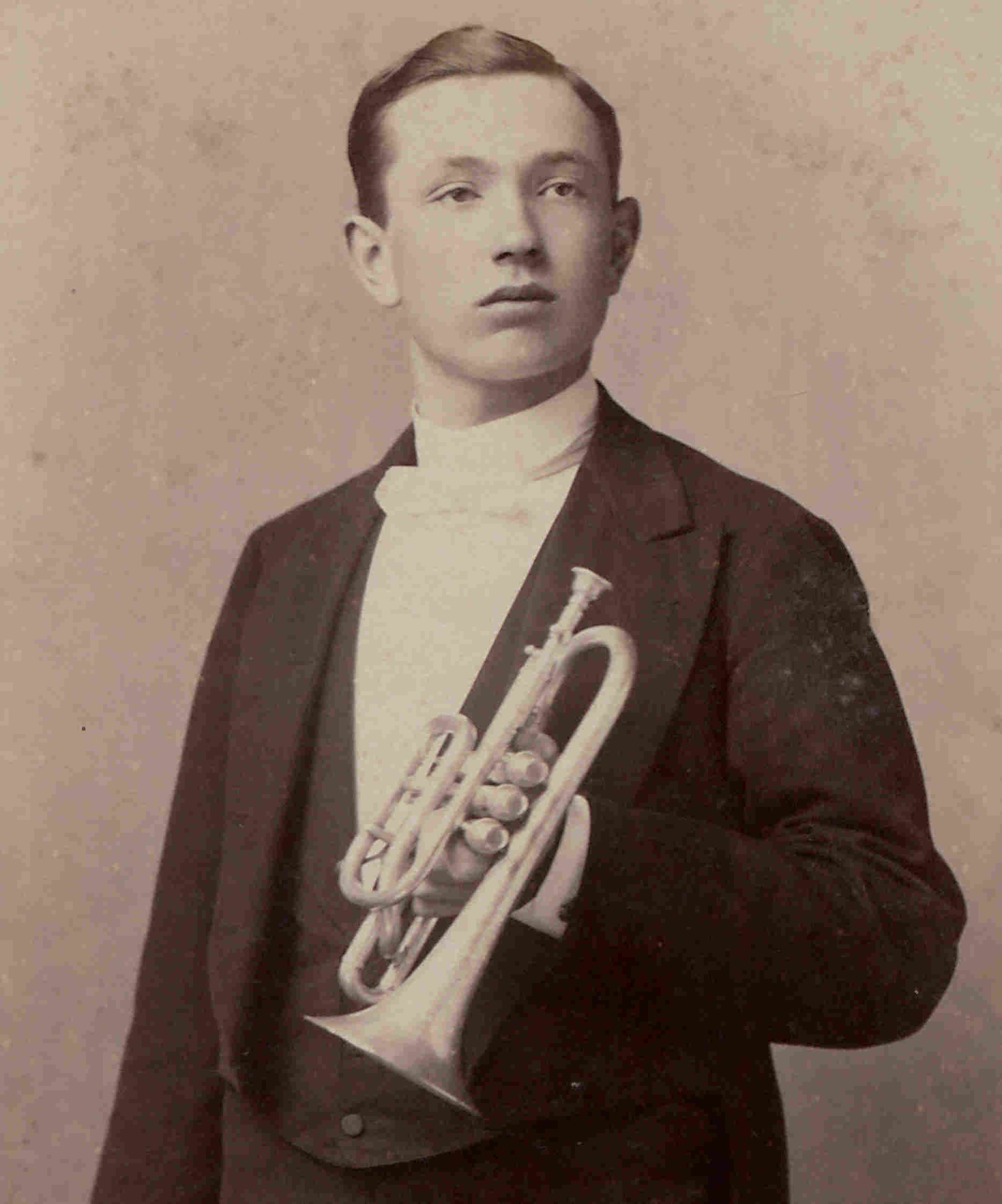
My third boy cornet is wearing a nearly identical outfit as the boy from Boston except that here the material is velvet. Otherwise it is the same wide bowtie, watch fob chain, short britches, and fine leather slippers. His blonde hair is almost lost in the light of the photographer's studio. I think he is a similar age to the previous boy, perhaps around 12-14 years old.


This boy's instrument is of an unusual design called a "pocket cornet". It is essentially the same length of tubing as the other cornets but is twisted tighter to make it compact and thereby pocket-sized.   


Philadelphia Times
2 June 1888

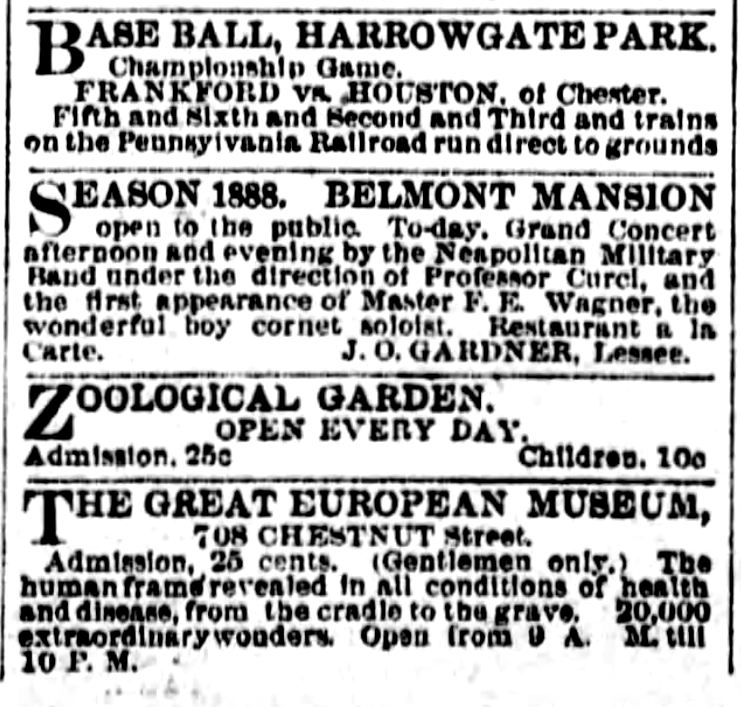
Like Boston, Philadelphia had lots of restaurants that engaged bands to entertain and attract patrons. In June 1888 the Belmont Mansion had the Neapolitan Military Band under the direction of Professor Curci perform two concerts a day. Their special guest was Master F. E. Wagner, the "wonderful boy cornet soloist". The restaurant was "a la Carte". 

The photographer for this cabinet card was Harry A. Webb, an "art photographer" located at 112 & 114 N. 9th Street in Philadelphia. The back of the photo has a fancy illustration typical of photos from the 1890s. The handwritten number at the bottom is most likely the photographer's notation of the negative file.


* * *


The previous two boys, and possibly the first boy, too, were surely "professional" child entertainers just based on their wardrobe. Normal boys don't walk around in slippers or have watch fobs. Evidently they had sufficient musical talent that some adult, usually a parent, decided to get the boys to perform for the public who, of course, would pay money to hear them. This kind of child entertainment was quite common in showbiz, especially in music, but in the 1880s many people saw these child entertainers as a wanton exploitation bordering on child abuse. Progressive societies demanded that civic officials put an end to this mistreatment and protect the child stars. In April 1885 a controversy arose in Brooklyn, New York over Master E. Clarence Worrall, a local boy cornetist, who was set to play concerts at a private "Musee" or museum in French. The mayor of Brooklyn was asked to intervene.


Brooklyn Eagle
6 April 1885

CAN'T BLOW HIS LITTLE HORN.

Mayor Grace Prevents a Brooklyn Prodigy
from Playing at the Eden Musee. 

A few days ago Mr. Elbridge T. Gerry caused the parents of Master E. Clarence Worrall, a very juvenile Brooklyn cornetist, to withdraw him from the Eden Musee, where he has been serving as an attraction under the caption of an infant cornetist.  The father appealed to Mayor Grace through Rev. Father E. J. O'Reilly, of St. Stephen's Church, and backed up the latter's words with testimony from Dr. George R. Kuhu, of this city, and Mr. Patrick S. Gilmore, the one saying that the boy was in good health and the other that cornet playing was a delightful and harmless exercise for an infant.  The Mayer looked at the boy himself, and then decided in favor of Mr. Gerry and his Society for the Prevention of Cruelty to Children, on the ground that the boy did not look healthy and was too little, anyway, to appear in public, even if he was a prodigy. 


One of young Worrall's advocates was Patrick Sarsfield Gilmore (1829–1892), an Irish-American composer and musician who was one of the most esteemed bandleaders of his time.  In the end the boy, E. Clarence Worrall, found an acceptable workaround and went on to play shows in the New York metro area. He achieved some success as his career extended into the next decade when he was recognized as a popular soloist and band leader. 


My final boy cornetist follows the same fashion as the other boys, though his suit looks more like a worsted wool material. Again he has a broad bowtie and a watch fob, though his mother has opted for high button shoes. He looks about age 12-14 and stands next to a faux carved stone plinth in front of a painted floral backdrop. His cornet is better positioned to see the design of the instrument and a hint of engraving on the bell. The photograph was taken in Los Angeles. 

Unlike the other boys this young man has his name recorded on the back of the cabinet photo. He is "Frank Reed, son of Laura Reed, sister of Laura Harpoll".


The photographer was the Sunbeam Art Studio of 236-238 S. Main St. in Los Angeles, California. Despite these good clues the name Frank Reed was too common in record archives to make a proper identification. But I did determine that the Sunbeam Art Studio was first listed in the 1894 Los Angeles city directory. Its proprietors were C. Coules and F. C. Dando. By 1897 they dropped the name Sunbeam Art Studio, added a second location at 313½ Spring St, and used only the 236 S. Main St. address. In the 1899 city directory Coules and Dando were no longer partners. That puts the date of Master Frank Reed's portrait to around 1894 to 1896.


1897 Los Angeles city directory.

On the opposite page in the 1897 Los Angeles city directory was an photo engraving of another photographer, Mr. J. T. Pollock of the Garden City Foto Co. He stands on top a horse-drawn carriage which has a windowless passenger box for his darkroom. On top Mr. Pollock has mounted a camera on a tall ladder. His advertisement claims he is "the only photographers in Los Angeles that are equipped for making views from 25-foot elevation. Largest assortment of choice views to be found in Southern California, at wholesale and retail. Developing and printing for amateurs a specialty. We are here to stay; we have no rent to pay."


* * *


All of these boys resemble a photo featured in Master Eddie Derville - Cornet Soloist, a story from September 2016. In his portrait Master Eddie wears the same style boys suit with a fancy watch fob stylishly displayed. His photo was taken in around 1883 by Charles Eisenmann, one of the best photographers in New York City who specialized in producing promotional photos of theatrical and circus entertainers. In the late 19th century American show business rapidly expanded with entrepreneurs building countless new theaters and music halls in any town where there was a train station. Theater managers needed to sell a lot of tickets to make a profit so it stimulated an explosion of new acts of every  kind. Child performers were a guaranteed draw. At least if they had genuine talent. The most common way for a child to become a performer was as member of a family musical ensemble, often grandly called a family band or orchestra. 

Master Eddie Derville played cornet in his family band and it is quite likely that some of the four boys I have featured here also learned to play their instrument that way too. But I think some could easily have had talent that merited being promoted as a cornet soloist in their own right. The career of a child entertainer was obviously very brief as the novelty of a young soloist didn't attract much public attention once the kid grew up. Did these boys go on to become professional musicians as adults? It is difficult, if not impossible, to know, since all we can see in an anonymous photo is a  single moment of youthful delight and charm. But at that moment the camera shutter clicked surely mama smiled too. 


    * The names correspond to the French cornetist Jean-Baptiste Arban (1825–1889),
                    the Scottish cornetist Matthew Arbuckle (1828–1883), 
                    the German cornetist Herman Bellstedt (1858–1926),
                    the English cornetist Jules Levy (1838–1903),
                    and the Italian cornetist Alessandro Liberati (1847–1927).
                    Each was a virtuoso of the piston valve cornet and a respected teacher
                    of the instrument. Their solo and method books are still required study for music
                    students in the 21st century. 


This is my contribution to Sepia Saturday
where charming portraits of boys
are on sale this weekend.


nolitbx

  © Blogger template Shush by Ourblogtemplates.com 2009

Back to TOP