This is a blog about music, photography, history, and culture.
These are photographs from my collection that tell a story about lost time and forgotten music.

Mike Brubaker
{ Click on the image to expand the photo }
Showing posts with label dance. Show all posts

Invitation to the Dance

31 January 2026

  
It was the swirl of motion that first caught my attention. It's a picture of a dancing couple in elegant formal dress. Without background and viewed from above as if seen from a balcony, the artist focuses only on their embrace in a quick moment of a dance turn. It's not the kind of postcard I usually buy but as I explored more of this artist's work I recognized he was depicting a time when formal dancing was the height of sophistication and cultured manners. 

The front of the card has a note and a date:
Tharandt 11/5 08
O! Welche Seligkeit! ~ 
Oh! What bliss!

Tharandt is a small town in Germany, situated on the Weißeritz River, 13 km (8.1 mi) southwest of Dresden. It is addressed to Frau M. von Eye of Berlin. The note is from Alfred, whom I'm guessing was her husband.


Ferdinand von Řezníček (1868–1909)
Source: Wikimedia

The artist is Ferdinand von Řezníček (1868–1909), a contemporary of Fritz Schönpflug whose work I featured on my blog last weekend. Řezníček was also Austrian, born in Sievering, (now part of Vienna), and the son of General Josef Řezníček and his second wife, Hermine née Conrad. Like many sons, Ferdinand was expected to follow his father and pursue a military career. But after his father's death in 1886, when Ferdinand was just eighteen, he instead followed a passion for art and moved to Munich to study painting. There he became a well-known illustrator for several German satirical magazines.  


This second card is a variation on the same theme, showing a different couple in mid-step. The young woman bends backward to smile at us. Both pictures are lightly tinted with color.

The front message is written in a style too difficult for me to translate. The back has a Bavarian postmark from München/Munich dated 22 January 1913. It is addressed to someone in Stuttgart which was the capital of Württemberg, a historical German territory east of Bayern/Bavaria know as the cultural and linguistic region of Swabia.   


Řezníček found his greatest success illustrating for Simplicissimus, a German weekly satirical magazine. It was founded in Munich by Albert Langen in April 1896 shortly after Řezníček became an editorial assistant to Langen. The magazine took its name from a picaresque German novel, Simplicius Simplicissimus, published in 1668 and considered the first adventure novel in the German language. The title Simplicius is the name given to the protagonist who early in the novel was thought so simple that he did not know what his own name was. 


Simplicissimus
March 1905
Source: Internet Archive


Every week Simplicissimus printed stories and essays on current social and political issues in Imperial Germany. The magazine engaged many prominent German writers and artists like Řezníček to give it a modern graphic style that was very different from conservative newspapers and journals. Its front covers poked fun at politicians and military figures with colorful caricatures which made Simplicissimus one of the more influential satirical magazines. 

This cover of a clown carrying a gayly masked woman on his shoulders was produced for a special edition of Simplicissimus celebrating Karnevals or Fasching, the festive season that occurs at the close of the Christian pre-Lenten period in the German-speaking countries of Germany, Switzerland and Austria. Though I'm not certain, I believe the artist is Ferdinand Reznicek, as several of his drawings, like the next one, were in this particular edition. 

Simplicissimus
March 1905
Source: Internet Archive


The Simplicissimus magazine published several collections of Ferdinand Reznicek's artwork in book form and then individually in series of postcards.


This dancing couple have added an energetic drop to their routine. The postcard was also sent to Frau v. Eye of Berlin by, I think, Alfred but a month later on 13 June 1908. 


The acrobatic stance of this couple shows they are clearly having a real good time on the dance floor. The penciled message on the front is too challenging for me but there is a date 3 II 06 which corresponds to the postmark of 4 February 1906 on the back. It was sent from München to Egmating, a small community near München. The card was published by Simplicissimus as Series I, no. 5. Notice that in the corner it is identified as a "Postkarte" in seventeen different langauages.
   
Several characters in Ferdinand Reznicek's drawings wear masks which I assume is connected to fancy dress costumes worn during the carnival season. This was also the winter season for balls which popularized the traditions  of ballroom dancing in Central Europe. 


But as is well known, after the invitation to the dance there are other invitations that can lead to more lascivious activities. This colorful drawing shows a couple in a passionate embrace after a few glasses of Champagne. I don't recognize the dance move but I feel sure that in the music the strings have modulated to a higher key. 

Pictures of dancers were only one theme that Ferdinand Reznicek was skilled at. He also made a lot of artwork for Simplicissimus that was risqué with subtle erotic overtones. This example was originally a drawing in black ink but was reprinted during the war years. This card was sent to a young woman in Wien on 29 January 1916, possibly by a soldier as it has a military overstamp next to Kaiser Franz-Joseph's green stamp. 


Ferdinand Reznicek died in May 1909, but his artwork continued to be reprinted by Simplicissimus. The magazine continued operating during the First Word War and later the Weimar period taking a tough stance against political extremists whether on the left or the right. But as the National Socialist party came to power, the editor of Simplicissimus, a Jew, was forced to resign and flee into exile. The remaining writers and artists turned the magazine into another propaganda rag for the Nazi party until it stopped publication in 1944. It was revived in 1954 but finally closed in 1967.


I have more postcards of Ferdinand Reznicek's artwork
which I plan to use in future stories. Stay tuned.


Meanwhile here are videos that demonstrate the Viennese waltz
which was the dance I believe Ferdinand Reznicek
was depicting in his drawings.
First there is this instructional video 
How-to dance the Viennese Waltz - It Takes Two
from the BBC Strictly Come Dancing show.
The explanation of the dance is terrific
but unfortunately the  accompanying music
is neither a waltz nor remotely Viennese. 


Next is a short video
from the Ball of the Vienna Philharmonic in 2019


And to finish here is a delightful scene
from the Wiener Opernball 2020,
the Galopp nach der Mitternachtsquadrille.
The beautiful trained dancers have left the floor
and now it's a frenzy as every man and woman 
starts kallomping around in time to the music. 
It's not a waltz in three but a gallop in two.


This is my contribution to Sepia Saturday
where everyone bends over backward
to offer the best blogging hospitality.


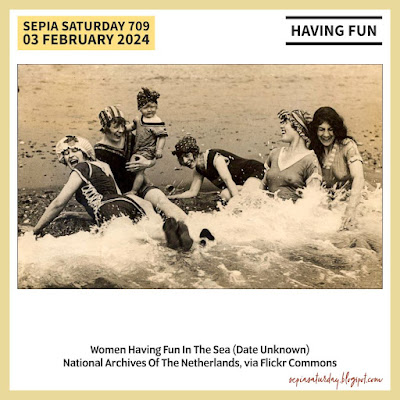
Girls Just Want to Have Fun

03 February 2024

 
They called themselves “Die Nymphen vom Nordseestrand” ~ “The nymphs from the North Sea beach” Wearing shiny satin bathing costumes complete white tights, slippers, and royal crowns this ladies singing quartet was one of director Franz Appel's Variety and Burlesque Ensembles. 

The postcard was sent on 24 February 1911 from Mittweida, a small town in Saxony, Germany. It's a very long way (300 miles) from the cold North Sea shore.


* * *


The Damen-Orchester “Monte-Carlo” dressed more sensibly for a visit to the seaside with matching sailor suits. But their small rowboat looks dangerously overloaded for a sextet. They do look a bit worried as one young lady waves a white handkerchief in hope of rescue.  Good thing they did not bring their instruments along.

The postmark is from 27 September 1911 from the port city of Bremerhaven, Germany where their costumes would certainly be familiar to most people. 


* * *


The four young ladies of the Original Flora-Truppe, directed by Frau M. Hinsch, chose more fashionable dresses with matching parasols for a stroll along a seaside boardwalk (at least that's what I think it's supposed to be).  Their specialty is not included in the caption but the short hem length of their dresses suggest they were a song and dance troupe. 

The postmark is dated 16 July 1910 but the location is smudged. However the writer conveniently included a place name in their message of Neuhaus, a municipality in the district of Cuxhaven, in Lower Saxony, Germany at the mouth of the River Oste on the North Sea.  


* * *


This next quartet of young women wear matching red costumes with short-shorts and rolled sleeves that hint of some recreational activity. Behind them is a gloomy backdrop that could be a boardwalk along a riverside but it's too vague to know for sure. They are “Die Feschen Original Lobersiana Mädels” ~ The attractive Lobersiana Lassies. Their act is not described but I think singing and dancing were part of it. Evidently they also promoted a beauty product as there is a 25 Pfennig advertising stamp affixed to the front of the postcard for Shampoon mit dem schwarzen-Kopf! mit Eigelb-Zusatz ~ Shampoo with the black head! With added egg yolk.

This  postcard was mailed by a German soldier during WW1 using the free military postal service on 5 May 1917. The postmark is possibly from Rodenberg, a town in Lower Saxony, Germany, just west of Hannover.  


* * *


But for shear joie de vie or Lebensfreude as Germans would say, few female acts could compete with the 6 Original Thalias Akrobatische Tanzsängerinnen from Gäthgen's Hamburger Variété und Brilesken Ensemble. Posed in a three tier human pyramid these young ladies did it all. Singing, dancing, and acrobatic feats in costumes made out of heavy embroidered upholstery fabric. 

This card was sent from Cassel, now Kassel, a city almost in the center of Germany. The writer includes a date of 8 December 1913. 


Several years ago I began collecting postcards of groups of professional female entertainers who performed on the music hall circuits of the German and Austrian/Hungarian Empires. As I have discovered, there were hundreds, maybe thousands, of young ladies who were members of small orchestras, brass bands, vocal groups, dance troupes, and folk ensembles. Their postcards made the German postcard publishers very wealthy men as every group used postcards to promote their act at a theater, restaurant, or beerhall. By themselves some of the cards are less interesting, but when they are put together in subcategories by their acts, they present a rich and vibrant Germanic culture. I only wish I could describe their music. I guess we will have to use our imagination.


This is my contribution to Sepia Saturday
where some people are enjoying a day at the beach.


Anita, the Dancing Violinist

08 April 2023


The photographer took the measure of his client and paused in thought. What would make this petite young woman look like a star act? He held out his arm with upturned thumb as he squinted at one of his studio backdrops. "Okay, miss," he said, "Here's what I want you to do. Go over there and stand real close to that curtain." He swiveled the camera stand and spun the lever a few times to put it as low as it would go. Gesturing to his assistant, he pointed at the footlights. "Give me less top and more bottom, Joe. And maybe move the red gell a tiny bit to the left." 
 
He ducked under the camera's dark cloth to check the film plate. "Good. Much better."  He popped out and cocked his head at the young woman. She looked cold. "Now, miss, could you spread your arms like you're taking final bows?"

"That's it. And hold your fiddle so it faces the camera. Now give us a thousand dollar smile. Perfect!" He clicked the shutter. "Prints will be ready tomorrow afternoon. Hope your show does well."

 
That's how I imagine this photograph was taken when this young violinist went to the Van Art Co. studio in New York. She wears a shapely oriental costume with white pantaloons, tight bodice, and bare shoulders which the photographer has subtly linked to the curves of her violin. A standard violin measures 23 inches from its scroll to the tailpiece and she is approximately 2 ⅔ times that length from her heels to the top of her head (but under her frizzy hair), so I calculate that she stands about 5 foot 2 inches in her stocking feet. I believe that counts as petite. Also known as pint-size.  
 
This is a typical promotional 8"x10" photo of a vaudeville entertainer which was used to describe an act for a theater manager in a single glance. Pretty girl with violin; exotic outfit; big smile. That would keep the old fellows in the audience from falling asleep. 

But the best part of her photo is the note on the back.


To Jack and the Boys
wist
(sic) best Wishes
From
Anita
with the
Crackerjacks
                       Dec 25. 1915


VAN ART CO
Photographers
1377 Broadway, N. Y.
N.W. Cor. of 37th St.


Though Anita's dedication provides only a few clues, it was just enough to find "The Cracker Jacks" in 1915. In September this show appeared at the Star Theater in Brooklyn, New York.

 
Brooklyn Daily Eagle
28 September 1915

The Star Theater was a large playhouse of 1,410 seats in downtown Brooklyn. It first opened in 1890 but by 1915 it specialized in burlesque, sometimes spelled as "burlesk", which was a kind of low-brow vaudeville revue that always featured bevies of beautiful girls. And this show had dozens of them on stage as well as several comedians, acrobats, singers, and dancers arranged in a high spirited medley of musical skits staring the lead comic, Phil Ott. 
 
Unlike vaudeville shows which presented a weekly variety of different acts engaged by a theater, burlesque entertainers often worked together as a company and followed a scripted arrangement of theatrical skits and musical numbers. In this era it might have some crude bawdy humor but it wasn't lewd or indecent. That kind of scandalous burlesque entertainment came later, in more prurient decades. In 1915 a theater like the Star still pretended to offer decent, if not classy, amusements. For the Cracker Jacks it was "comedy galore" and "keep the audience in high spirits".  According to a review in the Brooklyn Daily Eagle, "During the action of the first act, Anita, a dainty little violinist, entertains with several selections and was picked a favorite."
 
Click Images to Enlarge

 
Philadelphia Inquirer
17 November 1915

By November 1915 the show was playing in Philadelphia at the Gayety Burlesque. Anita, Oriental Dancing Violinist got top billing in the small advertisement at the bottom of the amusements page of the Inquirer, in between ads for concerts by the Boston Symphony Orchestra with German conductor Dr. Karl Muck; the great operatic contralto Ernestine Schumann-Heink; the Philadelphia Orchestra led by Leopold Stokowski performing music of Brahms, Beethoven, and Tchaikovsky; the Doree Opera Company presenting "Big Moments from Famous Operas"; and  Baron Singer's 25 midgets with 11 ponies and 2 baby elephants.

 
Detroit Evening Times
27 November 1915

If a show was to gain success for its investors it had to go on a national tour. In late November the "Famous Cracker Jacks" were in Detroit headed by Phil Ott and Nellie Nelson. The show now had its own family of midgets, the 3 Kundles, as well as "Novelty Comedy Sensation, Anita", along with French's Aeroplane Girls.
  
In newspaper reports on this show Anita was sometimes described as an "Oriental violiniste", or a "Harum violinist", or even a "Gypsy violinist". She took part in some of the skits, dancing and sometimes singing as well as playing the violin. The Aeroplane Girls was a kind of aerobatic show involving trapeze type stunts in a mock aeroplane suspended over the stage.

Though I have no proof, its quite possible that "The Famous Cracker Jacks" were financed by the company that made the snack food, "Cracker Jack". Established as a national brand in 1896 by the Rueckheim Brothers of Chicago, this iconic American product was first celebrated in the 1908 Tin Pan Alley song "Take Me Out to the Ball Game", with its line: "Buy me some peanuts and Cracker Jack!" In fact this branding was purely for the purpose of a good rhyme. More interesting is that the song's lyricist, Jack Norworth, and composer, Albert Von Tilzer, had never actually seen a baseball game when they wrote this hit, and then didn't get taken out to a ball game until 32 and 20 years later, respectively.
 
Even so, I suspect that burlesque theatres did a pretty good business selling boxes of Cracker Jacks in the lobby. "The More You Eat The More You Want"®.

Minneapolis Journal
26 December 1915

At the end of the year, the Cracker Jacks were advertised for the Gayety Burlesque in Minneapolis with a special New Year's Eve "Midnight Frolic". Amazingly I also found a review of the show in Minneapolis' French language newspaper, Echo de L'ouest, from 24 December 1915 which had a mention of Anita la merveille musicale ~ Anita the musical wonder.  
 
This conveniently confirmed that my photograph of Anita, the oriental dancing violinist, was signed in Minneapolis on Christmas day, 1915. From reading other earlier reviews of the Cracker Jacks show, I learned that the writer and producer was identified as Jack Magee, so I believe he is the "Jack" in Anita's note.
 
That might have been the end of Anita's story, except that it was frustrating to not discover her full name or anything about her background. I felt there had to be more. It was the same feeling I had when researching another burlesque entertainer's photo that turned out to have a great story hidden within the picture, Mademoiselle Fifi.
 
 And then I found this short letter
sent to the editor of the
"I Remember Old Brooklyn" column
of the New York Daily News.
I was published in June 1963.

 
New York Daily News
27 June 1963

                TIGHT MOMENT
   Life was good in Brooklyn 50 years ago.  I was featured as Anita, the dancing violinist, in Al Reeves' Beauty Show at the Gaiety Theatre.
   My most embarrassing moment came when my violin teacher saw me in tights on stage. All he said was:  "Why didn't you play something good?"
   My mother would go to Manhattan Ave. and buy beads and spangles for my costumes.  All were homemade and looked fine from out front.  I started in the theatre at 15, on my own. Your column brings backs memories.
     MRS. ANNA SCHULER
     17 Willoughby St., West Islip


It's very exciting for me to hear the "voice" of a musician in a photograph over 100 years old. Anna's simple letter of remembrance of her musical career in Brooklyn offered so many good clues that in just a few minutes I found Anna Schuler in the census records. In 1930 Anna was living in a rented house at 553 Layfayette Ave. in Brooklyn with her mother and her daughter.

1930 US Census for Brooklyn, Kings County, New York
Schuler, Anna

The head of the household was her mother, Helen Koeberle, age 62 and a widow. Born in New York, her parents were German. Below Anna's name was her daughter, Helen's granddaughter, June Schuler, age 11, born in New York. Anna was age 36, married since age 25, and also born in New York. But the prize was learning her occupation: Musician, Orchestra

Ten years later in the 1940 census, Helen Koeberle was still living at the same address in Brooklyn but Anna and June Schuler turned up in Islip, New York, a small town on the Atlantic coast of Long Island about 50 miles east of Brooklyn, where they were listed as lodgers. In a decade Anna had gained 12 years, and listed her age as 48. June Schuler was now 21 but her birthplace had moved from New York to New Jersey. She worked as a waitress at a restaurant. Anna's occupation? Musician, Entertainer.

Buffalo NY Commercial
8 October 1912


Al Reeves's "Big Beauty Show" had a similar format to Phil Ott's Cracker Jacks revue. In October it played Buffalo, New York at the Garden Theatre. "Stunningly gowned soubrettes, many clever comedians and a host of pretty chorus girls combine to make this one of the best and most attractive shows at the Garden this season. From beginning to end there is not a dull moment in the play. The songs are catchy and tuneful and the ensemble numbers are right up-to-the-minute...Anita, the wizard of the violin, is the extra attraction with the company. She was received with much applause."
 
The theatre even added a special feature for the World Series which began on October 8th by erecting a large electric score board that would show every play on the diamond. {The Boston Red Sox faced the New York Giants and took the championship in eight games(!) beating the Giants four games to three (with one tied game!)}

Reeves's show seems to have opened in Brooklyn around the late summer of 1912 with Anita as a side act, but the company very quickly hit the burlesque circuit traveling to Kansas City, Missouri; Omaha, Nebraska; and other places in the Midwest before returning to New York. Though Anita got favorable mention in the show's brief reviews, they rarely described her act. Her music was hardly noted, except to say that people enjoyed it. This was the last era of sentimental American music before jazz scrambled everything up in the 1920s. In 1912, ragtime styles were already a bit old fashioned and had never really become as dominant influence on musicals and theater music as jazz would do, so I don't think Anita ever played anything resembling dixieland or ragtime. During her first tour a reviewer said she played a light opera selection followed by an encore of Robert Schumann's "Träumerei" (Reverie), in an arrangement for violin of a movement from his piano set "Scenes from Childhood".  It's a slow sentimental melody that I suppose could be interpreted in dance too. 
 
As for Anita's oriental dancing she was once reported as an "exceedingly graceful toe dancer" which I imagine as being more like ballet than tap dancing. This was the age when Isadora Duncan, (1877–1927), the American dancer, choreographer, and pioneer of modern contemporary dance introduced audiences to new terpsichore art forms. It was also a time when exotic foreign fashions were also changing our culture, even in places far removed from the "Orient". I suspect Anita's style was a variation on the traditional burlesque shimmy and shake moves.
 
Considering the frenetic energy exhibited in a burlesque show it's not impossible that Anita's purpose in the company was to provide wholesome cultivated charm to contrast with the comic slapstick and jaunty merriment of the other acts. But in any case Anita evidently caught the show business bug on this first tour with Al Reeves's company as she remained on the bill for a full season. In 1913 she joined George Auger's company, followed by Andy Lewis's show in 1914. 
 
So my photograph from December 1915 shows a seasoned entertainer, a veteran trouper, even though she was only age 21, (or 23 if the truth were known.) Her act was not especially unique, as longtime readers will remember my story from last October, Dancing Violinists, which featured two photos of dancing/skating violin players. But they started some years after Anita's start in 1912 which I think makes her the real pioneer of this kind of act.

Finding Anna—Anita Koeberle Schuler's letter from 1963 was a thrill but it was matched by finding her picture from 1912. She isn't holding her violin and her costume is less sparkly but she's got the same captivating gaze.
 
St Joseph MO Gazette
8 September 1912

 
After the 1916 season, Anita the dancing violinist, disappeared from burlesque theater notices. I have been unable to find Anna Koeberle Schuler in any documents or records except for the 1930 and 1940 censuses so I can't present a very definitive biography for her. I know nothing about her parents, her marriage, her children, or even when she died. Not everything can be uncovered in the newspaper archives.
 
I'm intrigued that she remained a musician and played in an orchestra. But what kind? Did she join a women's orchestra? A society dance orchestra?  A country music radio band? More research is required. Perhaps her violin teacher remembers.
 
But just being able to give Anita's photograph a full name and place her burlesque stage career in the context of her time is reward enough for me.
 
Smile for the camera. please.


This is my contribution to Sepia Saturday
where everyone always tries to keep on their toes.


The Girls of the Alcazar d'été

10 December 2022


Fame is not reserved
just for royalty, politicians, and other luminaries.
Sometime even a pretty petite dancer
can become a celebrity
recognized for her acclaimed contributions
to the world of entertainment.
 
Meet Miss Williams,
 a star of the Alcazar d'été revue
in Paris, France.


Standing gracefully in the photography studio of Walery, Paris, Miss Williams gives a proud salute as she models her frilly costume which reveals just a hint of seductive skin. The photo print has a rich depth of sepia tones that give it an illusion of a color photo and a premium quality that surpasses most entertainers' souvenir postcards from this era.  

As was the custom in France, the stamp and postmark are affixed to the picture side of the card and it was posted from Vitry-le-Croisé, a commune in the Aube department about 125 miles southeast of Paris, on 5 Jan 1905 to Mademoiselle Liger of the same town.


* * *


Miss Williams posed with her dancing partners in another photo by Walery. In this postcard she is the shorter girl on the right neatly forming a ballet line with Miss Clara Davine, Miss Birks, and Miss Robinson. All wear the same dress style that has been colorized in shades of pink and blue with accent in gold.
 
The photographer was Stanisław Julian Ignacy Ostroróg, also known as Lucien Waléry, (1863–1929), who was a Polish photographer who was first active in London at his father's photography studio and then in Paris between 1890 and 1929. His studio was renowned for photographing many entertainers of Paris, especially beautiful women like the American dancer, Josephine Baker, published as a series in 1926.


* * *


Poster for Alcazar d'été, 1896
Source: Wikimedia

The Alcazar d'Été was a Parisian café-concert, also known as a café-chantant, described as a variation on an outdoor cafe/wine garden and a French music hall. The Alcazar d'été opened in 1869 at 8 Avenue Gabriel near the Place de la Concorde in Paris, and closed in 1914.  In addition to food and drinks it offered high-class musical performances which included many celebrated French singers, instrumentalists, and dancers of the Belle Époque. This so-called "beautiful time" of the Third French Republic lasted from the end of the Franco-Prussian War to the beginning of World War One and marked a peaceful era in French culture when all the arts and sciences florished.


This next Walery postcard is a 3/4 portrait of Miss Robinson, the tallest dancer of the quartet. I call her a dancer only because they wear dancing slippers. It's quite likely that they also sang and played parts in theatrical skits. Here Miss Robinson is wearing a very low cut dress or silk wrap around her bare shoulders as she gazes wistfully into the camera. A penciled note on the border gives a date of 8 March 1903 which is confirmed by the potmark on the back. It was sent to Mademoiselle Alice Berta of Corbeil-Essonnes, a suburb of Paris. 


* * *

 
Long time readers may remember a similar quartet of pretty dancers from the Alcazar d'été that I featured in my November 2018 story: Charming the Snook. Like that group, these young ladies all have English names. Whether they are actually English, or Scottish, Canadian or even American nationals I can not say as there is little history recorded on the internet about this kind of French entertainment.


This next Walery postcard has the four women posed in a cluster with Miss Robinson seated and the others standing close. Their costumes are detailed in color and look identical to the previous fashion. This card was sent 15 November 1902 from Beveren in Belgium, which is on the west bank of the River Schelde, opposite the port of Antwerp.


 * * *


Poster for Alcazar d'été, circa 1900
Source: ArtVee

 
One of the many celebrities associated with the Alcazar d'été was La Belle Otero who appeared on this poster for the café-concert in about 1900. She was a Spanish actress, dancer and courtesan whose full name was Agustina del Carmen Otero Iglesias (1868–1965). Her costume resembles the dresses worn by the English dancers and gives another perspective of what their revue might have looked like.


This last postcard of Mss. Robinson, Birks, Davine, and Williams has them bent over as if they are about to come onto the stage for one last bow. The postmark is February 8?, 1903. It's not surprising that these attractive postcards were used from 1902 to 1905, but because the girls are pictured in the same outfits, I believe all the photos were taken together in 1901 or 1902.


The Alcazar d'été presented a musical variety show or revue that offered Parisians and tourists a night of lighthearted French entertainment. It was not classical or operatic music but it was still more sophiosticated than the street ballads and folk music heard at cabarets. Like British music halls and American vaudeville theater, the French café-concert represents a branch of early popular music that connects directly to modern entertainment forms. It's not difficult to image these same dancers/singers performing on a contemporary stage of today.
 
This set of postcards is part of a larger collection that I have started acquiring on the entertainment at the Alcazar d'été, so stay tuned for more.  


Unfortunately I couldn't find any historic films of  Parisian nightclub dancers 
that date from 1900 but here is a British Pathé newsreel entitled:
Famous Parisian Clubs And Cabarets No. 2 (1933)


This second short film is also from the late 1930s
but it does evoke a style of dance
that may have resembled the dancers at the Alcazar d'été.
Some of these girls are very limber indeed.
It's entitled simply:
Paris Dances (1939)


This is my contribution to Sepia Saturday
where even granny can put her best foot foward.


nolitbx

  © Blogger template Shush by Ourblogtemplates.com 2009

Back to TOP