This is a blog about music, photography, history, and culture.
These are photographs from my collection that tell a story about lost time and forgotten music.

Mike Brubaker
{ Click on the image to expand the photo }
Showing posts with label parade. Show all posts

On Parade in Old Wien

08 June 2024

 
A parade was once a common thing to see in cities and town. Every religious holiday, political rally, protest demonstration, or other special event included a procession of people marching in the cause of some greater purpose. And that almost always required music from at least one band, though more was always better, to propel the participants along a city's streets in order to attract the public's attention. One of the places that has had a long history of parades was the Austrian city of Wien or Vienna. This first illustration shows  a military band marching along a boulevard with people watching and even joining the parade. It is captioned:

Wien. Burgring ~ Vienna. City ring road
Mit Lyra und  Säbel ~ With lyre and  saber


The artist of this lively watercolor sketch was the Viennese artist Fritz Schönpflug (1873–1951) whose work I began collecting a few years ago partly for their colorful novelty and light humor, but also because his caricatures record perceptive details of Wien's culture and its people that has largely disappeared following the two Great Wars of the 20th century. My last story on his artwork was in November 2023, The Frat Boys of Old Wien, which featured a set of his postcards on fraternity alumni from German/Austrian universities.

Today I present a small medley of what I think Fritz would have called Wiener Verein ~ Viennese Associations or civic clubs. His postcard drawings depict social groups that I can't always identify or understand, but it seems clear that in the 1900s these were groups of people who were easily recognizable and probably often seen in parades along Wien's grand avenues.


The first postcard shows six elderly ladies wearing long dresses and coats walking behind a man holding a banner on a staff. The women are arranged in block formation and have determined, if slightly sour, expressions as if they mean business. The man is bare headed and has a blue and white sash over his formal suit which, to my eye, resembles a servant's livery. They look like a women's club but not for a political movement like women's suffrage. Maybe they represent a religious or civic organization. Whatever their cause they are going someplace with a purpose.

Many of Schönpflug's drawings of people were printed on a plain white cardstock without any framework of sky, ground, or surroundings. The effect cleverly makes the viewer look closely at the characters to see their humor or irony. I think this was also done to allow space for a message since in the early years of the postcard only the address was permitted on a postcard's reverse side. Here the writer filled up most of the usable white space with a long message which unfortunately I'm unable to decipher. It's surprising how often people wrote cursive script in small compact letters.  However just below one lady's skirt is a date 27.2.05 which confirms the faded postmarks from Wien of 27 February 1905. 


* * *


The next postcard has a similar lineup of elderly men dressed in identical military hats and jackets with mismatched trousers. The sender of this postcard has helpfully added their own captions. At the top is written: Serie des Wiener-Vereine — Series of the Viennese clubs. And along the bottom:

                        I. Veteranen Verein — I. Veterans Association

                            Gott grüss Such, Alter! -- Schmeckt das Pfeifchen?
                            "Ich finde die fünf alten Mannli sehr schmuckig!"

                            God bless you, old man! -- Does the pipe taste good?
                            "I find the five old men very dapper!"

The men are veterans of the Austrian army and in 1900 likely served in the very brief Austro-Prussian War of 1866 which lasted all of seven weeks. The word schmuckig is a difficult one to translate. Since it is written, I think, with a lower case s it is not the German noun Schmuck which means fool or moron, but is instead an adjective based on schmuck which means neat, smart, or dapper. I think it was an invented word used by the writer much like how in English we add the suffix "ish" to imply a not-quite authentic or genuine quality, like fortyish, squarish, youngish, etc.

The way the writer notes that this card is in a series is one reason for Schönpflug's popularity in Wien. The publisher's mark on the back is B.W.K.I. which stands for Brüder Kohn Wien whose business was located in the no. 1, or I, district of Wien. This publishing firm was established in 1898 by Salomon Kohn (1873–1944†) with his brothers Adolf and Alfred Kohn. Salomon was also a photographer and their company produced thousands of colorful postcards and greeting cards illustrating Wien, and its citizens and celebrities. 

Schönpflug's humorous cards were arranged around a theme, usually  in a set of six or eight different pictures, and printed as a series with an identification number, in this case B. K. W. I. 597 - 2 ,  which means this was the second of the series. The ladies club was number 4.  (I'll come back to the word Deposé later).  This card was sent from Switzerland on 02.IV.04 – 2 April 1904. The word AMBULANT on the postmark refers to a Swiss railway postal wagon, in this case delivering mail to a civil and military hospital in Montpellier, France on the Mediterranean coast. 


* * *


The next group is a quartet of civic dignitaries, four old men in tailcoats and top hats. Like the men on the pervious card, these gentlemen all sport numerous campaign medals pinned to their  chests. One man carries a national flag. The printed title reads:  Kriegervereine – Veterans’ associations. They look like former officers standing for a review of the troops. This postcard was never mailed so there is no date

The word Deposé is printed in small letters under the picture but not on the back next to the series mark, which in this case is also B. K. W. I. 597 - 2. It is a French word that means deposited or filed and I think it may have something to do with copyright protection. It's also possible that the  two pictures sharing the same series number may indicate a second printing. My hope is to eventually acquire a full set of this particular series.


* * *


The picture on this postcard is definitely a parade that people of the 1900s would be familiar with. The printed caption reads: Heilsarmee – Salvation Army, which is also displayed on two banners carried in the procession. A trombonist and accordion player lead with a bass drummer bringing up the rear. One stalwart young women dressed in black holds out flyers as she sings along to the music. A pair of policemen escort the crowd. This card was never posted but is marked as B. K. W. I. 597 - 4. 


* * *


This next Wiener Verein look like they are also part of a parade. Six men are dressed alike in short jackets with broad brimmed hats stand around their leader who wears a black, red, orange sash and holds a large flag. This postcard was sent from Switzerland to the hospital in Montpellier by the same writer that sent the card with the five veterans. On the side is written:

                            VI Malerbund — VI. Painters Association

                                    Wenn ich nur wüsste, ob auch Damen beitreten dürfen!
                                    Wäre nämlich entschieden mein Fall!

                                    Schluss    J.SP


                                    If only I knew whether women could join too!
                                    That would definitely be my case!
        
                                    End J.SP


I'm uncertain if the writer is referring to this picture as an association of art painters or house painters. I think the former is more likely since most of the men each have an artistic style beard. The caricatures may even be Viennese artists familiar to people of this era. I don't understand the long horn carried by one man. Is it powder horn for a musket or a flask of some spirit?             

This card shares the same number B. K. W. I. 597 - 4 as the one with Salvation Army parade but has Deposé added so I think it is from another edition of the series. One of the special qualities of early postcards from this era was how people often sent a complete series like this to someone as a gift. Unfortunately I could only find two in this writer's sequence, but even so, their humorous captions add a helpful context that is often missing in old postcards. I hope the recipient, Monsieur Hans Keitz got a laugh from the full set. Was he a patient or a member of staff at the hospital?


* * *


This last picture postcard shows a spectator's view of a band on parade in Wien. It has a printed caption of Wien, Aufzug der Burgwache – Procession of the castle guard. In the foreground a gentleman seems to be marching with the band. The card has no postmark but is addressed to the Offiziertischgesellschaft – Officers' table society of a German army regiment in Metz, France which was then in the Imperial Territory of Alsace-Lorraine.  By coincidence Schönpflug did another series that lampoons that kind of club, too, but that will have to wait for a future story. 

Though I can't find Fritz Schönpflug's signature in the picture as it fills the card's space, I feel confident that it is his work as it was printed by the Brüder Kohn Wien and is marked as B. K. W. I. 510 - 4.  The back of the card also has "Printed in Austria" which is a post-war phrase never used in the time of the Austrian-Hungarian empire.


Fritz Schönpflug's postcards were distributed throughout Europe as I have found many with postmarks from Germany, Switzerland, Hungary, France, and the Netherlands. It's not surprising that his illustrations appealed to Wien's visitors and natives alike as his subtle humor captured a silliness that was universal and familiar to people of any language or culture. 


To finish my story I wanted to add some historic film footage of old Wien that showed a parade or people on the streets. I found a few vintage clips in black and white but the quality was poor. Then I found two short clips taken from Austrian movies that clearly used Schönpflug's postcards as inspiration for the scenes. 

The first clip is from "Die Deutschmeister" – "The German Master", directed by Ernst Marischka abd released in 1955. The story is set is late 19th century Vienna where a young girl named Stanzi meets a soldier of the famous “Deutschmeister” regiment and they fall in love. The girl's new boyfriend is a composer of a popular march that somehow causes some trouble for him and his regiment. Stanzi saves the day by smuggling the sheet music inside a pretzel stick to the emperor for whom her aunt is the baker. Kaiser Franz Joseph approves and all is forgiven and the girl gets the boy. 


The second clip comes from a film "Wiener Mädeln" ~ Viennese girls produced during WW2. It was directed and starred Willi Forst as Carl Michael Ziehrer, (1843–1922), a popular Austrian composer and rival to Johann Strauss Jr. The storyline is a romantic musical comedy similar to the other movie. A supporting character seen at the beginning and later playing a bass drum in a marching band, is played by Austrian actor Hans Moser (1880–1964) who was in two film clips in my story from two weeks ago. Music for a Wine Garden. The 


Wiener Mädeln was released in 1949 but was originally produced during the final months of the war, filmed in Vienna from March 9, 1944 to March 26, 1945. The director Willi Forst delayed finishing the film to protect his actors and crew from being called up for military service. During the filming the cast and crew had to stop several times due to air raid warnings of approaching allied bombers. It was the first color film made by the production company Wien-Film, but the final version of the movie was not released to public cinemas until August 1949 when Austria was under military occupation by the Soviet Union. 

The movie has a lighthearted exuberance that mimics the chirpy American and British movies made during the war. It's a kind of biopic romance that respectfully portrays Carl Michael Ziehrer, the composer and bandleader, with pride and admiration, if not historical accuracy. In another clip there is even a "battle of the bands" at a festival where an American bandleader, looking vaguely like John Philip Sousa, tries to outplay a Viennese band. Any guesses who wins?  I'll find a way to include it in a future story.  

What is not revealed is that unlike movies made in Hollywood or at Shepperton Studios, this film was made in a city that was under attack during a brutal war. From March 1944 to March 1945 during the filming in , there were 52 allied bombing raids on Wien and the vicinity around it. In February and March 1945 bombing intensified with 80,000 tons of bombs dropped by US and British aircraft, that destroyed over 12,000 buildings, and left 270,000 people homeless. A final tally estimates  that nearly 9,000 lives were lost during all the bombing of Wien.

We have to admire the artistic skill and determination of the actors 
who were able to smile, sing, and laugh despite the risk of imminent destruction.


CODA


I now have hundreds of Fritz Schönpflug's postcards in my collection and will doubtless add many more in my quest to complete some of his series. I find them fascinating for the social and cultural history he records in his caricatures of the people of Wien. But there is another more distrubing element of history that I only just discovered this week as I was researching Schönpflug's publisher, the Brothers Kohn – Salomon, Adolf, and Alfred Kohn. 

In this last example of his work from a different theme series, Schönpflug depicts a pair of gentlemen, one short and portly and the other tall and thin, travelers being welcomed to their Wien hotel by a courteous concierge and his staff. I can't sure but to my eye the two men look foreign rather that Austrian or German. The taller one especially looks English. 

Schönpflug's signature in the lower right corner includes the numbers 909 which was his way of dating a painting made in 1909 as he followed a European convention of leaving off the 1000.  Like all his other postcards this one was part of a series,  B. K. W. I. 543 - 1. 

What makes this card different from the others in my collection is that it was posted in 1943, nearly 25 years after Schönpflug painted it.
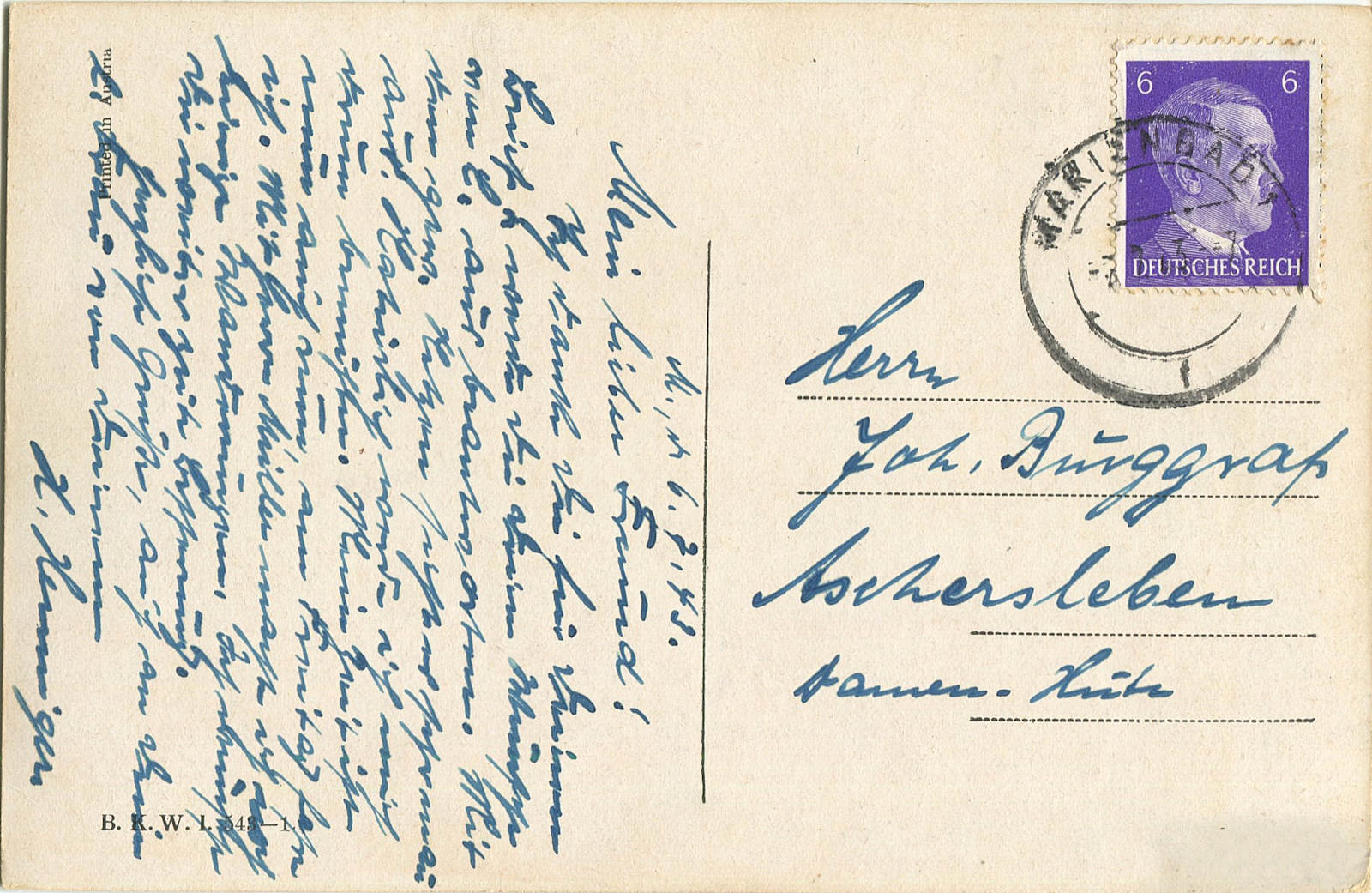


It was sent from the spa town of Marienbad, now known as Mariánské Lázně in the Czech Republic, and though the postmark date is unclear, the writer left a date of 6.7.43 – 6 July 1943. In the corner is a purple 6 pfennig stamp of the Deutsches Reich with the profile of Adolf Hitler. 

Needless to say, Hitler's offensive image taints Schönpflug's otherwise humorous card about two tourists in Wien. But what I learned this week makes this postcard and the history hidden in it much more disturbing. 

According to his short biography in the German Wikipedia (translation by Google) Salomon Kohn was born on July 31, 1873 to a Jewish family living in Wessely, Moravia, then a part of the Austrian Empire. His publishing firm, B. K. W. I., which he established in 1898 with his brothers Adolf and Alfred, produced countless postcards and greeting cards marketed all over Europe. Judging just from the huge variety of Schönpflug's postcards, it must have been a successful business, especially as it continued operations after the end of WW1 into the 1920s and 1930s, when all of the former empires of Central Europe were broken up into new independent nations.

After the Anschluss in 13 March 1938, when Nazi Germany, led by Adolf Hitler, annexed Austria, all Austrian businesses owned by Jews were confiscated, which included Salomon Kohn's B. K. W. I. Salomon received no compensation for the "sale"  of his firm, but was retained as the unpaid manager. During this brief respite before the outbreak of  WW2, Salomon and his wife Gittel Kohn was able to get their two children, Walter , age 15, and Minna, age 19, safe passage to England during the Kindertransport rescue operation which saved neatly 10,000 Jewish children from death under the evil Nazi genocide program.

Shortly after their children escaped Wien, Salomon and Gittel Kohn were arrested and interred first at the infamous Theresienstadt Ghetto in German-occupied Czechoslovakia and then transported to the Auschwitz concentration camp where they and a million more people were murdered. Salomon's older brother, Adolf Kohn, had died in 1918 while serving in the military. His younger brother, Alfred Kohn and his family, also perished in the Shoah.  

The history of Salomon Kohn's family might have been lost forever were it not for the good fortune that their children, Minna and Walter, were able to seek refuge in England in 1938. In 1940 on the outbreak of war, Walter Kohn (1923–2016), was sent to a detention camp in Canada as he was still considered an Austrian national. There he was able to continue his education at the University of Toronto, and later Harvard. He became a noted scientist in theoretical physics and chemistry making several important and significant contributions to science.  In 1998 Walter Kohn was awarded the Nobel Prize in Chemistry. In April 2014 he was interviewed for The Current, the magazine of the University of California Santa Barbara where Kohn was a professor of physics. In it Walter shares the story of his father and his early life in Wien and how he was able to escape the horrors of the Shoah which tragically took his parents. 


My discovery of the terrible deaths of Salomon Kohn and his family in the Holocaust changes the way I look at my collection of Fritz Schönpflug's postcards. Schönpflug died in 1951, after a lifetime of witnessing earthshattering changes to Europe, Austria, and especially Wien. The cartoons he drew of the people of Wien document a colorful world that was filled with many layers of society, from the proletariat to the aristocracy. But his artist's eye could not help but see the undercurrent of racism and bigotry that flowed through the cracks of this complex multi-layered city. I don't know anything about Schönpflug's background, much less about his political or religious views. But his relationship with Salomon Kohn must have been close as both men benefitted from a long collaboration between artist and publisher. Now I can't help but look at his postcards from the perspective of Salomon Kohn and wonder what their relationship was like. There are now more layers hidden in that postcard paper.


As the the other nations of the world began to recognize the dangerous threat posed by Hitler's dictatorial ambition and wicked genocidal policies, two United States senators, Senator Robert F. Wagner (Democrat, NY) and Rep. Edith Rogers (Republican, MA) proposed the Wagner-Rogers Bill in the United States Congress as a complement to Britain's Kindertransport program. This bill would have allowed 20,000 unaccompanied refugees under the age of 14 from Germany and areas under German control to enter the U. S. with special visas. Most of those child refugees would have been Jewish. However, due to opposition from Senator Robert Rice Reynolds, the bill never left the committee stage and failed to secure Congressional approval. 

Senator Reynolds (1884–1963) was a Democrat from North Carolina and represented the state from 1932 to 1945. This was in the era when the southern Democratic Party held ultra-conservative positions on segregation, immigration, and states' rights. Reynolds was a passionate isolationist and outspoken apologist for Nazi aggression in Europe. Robert Rice Reynolds was born, raised, and died in Asheville, North Carolina the city where I live now. History like this leaves a dark stain that is impossible to remove unless we preserve the difficult memory of abominable individuals who perpetrate such loathsome political views. "Never Again," is not a slogan. It is a moral commitment to humanity.


This is my contribution to Sepia Saturday
where no one ever lets a parade pass them by.


Bands on Parade

25 November 2023

 
A long time ago Americans used to love a parade. If there was a special occasion, a holiday, a visiting dignitary, or a society convention there was always a parade. And if people were going to march, there had to be a band to lead the procession.  


Town bands were a popular way of promoting a community's commercial and retail interests. A city parade was a moving concert that drew a crowd and gave merchants a chance to advertise their stores. 


The band's instruments were shiny and their uniforms were flashy. The music didn't have to be sophisticated to attract attention, just loud, brash and with a strong beat. 


In a small town the members of the band would be friends and neighbors that everyone knew. In the time before recorded music, before radio and motion pictures with sound , live music and parades were spectacles that everyone in a community wanted to see.


Today I present a set of postcards
featuring four bands on parade.


My first postcard is the only true photograph in this cavalcade of parades. It shows a brass band (with one or two clarinets) of about 15, all men with a few young boys, set up in a simple marching formation on a dirt street. They wear white shirts and ties with a few in suit coats. It looks like a warm summer day. In the background is a long block of shops with a sizeable number of people hidden under the shop awnings that cover the sidewalk. 

This postcard was sent from Clearfield, Iowa on 22 June 1907 to Ralph Jarvis of Jolley, Iowa. Clearfield is in southwest Iowa near the state's border with Missouri. 1900 was when it had its peak population of 698 but in 2020 that number has declined to just 278. Jolley, Iowa is in central Iowa, about 140 miles north of Clearfield, and it reached its height in 1920 with 300 residents. Today its population is just 28. 


Do you know
this place

Mamma


Clearfield, Iowa
Broadway St. 
Source: Google Maps 2021

The current 2021 Google streetview of Clearfield's Main Street, now called Broadway, shows the block with a recognizable frontage that retains the distinctive arch and hourglass brickwork seen in the 1907 photo. The shop awnings are gone and most of the retail ships look closed but Clearfield's post office occupies one of the old spaces in the block. It doesn't convey any sense of being as prosperous a place as it did in 1907.


* * *


The next postcard is of a parade with a band leading a line of marchers. The illustration was probably copied from a photo and then colorized on a half-tone print. A caption reads: 2nd Street Crookston, Minn. A large building on the street corner behind the band looks like a hotel. A clothing store is on the opposite side.

Crookston is in northwest Minnesota near the border with North Dakota and located in the vast Red River Valley. In 1910 it was a thriving city with 7,559 citizens, very close to its present population of 7,323. 

This card was sent on 6 February 1912 to Sister Nora Ambroson of North Leavitt St. in Chicago, Illinois. The address is on a block that is now a large modern hospital complex, but in 1912 it was near the location of Saint Mary of Nazareth Hospital. This small hospital was established in 1894 by the Sisters of the Holy Family of Nazareth to serve Chicago's Polish community. I believe the writer is a former nurse sister at the hospital who has moved to Crookston. Reading between the lines she sounds a bit lonesome.


Crookston  2/ 6/ 12
Dear Sister:
How are you
and all the others on
first floor?  Have you
been very busy since
I left.  I have not had
a word from any one
at home yet since I left
so I hope you will write
if you have any time.
Greet all from me. I am feeling (top)
fine and having a good
time up here.  Who are
working with you now?
Greet All & write soon.   Sr. Hanna.


Crookston, Minnesota, W 2nd St and Main
Source: Google Maps 2008

The Crookston streetview of 2008 on the corner of West 2nd Street and Main shows the tall hotel building with the same window arrangement. Though the image is grainy the building looks like it was restored. But the Google time machine plays a magician's trick because as soon as you cross Main street the structure suddenly vanishes as you jump four years into the future from 2008 to 2012. Sadly the old building has been demolished and turned into a parking lot.


* * *


Just a short march of 237 miles west of Crookston is Minot, North Dakota. In this colorized halftone photo 21 musicians are in parade position led by a drum major in a tall fur hat. They appear to be standing on a green football field, but I think this is an artistic license taken by the printer. Like the previous postcard this one was also printed in Germany where gigantic printing press factories churned out millions of cards for American orders. This was a common foreign business arrangement for US companies that in just a few years would be terminated by WW1. 

Minot is the county seat of Ward County, North Dakota in the north central region of the state. It saw it biggest growth between 1900 and 1910 when the population jumped 384.6% from 1,277 to 6,188 residents. However the postcard was sent on 10 July 1909 from Drake, North Dakota a small town 50 miles southeast of Minot. In 1910 its population was 348 citizens. Today it is a little less at 232. The card was addressed to Mrs. Gunda Dagfinrnd (?) of Malta, Montana, a city on the high plains of north central Montana. In 1910 it was bigger than Drake with 433 citizens and in the last century has actually grown to 1,860 with only a little decline since its height in the 1980s.


The writer on this card was H. Steen (?) who was Danish, I think, as the message is in that language and the first part translates as "I got here all right on Saturday morning and there was a lot to do here."  The handwriting style is too challenging for me to make out the remaining words.


Minot, North Dakota, Main St. and Central Ave.
Source: Google Maps, 2019

The three-story building behind the band was the Jacobson Opera House located at the corner of Main St and Central Avenue in Minot. The theatre was on the third floor and opened in January 1903 with seating for 800 patrons and a generous stage of 30 feet by 50 feet. It was an appropriate place to take a photo of the band since it's likely that some bandsmen played in the theater's orchestra too. In 1923 the Jacobson Opera House suffered the fate of many theaters in this era being destroyed in a fire. It was never rebuilt but the site was used in the 1960s for Minot's Taube Museum of Art. 


* * *


A similar postcard of a band was produced for the town of Wheaton, Minnesota. This parade has a band of about 13 musicians standing on a dirt street in front of a squad of men who may represent a fraternal society or other civic group. A few lines of adults and children watch from the sidewalk of a retail block. This is another colorized photo printed in Germany.

Wheaton is a small town in west central Minnesota on the border of South Dakota. In 1910 it boasted of a population of 1,300 which in a century has changed very little as today it has 1,426 residents. 

This card was sent on 24 August 1908 to Miss Hulda Hellenberg of Mishawaka, Illinois.


Dear Friend.
Arrived here all
O.K. and recieved
(sic)
your postal and
was pleased to 
get it. Hoping you
are having a good time
as I am.
Mrs A Cordes


Wheaton, Minnesota, Broadway looking east
Source: Google Maps 2015

I was unable to find any of the buildings seen on the postcard in Google Maps streetview. Main Street is now called Broadway but most of the old buildings are no longer standing. Like most towns in the West and Midwest the streets are arranged in neat grids with a single main road for most of the retail and commercial businesses. This view looking east is my best guess. 


However I did find another postcard that is based on the identical photo but printed in gray tone by a company in New York City for the L. E. Baker & Co. A caption reads: 

Wheaton Band and Firemen
on Thanksgiving Day, Wheaton, Mi(nn) 

The postmark though is dated 26 September 1908, so this must be a parade from at least 1907, and possibly earlier.


Sept 25 1908
Dear Mother
It is Raining to
day I am well
and hope you are
the same
Yours
Geo Lane(?)


I hope it didn't rain on the firemen's parade.
Marching in mud is never fun.


This is my contribution to Sepia Saturday
where some people march to a different dog.


The Wearing of the Green

09 July 2022


The first thing you notice is their hats.
Tall, silky black top hats,
and lots of them.
And next are the mustaches.
Long, bristly, mustaches
like cartoon Yosemite Sam's brush.
And then it's their sticks.
Not umbrellas or canes,
but very slender knobbly sticks,
almost switches really,
with small American flags attached.

It's a curious bunch of gentlemen,
assembled outdoors on the steps of a building
for a formal group photo.
Oh, and there's a brass band too,
which is why I took an interest
in the photograph.
Unfortunately there is nothing stenciled
on the bass drum head to identify them.

{Click on any image to enlarge it.}


Altogether there are 69 men and one boy in the group, and everyone is wearing a hat. On either side are two men astride horses with felt homburg hats. (The men, not the horses!) The band has 16 musicians, one hidden behind the horseman at left, dressed in wool uniform coats with short brimmed field caps. The band's leader, holding a cornet and wearing a longer wool coat, stands in front right. Further right next to a tall trombonist, is a young boy of seven or eight wearing a larger winter-weight hat. The remaining 51 gentlemen, sporting nearly identical top hats, zylinders in German, wear heavy double-breasted overcoats. It appears to be a sunny day but there is snow on the ground.
 
On the back of this 8" x 10" albumen photo, mounted on brittle buff card stock is a helpful stamp from the photographer.
 I. U. Doust
Photographer,
Supplies, Printing and
Developing for Amateurs
130 E. Genesee St.
Syracuse, N.Y.


The photographer's full name was Isaac Uriah Doust. Born in Syracuse in 1856, he first opened a studio and gallery in Syracuse in 1875. Mr. Doust also sold photography supplies, materials, and equipment and continued in business until just a year before his death in 1937 at the age of 80.

The photo's albumen print style is typical of the late 19th century going into the first decade of the 20th. But dating men's clothing is difficult since top hat fashions didn't change much between the 1850s and the 1920s. Initially I mistook them for a minstrel show company. In this era there were dozens of professional minstrel shows touring the theater circuits of America. Minstrel bands and singers, which often numbered over 50 members, typically marched in a parade before commencing their first concert, all dressed in identical long overcoats, top hats, and carrying canes. My story from 2018, Hi Henry's Minstrels and the Big Dog, featured a similar photo of 32 men wearing top hats standing outside a civic building in San Francisco. That photo was dated from 1899.

But here there are many more sticks and fewer instruments. Most of these fellows don't look like they ever wore blackface or sang novelty minstrel songs. Who were they? Could there be more clues?


Behind the group on the two columns framing the portico entrance are two pairs of numerals, 18—82, which I interpret as the year the building was constructed. In front of the doorway, one of the men holds a pole on which hangs a fringe-edged banner. It has the words DIVISION No. 8 separated by an design of a harp, a symbol recognized around the world as the emblem of Éire—Ireland. This was a terrific clue as no one likes to march in parade better than an Irishman.

Syracuse, New York has a long history of Irish immigration and even today Irish ancestry makes up the largest segment of nationalities represented within the city's population. So not surprisingly Syracuse has a tradition of celebrating St. Patrick's day on March 17, the Catholic feast day of Saint Patrick - the patron Saint of Ireland. In the newspaper archives I found several reports of the event beginning in the 1880s and continuing on to the 1920s. The principal organization responsible for overseeing the Syracuse parade was an Irish-American fraternal society, the Ancient Order of Hibernians. Founded in New York City in 1836, the A.O.H. sought to provide assistance and protection to Irish Catholic immigrants, and defended Catholic churches from anti-Catholic abuse that the Irish encountered in 19th century America. The Irish harp is prominently displayed in its emblem, along with shamrocks and the flags of Ireland and the United States.


Emblem of the Ancient Order of Hibernians
Source: Wikipedia

In a report from the 1894 St. Patrick's parade in Syracuse, there was a description of the A.O.H. units marching with blackthorn canes and bands playing tunes like "Yankee Doodle", "Garry Owen", and "The Wearing of the Green". Yet even though it was a long parade, the order listed only five Hibernian divisions, not eight. But in 1896 the celebration promised to be even larger, a "Monster Parade" with close to 1,500 men.

 
Syracuse NY Sunday Herald
16 March 1896
 
In the days of old, newspapers were printed on extra-large paper sizes with tiny fonts and multiple dense columns. The editor of the Syracuse Herald managed seven column pages and parades like this were always a great way to fill space with hundreds of official's names and details on the street route that would never get mentioned in reports today. On this St. Patrick's day there would be 10 divisions of the A.O.H. and Division No. 8 would be led by Patrick J. Guilfoyle followed by the band from Marcellus, a community about 12 miles west of the Syracuse.
 
  
Syracuse NY Evening Herald
17 March 1896
 
The parade started in the afternoon after mass was observed at Syracuse's Catholic churches that morning. The day was crisp and clear, though "the only disagreeable feature was the slush  through which the paraders tramped. The decorations of the stores and other places of business were in keeping with the occasion. The green flags, with the cherished 'Erin Go Braugh' were fluttering from many places. Side by side they were hung with the red, white and blue. Little bits of green were on pinned on coats out of honor to the patron saint." Thousands of people turned out to watch the parade which lasted several hours before it finished. Entertainments continued throughout the evening and into the early morning.


Syracuse NY Sunday Herald
16 March 1896
 
The Syracuse weather report for the previous day confirmed that it snowed overnight, a common springtime occurrence for a city so close to Lake Ontario. This snowfall matched the frozen precipitation seen on the ground in my photo. The slippery slush and mud must have given trouble even to the horses. Still it made good business for laundries and shoeshine boys.


A week later the Syracuse Sunday Herald rand a full page of news on the "Secret Societies" around Onondaga County. There was reports on the activities and lodge meetings of the Elks; the Odd Fellows; the Masons; the Royal Arcanum;  the Good Templars; the Select Knights; the Knights of Honor; the Knights of Pythias; the Knights of Sobriety, Fidelity, and Integrity; the Red Men; the United American Mechanics; the Ancient Order of United Workmen; the Foresters of America; the Daughters of Liberty; the Patriotic League; and a short followup on the Ancient Order of Hibernians at their St. Patrick's day parade.


Syracuse NY Sunday Herald
22 March 1896
Ancient Order Hibernians.

True to general expectation, Division No. 8 was far and away the finest appearing body in the parade on St. Patrick's day. The members were all attired in new dark clothes, the very latest style silk hat and carried themselves in fine marching style. Each member wore a bouquet and had an American flag fastened to the end of the cane, which was carried at the shoulder. Eighty men were in line, and the Central City band, the finest in the line, discoursed sweet music during the parade. All the pretty girls along the line were loud in their praises of Division No. 8.

 _ _ _
 
The description of the wardrobe worn by the Hibernian members of Division No. 8 could not be a better match for the smart coats, boutonnieres, canes, little flags, and silk hats that we see in my photo. So I am pretty confident that it exactly dates the photograph to 17 March 1896. 


However there is one mystery that will never be solved. The original photo is quite faded and bleached, but digital photo software is amazingly adept at restoring the image's contrast. But when I did that I noticed there was one man in the center, third row back, whose face has suffered an ink stain. It might be the result of an accident at Mr. Doust's studio or a blemish caused by storage next to a leaky ink pen. But I wonder if it was deliberate smudge, an inept attempt to eradicate the man's face. Could it be a mark of an Irish "black hand"? Sadly, not everything can be knowable. 
 
 
* * *
 
 
This photograph is a great example of two popular American pastimes, parades and fraternal societies. Once upon a time Americans loved the spectacle of parades, big or small, either watching one from the sidewalks or actually taking part as a marcher. Pick a newspaper from the 1890s at random and inevitably there is news about a parade. And every parade required a band to provide music. For this Hibernian celebration there were ten bands listed in the parade order. It was a source of pride for a community to have good bands, and in big cities like Syracuse there was a lot of work for professional musicians in accompanying an important parade.
 
This photo also illustrates how America's heritage was built by fraternal societies. These groups were originally formed as a means of self-protection and insurance against the many hardships America inflicted on immigrants and workers. The Irish-American gentlemen who marched on St. Patrick's day were celebrating more than just a Catholic tradition. The Ancient Order of Hibernians were demonstrating a patriotic connection to both old Ireland and their new home in America. It was a fun celebration, to be sure, but it was also a political statement as well, particularly since Ireland in this era was not free, but still an unwilling subject to Great Britain's monarch and parliamentary laws. In America the Irish could find freedom from the long history of English domination and repression. That deserved raising a toast to the American flag too.
 
After researching this photograph, I have reassessed a story I wrote in January 2018, Top Hats on Parade, about an unmarked postcard photo of a parade of men in top hats led by a British military band. At the time I speculated, based on the houses in the background, that the picture was taken in Canada. Now I think the men in black top hats could be a Canadian lodge of the Ancient Order of Hibernians.  
 
I can't resist adding some music to this story. One of the favorite tunes played by the bands on that St. Patrick's day was "The Wearing of the Green", a old Irish street ballad that laments the English suppression of the Irish Rebellion of 1798. The lyrics also describe an Irish rebel's exile to a free foreign land which might be France or America.
 
The melody can easily be played at a spirited tempo suitable for marching, but I bet later that evening after the parade the gentlemen of Division No. 8 sang the this song in a way not unlike this version recorded in 1912 by the celebrated Irish Tenor, John McCormack (1884–1945).


 Oh! Paddy, dear, an' did you hear the news that's going round,
The shamrock is by law forbid to grow on Irish ground.
No more Saint Patrick's Day we'll keep, his color can't be seen,
For there's a true law agin' the wearing of the green.

I met with Napper Tandy and he took me by the hand,
And he said "How's poor old Ireland? and how does she stand?"
She's the most distressful country that ever you have seen,
They're hanging men and women there for wearing of the green.
 
Then if the color we must wear is England's cruel red,
Let it remind us of the blood that all Ireland has shed.
Then take the shamrock from your hat and throw it on the sod,
But never fear, 'twill take root there, though under foot 'tis trod.

When the law can stop the blades of grass from growing as they grow,
And when the leaves in summer time, their colors dare not show,
Then I will change the color to I wear in my caubeen,
But 'till that day, praise God, I'll stick to wearin' o' the green.


This is my contribution to Sepia Saturday
where if you're not careful
somebody's liable to get poked in the eye.


nolitbx

  © Blogger template Shush by Ourblogtemplates.com 2009

Back to TOP