This is a blog about music, photography, history, and culture.
These are photographs from my collection that tell a story about lost time and forgotten music.

Mike Brubaker
{ Click on the image to expand the photo }
Showing posts with label Torggler. Show all posts

More Portraits by Hermann Torggler and Other Artists

05 September 2026


She turns her head and returns our gaze. Her candid expression might be an invitation, a challenge, or a dismissal. But perhaps that question is her intent. Nonetheless she wishes us well. 
Glück und Gruss! ~ Good luck and Greetings!

The young lady in the big hat has no name because she was not a real person. She is a product of the imagination of one of my favorite Austrian artists, Hermann Torggler (1878—1939). Her simple pencil portrait is on a postcard that was sent to Fräulein Emmy Trutschel(?) on 6 January 1899.    


In January of this year I featured a medley of Torggler's artwork in Portraits by Hermann Torggler. Today I expand on that theme by presenting more of his portrait drawings of young women and contrasting them with works by three artists who influenced him. There's a sub-theme about eyes, too.

Hermann Torggler was born on 27 February 1878 in Graz, Austria, the capital city of the southern Austrian province of Styria. His Wikipedia page is in German and is short on biographical details, but it seems that at a young age Hermann demonstrated an artistic talent worthy of study at the Königlich Bayerischen Akademie der bildenden Künste in Munich. It was founded in 1808 by King Maximilian I of Bavaria, but it is now known as just the Academy of Fine Arts without the "Royal Bavarian".


Akademie der Bildenden Künste,
München, Bavaria, 1900
Source: Wikipedia

In the 19th century it became a prestigious center for training artists from all over the German and Austrian Empires as well art students from other European nations. From 1813 it had admitted women, but in 1852 it reverted to accepting only male students. The Academy's grand main building was designed by Gottfried von Neureuther in a Neo-Renaissance style and finished construction in 1885. It was destroyed in WW2 but slowly restored between 1947 and 1959.

According to Hermann Torrgler's Wikipedia page, he studied at the Academy under two men, Wilhelm von Diez and Gabriel von Hackl. Wilhelm liked to fish. 


Wilhelm von Diez (1839–1907)
Source: Wikipedia

Wilhelm von Diez (1839—1907), was born Albrecht Christoph Wilhelm Diez, (in 1893 he was ennobled for his artistic services adding "von Diez") in Bayreuth, Bavaria. As a young man he briefly studied at the Munich Academy for four weeks, but he left to pursue his own education as a draftsman and illustrator for various weekly newspapers and books. In 1871, Diez was engaged as a teacher by the Munich Academy of Fine Arts and soon afterwards was made a professor there. 


"Mädchenantlitz" (Girl's face), 1896
by Wilhelm von Diez (1839-1907)
Source: Invaluable.com 

Most of Diez's artwork that I could find online at Wikimedia Commons were pictures of large scenes involving people in historic costumes with lots of horses. He didn't seem to produce many portraits of individuals. However this painting from 1896, entitled "Mädchenantlitz" (Girl's face), shares qualities that are in this next postcard by Hermann Torggler.


This image shows another young woman turned toward us, her wide eyes adding a bit of allure to her gentle smile. The printed title: H. Torggler — Studienkopf 8  or "Student head" is an art student's exercise, presumably done while Torggler was at the Munich Academy. This postcard is part of a series produced by the publisher, Fr. A. Ackermann, of München, which I am still hoping to collect a full set.

The card was posted on 27 September 1901 from Královské Vinohrady ("Royal Vineyards"), a district of Prague, to Wohlgeboren (Wellborn) Fräulein Grethe Fahrner of Krems an der Donau, a city in Lower Austria on the Danube River. The sender filled up all the free space around the picture with a message that unfortunately was written in pencil making it too difficult to decipher the words.


The other artist that Hermann Torggler studied with was Gabriel (von) Hackl (1843—1926). He was born in Marburg an der Drau, the historical German name for Maribor, the second-largest city in Slovenia, when it was part of the Austrian-Hungarian Empire. Hackl was the son of a surgeon and after finishing his early school years in his hometown was sent to the University of Vienna to study anatomy, archaeology, and drawing. It is interesting how in earlier times higher education for many professions included drawing and drafting classes in their academic programs.  


Portrait of the artist Gabriel von Hackl, circa 1914
by Leo Samberger (1861-1949)
Source: Wikimedia

In 1865 Gabriel von Hackl was accepted as a student at Munich's Academy of Fine Arts where he must have excelled, as in 1878 he became a professor there. Two years later he was promoted to head of the drawing class, a position he held until 1919. This portrait of Hackl, which I believe is black and white photo of a painting in color, was made by one of his students in Munich, Leo Samberger (1861-1949). 


Two Women Sketching a Sculpture, 1878
by Gabriel von Hackl (1843—1926)
Source: Wikimedia

There are not many examples of Hackl's artwork on Wikimedia. Most show family groups or bucolic country scenes. However he was clearly very skilled in different mediums. This pen and ink drawing of 1878 shows two women, possibly private drawing students, sketching a sculpture. His careful attention to the women's clothing, hat, hair, and expression resembles many of the female characters found in Herman Torggler's drawings. 

Das Wunderkind, 1878
by Gabriel von Hackl (1843–1926)
Source: Wikimedia

Some of Gabriel von Hackl's paintings are historic scenes and I have to include this one because its title, "Das Wunderkind" fits with my recent story on two prodigies, Willie and Johanna Hess. This painting shows an event at an 18th century aristocrat's dinner party where a small boy entertains guests by playing a violin while sitting on the dining table. Another slightly older girl leans distractedly on the host's knee. A father figure stands in the background. The title alludes, of course, to Wolfgang and Nannerl Mozart who performed at many courts when their father Leopold Mozart took them on a grand tour through western Europe from 1763 to 1766.  

This painting highlights a German style of depicting famous personages doing ordinary things, a kind of historic realism. I suspect that the public's interest in this style of art was partly driven by publishers in the 19th century adding more illustrations to books and magazines. As we all know, a good picture can tell a story better than a thousand words. In any case, Hackl's subject matter, if he intended this picture to be the Mozart family, may have inspired Hermann Torggler's interest in musical subjects, and in particular, famous Germanic composers. I featured his series of composer postcards back in 2020 in Hermann Torggler's Great Composers - part 1 and part 2.  


This next postcard of Hermann Torggler is another Studienkopf, number XIX. This young woman, really a girl, I think, gazes at us with a subtle upward tilt to her head. It's enough to make us turn to see what she is looking at. She has an innocent neutral expression typical of a youth whose head is in the clouds. 

This  card was sent on 28 December 1899 to Monsieur Gerôme Walder of Mühlhausen, Elsass, then a part of Germany, but now known as Mulhouse, Alsace, France. It is a city near the border with Switzerland and Germany, the largest city in Haut-Rhin and second largest in Alsace after Strasbourg. 


Though Herman Torggler's Wikipedia page has only a brief sentence about this next artist, I think Torggler was tremendously influenced by him. His name is Franz von Lenbach (1836—1904). He was one of the leading German portrait artists of the 19th century, sometimes called "Munich's Prince of Painters". Franz von Lenbach made numerous self-portraits during his lifetime and this next one shows a serious artist capable of seeing into any subject's soul. (I believe it shows him looking into an oval mirror, so it is a reverse image and in real life he held his paint palette in his left hand, not his right.)  


Self-portrait by Franz von Lenbach, 1903
Source: Wikipedia 


Lenbach was born in 1836 in Schrobenhausen, Bavaria, the fourth child from the second marriage of the Schrobenhausen master builder Franz Joseph Lenbach. The father's first two marriages produced a total of 17 children, eleven of whom were still alive in 1844 when Franz's mother died.

Initially Lenbach's education and training were to prepare him to work in his father's construction business. After his father died in 1852 he was sent to a polytechnical school in Augsburg where he learned figure drawing and began painting townscapes and other studies. In 1854 Franz was admitted to the Academy of Fine Arts in Munich where he completed three semesters of basic drawing training before moving into technical painting classes in 1856. 

Though his home was now in Munich, within a few years Lenbach also traveled to many different places around Europe and was producing landscape pictures which earned critical praise that described him as a German Impressionist, though his talents covered many different styles. After his initial success and more travels around Italy and Spain, in the late 1860s he began concentrating on fine portraiture which accorded him the most success. By the end of his life he had painted the likeness of Otto von Bismarck, the two German emperors Wilhelm  I. and William  II, the Austrian Emperor Franz Joseph, Pope Leo XIII, as well as many prominent German and Austrian figures from the arts, society, and business. 


Portrait of a Lady
by  Franz von Lenbach (1836–1904)
Source: Wikimedia

This first example by Lenbach is simply titled "Portrait of a Lady". It looks very like one of Torggler's Studienkopf,  but it is a painting, not a drawing. It shows the same attention to expression, fashion, and posture that Torggler would follow in his drawings. 


Cosima Wagner, 1870
by  Franz von Lenbach (1836–1904)
Source: Wikimedia

What I had not appreciated until I began looking closely at Franz von Lenbach's artwork on Wikimedia is how many portraits of women he painted, including several connected to music. One that I had never seen before is a portrait of Cosima Wagner, née Liszt (1837– 1930), the wife of composer Richard Wagner (1813–1883). Cosima was also the daughter of Hungarian composer Franz Liszt (1811–1886). 

I won't go into the complicated love life of Liszt and Wagner, except to say that it was a monumental soap opera that ran for decades. In 1870, the year Lenbach painted this portrait of her, Richard and Cosima finally married on 25 August, eight years after the start of their affair. Later that same year on Cosima's birthday, December 24th, Wagner arranged for her to be awakened that morning by the sounds of an orchestra, a "Symphonic Birthday Greeting", which became known as the Siegfried Idyll, one of Wagner's finest instrumental works. 

It is now recognized that Cosima inspired some of Richard Wagner's best work. After his death in 1883 she ran his Bayreuth Festival as its director for more than 20 years. It was her dedication to his music that established its core repertoire around his ten principal operas, or "music dramas" as he preferred to call them. In some ways it was her vision that turned the Bayreuth Festival into a place of pilgrimage for all lovers of Wagner's music. (Read more about Bayreuth's Festspielhaus and Wagner in my January 2024 story: A Temple of Music.)


Clara Schumann, 1878/1879
by  Franz von Lenbach (1836–1904)
Source: Wikimedia

This is another of Lenbach's striking portraits. It is of Clara Josephine Schumann, née Wieck (1819–1896), the wife of German composer Robert Schumann (1810–1856). Clara Schumann was a virtuoso pianist, as well as a composer, and noted piano teacher. Though her husband's music she became  a close friend of German composer Johannes Brahms (1833–1897) and Hungarian violinist Joseph Joachim (1831–1907) among many others. 

In 1878 when Lenbach painted her portrait she had just been appointed as the first piano teacher at Dr. Hoch's new Konservatorium in Frankfurt, Germany, where she was the only woman on the faculty. Her fame as a concert soloist attracted many students from abroad, including Britain and the United States.  That same year the Konservatorium held events celebrating her 50th year on stage which she had begun in 1828 at age nine by performing at the Gewandhaus in Leipzig. They celebrated it again in 1888 on her 60th career anniversary. Clara Schumann remained at this teaching post until 1892 and is universally recognized for her contributions to improving modern piano playing technique.

Lenbach concentrated on Clara Schumann's face while only sketching her dress and leaving out any background. I find it a poignant and honest likeness of a woman who endured much sorrow in her life, yet lived for music.   


Yvette Guilbert, circa 1902
by  Franz von Lenbach (1836—1904)
Source: Wikimedia

This last portrait by Franz von Lenbach is of the French cabaret singer Yvette Guilbert (1865–1944). Guilbert was born in Paris and was forced to find work as a singer to support her family when her mother's millinery business failed and her father abandoned his wife and children.  She developed a style of singing French chanson which proved hugely popular in Parisian theatres and cabarets. By 1890 she was the headline act at the Moulin Rouge in Montemartre.  

For her performances she usually dressed in bright yellow gowns with long gloves and stood almost perfectly still as she sang, emphasizing the lyrics by gesturing with her long arms. Many of her songs were "patter songs", almost like monologues that told a ballad type story. Her international popularity increased when in 1897  she married Max Schiller, a theater impresario, and began touring Europe making successful tours of England and Germany. She came to the United States in 1895–1896 where she performed at Carnegie Hall in New York City. 

I think this portrait captures Yvette Guilbert unique individualism, though I believe this is another black and white photo of an original painting in color. It is a confident face of a singular entertainer.


This last portrait postcard by Hermann Torggler shows a closeup of young woman with loose long hair and a black ribbon tied around her throat. Her dark eyes and disdainful bearing suggest someone not prone to suffer fools gladly. This is not another Studienkopf  but has a title:
Meine Ateliernachbarin. ~ My studio neighbor.

We are left to wonder about this woman. Is she an artist, too? What kind of relationship did she have with Hermann? I think Torggler leaves the question hanging on purpose and instead wants us to use our imagination. That is the true purpose of all art. 

This card was never posted but dates roughly to 1900 like Torggler's other cards.  


Picture of a Woman with a mandolin, before 1904
by  Franz von Lenbach (1836–1904)
Source: Wikimedia

I found one last portrait by Franz von Lenbach that caught my attention because it includes a musical instrument. It's a pastel drawing, dated 1904, of a woman with a mandolin. It lacks refinement so I think it is more a sketch for Lenbach to consider using for a full portrait. As I looked at it, there was something that seemed familiar. I knew I had seen another picture of a young woman with a mandolin very like this. 


It is a postcard I featured back in March 2019 in my first story on the artwork of Hermann Torggler: The Girls of Austrian Postcards. The card shows a young girl seated in a kitchen and playing a mandolin-like instrument as she waits for a kettle to boil. Her attention seems focused on something hidden beyond the steam. The captioned title reads: 
Heimchen am Herd ~ Cricket at the stove 

The similarity of Torggler's drawing to Lenbach's pastel is likely just a coincidence. In fact, though the postmark is obscured, I think Torggler's image was likely done around 1899 to 1902, predating Lenbach's work. But artists are always drawing, sketching, and testing ideas. It's conceivable that they knew each other and shared concepts for new works or artistic directions.  I think the resemblance does show how Lenbach influenced Torggler's artistic style, even as he moved on to create his own original identity. 

I hope to add more to this connection between Torggler and Lenbach in future stories about Hermann Torggler's portrait postcards. There are several more in my collection which date from the years of the Great War.   


Self-portrait by Hermann Torggler (1878–1939)
Source: The Internets

Perhaps the best reward for my research this week on Torggler's teachers was discovering this self-portrait of Herman Torggler. There is no date but he appears to be fairly mature, perhaps in his 30s or 40s, which roughly would be 1908 to 1918. Note the portrait pictures on the wall behind him. It's interesting that in this picture he appears to be left-handed like Franz von Lenbach. Or was this a mirror image too? 


This is my contribution to Sepia Saturday
where the eyes of time are always following you.


Portraits by Hermann Torggler

03 January 2026

 
Erinnerung.
~
Remembrance.


This picture postcard of a young woman was sent to someone in Wien, Austria on 2 January 1900. Her gaze is one of reflection, perhaps. The artist is Hermann Torggler (1878 - 1939), an Austrian artist whose work I collect. Torggler produced a large number of etchings for postcards at the turn of the 19th century just when picture postcards were becoming the new social media in Austria and Germany. 


* * *


Am Sprudel.
~
At the spa.

This etching by Torggler shows a young woman enjoying a glass of fizzy water at a spa. Is someone approaching her table? It was posted on 5 October 1899 from Salzburg, Austria to Ried im Innkreis, a town in the Austrian state of Upper Austria, approximately 70 km (43 miles) west of Linz and 60 km (37 miles) north of Salzburg. 


* * *


Glück und Gruss
~
Good luck and greetings

In this postcard another young woman stands at a garden gate, picking or arranging flowers. She seems to see something or, more likely, someone in the distance beyond the boundary of the paper. The card was sent from Wien on 11 January 1902.


* * *


Ein Akkord
~
A chord

Here a woman sits in front of a piano as her right hand plays a chord on the keyboard. Her left hand awaits to begin the accompaniment. The postmark is unclear but the stamp is from Bayern~Bavaria and likely dates from 1900-1904.  


* * *


Adagio
~
Very slow

This woman is also seated but in a sturdy adult-size swing. I think she's asking for a push. Her light-colored hat and dress suggest springtime, and, in fact, the postmark is dated 14 May 1903 from Freising, a university town in Bavaria, Germany.


* * *


Hip, hip, hurrah!
~
Hip, hip, hurrah!

1900

My final portrait by Hermann Torggler is of a young woman wearing a loose gypsy style dress as she delivers a large steaming tureen, no doubt a delicacy for a new year's feast. She smiles as her eyes look into ours. It's an image that seems fitting now at the start of another new year, a century and a quarter later. Let's all give a cheer for peace, love, and happiness. The world needs all it can get.


For the new year
here is a cover of John Lennon's song Imagine
beautifully sung and played by Connie Talbot.


Wikipedia provides an unexpected page devoted to the phrase "Hip, hip, hurrah!". This cheer of congratulations is usually expressed by English-speaking people, but for some reason the definition is illustrated with a painting made by a Danish artist. 

Hip, Hip, Hurrah!
by Peder Severin Krøyer (1888)
Source: Wikipedia

This painting is entitled "Hip, Hip, Hurrah!" and was created by Peder Severin Krøyer (1851 – 1909). It depicts members of the Skagen Painters, a group of Danish, Norwegian and Swedish artists in the 1880s and early 1890s who worked in the fishing village of Skagen, situated at the northernmost part of Denmark. "Hip, Hip, Hurrah!" follows a style popular with these Scandinavian painters who were influenced by the French Impressionists and Naturalists of this era. 

The painting was begun in 1884 after a garden party for one of the artists. Krøyer used photos of the occasion after he was prevented from returning to the house to paint the garden in the open air. It took him four years to complete and was first displayed in 1888. Today it hangs in the Gothenburg Museum of Art. In 2012 it was recreated full-size in Lego blocks for a special exhibit of Danish art. 


Peder Severin Krøyer's painting Hip, Hip, Hurrah!
recreated as a Lego mosaic
at the IMAGINATION Danish festival
at St Katharine Docks, in August 2012.
Author: Cmglee
Source: Wikimedia


This is my contribution to Sepia Saturday
where vintage photos are always free.


More Children at Play

01 March 2025


I suppose everyone must remember some of the games they played as children. Tag, hide-and-seek, hopscotch, red rover, marbles, jacks, etc., etc. Some games involved lots of kids while others only needed two or three to be fun. What you played depended on the size of your family or neighborhood as well as your location. Wikipedia has a very long list of children's games that makes me feel very left out for all the ones I never played.

Today I feature some of the charming artwork of Hermann Torggler, (1878-1939), an Austrian artist whose postcards I have been collecting for his lighthearted pictures. One of his popular themes were illustrations of children published in series. Back in January 2021 I featured a set called Children at Play, and today I add some more of his clever cards.

This first one shows two girls and a boy playing a game outdoors. The boy is blindfolded and has 'captured' a girl in an embrace. Torggler's title reads Blindekuh ~ Blindman's Buff. The second girl looks back with a look of surprise, maybe envy. I'm not sure of the sender's language. It looks a bit like Italian. But it was sent to a Signurina Babina Serchi in St Moritz, Switzerland from Schuls, (now Scuol) in the Canton of Graubünden in eastern Switzerland. The official language in Scuol is Romansh, one of the four national languages of Switzerland, but spoken only in this part of the country. It currently is the native language of just 40,000 people.


* * *


This postcard shows three youngsters, two boys and a girl, dressed in a very formal style and singing as if they are in an opera. They are roughly the same age as in the previous drawing, five to eight but Torggler has a knack for making them seem much more mature. The children are  very convincing as opera singers complete with dramatic gestures and facial expressions as if they really are performing on a stage. 

The title of this is Terzett ~ Trio. It's an Italian musical term that I have rarely heard or used in my musical career. It's odd that in English musical compositions written in separate parts can refer to a duet, quartet, quintet, sextet, septet, octet, nonet, etc. but for three players it's always a trio. Languages are funny. 

This postcard has a long message written around half the card as in this era the back of postcards  could only be used for the address. In this case it was sent on 27 March 1900 to Fräulein Annei Kolb at the simple address known to the postoffice of hier ~ here, as in Muenchen, Bayern an alternate spelling of München ~ Munich, Bavaria.


* * *


In this drawing Herman Torggeler creates a singular moment just before some children are about to unleash chaos. Three children, again two boys and a girl, are dressed in period costumes for an opera or play. In the background is a forest or woodland garden. The girl carries a tray with a tall cake when a boy grabs hold of her arms. She is pleasantly distracted and the upset cake is about to fall onto another boy who seems unaware of the impending accident. Torggler entitled this drawing: Blinder Eifer ~ Blind Ardor. Both boys carry swords on their costume belts which seems an indication that this is a scene in some theatrical story. 

This postcard was also sent from Muenchen ~ München ~ Munich with a postmark of 3 March 1900 but this time to a Fräulein Fanny Rumpf of Eichstätt, a city north of Munich about half way to Nürnberg ~ Nuremberg. The Germanic Umlaut diacritical mark is a very useful and efficient mark for the German language. But I don't think English translation improved anything by adding two letters or even new pronunciations to common placenames.


* * *


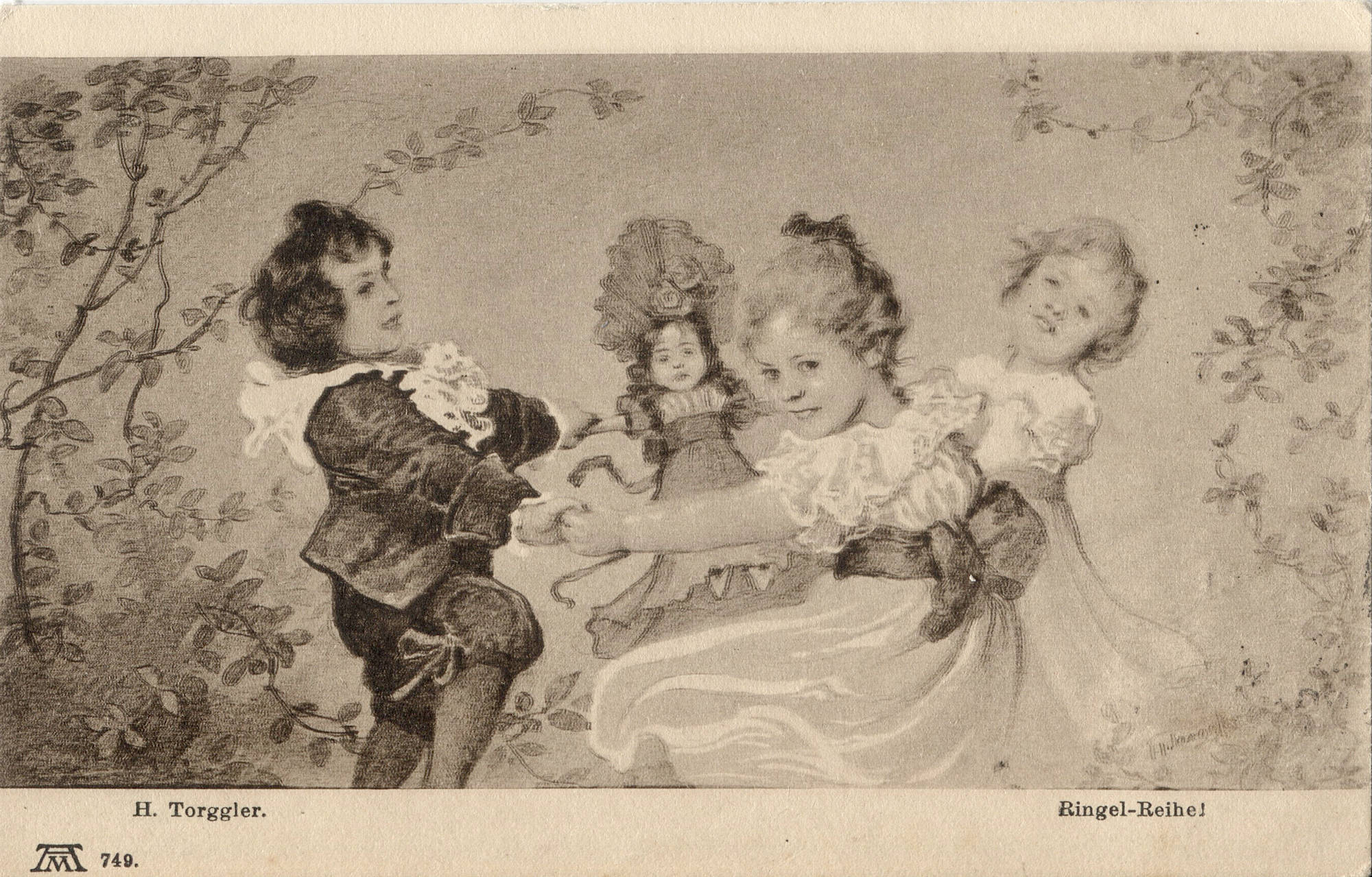
My final postcard of Herman Torggler is one that I used before in my 2021 story on his children series. But that one was covered in a length message and had a postmark of 1901. This one has a message on the back and a postmark of 1909, so it is an example of the long popularity of Torggler's illustrations. Here another trio or Terzett of children, two girls and one boy, are whirling about in a kind of dance. A doll looks a bit alarmed at being pulled apart in the frenzy. One girl looks directly at us as she and her friends take delight at being in motion. The title here is Ringel-Reihe! ~ Ringelet turn!, but in Torggler's identical card in 1901 the title was Kinderlust ~ Childhood. 

This card was sent from Stuttgart on 22 July 1909 to another Fräulein. It's very curious that a  significant number all of the German postcards in my collection, maybe 80-90% were addressed to young women using the traditional  German honorific Fräulein. However since the 1970s many Germans began to feel this term was expressing a "diminutive of woman", and that it implied a Fräulein was not-quite-a-woman. As modern feminism advanced in Germany usage of the word Fräulein was increasingly seen as patronizing and in 1972 it was banned from official government use in West Germany. Now all women in Germany are addressed as Frau regardless of their marital status. 

Similarly the same thing happened in France when in 2012 the honorific Mademoiselle was banned in all official documents. Now the courtesy title of "Madame" is accorded women where their marital status is unknown.


It is said that children are our future. But they are also our past, too. One might say that the essence of what childhood is comes from adult hindsight, reminiscing on the years when we were younger and immature. Children learn to recognize the difference between themselves and adults.  After all every kid strives to grow up one day. And sometimes we older folk get admonished to act our age. But to a child, time is neither past nor future but always in the present. 

Herman Torggler's illustration of these lively cute children were made in an era when, compared to modern times, most children were considered mature at a very young age. Many children left school and went to work at age 10, 12, or 14. Marriage at 16 was common as was pregnancy. And of course in previous centuries, many, many more children succumbed to death caused by industrial accidents and infectious diseases than are killed in the 21st century. 

I think Torggler was drawing on a romantic notion of an innocent childhood filled with wonder and delight. It was a fantasy that clearly appealed to Germans and Austrians since Torggler created so many of them that have been preserved for over a century. What intrigues me is how he slyly drew children with faces that show subtle adult emotions of worry, cunning, and desire. 

In 1900 it was a kind of caricature of childhood that perfectly fit the new medium of the postcard.  I don't know that Herman Torggler was the first artist to create this style but a lot of people bought his cards in order to share a novel sentiment or moment of lighthearted humor. In a way it is no different than how in our time people share a meme video or an emoji when sending a text or email. But in 125 years I don't think anyone will be collecting things like that.


This is my contribution to Sepia Saturday
where things may get a bit sticky this weekend.


The Art of War, part 1

24 June 2023


An attractive young nurse lights a wounded soldier's cigarette.

It's like a romantic scene from a old movie,
except this simple color illustration of that moment
was drawn before the golden age of cinema.
It's a postcard from the Great War of 1914-1918
created by the Austrian artist, Hermann Torggler, (1878-1939).

Raucher, Gedenket Durch Eine Spende
Der Verwundeten Soldaten!

~
Smokers, Make a Donation to Commemorate
the Wounded Soldiers!


Offizielle Karte
Zugunsten Der Kriegsfürsorge
No. 23

~
Official card
in aid of war welfare


Herman Torggler is one of my favorite artists, and I used this image in my story from August 2019, Up, Up, and Away!. It's an example of how artists during this turbulent period contributed to their nation's war effort by creating imaginative postcards that were sold for the benefit of wounded soldiers. I suppose it's a kind of propaganda, but it served an honorable goal since in 1914, regardless of which country, veterans and families of servicemen killed or wounded in action did not receive any government assistance. In this case, Torggler's appeal was targeted to civilian smokers who would easily imagine the hardship of a wounded soldier being in hospital but without the solace of tobacco. 


* * *


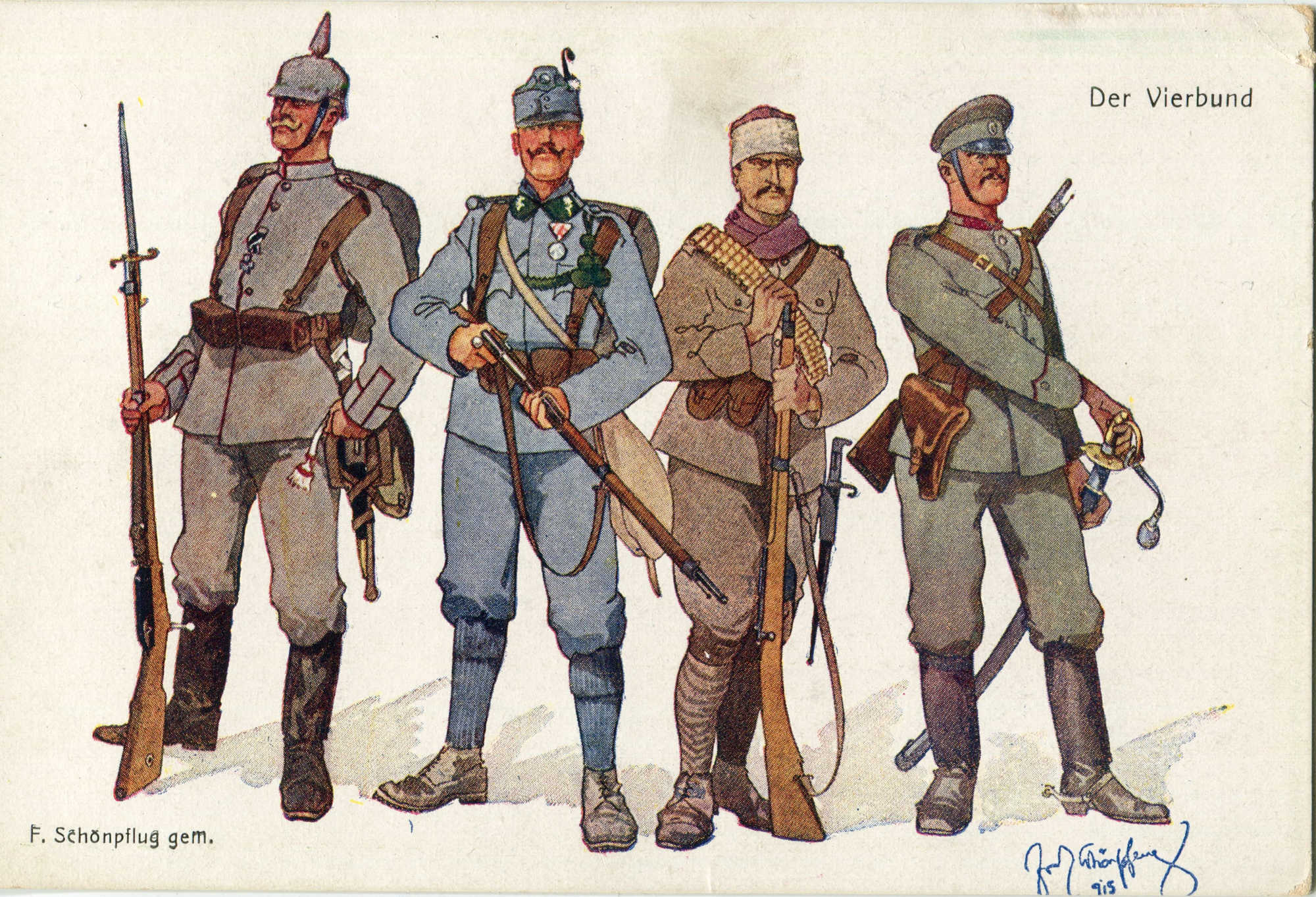
Another of my favorite Austrian artists, Fritz Schönpflug (1873 – 1951), chose a different theme for his contribution to a soldiers benefit association. In his postcard four stalwart soldiers, each in a different uniform take a heroic defensive stand. The short caption reads: Der Vierbund, or the Quadruple Alliance, which was the German term for the Central Powers in the war. Starting on the left, Schönpflug shows a soldier of the German Empire wearing their distinctive pickelhaube helmet; next to him is a soldier in the pale blue uniform of the Austro-Hungarian Empire; then a soldier in dusky brown of the Ottoman Empire; and finally on the right a soldier from the Kingdom of Bulgaria. 

Before the war, Schönpflug made hundreds of humorous postcards, often lampooning military life in Wien with stinging satire. But he was a skilled artist who knew how to manipulate a drawing and change a comic moment into a courageous image.

The card was never mailed but Schönpflug's signature has the number 915 beneath it which was a shorthand for the year 1915. Bulgaria also officially entered the war on 14 October 1915, so he was tasked with depicting Austria's allies in a way that would make plain their unified power. 

The irony is that in 1915 Bulgaria was a very young country, first established seven years earlier in 1908 as a supposedly constitutional monarchy under its leader, Tsar Ferdinand I. Previously it had been just a principality within the Ottoman Empire though with closer ethnic, religious, and political ties to the Austrian and Russian empires than to the Muslim Turks. 

In 1914 Bulgaria was very familiar with war because in October 1912 it had joined a coalition with Greece, Serbia, and Montenegro to fight the Ottoman Empire over territory in the Balkan region. This First Balkan War lasted only 7 months, 3 weeks and 1 day, but just three weeks after a peace treaty was signed in London, Bulgaria took issue with the settlement and started a Second Balkan War against its former allies Greece, Serbia, and Montenegro as well as the Ottoman Empire and Romania, too. 

The casualties from both Balkan Wars are very disturbing considering that the two  conflicts lasted from 8 October 1912 to 10 August 1913, barely a week over nine months in total. One estimate of casualty deaths in combat listed Bulgaria - 32,000; Greece  - 5,000; Montenegro - 3,000; Serbia - 15,000; and the Ottoman Empire - 30,000. Other estimates are even higher when including death from diseases. And there were hundreds of thousands of civilian who perished in the wars and even more were displaced from their homelands. The messy conclusion of these two short regional conflicts wars set up the conditions that caused all of Europe to explode into war in August 1914. 


Offizielle Karte für
Rotes Kreuz, Kriegsfürsorgeamt
Kriegshilfsbüro
Nr. 370

~
Official card for
Red Cross, War Welfare Office
War Relief Bureau

The notice on the back of this card shows it came from the same welfare office but it now included the Austrian Red Cross as well. The number 370 implies that the series involved many artists, so I may have to start a new collection category.


* * *


This third postcard from the Great War has a painting made by another of my favorite artists, Arthur Thiele, (1860 – 1936). Thiele was German and here he depicts a cavalryman playing his trumpet while what looks like a battle goes on in the background. The caption reads:

Behüt Dich Gott!
Auf Wiedersehen!

~
God protect you!
Until seeing you again!


The curious caption is actually the title of a song from a well-known German opera from 1884, Der Trompeter von Säckingen, by Alsatian composer, Viktor Ernst Nessler, (1841–1890). It is based on an epic poem with the same title by German poet, Joseph Victor von Scheffe, (1826–1886). The storyline from its Wikipedia entry describes the opera best.

The setting is 17th-century Heidelberg and Säckingen, after the Thirty Years' War. The trumpeter Werner loves Maria, the daughter of the Baron, but her father and mother want her to marry the cowardly Damian. Werner proves himself a hero and is opportunely discovered to be of noble birth, so all ends happily.


In the 1890s and 1900s the character of Werner with his trumpet (bugle) proved tremendously popular in Germany as hundreds of different postcards were produced with an image of the gallant 17th century trumpeter. The setting in the small rural town of Bad Säckingen, which is in the state of Baden-Württemberg in southwest Germany,  close to the Swiss border, was tied to Germany's violent history with France and the disputed region of Alsace-Lorraine which in 1914 was part of the German Empire. 

In the opera there is a slow sentimental song, Behüt Dich Gott!, that includes a famous trumpet solo. My English translation of the title follows a more literal meaning which, I believe, is how Arthur Thiele intended his picture to link this familiar song of the 1880s to a battle scene in 1914. The postcard was sent by a soldier via free military Feldpost and dated 16 October 1914 from Borkum, a tiny island on Germany's North Sea coast, practically part of the Netherlands, and a very long distance from Bad Säckingen. 


* * *


This next postcard artwork of the Great War is unsigned but made by a competent artist who certainly knew how to draw a horse. It shows a few cavalrymen vainly firing their rifles (and shaking a saber!) at a biplane high above them in the blue sky. A description is found printed in a caption on the back.

Ulanen beschießen ein feindliches Flugzeug
~
Lancers fire at an enemy plane


A larger printed caption identifies this card as another benefit for wounded soldiers.

Herausgegeben am Besten von Schwestern des
Verbandes deutscher Krankenpflege-anstalten vom
Roten Kreuz.
Preis 10 Pfg.— Dem Wohlfahrtszweck
fliessen 3 Pfg. zu.

~
Edited as best by sisters of
the Association of German Nursing Homes of
the Red Cross.
Price 10 Pfg. — 3 Pfg.
flows to the welfare purpose.


* * *


Some of the wartime artists took their inspiration from older wars. In this sepia-tone drawing, a fearsome medieval melee of soldiers fight hand to hand with bayonets and swords. There is a struggle over a flag. The back has a caption describing it:

Der grosse Krieg 1914/15.
Eroberung einer französischen Fahne bei Lunéville
~
The great war of 1914/15.
Conquest of a French flag at Lunéville

I believe this depicts, supposedly, the Battle of Grand Couronné from 4 to 13 September 1914, where the German army captured Lunéville, a French town on the border of German-held Lorraine. However a few days later the Germans withdrew, returning it to French forces. According to the Wikipedia entry the German 6th and 7th armies together lost 66,000 casualties, with an estimated 17,000 men killed in this battle. 


The postcard was never sent but on the back is a symbol of a German Iron Cross medal 
for a veterans organization honoring the years 1870 and 1914.
A large caption reads:

Wohlfahrtskarte
des "Reichsverband zur Unterstützung
deutscher Veteranen E. V."
für Kriegsteilnehmer des Heeres und der Marine
~
Welfare card
from the "Reich Association for the Support of
German Veterans E.V."
for combatants in the army and navy

Mindestertrag 3½ Pfg ~ Minimum yield 3½ Pfg.


* * *


The French also produced a great number of artist designed postcards. Instead of a picture, this postcard shows a clay sculpture of a bugler rising from the battleground to call his comrades. The artist is not identified on the card but the name on the model is T. Cartier. I believe this is the work of Thomas Francois-Cartier, (1879–1943), a French sculptor, born in Marseilles, who specialized in creating bronze works in the animalier style, a mid-19th century trend of naturalistic yet romanticized portrayals of animals, particularly dogs and big cats, i.e. lions. The title of this work is printed at the bottom with a quote at the top.

Le Clairon
~
The Bugle

Et sur sa lèvre sanglante.
Gardant sa trompette ardente.
Il sonne, il sonne toujours!
~
And on his bloody lip.
Keeping his fiery trumpet.
It sounds, it still sounds!

The trumpeter stands next to a monolithic gravestone,
that has an engraving of the face of a bearded man and the words:

1914   Quand Même
~
1914   All the same

The image is of Paul Déroulède (1846–1914),  a French author and politician, and one of the founders of the rightwing nationalist League of Patriots. His early career started with the publication of a collection of patriotic poems (Chants du soldat) in 1871 during the time of the Franco-Prussian War. This quote may come from a poem in that work. After France's defeat Déroulède helped organize the League of Patriots to demand the return of Alsace and Lorraine from Germany. His opposition to the French government became so extreme that he was arrested in 1899 and tried for conspiracy against the republic. He was convicted and sentenced in January 1900 to banishment from France so he moved to Spain. When he died in January 1914, six months before war began, his funeral procession in Paris attracted the largest crowds since that of the novelist Victor Hugo. 

Clearly there is more context behind this trumpeter's sculpture that is not easy to recognize in the 21st century. In 1914 French politics was incredibly volatile and a "patriot" had a different meaning depending on whether it came from a leftist or rightist viewpoint. The back of this card has no postmark but was dated by the writer 18 January 1915. By coincidence it was sent to a young woman in Lyon who lived at 12 rue Victor Hugo. 


UPDATE:

There was something familiar about the image of Paul Déroulède that triggered a memory of one of my other stories on a French political postcard. In my story Music as Metaphor from 15 January 2015, days after a terrible terrorist attack in Paris, I featured a postcard of a band made up of French politicians. The face of Déroulède is in the upper right corner as the leader of the the Ligue des Patriotes  or League of Patriots. 


* * *


My second French postcard links to Cartier's bugler with a impressionist painting of a troop of French drummers and buglers. They march down a street dressed in blue jackets and bright red trousers. A caption reads: Les Zouzous, a nickname for young soldiers from the Zouave light infantry regiments of France's North African colonies, principally Algeria. The zouave soldiers wore distinctive uniforms characteristic of their North African origin with short open-fronted jackets, baggy trousers, sashes, and a chéchia, a fez-like head-dress. The artist is not identified except for the initials L.V.C. painted in the lower corner.

There is no postmark but the writer sent the postcard
to another soldier of the 3rd Zouave regiment
staying in a temporary hospital in Marney, (?) France
and finishes their message offering best wishes for: 

une bonne sante et que cette mauvaise guerre sera finie en 1917
~
to 
good health and that this bad war will be over in 1917 


* * *


My last art work depicts another regimental trumpeter blowing his instrument and holding a rifle too. (Actually it's a crudely colorized photo, but it fits with my trumpeter theme anyway) The frilly black-green plume on his hat marks him as a Bersagliere, a soldier in the special troop of marksmen in the Italian Army's infantry corps. The plume is made of hundreds of feathers from the black capercaillie bird, a Eurasian wood grouse. This distinctive decoration on the Bersagliere's uniform served a practical purpose of camouflage and as a sunshade for the marksman's shooting eye. The postcard's sender has added a translation of Sharpshooter under the imprint on the card. 

The soldier's bugle is unusual because unlike other bugles, this one has a single piston valve. This gives the instrument a second overtone series that is one whole-step lower in pitch which greatly increases the melodic potential of its bugle calls. I suppose this is should not be unexpected for an Italian musical instrument but Italian army bugle calls must have been far more complicated than those of other nations as I've never seen it used in any other bugle corps. 

The two 5 centesimi stamps have the face of King Victor Emmanuel III and a postmark of either 2 or 12 October 1914, coincidently sent almost the same week as the postcard of Thiele's cavalry trumpeter. It was mailed to James J. Martin of Lincoln, England. The writer here added a rubber stamp of his name and address: Michele Atlante di Gius, Bari (Italy), which is a port city on the Adriatic Sea on the heel of Italy's boot-shaped peninsula. 


Please send me, if
you can, some English
papers with war pictures.
Thanks for.
Your friend
M. a. d. G.


When the Great War started no one, from Kaisers down to generals, politicians, journalists, and eventually to the proverbial man-in-the-street, expected the war to last more than a few months. The expectation was that like the two recent Balkan Wars, or the Russo-Japanese War, or the Spanish-American War, the conflict would be brief and end quickly. No one expected or understood the terrible consequences that would come from over 4 years of total global warfare. It was unimaginable.

By 1914 photography was already a well-established tool for documenting a war, and it was used by all the belligerent nations to promote and define their national goals. Though a good writer might describe a war in bold, even terrifying words, once a reader saw a picture of a battlefield's devastation their emotional response was intensified more than any polished prose could accomplish. 

Fine art was an even older and more familiar medium that people were accustomed to seeing in advertisements, propaganda, posters, and postcards. What intrigues me is the way artists used their imagination and artistic skills to provoke a more immediate reaction from the viewer. People were moved to contribute to a veterans' charity because the image of an attractive nurse and handsome soldier sharing a moment caught their attention. It's the essential quality of all advertisements. Grab the eyes. Then persuade. 

In the 21st century we daily, even hourly, endure an endless barrage of competing media trying to change our focus. People in 1914 probably felt the same, even though the scale of their media was smaller, required live voices, and was only on printed paper. But these small postcards were important because this was a media that people regularly used for communication and the images were how they interpreted what was happening in this tempestuous time. I hope that Michele Atlante di Gius's English friend was able to oblige and send him British postcards if not newspapers with pictures of the war. 


The Bersaglieri were renown for their unique style
of marching in parades, and that tradition continues
in the Italian army corps of our modern time too.
It's a very unusual style so I can't resist finishing
with a short video of a Bersaglieri band in Bologna, Italy
on the occasion of the rally for the 6th Bersaglieri Regiment.

I can't decide who has the more impressive technique,
the tuba players or the trombonists.
In any case it is a brass method
that must require lips of steel.

Watch out for the little mascot
who follows the band. 
Apparently they start training
at a young age in Italy.


This topic of art in the Great War of 1914-18
is one which I plan to revisit soon
as I have acquired many more postcards on this theme.


This is my contribution to Sepia Saturday
where it's always best to follow a nurse's direction.


nolitbx

  © Blogger template Shush by Ourblogtemplates.com 2009

Back to TOP