This is a blog about music, photography, history, and culture.
These are photographs from my collection that tell a story about lost time and forgotten music.

Mike Brubaker
{ Click on the image to expand the photo }
Showing posts with label prison. Show all posts

The Art of War - Portraits of Soldiers

22 October 2023


In August 1914 as armies across Europe mobilized for war, military commands gave little thought to the consequences of a prolonged conflict. Almost everyone believed that this war would last only a few weeks, certainly no more than a month or two. The assassination of Archduke Franz Ferdinand, the heir to the Austro-Hungarian throne, and his wife, Sophie by a half-dozen Bosnia-Serb terrorists on 28 June 1914 was a terrible tragedy, but it seemed unthinkable that diplomacy would fail and nations would be forced into war.

Yet only a month later hundreds of thousands of soldiers were engaged in ferocious combat across tremendous battlelines drawn across both western and eastern Europe. 


The empires of Germany and Austria-Hungary, as well as Russia and the Ottoman empires, were much larger in 1914 than these nations are in the 21st century. As Austria-Hungary embarked on a Serbian campaign on 28 July 1914, it triggered a complicated series of military agreements that compelled Russia and then Germany to deploy their armies, closely followed by Belgium, France, and Britain. In the first weeks of the war Germany took advantage of its military planning and completely overwhelmed the small Belgian army as German forces marched to attack France. Thousands of Belgian soldiers were taken prisoner.


On the Eastern Front at the Battle of Tannenberg, General Paul von Hindenburg's troops effectively destroyed the Russian 2nd Army in just seven days at the end of August 1914. The German victory resulted in the capture of 92,000 Russian soldiers, including 13 generals.

But for Germany, these early victories came at a cost. Tens of thousands of Belgian and Russian soldiers were captured. As the war stretched into September more French and British soldiers were taken too. As enemy soldiers, of course, they could not be released. So Germany was compelled to hurriedly construct camps to hold its prisoners of war. 


By February 1915 Germany had imprisoned 652,000 enemy soldiers and by August that number increased to 1,045,232. Hundreds of camps were established throughout Germany with separate facilities for officers and enlisted men. Later the camps were further divided by nationalities. In August 1916 the POW population in Germany had grown to 1,625,000 soldiers and it would expand to an astounding 2,415,000 prisoners by the end of the war in November 1918. Though there were German prisoners of war held in Russia, France, and Britain, it was the POW camps in Germany that confined the most soldiers from August 1914 to November 1918. 

The numbers of the Great War are staggering to understand, especially when combined with the horrible casualties and deaths incurred by all the armed forces. As each nation realized that this war would be horribly different, governments created new departments of propaganda. Germany was especially effective in using picture postcards, a popular medium of communication, to persuade its citizens that this war was a just and righteous struggle against ignoble and villainous foreign people.  

A few years ago I began collecting postcards that depicted captive soldiers from both sides of the war. These postcards are typically black and white photographs, sometimes colorized, of ranks of enemy troops usually marching through city streets or assembled for transport to confinement camps. Readers can see examples of these cards in my story The Color of War from November 2022.

But my collecting interest was also attracted to a very different kind of German postcard from the war that did not show captive soldiers as unsympathetic masses of enemy troops. These were sensitive portraits of individual soldiers  painted or sketched by accomplished artists and then published by respectable German publishing companies. Unlike other postcards of POWs these were not caricatures or cartoons that emphasized racist stereotypes or tried to incite bellicose hatred. These fine art portraits expressed an unusual respectful view of an individual soldier without any blatant bias. Many of the pictures are dated and sometimes identified their subjects or their military units. This collection represents the work of four different artists which I feature today..


My first artist is the one who painted the colorful soldier at the top of my story. This man is dressed in the colors of a French soldier's uniform with blue jacket and red pantaloons tucked into high cavalry boots. The artist's signature is A. Bitterlich.


The back of the card has a caption identifying the figure as an Afrikanischer Jäger zu Pferd (Wachtmeister) ~ African hunter (ranger) on horseback (sergeant). It is from a series of cards entitled: Studien aus den Gefangenen-Lagern ~ Studies from the prison camps, produced by the GMT printing company with militäramtlich genehmigt ~ officially approved by the military. 

The card was addressed to Madame & Monsieur Dupuis of Montmirey-le-Château a small commune in the Jura department of eastern France. In 1911 its population was 271. The card was dated 25 June 1917 and signed with a single name that I can't quite make out. 


This second watercolor by Bitterlich shows another French soldier, called an Infanterist or infantryman in the card's caption. This man is wounded with his left arm and hand bandaged and in a sling under his great coat. The colors of uniforms are, of course, absent in a black and white photo but here the artist gives us the accurate hues worn by French soldiers who began the war in gallant blue coats and cardinal red caps and trousers. However this brilliant fashion may have suited 19th century warfare but in early 1914 the French military command realized that the red and blue made their soldiers easy targets for the enemy. In July 1914 a new uniform was ordered in a blue-grey color known as "horizon-blue" as this tint was considered a better color to mask a soldier's outline against the sky.  However the war began before most mobilized units could receive the new uniforms. Therefore this soldier was clearly captured during the first weeks of the conflict.

The artist's full name was Albert Bitterlich who was a German painter and printmaker born in Bräunsdorf, Saxony, Germany in 1871. He studied at art schools in Dresden and in Munich which became his residence before the war. Some of his artwork is preserved in the State Painting Collection of Munich. Albert Bitterlich died in 1960 in Newuberg, Germany. 


This third image by Bitterlich is called simply Tartar and it shows a Russian soldier reclining on the ground. The man wears a blue peasant shirt and a tall fur hat that has no brim. He looks resigned to his fate. 

This card, like the previous two, was also addressed to Madame & Monsieur Dupuis of Montmirey-le-Château and  signed by the same soldier. This one is dated 15 May 1917 so I presume it was sent to France from a German POW camp. 

Some of Bitterlich's paintings can be seen at ArtNet. It's a small collection of a few bucolic landscapes and some charming flower arrangements, but I think these cards are far more interesting for both their subjects and his impressionist style.


* * *


My second artist used a different technique to create quickly sketched portraits in shades of black and grey. I think the medium is charcoal or pastel crayons, but it may be a brushed ink. This postcard shows a Russian soldier with the artist's signature, Erich Lüdke, very clear in the lower corner. Also with the signature is Biała 1915, Belin in block letters and another line in cursive which is unclear. Biala was part of the twin cities now known as Bielsko-Biała in southern Poland near the borders of Slovakia and the Czech Republic. In 1914 it was within the crownland of Galicia in the Austro-Hungarian Empire. Several battles between the Russian and Austrian-Hungarian armies were fought in this area.


The back of this card has one of the most unusual handwriting styles I've ever encountered. I believe the long message is in German and written by a soldier, but the spiky penmanship is too dense to make out words. The only thing I can decipher is the date 24 III 17. 

Tracking down this artist was not easy, partly because the name is shared with Erich Lüdke (1882–1946) a German general who served in both WW1 and WW2. At first I wanted this career army officer to have a side talent as an artist because ironically at the end of WW2 he was captured by the Soviet Union and died in a  Russian prison in 1946. However I found other commercial artwork by a Erich Lüdke with the same signature that leads me to believe the artist was a different man. This next German poster has his block letter signature and it dates from 1924/25. I also found examples of illustrations for advertisement posters for cigarettes and coffee that date to the postwar years. 


2ter Deutscher Hanfa-Tag Poster
by Erich Lüdke, c1925
Source: Postermuseum

I could not find any other information about Erich Lüdke, but I suspect he was Austrian, either a soldier fighting in Galicia or an artist commissioned to draw pictures of Russian prisoners of war since all of his postcards were used by Austrian soldiers. 

I'm trying a new method to display a gallery of images on my blog. It's a Google Slideshow document which I hope will work for all viewers, but with all the privacy blockers around it may not display for everyone. Please leave a comment if you are unable to see this collection of 3 other soldiers' portraits by Erich Lüdke.


_ _ _ _


_ _ _ _


* * *


My third artist also worked in charcoal pencil to sketch many portraits of captured soldiers. This example shows a proud Russian in a heavy coat, fur cap and with a very insulating beard. A printed caption identifies him simply as a Sibirier ~ Siberian with his full name, Lesow Kaluga. The third photo at the beginning of my story is by the same artist and has a similar caption and name: Buddist ~ Buddhist Jwan Leiduhoff, Sib. Inf._Reg. No. 26.  

The artist signed the pictures as M. Tilke  and added a date underneath of Dec.14 for the Siberian Kaluga, and Jan. 15 for the Buddhist Leiduhoff, the numeral standing as the year. Tilke also added a written note of Nach dem Leben gezeichnet ~ Drawn from life. So I think these were soldiers that he met personally and who sat for him as he made his sketch. 


The first Tilke card was never mailed, but this second one was sent using the German civil postal service but the postmark is smudged. However the writer properly dated it 16. 8. 15. 

The artist's full name was Max Karl Tilke (1869–1942), and he was born in 1869 in Breslau which was then in Prussian Silesia but is now known as  Wrocław, Poland. He was only age 17 when he entered the Prussian Academy of Arts in Berlin and traveled to France and Italy as a young man. In 1901 Tilke opened the first cabaret in Berlin called "The Hungry Pegasus" ~ "Zum hungrigen Pegasus" where he acted as the Conferencier  or master of ceremonies. 

Tilke had a wide range of artistic interests and earned a reputation for his knowledge of historical and oriental costume. In 1912 at the invitation of the Tsar, he traveled to Tbilisi, Georgia to work at the Caucasus Museum painting the costumes in the museum's collections and undertaking expedition to find more ethnic folk costumes. But the onset of the war in August  1914 prevented him from ever completing his research. On his return to Germany Tilke worked for the publishing union, Deutsche Verlag Union, in Stuttgart and produced other paintings on themes of the war. In the 1920s he returned to his study of Oriental and folk costumes and published several works on this topic. 

Max Tilke produced several postcard series of prisoner of war portraits. Almost all with individual names, dates, and sometimes units. It is easy to see how his interest in folk costumes influenced his choice of subjects. I imagine his sketchbooks were filled with hundreds of soldiers from across Eastern Europe and the Russian Empire. Here is a second slideshow of six more of Tilke's portraits.

_ _ _ _


_ _ _ _


* * *


My fourth artist used both charcoal pencil and watercolors and is arguably the most prolific of this quartet of wartime artists. In this sketch we see a bearded French soldier in profile. A caption identifies him as a Französ. Landsturm ~ French militia (reserve) in the 45th regt. of infantry from his collar badge. The artist has signed it: Günkel 1914. 

His previous work at the top of my story was in color and shows a Belgian cavalryman of the 1st regiment of Guides in Brussels. That portrait has a signature of E. Gunkel.

The French soldier's card was sent by a German soldier using the military post on 2 October 1915 from Arlon, Belgium in the southern region just next to Luxemburg.  


The artist's full name was Ernst Günkel (1876–1925). His German Wikipedia entry offers very little except to say he was a German painter "who was best known for his colored portrait drawings, which were published as war souvenir cards by Dr. Trenkler & Co., Leipzig." By a strange coincidence the only image file included on his Wikipedia page is a slightly different version of this same French soldier.
 
Artwork of Ernst Günkel (1876–1925)
Source: de.wikipedia.org


Ernst Günkel's prisoner of war portraits were evidently very popular during the war years as I have found many of his postcards. Like Bitterlich, Lüdke, and Tilke, Günkel painted numerous portraits of Russian soldiers but he was also attracted to the various French-African colonial soldiers who were brought to work and fight on the Western Front. His depiction of Black Africans from Sudan and Sengal as well as swarthy "Turkos" from Algeria and Morocco took a very sympathetic, even fraternal, approach to men whose race was considered exotic to most Germans. 

Printed om the back of many of the cards is a title: Kriegs-Erinnerungs-Karte ~ War memorial card. Some were distributed in aid of the German Red Cross. In several portraits the prisoner of war camp is also identified with the soldier. Günkel's signature on the charcoal sketches almost always has the year 1914, so I believe these soldiers were among the first taken prisoner in the war. Based on some of the postmarks, these cards were published throughout the war years, a testimony to the popularity of Günkel's artwork. 

This last slideshow shows twenty of Günkel's portraits in my collection. 


_ _ _ _


_ _ _ _


A century later it is difficult to interpret how these portraits of enemy soldiers were perceived by Germans during the war. No doubt many Germans found the unusual uniforms, hats, and complexions a novel curiosity. Perhaps the postcard publisher's intent was to humanize the enemy as a subtle way to check anti-war sentiments in the German public and encourage benevolent feelings toward enemy peoples. But only so long as they were pictures of vanquished soldiers who were incarcerated in prison camps. 

What most intrigues me is that Günkel, Tilke, Lüdke, and Bitterlich used their artistic talent in a way that transcends any fake disinformation or jingoistic bluster. These were artists who painted what they saw: real men whose faces reveal pride, anxiety, and even suffering. These were soldiers removed from the horrors of battle but now confined indefinitely to a prison camp. It was a fate that in 1914-15 seemed to have no end.  
 
There is one more question about these portraits that may never be answered. Did these soldiers ever receive a postcard of their sketch or painting that they could send to the folks back in their homeland? I'd like to believe the artists found a way to give each of the men a personally signed picture.


This is my contribution to Sepia Saturday
where great grandpa is always watching what you do. 


The Prisoners of Königsbrück

12 January 2019


They were probably the first to arrive.
Begrudging passengers on trains
where the language spoken on the trip out
was now a very different language on the return.


They were put to work digging in sandy soil
building their own camp.
It was hard work but at least 
construction was better than destruction. 

They were Russian and French soldiers,
captives of the war, 1914-1918,

and incarcerated at a German military prison camp
in Königsbrück, Saxony.


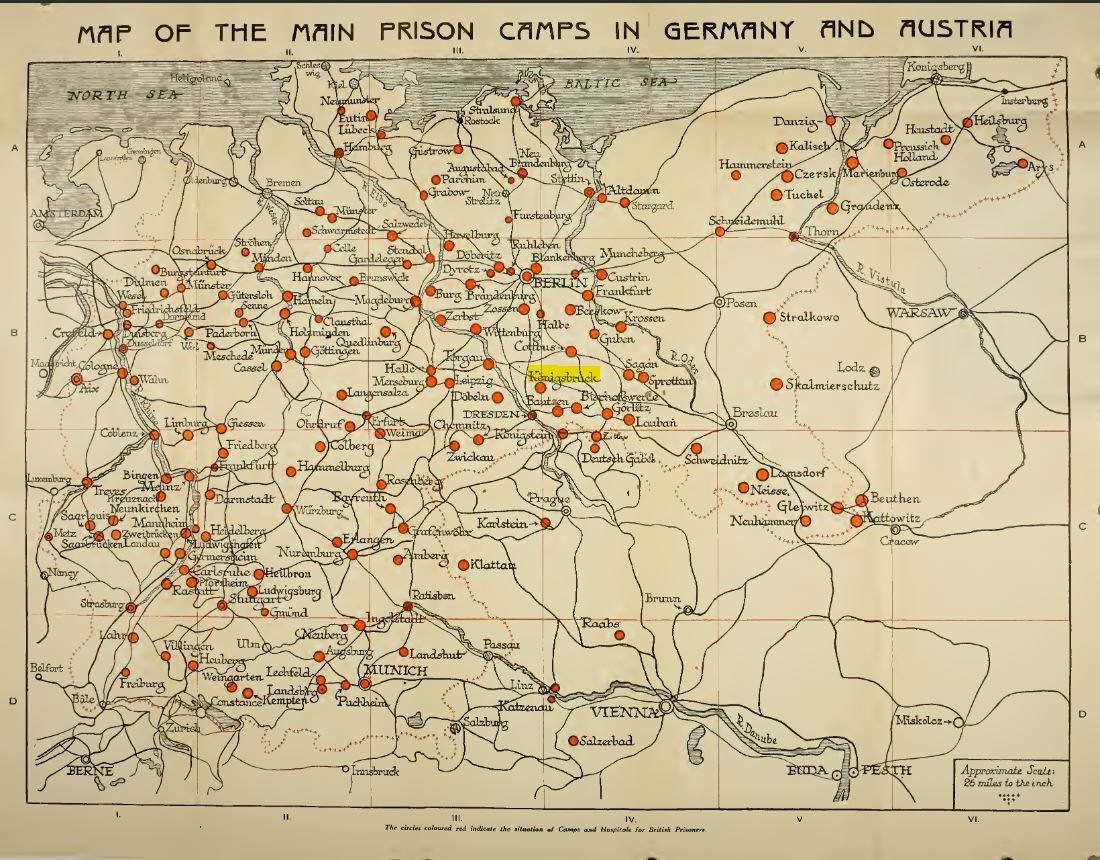
Map of the main prison camps in Germany and Austria
by Mrs. Pope-Hennessy, 1920
Source: Internet Archive


The first postcard image is of a train with Russian soldiers looking out the carriage windows  at a large block of German armed servicemen, probably a Saxony state police force, on the train platform. The caption reads:


Königsbrück - Ankunft gefangener Russen
~
Königsbrück - Arrival of captured Russians

The postcard was never posted but the back has an inscription curiously printed in red ink in French.

Arrivée des prisonniers Russes à Königsbrück
~

Arrival of Russian prisoners at Königsbrück


* * *


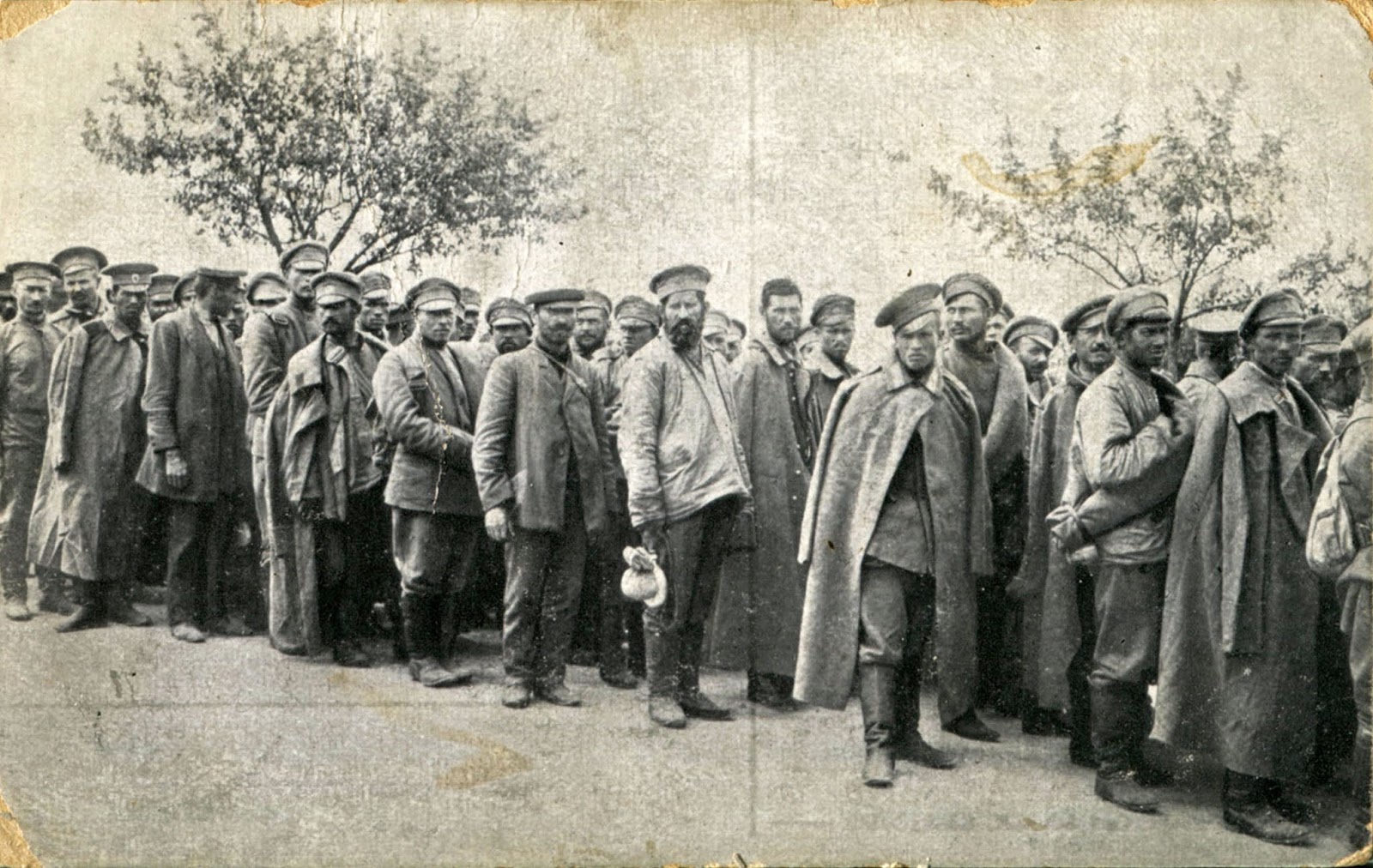
This next image shows a group of captured Russian soldiers destined for the POW camp at Königsbrück. The back of this half-tone printed postcard has the same caption:

Königsbrück - Ankunft gefangener Russen
~
Königsbrück - Arrival of captured Russians

The publisher is the same as on the train postcard: Verlag: Carl Schmidt, Königsbrück. I suspect that the photographs were taken by photographers on assignment from the German government's Information Office to produce propaganda postcards for German troops, though the French caption implies the cards could be used by the POWs too. This card was sent using the free-post available to the military during the war by a German soldier named Rainhard to a Fraulein Luise Vofs(?) in Hademarschen, a town in Schleswig-Holstein, Germany near the Kiel Canal. The postmark is obscured so there is no date.


* * *


The image of the men digging in the sand was cropped from another postcard captioned in German on the back:

Gefangene Franzosen bei der Arbeit
~
French Prisoners at work

This Kriefs-Postkarte – War Postcard was sent from Königsbrück to a German soldier's family on 25 February 1915. The rules for dealing with captive soldiers were very sketchy in 1914 and not entirely understood or accepted by the belligerent nations. Everyone expected this to be a short conflict, over by Christmas, so making practical arrangements for the hundreds of thousands of prisoners unexpectedly taken on both the Western and Eastern Fronts was sorely neglected by the German military and civil authorities. In general POWs were not supposed to be used for any labor that supported the war effort. As Europe was still a very class-structured society, officers were supposedly excluded from doing any work. Nonetheless, many soldiers were drafted into manual details for rough construction or agriculture.


* * *


This group of French soldiers appear as relaxed as if they were on the streets of Paris. But standing behind them are German soldiers guarding them as prisoners of war. I expect they are on a street in Königsbrück and like the Russians soldiers are about to march off from the train depot to the POW camp. The publisher is the same Carl Schmidt and on the back is a caption:

Königsbrück - Gefangene Franzosen
~
Königsbrück - French Prisoners

There is no postmark but at the top left in faded purple ink is a faint Königsbrück 11_30_14 written by a soldier to someone in Chemnitz, in Saxony. This early date in the war shows how quickly propaganda was mobilized by the Kaiser's government to reassure the German public that their troops were winning by showing images of the captured enemy. By my rough estimation the majority of postcards depicting POW camps were used by German soldiers, presumably those assigned to the camps or nearby. The next largest are postcards sent by French or Belgian soldiers from the POW camps. Surprisingly not many were sent by British POWs, or at least not many have survived to be sold online. And I have yet to see any that were sent by Russian soldiers. They were the ones who suffered the worst privations and were typically isolated from the French and British in separate camps.


The map showing the hundreds of POW camps in Germany and Austria came from a small gazetteer produced during the last stage of the war. It was compiled by Mrs. Pope-Hennessy to help families of British POWs understand the complex system of German military prison, several of which were for civilians interred as enemy foreigners in 1914. Page 7 describes the camp in Königsbrück – in Saxony. A camp wooden hutments situated on sandy soil amidst pine-woods a short distance from the town. Capacity, 15,000. 12th Army Corps (the German military force in charge.)


Map of the main prison camps in Germany and Austria
by Mrs. Pope-Hennessy, 1920
Source: Internet Archive

After just one month of war, in September 1914 the German army had captured over 200,000 enemy combatants - Russian, Belgian, French, and British as well as confining a large number of foreign civilians. By early 1915 their POW population had grown to 652,000, increasing to 1,625,000 by August 1916, and finally reaching 2,415,000 by the end of the war. Though the men were removed from the hazards of war they still endured hardship from poor food, ill health, and unsanitary conditions, not to mention the mental and emotional stress of being indefinitely confined away from their families and compatriots.

For reasons not entirely clear there are a lot of photo postcards of the Königsbrück POW camp. Perhaps because the town had a number of good photographers, or the camp allowed prisoners to use cameras, I'm not certain why. A few years ago in July 2014 I wrote about some of the postcards of the Königsbrück POW theatre in a story entitled Theatrical Ladies. There is still much more to write about the musical and artistic activities that the Königsbrück prisoners created to alleviate the boredom of captivity, so stay tuned for future posts on this POW camp. 


This is my contribution to Sepia Saturday
click the link for another side of the track.

http://sepiasaturday.blogspot.com/2019/01/sepia-saturday-452-12-january-2019.html


A Birdseye View of a Girls Orchestra

13 January 2017


They say two is company, three's a crowd.
And that applies to double bass players
when there are only two instruments to share.
On the other hand,
bass drummers
often do the job of two
by doubling up on cymbals,
with half a pair fixed onto the top of the drum.


Cellists usually come in pairs,
though some like to hide
behind snare drummers.
 
Violinists always seem to come in gangs.


An orchestra should have
a generous number of strings
but really needs only one oboe.
(back row, second from left)
 
Having two trombones is okay,
but five clarinets is a bit excessive.


Three cornets
and a melophone
is about right.
 
Although a single flutist is apt to get lost
in the sound of such a large group.


And with 41 musicians,
all young ladies,
this is definitely a very large orchestra.


The Orchestra
of the Iowa State Industrial School for Girls
Mitchellville, IA

Reichard the Druggist (photographer)


Each girl wears a nearly identical dress, with hair done up in a similar style and held with a large bow. But there are few real smiles on their faces. Several have what I would describe as scowls, even though the sun is not in their eyes. Their unhappy demeanor is not typical of a school orchestra, because this was not a typical school. The Iowa State Industrial School for Girls was a place of incarceration, a reformatory for "wayward", "unfortunate", and "incorrigible" girls. This state institution was established in 1889 as a spinoff from the Iowa reformatory for boys. Girls, ages 10 to 18, who had run foul of the law, and often were without one or both parents, were made wards of the state and sent to this school for correctional education and vocational training. Mitchellville, IA is a small town near Des Moines, just below the center of the state, and in 1900 it had a population of 768. About 220 were young female inmates at the State Industrial School for Girls.  

In 1899 the girls at the school protested over what they considered bad conditions by going on a destructive rampage of school property, mainly shattering glass and china. At the time a new superintendent had just joined the school. His name was F. P. Fitzgerald, a man who had already earned respect for his work managing the State Industrial School for Boys in Eldora, IA. After the rioters were placed under control, Fitzgerald noticed that the girls had protected the pianos in the buildings from damage by wrapping them in quilts and mattresses. As an educator who was also a trained musician and composer, he recognized this desire for music and cleverly set about developing a music program for his young charges. He arranged to purchase music and instruments, and hire a female music teacher. Within a year, the girls orchestra at the Mitchellville Industrial School, with F. P. Fitzgerald conducting, were performing concerts for the public. The discontent and agitation within the institution diminished and the girls began to appreciate Fitzgerald's management.


The postcard was sent
from Farrar, in Polk County, Iowa
on Aug. 21, 1908 to
Mr. Chas Bailey
Delavan
Minn.


Dear Brother, I thought
I would write and let you
know what a great mistake
you made and how far you
are behind the times.
O.S. is of the past not
yet but soon.  if you
have any tears pleas(sic) shed
a few for me as mine
are all gone.
Your Loving Sister

Please send them by
return mail.
Mandie Bailey
8 20 08


I've been unable to determine if Mandie Bailey was an inmate at the school, much less that she was a member of the girls orchestra. But her sad enigmatic note, playing on her brother's sympathy, seems the sort that an unfortunate girl might write.

All correspondence at the school was limited for outgoing mail and subject to censorship. The girls, some of whom were illiterate, had regular classes in basic education and also instruction at trades suitable for women like cooking and sewing. In 1907 there were 241 inmates, of which 17 were African-American. At eighteen a girl was deemed an adult and released, but Superintendent Fitzgerald argued, unsuccessfully, that some girls should be allowed to extend their "stay" in order to complete their education.

His music program proved very popular and no notable protest events occurred after it was begun. The orchestra soon had over 40 musicians and a second lower level orchestra was started. The girls played for school dances (though without boys), and even gave run-out concerts for public events.  F. P. Fitzgerald considered himself a composer, and published critiques in Iowa newspapers on the importance of American music in preference to European music. In May 1905, the girls orchestra and choir performed a cantata, written and composed by F. P. Fitzgerald, entitled "The Frolic of the Fairies". That was followed in 1907 by his opera called "The Sorceress" which had "forty-five solos, choruses, and scenic music."  


Some time around 1908-09, a photographer,
perhaps Mr. Reichard the druggist,
tied a camera to a balloon
and took a picture of the school
from an unusual perspective.


Birdseye View
State Industrial School for Girls
Mitchellville, IA


From the altitude of a pigeon, the school is situated on level prairie farmland with only a scattering of trees. The large buildings set around a center quad look very scholastic, even handsome. The grounds show none of the usual prison accoutrements like walls or fences. It's a real photo postcard that surely was admired as a wonder of photography when it first went on display at the Mitchellville drugstore. My guess is that a camera was fixed onto a simple hydrogen balloon, though a kite might be another possibility, with the shutter set off by a long string.  It was still too early in the 20th century to be attached to an airplane.


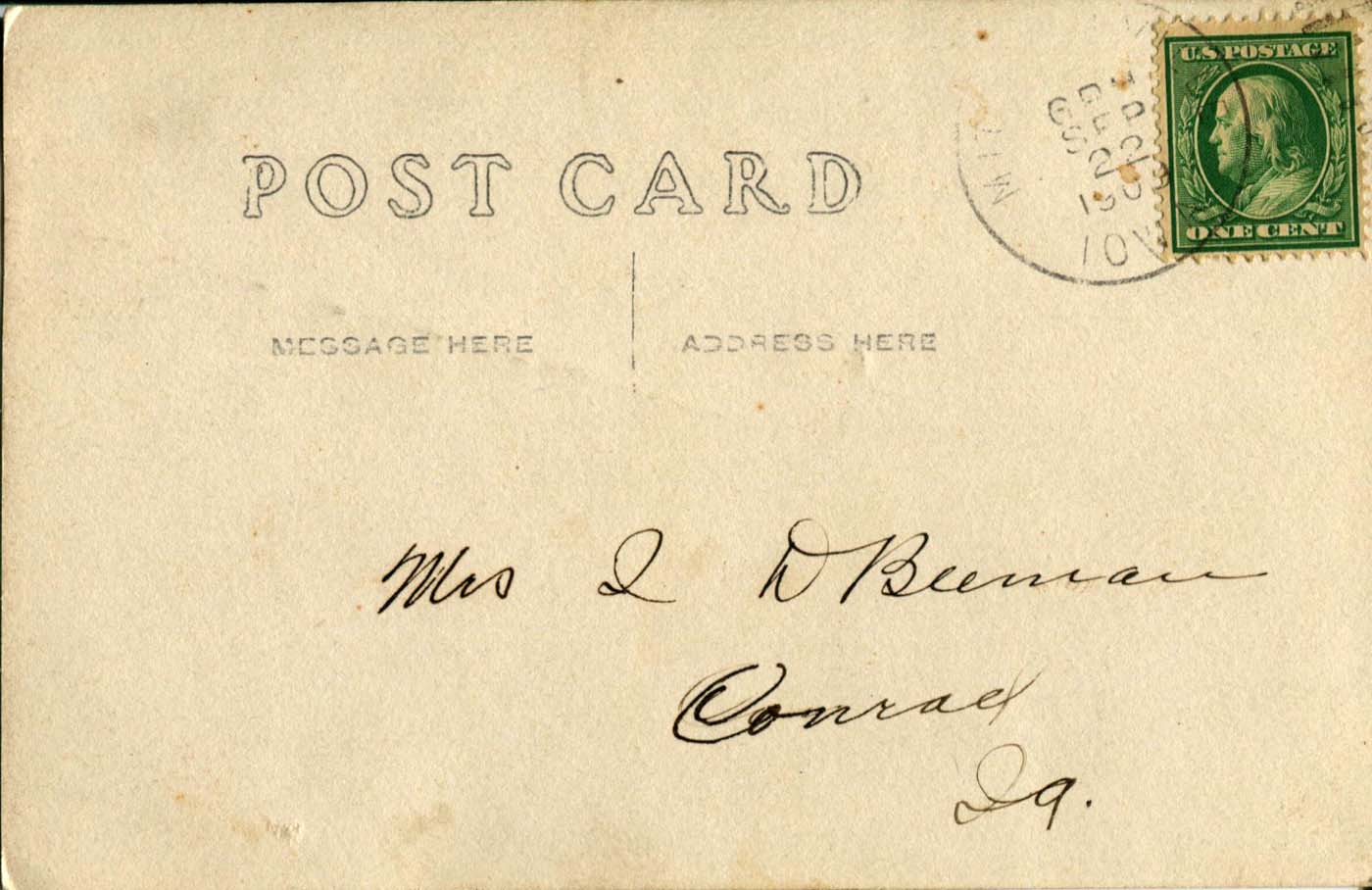
The postcard was mailed
on SEP 22, 1909 to
Mrs I  D Beeman
Conrad, Ia.


If we move in closer to the buildings,
could we see where the photo
of the girls orchestra was taken? 


These building are too plain.
More like dormitories or classrooms.


This one looks too ornate,
and the windows are not the same.


Again this one is too plain
and the little house on the left
is made of wooden clapboard not brick.


Let's look at the windows of the building behind the orchestra.


I think they are leaded stained glass windows
placed close together in a group of three. 


That's not a typical fenestration style
for a security institution like this.
So I went on the hunt for more history
on the Mitchellville Industrial School for Girls


I found it on a 1914 Iowa state map.


Detail 1914 Map of Mitchellville, Iowa

The survey map shows the grounds of the State of Iowa Girl's Industrial School in Mitchellville with each building labeled. In order of my cutouts, Dormitory No. 1 and behind the Laundry Hospital Storage; the Office and Supt. Residence; and the Dormitory No. 2. But at the northeast corner, not visible in the aerial photo, is a Chapel, a building probably large enough for 240 young girls and designed to inspire moral virtues with stained glass light. It was also likely a building suitable for an orchestra to give concerts. That's where I think the orchestra posed. On the map I've marked a red dot for that view and a blue arrow for the balloon camera.

In 1909, Superintendent F. P. Fitzgerald was falsely accused of taken liberties with his female charges. In our time it might be characterized as mildly inappropriate touching and the allegations were never proven. Nonetheless Fitzgerald resigned and left Mitchellville to run his son's confectionery shop in Idaho. In July 1909 he was replaced by a woman, Miss Hattie Garrison. She was a decidedly different school administrator. 

Only a few months into managing a difficult bunch of girls, Miss Garrison was confronted with riots and accusations of abuse. In March 1910 Twenty-five girls "escaped" from the school and walked over 16 miles to the big city of Des Moines. After they were returned by police, a near riot ensued. Eight girls were arrested and sent to county jail for a few days. They showed no remorse.

Instead they reported on whippings with a rubber hose that they received from Miss Garrison. They complained of her severe restriction on privileges and activities, one of which was a drastic reduction of the orchestra and an elimination of dancing. Miss Garrison believed that music and dancing led the girls to improper behavior after they were released. She also didn't care for popular music like ragtime and permitted the girls to play only church hymns and songs.

The story made the pages of several Iowa newspapers. A conflict arose between Superintendent Garrison and the chairman of the state control board. The governor became entangled. Words were said, witnesses called, sparks flew, dirt was flung, and lawyers got involved. It was not pretty. 

Miss Garrison was exonerated but by April 1911 she resigned from what was clearly a demanding and thankless job. She was replaced by another woman. The girls orchestra never regained it's potential for reform.

In March 1910, the Des Moines Register printed a letter from an anonymous ex-inmate entitled Mitchellville From the Girls' Side. The writer takes strong exception to Miss Garrison's argument that learning music might lead girls "into the gay life". She concludes by saying she took piano and vocal lessons while at the school and is now married with a baby. "Music never led me astray." 

Des Moines Register
22 March 1910


These were not ordinary children. They were troubled young girls. The victims of poverty and abuse, broken homes, poor neighborhoods, and isolated rural communities. Many had limited or no education. A number of girls undoubtedly came from immigrant families with few resources to help them in mid-west America. These girls knew what a "hard scrabble life" meant. The time they served inside a reform school was difficult and not without heartbreak.

But music made it better.


* * *


Today the Girls Industrial School property in Mitchellville is the site of the Iowa Correctional Institution for Women. It is a minimum/medium security facility with a staff of 190. It can house 510 female inmates. Surrounded by heavy barbed wire fences, from Google Maps satellite view it doesn't resemble the 1909 birds-eye view in any way. As far as I can tell the old buildings including the chapel are long gone. 

I doubt that this 2017 generation of Iowa female inmates
has as lovely an orchestra as the one in 1908. 


Iowa Correctional Institution for Women
Mitchellville, Iowa


This is my contribution to Sepia Saturday
where everyone is always on the look out.

http://sepiasaturday.blogspot.com/2017/01/sepia-saturday-350-14-january-2017.html


The Quedlinburg POW Camp Orchestra

26 November 2016


Dressed in long military overcoats,
we can see that they are soldiers.
But as they are armed
with musical instruments,
they are musicians too.


Yet they are not a military band.
With six violins and one contrabass
they are instead a kind of small orchestra.

Their concerts were not open to the public.
They played for a very select
audience,
as these musical soldiers were
Prisonniers de guerre,
Prisoners of War.


These 21 musicians carefully posed
outdoors for the photographer,
next to some crude barracks.
Attached to their uniform coats
are nonmilitary badges and armbands,
clues that distinguish them as enemy captives.

Fortunately we do not have to guess where they are,
as this photo postcard was posted
on 1"-9-15,  1st September 1915,
printed by Otto Wendt,
and stamped Geprüft! - Examined!
by the censors
of the prisoner of war camp,
of Quedlinburg, Germany.


The card was addressed to:
Monsieur - Madame
R. Couaillet
St. Nicolas d' Aliermont
Seine-Inférieure
Frankreich

Affection Sincère
?ensies constantes

Sincere affection
? constant

Emil


***
The third word of the greeting looks like
Gensies
but according to online dictionaries
that is not a valid French word.

Even using a French version of a Scrabble word finder
did not produce a suitable match.
Any suggestion from my readers would be much appreciated.
***


Carriage Clock manufactured by Armand Couaillet Co.
of Saint-Nicolas d'Aliermont, France
Source: Wikipedia


A simple internet search for the name Couaillet and the address, Saint-Nicolas d'Aliermont, produced an interesting result. This small town near Dieppe on the English Channel is known for carriage clocks and watches produced by Armand Couaillet (1865-1954). Armand developed his company with his brothers Henri and Ernest. Together their firm of about 150 employees manufactured fine clocks that are highly prized today. However as the  addressee name is R. Couaillet, there is no way to know if there is a direct family connection.


* *


One man in the photo particularly caught my attention as he holds a woodwind instrument that is very rare to find in old photographs. It is an oboe, or hautbois in French. This double reed instrument with its high nasal voice was one of the first instruments of the military band. But by the 1900s, it was not so common, being supplanted by more durable clarinets and saxophones. French army bands however maintained the old tradition, and this oboist wears the regiment number 36 on his collar.

His dark hair and dashing goateee gives him a kind of debonair movie star look. It made him easy to spot in a second postcard photo of the orchestra.


This group of musicians are dressed
in a strange mixture of uniforms and hats,
with some French, some British,
and even some civilian fashions.
The jaunty French oboe player
now sports a soft cap.


The string section has added a British cello.
The conductor leans back
in a crudely made arm chair.
His mustache looks English,
but the light grey tone of his jacket
and his tall boots suggests a Russian soldier.


This international soldier's orchestra has 24 musicians.
The two men in woolly sweaters and caps
may be merchant seamen taken
from British or French commercial ships
that were either sunk or captured by the Imperial German Navy.  

This postcard was sent on 1er Juni 1917, 1st June 1917,
twenty one months after the 1915 photo.
Though it is not postmarked from Quedlinburg
the addressee and writer's name on the back is the same as the first card.


Like the other postcard, this was sent to:

Monsieur - Madame
R. Couaillet
St. Nicolas d' Aliermont
Seine-Inférieure
Frankreich

Embrassements affectueux

Emil


Source: ICRC.org

Though the greetings are very brief, it seems reasonable to assume that the writer was related to Monsieur and Madame R. Couaillet. Now almost a century after the end of  World War One, it is astonishing to me that written records from 1914-18 have survived. Even more thrilling is that the ICRC or International Committee of the Red Cross keeps an online database these records available to anyone around the world with an internet browser. During the war the Red Cross collected thousands of names of British, French, Belgium, Italian, and Sebian prisoners of war. Each name was written onto a simple paper card which was used to cross-index names with camp documents. With a name that has more vowels than consonants, it did not take long to find this prisoner of war on a German military index card.

COU
Couaillet
Emile

Soldat Inf reg 36


* *


The code number of Emile Couaillet's card refers to page 13576 of a large German military account book of captured soldiers. His name was entered at the top on 27 JAN 1915 as a Franzosen - French soldier.


Source: ICRC.org


24. Couaillet, Emile  Soldat Inf. Reg. 36 
gef.in Bétheny  Gefglg. Quedlinburg


The list identifies where each man was captured, and in which POW Camp they are held. In Emile's case, he was being held at Quedlinburg, and taken in Bétheny, a town in the region of the First Battle of the Marne. This battle from September 7-12, 1914 stopped the initial German advance on Paris and forced the war into the trenches, where so many men lost their lives over the next 4 years.


Source: ICRC.org


A third index card was complied by the French military and added enough information for a confirmation of his identity.

Couaillet Emile F BB 502

Musicien brancardier, 36me d'
Inf., 3me Corps Disparu depuis
le 12 septembre environs de Reims.
Rép. M. Couaillet, St. Nico-
las d'Aloermont. (Seine Inf.)


P. 13576 C.E. sold. 36e Puis Bétheny
Gef.lag Quedlinburg

Communiqué famille
12/2. 15


The writer Emile Couaillet was a Musicien, a Bandsman in the French Army's 36th Infantry regimental band. He was also a brancardier, a stretcher bearer, responsible for transporting any casualties off the battlefield. He was reported Disparu depuis, missing since the 12th September 1914 in the region of Reims, France. The village of Bétheny is only 4.4 km away by bicycle.  The French department in charge of notifying the families of servicemen who were killed, wounded, or missing in action, added Couaillet's location at the Quedlinburg POW camp and a date when they contacted the family 12-2-15, 12 February 1915.


* *


So was the hautboïste, the oboist with the affable smile,
the bandsman, Emile Couaillet?

 I'd like to think so,
but I believe he is another man.


In searching for Couaillet's name and the Quedlinburg camp, I came across a website called Le camp de prisonniers de guerre de Quedlinburg, devoted to the history of this POW camp. There are numerous web pages, (in French) describing the conditions of the camp and the life of the soldiers imprisoned there. One page even has a different photo of the camp orchestra, taken in about 1915 as they perform a concert for the other soldiers. The soldiers in the camp organized many activities to cope with boredom and low morale. They had a men's choir and a theater for entertainment. They put on boxing matches and various sports games. Despite their containment, the men could earn small wages for camp work that was paid in special camp currency. The German military guards did not seem to mind cameras and the POWs probably paid for photographs like these to send home. This was undoubtedly a propaganda move by the German government who used postcards to influence both the patriotic public opinion in the German homeland, and the enemy opposition to the war by inculcating resentment and dissent amongst the Allied troops.  


Page from the 1914-15 Red Cross Report
on POW camps in Germany
Quedlinburg is a small town in the Harz district of Saxony-Anhalt, more of less the center of Germany. At the beginning of the war, none of the belligerent nations had anticipated the numbers of enemy soldiers that would be captured. Quedlinburg was one of the first prisoner camps built in Germany. It was designed for 15,000 men. By late 1915, the Red Cross had made two trips to inspect camps and reported that Quedlinburg held 4,285 French; 5,521 Russian; 100 Beligian; and 65 English soldiers, for a total of 9,971 prisoners of war.

The total for both inspection tours was 236,880 officers and soldiers distributed over about 14 camps. But there were more camps uncounted in 1915. Many, many more.  The war would continue for three more years, during which Germany maintained POW camps for 2,500,000 captive soldiers. 

* *


The Quedlinburg POW Camp, or Kriegsgefangenenlager as it was called in German, allowed the prisoners to send and receive mail, but of course under strict rules and always subject to military censors. Usually one postcard per week and one letter ever two weeks. Evidently early in 1915, the prisoners could receive packages which included unusual musical instruments like a trombone or a cello. The website on the history of the Quedlinburg camp included several transcriptions of the camp's newspaper, le Tuyau, or The Pipe. On page 5 of the first edition of the paper, printed in July 1915, there was an announcement about the camp orchestra.

Notre Musique
Un orchestre…? Charme pour des captifs! Quelle imagination féconde eut osé rêver la possibilité d'une telle récréation en septembre dernier lorsque, (censure) exténués, malades, nous arrivâmes au Camp des prisonniers.


C'est aujourd'hui la réalité! Dès l'autorisation obtenue de nos gardiens, un comité se forma, son premier devoir fut de se procurer des fonds. Les sommes rapidement récoltées prouvèrent l'enthousiasme du public. Les exécutants, pour leur part s'infligèrent de gros sacrifices, ceux-ci ont permis la formation d'un orchestre satisfaisant. Pourtant les choses traînent et l'on dit….que le public s'impatiente! Il a tort. S'il a fait beaucoup pour nous, n'avons-nous pas fait autant pour lui permettre d'attendre la date du premier concert. Les auditions musicales du dimanche ne lui suffisent pas. Il veut plus, il est très exigeant; cela est bon signe, c'est qu'il s'intéresse à "notre musique", celle du camp, l'œuvre de tous. Il veut assister à la moindre de nos répétitions. Cela est hélas impossible. Nous ne pouvons lui donner satisfaction, autant pour la bonne exécution des auditions actuelles que pour celle des concerts futurs. A l'heure actuelle, nous manquons de partitions. Nous en attendons beaucoup de France. Nous en avons commandé en Allemagne, elles ne viennent pas. C'est long et nous en sommes les premiers privés. Nous ne restons pas pourtant dans l'inactivité. Grâce au zèle de notre distingué contre bassiste, Mr L. Kircher qui, de mémoire ou à l'aide de médiocres documents, a adapté pour "notre musique" presque tous les morceaux exécutés jusqu'à présent. Des dévouements plus obscurs, mais non moins appréciables complètent l'œuvre entreprise et aucun exécutant ne se refuse à copier et à transposer même après les longues heures de labeur individuel et de répétitions.
 

Lorsque nos lecteurs, qui ne peuvent dans la salle de répétition, liront ces détails, ils comprendront qu'il est inadmissible d'exiger de nous plus d'une heure de musique par semaine. Il est matériellement impossible que nous fassions plus. Comme nous ils se résigneront et attendront.
 

Le temps heureux des concerts ne peut plus tarder. Un instrument vient d'arriver de France, c'est le premier et son propriétaire, le hautboiste renommé Mr Marson, prix du conservatoire, s'est fait entendre dès le lendemain au cours de la répétition générale du Grand Concert populaire annoncé pour la fête Nationale de 14 juillet. Ce concert hors série précédera de peu, nous l'espérons le Grand concert d'inauguration.

Celui-ci est encore différé par suite du départ annoncé des brancardiers. Des commandes de musique et d'instruments ont été suspendues, causant ainsi un nouveau retard d'une semaine au moins. Nous attendons incessamment de nouveaux instruments. L'arrivée du trombone à coulisses est imminente. Le fournisseur nous apprend qu'il est au polissage! L'impatience est maintenant fébrile. A bientôt donc pour le premier concert; une grande assistance nous encouragera!


     A Google Translation     

Our music

An orchestra…? Charm for captives! What fertile imagination would have dared to dream of the possibility of such recreation in September when, (censored) exhausted, sick, we arrived at the Prisoner Camp.
 

Today is the reality! As soon as we obtained permission from our guards, a committee was formed, its first duty was to raise funds. The money quickly gathered proved the enthusiasm of the public. The performers, for their part, inflicted great sacrifices, these allowed the formation of a satisfactory orchestra. Yet things drag and it is said ... .the public is impatient! He is wrong. If he did much for us, did not we do as much to allow him to wait for the date of the first concert. Sunday's musical auditions do not suffice. He wants more, he is very demanding; This is a good sign, it is that he is interested in "our music", that of the camp, the work of all. He wants to attend the least of our rehearsals. This is unfortunately impossible. We can not give him satisfaction, as much for the proper execution of the current hearings as for that of the future concerts. At present, we lack scores. We expect a lot from France. We ordered from Germany, they do not come. It is long and we are the first private. We do not, however, remain in inactivity. Thanks to the zeal of our distinguished bassist, Mr L. Kircher, who, from memory or with the help of mediocre documents, adapted for our "music" almost all the pieces executed until now. More obscure but no less appreciable devotions complement the work undertaken and no performer refuses to copy and transpose even after long hours of individual labor and repetition.

When our readers can not read the details in the rehearsal room, they will understand that it is inadmissible to require more than one hour of music per week. It is materially impossible for us to do more. As they will resign themselves and wait.
 

The happy time of the concerts can not be long. An instrument has just arrived from France, it is the first and its owner, the renowned oboe Mr Marson, prize of the conservatory, was heard the very next day during the rehearsal of the Grand Concert Populaire announced for the celebration National of 14 July. This special concert will precede, hopefully, the Grand Concert inauguration.
 

This is still delayed by the announced departure of the stretcher-bearers. Music and instrument controls were suspended, causing a further delay of at least one week. We are constantly awaiting new instruments. The arrival of the trombone slide is imminent. The supplier tells us that he is polishing! Impatience is now feverish. See you soon for the first concert; Great assistance will encourage us!

 ***


Source: ICRC.org


The name of the oboist, Mr. Marson, was found on the next page of the Quedlinburg prisoner log where Emile Couaillet was listed. His full name was Ernest Marson and like Emile, he was a Musicien-brancardier in the 36e Infantry Regiment band. 

His hometown was further west in Normandy where his family contact was M. Ch. Marson, 51 rue de Vancelles, Caen, France.

The bottom note: À retourner à la Trésorerie - To be returned to the Treasury, is unclear as to its purpose. It may be in regards to a pension application.


* *


The Quedlinburg newspaper's report also gives us a clue, L. Kircher to search for the name of the contrabass player, , who provided much of the first music for the orchestra. His nane, Lucien Kircher, was also listed on the same page of the January 1915 Quedlinburg Camp log as Ernest Marson. He also was a soldier in the 36e Infantry regiment.. He is the man standing behind the oboist Marson in the 1917 photo.  


On page 6 of the July 1915 edition of The Quedlinburg newspaper there was a review of the orchestra's first concert. The director was named Chatenet and he received some criticism.

Si ces premières auditions ne pouvaient prétendre à la perfection elles nous permettent du moins d'espérer pour de fort bonnes séances musicales lorsque les conditions matérielles seront plus favorables l'orchestre plus complet, un plus grand nombre de partitions intéressantes arrivé. Les instrumentistes sont pour la plupart de bons musiciens et d'acharnés travailleurs.
 

Le geste un peu hésitant au début ( Mr Chatenet n'avait jamais conduit avant d'être à Quedlinburg) s'assure peu à peu, il est élégant et prend de l'ampleur. Peut-être la main gauche est-elle encore un peu hésitante, elle aurait besoin de plus de fermeté pour retenir parfois les musiciens qui ont tendance à trop jouer uniquement en forte. Au reste le goût très sur et la grande autorité de Monsieur Chatenet sont le meilleur garant que l'on fera d'ici peu de la fort bonne musique à Quedlinburg


If these first auditions could not pretend to perfection, they at least allow us to hope for very good musical performances when the material conditions are more favorable to the more complete orchestra, a greater number of interesting scores have arrived. The instrumentalists are for the most part good musicians and hard-working workers.
 

The gesture a little hesitant at first (Mr Chatenet had never conducted before being in Quedlinburg) secures little by little, it is elegant and grows. Maybe the left hand is still a little hesitant, it would need more firmness to retain sometimes the musicians who tend to play too strongly. Besides, the great taste and the great authority of Monsieur Chatenet are the best guarantor that will be made soon of the very good music in Quedlinburg


 ***

So can we identify Emile Couaillet?


Perhaps he is the horn player who appears in both photos.


Or one of the two violinists.


Or the young violinist
who was also
a member of the 36e Infantry regiment.


Or the snare drummer
who may have been one of the field musicians
of
the 36e Infantry regiment.


In the end it doesn't matter. A century later, Emile Couailette did his duty to posterity by sending two postcards that give us a glimpse of musical life in a WW1 prisoner of war camp. The POW camps were improvised prisons of course, so the food, sanitation, medical care, and general conditions caused a great deal of privation for the soldiers. But in September 1914 when he and his compatriots of the 36e Inf. reg. were captured, it was still very early in a very long war, so in a sense they were saved from the horrors to come. They needed a different kind of endurance to survive.

They surely felt anguish and fear for their families back home. And as soldiers, the news of the war certainly gave them great distress over the fate of their old army comrades still valiantly carrying on the fight. Though the camps were run with German military regulations, the men followed their own army's discipline and were allowed to create a prison life that offered the soldiers a semblance of a proper army base if not a civilian town. In this context, music was more than mere entertainment. It allowed the men to use their artistic skills to express self-worth and human dignity even while imprisoned. It added value to the other prisoners' lives too.

During the four years that the camp operated, many men succumbed to disease and ill health. Quedlinburg, like most of the POW camps, had its own cemetery. In January 1917 the Red Cross report noted 144 deaths but this is very likely lower than the actual number of deaths. 

Towards the end of the war in June 1918 the soldiers erected a monument which they designed and paid for. There was a dedication ceremony which included all the camp's nationalities including the German military camp guards. The Quedlinburg prisonniers de guerre camp orchestra and choir performed for the service. The memorial was made to honor the fallen, that is their fellow prisoners who had died not in combat but in prison.


The monumnet still stands in Quedlinburg and on its columns are 444 names of English, Italian, French, Belgian and Russian prisoners who died there during the war years. In fact the archives later brought the total to 703 deaths.

Engraved on the Quedlinburg monumemt are the words:
"À ceux qui ne reverront plus leurs patrie"
"To those who will no longer see their homeland"


This is my contribution to Sepia Saturday
where everyone loves the sound of peace

http://sepiasaturday.blogspot.com/2016/10/sepia-saturday-345-november-2016-war.html


nolitbx

  © Blogger template Shush by Ourblogtemplates.com 2009

Back to TOP