This is a blog about music, photography, history, and culture.
These are photographs from my collection that tell a story about lost time and forgotten music.

Mike Brubaker
{ Click on the image to expand the photo }
Showing posts with label family band. Show all posts

Five Family Orchestras

14 March 2026


An orchestra doesn't really need 100 musicians to call itself an orchestra. In past times five would do. In this case two violins, cello, double bass, and a pump organ make up a family orchestra of a husband and wife, and their two daughters and son. On the side is a caption in German:

Musikdirektor Edmund Link
mit seinem unübertreffbaren Künstler-Familien-Orchester
Inhaber des gesetzlichen Kunstscheines  

~
Music director Edmund Link
with his unsurpassed Family Artist Orchestra
Holder of the Official Artist's License 

The photo has a personal quality, almost like a Christmas family picture to send to friends and relations. Notice that the young violinist stands on a small box to balance her height in the grouping. But this photo was clearly designed to market the family as concert artists. To what degree they succeeded is unknown, but the parents seem duly proud of their talented offspring. 

The postcard was sent from Görlitz, Germany on 26 October 1913 to Herrn Hermann Raschig of Cottbus. It's odd how the message and address are arranged on the proper sides of the divided back but are flipped so the address is on the left. Perhaps the writer was a bit dyslexic?  


* * *


In this postcard a similar group of five pose in a photographer's studio set pretending to be a home salon. Here the mother is missing but father plays cello as two daughters play flute and piano, his son plays violin, and the youngest daughter, around age five, plays a triangle. The caption reads in German:

Capelle Wolf – Gasthof "Drei Königen", Herisau (Telephon 245) 
~
Wolf Band – "Three Kings" Inn, Herisau

Here the father leads not from the treble but from the bass line. His children are younger, the oldest girl on piano might be 14. The flutist sister and violinist brother are clearly not in their teens yet. And of course the littlest sister is assigned the easiest instrument which still requires strong confidence to ring it at just the right moment. 

Kapelle is a German word used confusingly for both a chapel and a band/orchestra. Here is it spelled with a C as this is a Swiss-German family band. Herisau is the capital of the canton of Appenzell Ausserrhoden in Switzerland, a very small country with four official languages: German (62%), French (23%), Italian (8%), Romansh (0.5%).   This postcard was sent on an unknown date from a Swiss army base to a young woman in Thusis, Switzerland, a small town 90 miles south of Herisau, deep into the Alps following the Rhine river to one of its tributaries.


* * *


In my third family orchestra we see another quintet with father and mother and three daughters, though one is much older than the other two and might be an aunt or cousin. In the card's caption they called themselves:

Familie Heinrich.  

The daughters play cello and violins and father, who sports an impressive beard, holds a blackwood flute. His wife sits center with her hands resting on a few books, presumably music. She doesn't hold an instrument but next to the cello is a large folk harp which may be her musical specialty. It's another charming family scene demonstrating music culture if not novelty entertainment. Their postcard is typical of thousands of other souvenir cards produced for small ensembles like this during the time of the German and Austrian empires. I expect they performed light music at cafes, restaurants, and hotels which appealed to a respectable clientele, the opposite of the boisterous patrons of music theaters and beer halls.

This card was never posted but the back has the printed name of the photographer, Arthur Eckerlein of  Lindau im Bodensee, a major town on the eastern side of Lake Constance (Bodensee in German) in Bavaria, Germany. It's actually not far from Herisau, Switzerland, just 38 miles around the southern bowl of the lake.

* * *


This next family orchestra is another string quintet with two violins, cello, contraguitar, and a German type of button accordion. They are identified by the caption on their postcard as:
Familie Röttig
Singspiel und Possen Ensemble und Schrammel Quintet
~
Musical and farce-ensemble and schrammel quintet 

Mother, seated center, holds a contraguitar, also known as a Schrammel guitar, which is a type of harp guitar with two necks and extra strings. It was developed in Vienna in the mid-19th century and is associated with the light music of Viennese cafes and wine gardens.  The squeezebox played by her husband, is, I believe, a Chemnitzer concertina. This instrument originated in Saxony and became popular in polka bands. The father and his son on violin, both wear dark but not-too-formal suits, while mother and her two daughters wear dresses and shawls embellished with colorful folk patterns. Their address under the caption was in Komotau, Bohemia which is now known as Chomutov, Czechia. So they probably had a few polkas in their repertoire. 

This card has a 5 heller Austrian stamp of Kaiser Franz Joseph and the postmark date looks to be 31 January 1911. It was sent to someone in Berlin.


* * *


My last family orchestra are certainly the largest with an octet of 8 family members and are perhaps the most colorful and exotic. They called themselves: 

Künster-Familien-Ensemble "de Espania Aida"
mit dem kleinsten Kappelmeister Carlos
~
The Artist Family Ensemble ""the Spanish Aida"
featuring the youngest conductor, Carlos.

Father and mother stand at the back with their eldest son who holds a violin. Two daughters, twins I think, sit in front of their father and play violin and mandolin. In the center is the youngest, a girl wearing a top hat and holding drum sticks, I think. Beside her is an older son on cello. And on the far left is young Carlos on violin. A Kappelmeister is a German word for the principal violinist or concertmaster of an orchestra.

Their outfits pass for a kind of flashy Spanish costumes with all the men wearing silly double-eared montera hats like a toreador would wear. The women wear heavy embroidered short-sleeved jackets. The printer has gone to extra expense to colorize the fabrics in yellow, red, and a faded blue. The lower caption claims this ensemble performed music, songs, dances, and farces, which I interpret as humorous skits. The "Spanish Aida" may not be their real name, since their contact address was in Cöln, now spelt as Köln or Cologne, Germany. 

This group resembles more of a music hall act, i.e. "vaudeville". Their costumes are clearly a theatrical dress which suggests they played Spanish or Italian music, maybe opera too, rather than Germanic folk tunes. There are dozens of other ensembles in my collection that claimed to have the world's youngest or smallest bandleader. It was a common showbiz embellishment.

This postcard was never mailed but "Prosit Neujahr" ~ "Cheers, New Year" is printed on the back. It included a year but someone scratched it out. Maybe 1908 which seems about right for this type of card.  

String instruments are not very loud compared to brass instruments. These "orchestras" played a different repertoire from brass bands. They did not march in parades or play ceremonial fanfares. Their music was quiet and refined, a cultured sound that charmed with the talent of the children. 

As I have noted in my previous stories on family bands, the shelf life for these ensembles was very short since inevitably children always grow up and eventually are no longer cute. However in the time before World War One musical families were once very common, especially in Central Europe. It offered enterprising parents a way to make some money as entertainers while training their children in a respectable trade. And they made a lot of grandparents smile.  


This my contribution to Sepia Saturday
where families are on the march for March.


Peruna Presents: Crockett's Kentucky Mountaineers

01 June 2025


They were all there.
Albert was on bass,
Allen and George on fiddles,
Pauline, Christine, and Elnora looking very pretty,
and Johnny and Clarence on guitars. 


Little Dorothy and Sonny joined in the show
along with Glen Hardy,
and, of course,
Ma and Dad, too.

They played some snappy music
and sang a couple of old-time songs.
You should have seen them dancing.
They were the Crockett Family Kentucky Mountaineers.
They were swell!


This battered card, a half-tone print, is captioned:

Greetings from The Crocket(sic) Family, K.N.X.
and Peruna

What makes it a special souvenir is that someone wrote  the names of each member of the band onto the card. The Crockett Family were a country string band who called themselves the Kentucky Mountaineers. This card is a souvenir from when they performed on KNX, an AM radio station in Los Angeles, California, a very long way from their origins in Kentucky. This family band was started by John Harvey "Dad" Crockett, who was born in 1877 in Wayne County, West Virginia, but as a young man moved to Bath County, Kentucky. The University of Kentucky archives keeps a collection of the Crockett family papers and has the best biography of John H. Crockett with a history of his string band, which I will reprint here.
John Harvey Crockett, Sr. was a musician, music teacher, and maker of musical instruments who taught fiddle, banjo, shapenote singing, harmonica, and guitar in communities throughout the mountains of West Virginia and Kentucky. He married Admonia Jane Patrick of Tennessee, with whom he had eleven children, seven of whom lived to adulthood: Ethel (1898), George (1900), Clarence (1905), Albert (1907), Johnny (John Harvey Crockett, Jr, 1909), Alan (1915), and Elnora (1920).

In 1916, the Crockett family moved to California, where they lived for several years near Fresno. The Crockett children performed for their schools and at local dances throughout their youth. In the mid 1920s, the Crockett brothers were an early hit on the Fresno Bee radio station KMJ. The brothers sang songs written by Johnny, popular songs, novelty tunes, cowboy songs, songs from minstrel shows, and old-time songs that the boys learned from their grandfather, George A. Crockett.

The Crockett Family Kentucky Mountaineers was formed in 1926 and included all of the Crockett children except for Ethel. Earlier names of the group included The Crockett Minstrels and The Crockett Family Orchestra. Albert, Johnny, Alan, and Elnora, who grew up mostly in California, gravitated towards modern music and old-time music that they learned from elder family members. George and Clarence, who were rooted in Appalachia, always preferred the music of the hills where they and their parents were born and raised.

Following their success on Fresno radio, John Harvey Crockett, Sr. and his five sons played for stations in Los Angeles and southern California. In 1927-1928 the group signed with the Keith-Orpheum Vaudeville Circuit and became a headline act on that nationwide circuit. They toured vaudeville theatres throughout the United States and Canada, played regularly over the radio, and broadcast nationally from New York station, WABC. The Crockett Family Kentucky Mountaineers returned to California after their WABC stint and became the lead act on The Hollywood Barn Dance, a program on Los Angeles radio station, KNX. The Crockett Family Kentucky Mountaineers' final tour was of the west coast in 1936-1937. Family addictions to alcohol led to the downfall of the group, with George Crockett's death from alcohol poisoning (1941) and the suicides of Clarence (1936) and Alan (1947).

Before we go any further
in their story let's listen to 
Crockett's Kentucky Mountaineers
playing Buffalo Gal's Medley
in a recording made in 1931.


Though my picture of the Crockett family is the size of a postcard, instead of the usual stamp box on the back there is a small calendar for the year 1935. It has a title:

TRY PERUNA
TO HELP BUID UP
—COLD CHASING—
—COLD FIGHTING—
RESISTANCE


The band was led by John Harvey Crockett, Sr., "Dad", on fiddle and banjo, and accompanied by his wife, Admonia Jane, "Ma", and their five sons, George (fiddle), Johnny (banjo, guitar, vocals), Alan (fiddle, bones), Clarence (guitar), and Albert (bass, tenor guitar) and daughter, Elnora (vocals). The two other young women in the photo were sisters, Pauline and Christine Stafford, reportedly neighbors from Tennessee. The two children, Dorothy and Sonny, and the young man, Glen Hardy were likely extras used to add more youth to this family entertainment.  


Coos Bay, OR The World
7 May 1935


The group pictured on the card has 13 members but they usually toured with 10, as pictured here in a 1935 theater promotion in the Coos Bay, Oregon newspaper. By 1935 the Crockett family were seasoned entertainers having played on both vaudeville and radio. In January 1928 the Crockett Family (Kentucky) Mountaineers appeared at the Orpheum theater in Oakland, California as one of a half-dozen acts arranged around a featured film. A reviewer in the Oakland newspaper said "One of the greatest novelties which has ever played the circuit is the act of the Crockett Family Kentucky Mountaineers, whose old-time music and square dances are something really out of the ordinary."  

Oakland CA Tribune
13 January 1928

The film was "Show Girl", starring "Hollywood's newest sensation", Alice White, as "the hottest little hotsy-totsy that ever shook a scanty at a tired businessman." I don't think she did square dancing. The "Show Girl" was a semi-silent film with caption cards for the drama and no audible dialog, but it did use a new audio technology with a synchronized musical score and sound effects that used the Vitaphone sound-on-disc process.

One tune was not enough.
Let's have an encore!
Here again are the
Crockett's Kentucky Mountaineers
in a rendition of that great old-time classic
 Little Rabbit (1931).


In around 1927 the Crockett boys got their start on radio in Fresno, California at station KMJ. This station was one of oldest in America having secured its commercial license in March 1922. The first radio stations used an amplitude-modulated (AM) signal which, with enough power, could be picked up by listeners who were hundreds, or even thousands, of miles from the radio transmission antenna. Performances of radio plays and music concerts were broadcast live, and not pre-recorded. Over the next decade, as the technology of microphones, amplifiers, and receivers improved, radio shows were produced in front of a studio audience, which allowed performers like the Crockett family to appear dressed in costume. 

After some local success, the Crockett Family Kentucky Mountaineers were taken up by larger stations and then national networks. As more and more people around the country began purchasing radio sets, their infectious music quickly created a sensation in the new medium. This opened up opportunities for the Crocketts to tour the vaudeville theater circuit.   


Fresno CA Bee
2 September 1929

The Crockett's home in California was in Fowler, a little farming town in the San Joaquin Valley about 12 miles southeast of Fresno. On 2 September 1929 the Fresno Bee, which now owned the KMJ radio  station, published a front page feature and photo about the meteoric rise to fame of the Crockett family.  The popularity of the Kentucky Mountaineers was bringing them new bookings in major cities like New York City. They were publishing their own songbooks, starting a nationwide tour of vaudeville theaters, and planned to release new recordings. They were now reputed to earn $2,000 a week. Not eight weeks later, on 24 October, also known as Black Thursday, the American stock market crashed, marking the beginning of the Great Depression.

The people of Fresno seemed just as proud of the Crocketts as the folks back in Kentucky. The writer of the article explained their success this way:  
"The high praise that is accorded the Crocketts throughout the country is evidenced in the following review of their act, printed by a Denver, Colorado, newspaper: "In this sophisticated age, when there is consorted effort upon the part of the the majority of performers to be arty, Crockett's Kentucky Mountaineers offer such a startling contrast that they all but caused a riot. 

   "The parent Crockett and his five sons present such a picture as has not been seen here in ages. That they are authentic is plain to be seen. Without any flourishes they fiddle away at the old tunes familiar to every one, keeping time with their swinging feet. 

   "Then to disclose their versatility two of the boys sing 'Sipping Cider'—and how they can sing it. The baby of the family then fiddles a tune accompanied by his brothers. 

   "But the riotous feature is when one of the boys calls off the old fashioned dances and trips about the stage showing this generation how it is done, while the rest of the family provide. the melody. 
   
   "The family also have a. priceless possession, huge, shy smiles that will win an audience no matter what they do. Really, no one should miss this troupe if for no other reason than to be convinced that people can, in this day and age, be so ingenuous and present their talents with such disarming simplicity." 


The following summer in 1930 the friends and fans of the Kentucky Mountaineers learned that they would get a rare treat courtesy of the Fresno Bee. Albert Crockett, the bass player with the big grin, was to be married to Miss Josephine Phillips of Pineville, Kentucky. The wedding ceremony was to be held in New York City, but it would be broadcast live over the CBS radio network which included the Bee's KML station.


Fresno CA Bee
8 July 1930


The audience demands more!
So here again is 
the Crockett Kentucky Mountaineers
in Sweet Betsy From Pike.
It was recorded in New York City
in either January or February 1931


The Crockett family's national tour in 1935 followed a route familiar to many family entertainers over previous decades. It was a trail of theaters in cities and towns linked by America's railway lines. Early vaudeville in the 1890s had all live performers of course. Change was coming though and after 1910 entertainers shared the stage with a new fade—movies. The actors may have been mute, mouthing their words, but the films were certainly not silent as there was always an orchestra, a pianist, or organist to provide accompaniment. And as early feature movies were usually short, theaters still depended on live acts to keep audiences entertained while the film reels were changed. But by the mid-1930s movies with full sound and exciting cinematic action forced theaters to give up on house orchestras and quit booking live acts altogether. Vaudeville struggled along in smaller towns but it would soon disappear.


Casper, WY Star-Tribune
22 August 1935

In August 1935 the Kentucky Mountaineers appeared in Casper, Wyoming at the America theater. The local newspaper ran an advert which showed eight members of the "internationally famous" Crockett family onboard a horse-drawn farm wagon. They were radio stars from KNX Hollywood.  The movie feature was "We're in the Money", a romantic comedy film starring Joan Blondell and Glenda Farrell in a kind of "buddy" story. 

The Crockett family finished that 1935 season but despite their success, they seemed to have given up the vaudeville circuit and radio too. I could not find their group's name on radio listings or in theater adverts after 1937. Beginning in 1935 another group called "Uncle Henry's Original Kentucky Mountaineers" showed up in several newspaper, mostly in the East. Like the Crocketts it was a mountain string band, but with eight musicians. I suspect this band was produced as a deliberate imitation of the more famous Crockett family. It lasted up to the war years and then disappears.

From John H. Crockett's brief biography we learn that the Crocketts suffered some cruel sadness in their family. Their first loss occurred on 20 August 1936 when Clarence Crockett took his own life. After he had threatened his wife several times with a gun, she took their children and left their house. Shortly afterward Clarence shot himself. Tragically it was his father who discovered his son's body.

Oakland CA Tribune
20 August 1936

Such terrible events are a burden to any family, but for those working in show business, it can be even more stressful to keep performing. But the Crockett Family tried anyway, playing a show in December 1936 and a couple more in 1937. Yet like in all family  bands, the kids inevitably grow up and find other interests, start their own families, and pursue new ambitions. It was also the height of the depression which was affecting every industry including show business. After 1937 Crockett's Kentucky Mountaineers seems to have broke up. Some of the other family members found music work in other string bands and even in Hollywood, too. But newspapers did not record any further concerts of the whole Crocket family. 

John Harvey Crockett, born 1877 in West Virginia died in Sacrament, California in January 1972.


* * *


I don't know how influential the Crockett family string band was to the growth of Country & Western music. The Crocketts called it old-time music,  even though some of the boys wrote new tunes for their band to play. They were influenced by Grandfather Crockett and a family memory of Kentucky mountain songs and dances. At the time some newspapers called it Hill Billy music, or Barn Dance music. What it lacked in sophistication was made up by its infectious toe-tapping rhythms. But I think the real reason for the Crockett family's appeal was that they were authentic. 

This was an era when traditional folk music was still alive and unspoiled by commercialization. The Appalachian mountains, from Alabama to Maine, were home to a mix of many cultures that in the 1930s were still very much isolated from the rest of America. By moving to California the Crockett family managed to take advantage of two new mediums—radio and recording. For a brief few years their genuine mountain music entertained American audiences with a sound that was fresh and novel. Eventually the world would recognize Appalachian music for its roots in Scotland, Ireland, Africa, and other musical cultures. For the Crocketts I think it was all about playing homemade music that kept you dancing on your toes.


Readers who have got this far may ask,
"Wait! What's the deal about Peruna?"


St Louis, MO Republic
28 February 1901


Peruna, or Pe-ru-na as it was sometimes called, was a patent medicine concocted by Samuel Brubaker Hartman,1830–1918, and sold to the public at great profit in the late 19th and early 20th centuries. Peruna was purported to cure catarrh, a general purpose word for inflammation that covered all manner of ailments in the human body. Hartman was a trained physician and surgeon but his true talent was as a quack doctor. 

When his patients complained that their pharmacists were not preparing his prescriptions correctly, Hartman decided to manufacture his own special cure-all medicine. He called it Peruna and began selling it in 1885. He claimed it was beneficial for anyone suffering from pneumonia; tuberculosis; grippe – influenza; the common cold – catarrh of the lungs; canker sores – catarrh of the mouth; appendicitis – catarrh of the appendix; chronic indigestion – catarrh of the stomach; mumps – catarrh of the glands; Bright's disease – cattarh of the kidneys; and Yellow fever. It could also help people gain weight.

This wonder drug became a miraculous tonic, a magic elixir that was advertised in thousands of newspapers and magazines. Peruna was endorsed by hundreds of politicians, military officers, and other prominent dignitaries and received testimonials of its wonderous qualities from countless ordinary people. It made Hartman a very wealthy man. 

In 1905, Collier's magazine published a series of eleven articles by the journalist Samuel Hopkins Adams entitled "The Great American Fraud". In his report Adams exposed Peruna and other patent medicines as complete frauds and, in some cases, dangerous due to toxic substances. The only active ingredient in Peruna was 28% ethanol. Supposedly it was at least better than other panaceas which used opium and cocaine as ingredients. Adams' work was widely read and it led to the passage of the Pure Food and Drug Act of 1906. 

However Peruna continued to be manufactured though now under a different formula with less alcohol. After his death in 1918, Samuel Brubaker Hartman's company (No relation to me that I know of. Yet.)  stayed in business selling its fantastic brew to foolish people desperate to find cheap cures. 

By 1935 Peruna was still sold to the public but it was now just an ordinary household brand name. But in order to promote sales the Peruna company began sponsoring radio programs and musical artists. What I did not know until I began doing research on the Crockett family this week was that Peruna sponsored other radio bands too. There are promotional cards for Western, country, swing bands and more, all with a calendar for 1935 printed on the back.

Thus a new genre in my collection has begun—the Peruna Presents series. Stayed tuned for the next episode.


This is my contribution to Sepia Saturday
where everyone is tuned to their radio, 
so
DON'T TOUCH THAT DIAL!


Polar Opposites

22 March 2025

 
As fair-haired as light? 


Or as dark as a raven?


Brighter than flax?


Or solemn as dusk?


These are family questions of personal style,
fashion, and even genetics
that have no definitive answer.

Today I present
two musical families,
each as opposite as magnetic poles.
Both are professional entertainers,
but one family is positively bright as sunshine
and the other as negatively somber as a thundercloud.

Their salt and pepper contrast is purely accidental,
a coincidence of two different photography studios.
Yet each appealed to a concert style that fit their family.


The first family ensemble is quite large with mother and father presiding over nine talented children—four girls and five boys. They are dressed in matching folk-style costumes with the mother and daughters in Germanic dirndl dresses and father and sons in knee pants and satin vests. 

The youngest is a boy about age 5 who stands center holding a triangle. He has twitched his head just as the photographer clicked the camera shutter. Two slightly older sisters play drums while the oldest girl and another younger sister hold violins. Two brothers on the left look enough alike to be twins. One plays cello and the other a piston valve cornet. On the right the tallest boy, perhaps the oldest child, holds a flute made of blackwood with an ivory headstock. His younger brother in front has a viola, slightly larger than his sisters' violins. At the back is mother with a double bass and a slightly sour or even annoyed expression. Next to her is her husband but he has no instrument, maybe because he is the conductor of his family orchestra.

Their names and date is unknown, but the location of their photo is not. They are in Amsterdam,  capital of the Netherlands. The photographer was P. D. van Rhÿn of Damrak 42 and Utrechtschestraat 47. {The first address is now a chip shop named "Mannekin Pis" (oddly a landmark of Brussels, Belgium) famous for its Dutch fried potatoes, and the second address is now an luxury shoe shop.}  

This cabinet card photo with its wide landscape format is undated but is similar to American and European photographs from around 1890-1900. The family's costumes resemble a Tyrolean fashion like those of folk groups from Bavaria, Austrian, or Switzerland, but they could be Dutch too. I think they likely played a larger assortment of instruments and sang too. 


 * * *


My second family orchestra is a group of seven siblings, I think, as there is no one who looks old enough to be a parent of the others. The youngest is a girl about age 6-7 seated in front with a small banjo and a wooden xylophone. Her three older sisters have similar dark hair with long curls let free rather than styled tied atop their head. On the right, one sister, possibly the oldest at over 18, has a mandolin; the next in center holds a piccolo; and the third, seated right, has a violin. The brothers are older, early twenties maybe? They play cello, pocket cornet, and a button concertina. 

They are an eclectic mix made darker because of the men's formal tail coats and sash and the women's long dark gowns. It resembles a "concert party" fashion that was popular in the early 20th century for performances at private society events rather than on a music hall stage. I think they are actually more colorful that they appear, as the sepia tone photo does not really favor their costumes.

Like the group from Amsterdam, the name and date of this ensemble is unknown, but their location is. The photographer was Cooper & Sons of Blackpool, England with a studio on The Promenade, the seaside resort's celebrated boardwalk avenue between Blackpool's North and South Piers. The back of this cabinet card has an fanciful illustration of a young woman, looking like a Grecian goddess, arranging a large wooden camera. I was only able to find a few references to the photographer, Mr. H. Cooper, who with his sons ran a studio in Blackpool from around 1904 to about 1910 before moving on to another town. But they only advertised an address at The Promenade in 1904 and not later. So that seems to narrow down a time for this family orchestra who very likely were performing at a theater on The Promenade. 


Like many of the anonymous photos in my collection there is little more history about these two musical families that I can add. Yet hidden in their respective bright and dark photos are little details of their lives that we can still deduce. That they were professional entertainers is easy to presume as these are not casual snapshots but formal studio photographs of people posing in stage costumes to promote their ensembles. And clearly each family must have had a talented bunch of kids to have learned how to play so many musical instruments. A family band's performance might be as little as a 15 minute turn on a theater stage, or at most, an hour or two long concert at a wine garden or private soiree. Their repertoire was likely not new original music but popular tunes familiar to their audiences. Any act had to sell tickets if it was going to be successful.

But now picture how a large family of seven or eleven entertainers might travel in the 1890s or 1900s. Each troupe surely required numerous trunks and suitcases for their regular clothes and their stage outfits too. Even more cases were needed for their instruments. 

No doubt the mother was responsible for keeping her brood clean, dressed, healthy and well fed when out on the road. She was also in charge of lost drum sticks and gender appropriate dressing rooms. How she managed laundry is another question. 

It was surely the father who managed the show business work, corresponding with theater agents, booking train and ship tickets, and arranging hotel accommodation. And he likely did  all the porter duties, too, lugging the children's cases around. Since most family bands got their start from a father's musical skills, it was he who created their concert programs, arranged parts, and taught his offspring how to play their instruments. 

But how did the children get a proper education? Or even find time to just play outside and make new friends? Those are the questions I wish I could answer. All that's left is to use our imagination.


This is my contribution to Sepia Saturday
where every family smiles for the camera.


Notes from a Time Traveler

16 November 2024


I am a time traveler. Nearly every day I set off on a journey to meet people in some far-off place in the infinite dimensions of history. However my span of infinity is actually pretty narrow as modern time transport technology has strict limitations. Generally it's some date between 1845 and 1945, though occasionally I'll end up somewhere during my lifetime. 

Most of my encounters with people of the past are very brief, only lasting a split second really. Sometimes we might be properly introduced, but typically they remain nameless. And, due to the fleeting brevity of this moment, I am invisible to their eyes, so they never know that I can see them. I tend to seek out musicians, though once in a while I'll be attracted to other showbiz occupations like dancers, singers, or comedians. Lately I've become fascinated by aviators and artists. 

When I do learn who these vintage people are I like to ask questions about their life, their family, and in the case of musicians, their instruments and musical ensembles. Unfortunately in that blink of an eye that we connect they don't talk much, so it's a real challenge to get answers. In fact the time goes by so fast that I'm lucky if I can determine a location or a decade of when I first make their acquaintance. 

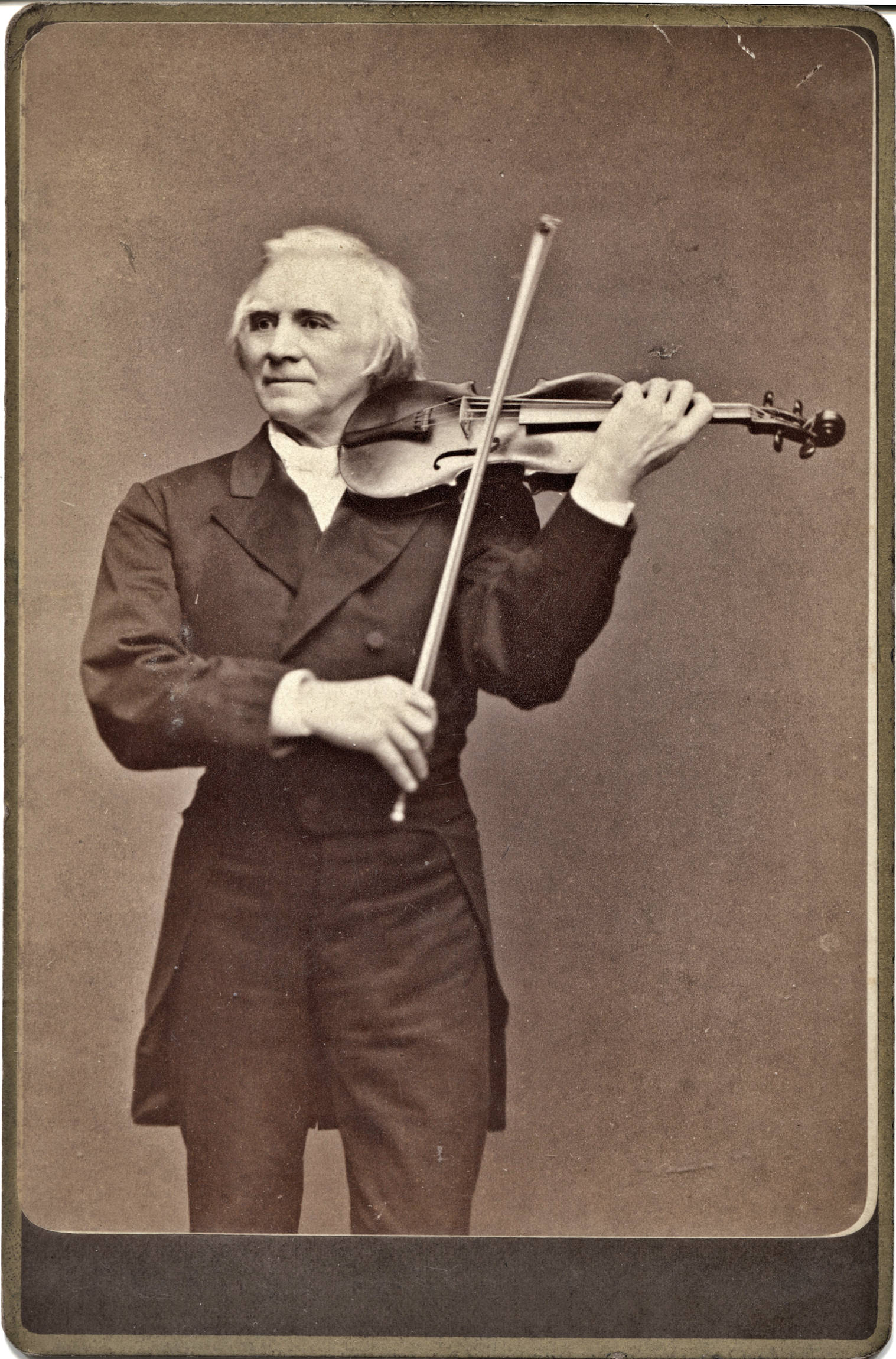
Today, in honor of the special 750th weekend of the Sepia Saturday Club (more about that later), I thought I would present a few of my antique friends whom I've renewed contact with on my time travel adventures in just the last few weeks. They should be familiar to longtime readers as I have already featured  them  in previous stories here on my blog. One is the gentleman that begins this post. He is the celebrated Norwegian violinist Ole Bull. I've grown so found of him that I often set the controls on my time machine to go visit him. But first I'll bring back a new souvenir of one of my favorite child performers.


I first introduced these three boys in July 2022 in my story The Little Vernon Brothers. They are Sidney Clyde Vernon, the tallest boy holding a violin, born 1878 in Elgin, Ontario, Canada; Howard Alexander Vernon, the boy with a piccolo, born 1881 in Marshalltown, Iowa; and Percival Lessington Vernon, the youngest with the long blond hair and a cello, born 1884, also in Marshalltown.  The three brothers are accompanied in this picture by their mother, Mary Jerusha Vernon, who is seated at a reed organ.  

This cabinet card was produced by the Holdridge studio of Trenton, New Jersey, at 223 East  State Street. The other four photos I have of the "little" Vernon brothers were taken by photographers in Marshalltown, Iowa; Beloit, Wisconsin; and Philadelphia, Pennsylvania. That photo is of the whole family with their mother Mary and their father, Edward H. Vernon, an accountant who evidently was successful enough to support moving his family around the country. 

This photo from New Jersey shows Sidney at his tallest so based on my previous research I think it was taken around 1895-96. This photo was also the only one that came with a caption for the "Little Vernon Brothers" so it was clearly intended to be a promotional photo for their performances. Unlike a troupe of vaudeville theater entertainers, the Vernon family played at churches and society halls. Their repertoire was designed to appeal to a family audience with an emphasis on Christian songs, hymn tunes, and wholesome folk tunes, interspersed with recitations of poetry. This review from 1895 describes one of their concerts in Goshen, New York.


Goshen NY Democrat
14 March 1895


The entertainment in the Presbyterian church last Friday evening was a success.  It was well attended, considering the condition of the roads.  The Little Vernon Brothers are all they are recommended to be.  Sidney, the eldest, who plays the violin, has a very fine touch; Howard, the next, plays the piccolo well; and Percy, the child who plays the violincello, is a prodigy, is natural and homelike on the stage, plays his part perfectly and sings just as well.  His childish movements on the stage are a strong hold on the public. 


_ _ _

The Vernon brothers began performing in 1889 in Marshalltown, Iowa and continued giving regular concerts around the country until about 1899 when they were not so little anymore. By the turn of the century the Vernon family was living in Detroit and the boys were beginning higher education. What I find remarkable is that all three brothers entered seminaries and became ordained ministers, two in Baptist churches and one in a Presbyterian. Reader's can find out more in my original story of the Vernon brothers. 


* * *


One genre of postcards that I regularly search for is "orphan bands". I few weeks ago I spotted this one and recognized it as a picture of a children's band that I featured on this blog back in 2018. There are 14 boys and girls holding musical instruments, mostly brass, and dressed in nice Sunday best. They called themselves "The Jolly Entertainers". I told their story in two parts, The Children's Home Band of Des Moines, Washington and Mr. Draper's Children's Home Band of of Des Moines, Washington. This "Children's Industrial Home" was established and run by Mr. Herman M. Draper, seen here seated center holding a cornet. A native of Canada, Draper was born in Ontario in 1857, but immigrated to the United States in 1882. As a young man he pursued a career as a music teacher, specifically for chorus and voice using a music education technique called Solfège which uses syllables for the musical scale pitches, i.e. Do, Re, Mi, Fa, So, La, Ti. 

In 1887 he taught music in several Nebraska public schools where he developed his own methods for teaching elementary music. Ten years later in 1897 he moved to Calumet, Michigan where he was employed as a superintendent of an orphanage of about 50 children. In 1906 after a dispute with the orphanage's board of governors Draper and his wife left Calumet and "took" six children with them to Seattle where he decided they could operate a smaller but more compassionate orphanage in the Pacific Northwest. After a couple of years in Seattle, in 1908 the orphanage moved to Des Moines, a small village on Puget Sound named by its first settlers after the much larger Des Moines, Iowa.

Draper wanted it to be a self-supported private orphanage so he trained his young charges in various practical trades including music and printing. I have two other postcards with the same image that date from the summer of 1910, but this one has a notice on the back that is not on the others. It reads:

Help us pay for
OUR HOME

We own a complete printing outfit and
our boys are printers;  send us an order
for cards, letter heads, bill heads, etc.
We guarantee satisfaction   and
We need your help.

But there is a message too, which cliched the sale for me. 


Geo. saw these
children as he
came from     
Seattle the    
other day.     
He wanted the
little girl marked
X  but they would
not let her      
go.               


The message is a bit ambiguous since the writer is not identified and we don't know if Geo(rge) is age six or sixty.  So it is both charming or creepy depending on ones interpretation. But the X mark is actually on the back just above the U in OUR. It corresponds to the little girl seated right with an alto horn. 


This postcard was produced at a time when Mr. Draper was beginning to take his children on short tours in the region. He had some success so purchased a small bus and organized more trips to Oregon and California. In 1925 he undertook the biggest adventure taking 22 children on a year-long tour of the United States playing benefit concerts everywhere they could. It made the pages of newspapers all across the nation.

Sadly Mrs. Annie Draper died on 13 April 1927. Four days later just before her funeral, her husband followed her, tragically succumbing to a heart condition. Herman M. "Daddy" Draper was 70 years old. He and his wife had cared for over 300 children at their orphanage. It's an inspiring story of perseverance, dedication, and love. Here's the link to part one.


* * *


We met this handsome violinist in my three part series Ole Bull, Adventures in America, part 1, part 2, part 3. He is Ole Bornemann Bull (1810–1880) a Norwegian violin virtuoso who was one of the first violinists in the early 19th century to create a successful career as a concert soloist. By 1837 Ole Bull was performing hundreds of concerts each season in Europe that established him as the equal of other Romantic musical artists like his contemporaries: Felix Mendelssohn (1809–1847), Frédéric Chopin (1810–1849), Robert Schumann (1810–1856), Franz Liszt (1811–1886) and the great Italian violinist  Niccolò Paganini (1782–1840), whom he tried to emulate as a violinist and composer,  too. But no concert artist of his time ever covered as much distance in traveling the world as Ole Bull. 

My series on Ole Bull focused on a set of carte de visite photos that were produced by a Chicago photographer in the winter of 1867-68. This was during his third tour of America just after the end of the Civil War. He made his first tour in 1843-45 and his second tour in 1852-57. This happened to be when photography was just becoming popular as a new portrait art form. However early photographs like daguerreotypes and ferrotypes of the 1840s and 1850s were each singular positive images and could not be easily duplicated. In the 1860s when the carte de visite, or cdv, were introduced the process used a negative image on a glass plate which allowed multiple copies to be printed quickly and cheaply. It was the perfect medium for an entertainer who wanted pictures to promote themselves. In 1867 Ole Bull clearly recognized the value of cdvs as souvenirs for devoted fans. 

Since publishing my Ole Bull series in January 2021, I've acquired even more photos of him, including more cdvs from Chicago, a ferrotype–tintype, and recently last month a couple of larger cabinet card photographs. The first one shows Ole Bull seated in a relaxed pose. His hair is long but now quite white. The photographer was S. W. Felt of Chicago, a different photographer than the one who made the cdvs in 1867-68. This photograph could have been taken during Ole Bull's fourth appearance in America in 1871-72 when he played Chicago in March 1872. That was just  five months after the Great Chicago Fire destroyed the city center's theater district where he had last performed. But I think this image fits better with his fifth tour from 1876-77 when reviewers took note of the "snow in his hair." The photograph print is a bit soiled and abraded but I like that his name is written in pencil on the front. I'm not certain yet, as the simplicity of his name makes it easy to reproduce, but I think it might be Ole Bull's real signature. 


This second cabinet card of Ole Bull is very clear and well preserved, requiring little correction of contrast. It shows a 3/4 view of him with his violin and bow in playing position. The photographer was J. P. Moore of Meriden, Connecticut. Ole Bull's face and expression resembles his other photo, so I think this may date from 1876-77 too. 

Bull returned to America once more in 1878 but reports describe him as diminished,  no longer fit as a fiddle as some might say. He did play a final concert in Chicago in May 1880, but concern over his poor health forced him to return to his home in Bergen, Norway where he died on 17 August 1880. Readers can read about the exciting adventures of Ole Bull's 1867-68 tour by starting at this link.

Most of the musicians I meet in my time machine are mute, their stories and biographies locked away in the secret vaults of history. Ole Bull is a rare exception as there are literally thousands of newspaper reports, letters, and books on his life. It makes it much easier to know the man, but more difficult to puzzle out exactly when his photos were taken. I'm planning a reprise story on Ole Bull so I can display these two photos alongside the other new photos I've found. Stay tuned.


* * *


My final photo is a postcard that just arrived in the post a few days ago. It's obviously not a picture of a musical group but, as the caption says. it's a track team from E.P.H.S. Those initials stand for East Palestine High School and some of these boys appeared in my three part series The Glee Club of East Palestine, Ohio - part 1, part 2, part 3. 

East Palestine, Ohio is another place I frequently check out in my time machine, specifically during the period from 1906 to 1910 when one young man in particular was a student there. Here he is seated on the floor in front, one of ten members of the track team and the only one with a dark African complexion. His name is James Aaron Washington and I'm rather proud to have figured out who he was, as he did not grow up in Ohio but in Asheville, North Carolina, the city where I now live. 

This photo was taken in 1909, either in the spring or maybe the previous fall of 1908. In 2024 this picture is not unlike thousands of similar high school team photos. But in 1909 it was exceptionally rare to see a Black student sitting as an equal with fellow White students. America's terrible legacy of slavery continued in the post-Civil War era with society strictly divided by race using countless harsh laws to enforce racial segregation. How James Washington came to be in eastern Ohio was the first question I asked in part 1 of his story.  Certainly in 1909 North Carolina a young African-American man would never be accepted as a member of a high school athletic team, much less photographed with one. There are still many questions I want to ask but may never get an answer. 

This postcard is also an example of when I get to hear someone from the past speak across the vastness of the spacetime continuum. It was sent to Mrs. C. E. Oliver of Pittsburg, Pa. on 19 May 1909, perhaps care of Mercy Hospital.

Will be up Saturday
if my head gets
well.  I will have to
jump against the
same fellows that I
jumped against Saturday


The boys competed in springtime track meets against other high school teams in the region. A year later in May 1910 there was an all-county contest with four schools and the East Palestine Reveille Echo reported that Washington placed second in the 220 yard dash and Oliver got third in the running broad jump. But their rivals as Lisbon High still took the most points to win the championship leaving East Palestine to settle for a 2nd place. 


If you look closely some of the boys have medals pinned to their shirts. James has one and the boy behind  him on the right has six. The boy to the left is the same boy in the E.P.H.S. Glee Club photos wearing a top hat. I believe his name is Cecil Oliver. He and James sang duets in the Glee Club concerts. Could he be the son of Mrs. Oliver writing for some sympathy on this postcard? Yet another question that may go unanswered. 


This is actually the second photo postcard I've found of the E.P,H.S. track team with young James Washington. The other one is dated 1908 and is even more remarkable because James is not the only Black athlete in the group. That photo is in the Postscript at the end of  part 3.   

James Aaron Washington's story took another surprising turn when I discovered that after high school he returned to North Carolina; attended Shaw College in Raleigh; got married in Asheville, raised a family there; and then in the 1920s moved to Washington, D. C. where he worked for the U. S. Post Office. That's all explained in part 2.  

But the biggest surprise was to learn that his son, James Aaron Washington Jr. became a noted civil rights attorney, a law professor and dean at  Howard University in D. C., and later a judge to the Superior Court of the District of Columbia appointed in 1971 by President Richard Nixon. But more significant was that Professor James Washington Jr., the son of the young man in East Palestine High School's Glee Club and track team, was also one of the advisors who helped to craft the 1954 case of Brown vs. Board of Education of Topeka which became a landmark decision of the U.S. Supreme Court ruling that U. S. state laws establishing racial segregation in public schools were unconstitutional, even if the segregated schools were otherwise equal in quality. That's a real story of bending the arc of justice.


I am a time traveler.
Even just a glimpse of a moment in time
can contain millions of threads of history.
Some lead backwards and some forward,
but they all weave into an amazing fabric of time.
That's why I keep alert when I'm in my time machine.
You never know when you might meet an old friend.


This is my contribution to Sepia Saturday
where everyone is celebrating
the art of vintage photos.


This is my 724th post on my blog TempoSenzaTempo — Time Without Time. I first joined the Sepia Saturday club hub pub on January 8, 2011, number 56. I submitted A Mystery Band which seems incredibly brief compared to my usual output (like this one) in 2024. It took me a few more weekends before I settled into the idea of following Alan's theme image, but since February 2011 I have participated in nearly every Sepia Saturday, which makes about 690 weekends. That's a lot of postcards and photos.

I never expected that my hobby of collecting vintage musician photos would become the passion it is today. (Some people, like my dear wife, think it might be an illness.) But the inspiration really came from meeting fellow time travelers who shared my interest in telling stories about old photographs. It's sad to say that many of those bloggers have faded away into the Sepia Mists. But I am very grateful for all that I learned from reading each blogger's stories and gaining a different perspective on writing, collecting, analyzing, research, and presentation on this wonderful medium of the internet. I continue to delight in every blogger's contribution to Sepia Saturday. Thank you, Alan, for keeping the Sepia Saturday club pub going and offering up a fascinating image every week. I look forward to Number 1000. I'm pretty sure I'll still have enough photos in my collection to make a good match.

nolitbx

  © Blogger template Shush by Ourblogtemplates.com 2009

Back to TOP