This is a blog about music, photography, history, and culture. These are photographs from my collection that tell a story about lost time and forgotten music. Mike Brubaker
In August 1914 the Imperial German Army mobilized 3,822,450 soldiers who were then ordered to attack on two fronts, eastwards to Russia and westwards to France. Every man needed a uniform, a helmet, a field kit, a gun, and a pair of boots. By late summer the Kaiser's quartermasters would issue around 7,644,900 boots. They would need a lot more. It was going to be a very long march.
A single leather hide was typically large enough to make 3 to 4 pairs of boots. So a lot of cows and pigs gave up their lives to shod the soldiers of World War One. But leather was used for many other things besides footwear. Countless leather harnesses, reins, belts, and straps were needed for millions of mules and draft horses who hauled artillery and supply wagons, not to mention saddles for cavalry mounts.
This postcard photo shows six German soldiers repairing boots, a saddle and other leather gear. Across the top is a caption:
Handwerkstube im Feldzug 1914/15 ~ Crafting Workshop on Campaign 1914/15
The numbers 2/5i may refer to the soldiers' company and regiment. The card was never mailed and has no marking to identify the location.
In this photo five German soldiers relax on the ground of a forest glen. They are playing instruments—violin, zither, posthorn (a coiled up trumpet), and two guitars—as if they were entertaining a picnic. Two men sit cross-legged showing the hobnailed soles of their boots. A board in front of them has a message written in chalk.
Erinnerung an Aldersbach. 1916. ~ Remembrance of Aldersbach 1916
Aldersbach is small town in the Bavarian district of Passau in Germany, not far from the Austrian border. The card was also never posted and has no other marks. The location may not be where the soldiers actually are. If they were a Bavarian unit, it might be where they were from.
A larger group of ten soldiers appears on this next photo of a similar forest scene. Several men hold the same instruments as in the other photo except that instead of one violinist there are two mandolinists positioned with their instrument's peg-end pointed at the camera, almost like how a rifle is held. In the center one man grins as he sits astride a child's hobby horse. All the men have removed their tunics and rolled up their shirt sleeves for some kind of sweaty work. A caption is written on a rectangular wooden board.
"Die Lünftigen Brüder" von Stube 16 ~ "The Merry Brothers" of barrack room 16
The word "Lünftigen" is not in German dictionaries that I could find. Two other words have nearly the same spelling. Künftigen means future and fünftigen means fifth but those words don't make sense with what we see in the photo. However with the help of Claude, my A.I. assistant, this could be a dialect spelling of Lustigen, the German word for merry, jolly, or funny, which seems more appropriate for these fellows.
Sharp-eyed readers will have spotted several similar faces in the three photos, the most striking being the man with a leathery bronze complexion, dark eyes, and a very broad mustache. It's a surprising coincidence for me as all three photos were purchased at different times, but I'm convinced this soldier and a couple of his comrades appear in all the photos. One subtle clue is the board used for the captions in the last two photos appears to be identical, as does the little pocket posthorn and the turned rod on the zither.
The soldier in this postcard is not, as far as I can tell, a member of the Merry Brothers, but he is occupied repairing boots. Six to be exact, not counting his own. It's a clever image produced by a German publisher as a postcard for the troops. In the top corner is a printed caption:
Der Regimentsschuster ~ The regiment shoemaker
Other than these scenes of soldiers at work and recreation, everything else about them must remain unknown. What did they know of digging trenches in in the fields of Flanders or hauling munition wagons over the vast plains of Poland? Yet not all soldiers served in combat. Battles are often won or lost based on the simplest of military duties like feeding soldiers or refitting a boot heel. So it's not surprising that a regiment might assign a special unit to repair boots. No doubt these men knew about the terrible affliction of "trench foot" which caused thousands of casualties in all the armies of WW1. They understood how heavy ill-fitting boots brought on severe blisters, even gangrene, which could lead to amputations. So I think these soldiers took pride in their craft, confident that a hobnail was just as important as an artillery shell.
By the end of the war in November 1918, Germany had called up over 13 million men to serve in its army and navy. Around 2 million were killed, roughly 15 percent, and that is not counting other non-combat deaths from disease and accidents.
These are army boots from a different war. My father, Lt. Colonel Russell Brubaker wore these during his service in Vietnam. They didn't get abused much, as fortunately during most of his time there he sat behind a desk, though he said there were a few scary moments. These boots have been stored in my basement for 25+ years now and likely weren't worn in the previous ¼ century after my dad's retirement. These are lighter and better designed for a tropical climate than his older all-leather pair which he wore as an infantryman in the Korean War. As a kid I remember trying to learn how to polish those to a spit-shine level. They had smooth leather soles and extra long laces that were challenging for a 6 year old to weave into dozens of eyelets.
Early in his military career my dad transferred from the U.S. Army's infantry corps to the transportation corps which is responsible for the army's logistical movement of troops and equipment. His work involved arranging plans for countless military trucks, amphibious ships, helicopters, and cargo planes to convey thousands of soldiers and their gear from one place to another in both peace and war.
In the past few months the phrase "Boots on the Ground" has been so bandied about by dishonest politicians and asinine pundits that it has become an offensive cliche meme. Not only does the expression ignore the immense challenges that must be overcome to transport troops into remote foreign lands, it is cheap dehumanizing jargon that reduces soldiers into things.
After the United States entered WW1 and later WW2, it took many months before our armed forces were assembled and ready to deploy. Generals and admirals knew then, as they should know now, that the success of any military action depends on meticulous planning. Failure to assess risk, map terrain, and identify enemy forces leads to increased casualties. It's a tragic consequence recognized by common soldiers in every war. How can any soldier be expected to do their duty if their boots are falling apart?
Next Monday will be Memorial Day, a public holiday established to honor and mourn the men and women who have given their lives in military service to the United States. It is fittingly a time of remembrance for the individuals we have lost in wars, but it should also be when we as a nation reflect on the tremendous cost of these conflicts. As citizens the best way to honor our fallen is to preserve our commitment to peace and reject all efforts to engage in another unjust and immoral war.
The first subjects of early cameras were people. The novelty of a photograph portrait was irresistible. It was relatively quick and inexpensive, and though it wasn't in color like a painted picture, it still preserved a person's true likeness. Everyone want one, especially married couples who wanted a memento of their lives together.
Taking a photograph was a special occasion. It demanded the best clothes, and slickest hair style. Smiles were not really necessary but eye contact with the camera lens was important. And for this most personal of photos a couple might display symbols of their enduring love and marital pride.
Like a trumpet.
My first happy couple are pictured on a small ferrotype, aka. a tintype photograph. The original is fairly dark but through the magic of computer software I can adjust the contrast to add more light, so here is a comparison of before (left) and after (right). The photo shows a man and a woman seated, he is holding a trumpet and she has a book or letter in her lap. Behind them is a painted canvas backdrop of a landscape, though only a thin pointed treetop is visible. I think they are husband and wife, but judging their ages is difficult so I could be mistaken. They might be mother and son, or sister and younger brother for all I know. But I'm going with married couple because that seems the most likely reason in this era for taking such a photo.
Ferrotypes are made on a thin sheet of iron, not 'tin', coated with a dark lacquer or enamel which supports the photographic emulsion. Placed into a camera the light through the lens produces a direct positive image on the metal just like on a mirror. There is no negative to reproduce more photos, so the image is a unique one-of-a-kind image. [Though there were cameras with multiple lens that could take several ferrotypes simultaneously.] It was also called a melanotype and was first introduced in 1853 by Adolphe Alexandre Martin in Paris.
Using software I can flip the image to give a true real-life perspective. Looking at them in this view shows that the buttonhole edge of their garments are now in a traditional orientation: to the right on men and to the left on women. The trumpet is also now correct with valve keys set for right-handed playing. (More on the instrument later.)
This photo is a sixth plate size, roughly 2.75 x 3.25 inches, and has been carefully preserved in its original paper mat frame. On the back of the photo is an orange 2¢ United States Revenue stamp with the face of George Washington. This was a tax stamp first issued in August 1864 during the American Civil War. It followed similar revenue stamps established in 1862 that were duties collected on other proprietary items such as playing cards, patent medicines and luxuries, as well as various legal documents, stocks, transactions and other legal services. Portrait photos like this were understandably very popular during the war, and the small sales tax collected by photographers, usually only 2¢—4¢, became an important source of public funds for the federal government's treasury. The requirement for revenue stamps on photographs was repealed in August 1866.
My second happy couple are similarly seated in a photographer's studio but their photo is a carte de visite. or cdv. Like in the other photo, the man holds a trumpet, but here his wife only clasps her hands. The man has a chinstrap beard and a curious oiled top wave in his hair. His wife, like the woman in the ferrotype, has hair heavily oiled and pulled tight at the back. They look about the same age, roughly in their mid 30s or late 20s.
This photo is actually a duplicate of another cdv of the same couple that I have in my collection. Both prints are the same image but have different designs on the photo card's back.
It's a great example of how a cdv's albumen print process using a collodion negative could make multiple copies easily and cheaply. I acquired the first photo several years ago but it offered few clues for identification with only the photograph studio's name: Bundy & Williams of 314 & 326 Chapel St. in New Haven, Connecticut. The back of that cdv is pictured on the left in this composite image.
However the second one, pictured on right, I bought two years ago because it has two first class clues. On the bottom of the back is a green 3¢ U. S. Proprietary stamp, so it dates from 1864 to 1866. But more important was a name written on the top by the dealer: "Benjamin Lord + Wife".
[The tiny Latin words in the center illustration on the right card are "Qui Trans Sust", a short version of the Connecticut state motto "Qui transtulit sustinet" ~ "He Who Transplanted Still Sustains"]
This photo was trimmed to fit into a very large photo album which the dealer was breaking up to sell each individual photo. They helpfully wrote down the names as recorded in the album by its original owner. Many of the photos were taken by the same photographer, Bundy & Williams and clearly date from New Haven in the mid 1860s, during or shortly after the war.
I could not help but purchase some of them. Unfortunately all the clues in these photos connected their subjects to other family names and not to Benjamin Lord and his wife, who must have been only friends or neighbors. And most frustratingly, I've been unable to find Mr. & Mrs. Lord in any New Haven records. There were a few men named Benjamin Lord who lived in other parts of Connecticut and adjacent states but there are too many puzzle pieces missing to connect them to New Haven and the family names in the photo album. So this is another genealogy dead-end, so to speak. At least until I stumble upon more photos or better clues.
Advert for Bundy & Williams Photography Rooms 1863 New Haven, Connecticut city directory
The photographers were Joseph K. Bundy and Simon Williams. They both had received training under other photographers making ferrotypes and daguerreotypes. In 1863 they set up their own studio in New Haven joining a group of a dozen photographers who all worked at addresses on the 300 or 200 blocks of Chapel St. In their first advertisements in the city directory they promote CARTE DE VISITES! and also that they are able to "COPY PORTRAITS from OLD DAGUEREOTYPES, all sizes up to life, and colored in OIL, INK, OR PASTEL."
I'm intrigued by this offer to copy a daguerreotype because I feel there is something odd about Benjamin Lord's appearance. I think his haircut and chin beard resembles an earlier fashion seen in gentlemen pictured in older daguerreotype and ambrotype photos from the late 1840s and 1850s. Could this be one of those copies that Misters Bundy & Williams offered to take "particular pains" to make? It's only a hunch but there is another thing in the photo that doesn't fit with a musician from 1864-1866
Benjamin Lord's trumpet is an unusual type of early brass instrument design that was very uncommon in the United States. It has double piston valves that likely came from Wien, Austria.
In the mid-19th century brass instruments were evolving very fast. The industrial revolution inspired countless musical innovations with new metal working tools and better metal fabricating techniques. Many of these novel musical inventions came from improved valve designs that lengthened the instrument to give it more chromatic notes. Most of this development originated in Europe. German and Bohemian brass instruments makers favored rotary valves. Those in France, Belgium, and Britain preferred piston valves. But in Austria, especially in Wien~Vienna, the double piston was the popular style. It is still used on the horn played today in the Vienna Philharmonic.
The mechanics of the double piston involve spring-wound key levers and tightly fitted twin pistons which we can see in a closeup of Mr. Lord's instrument. It was a type of early valve trumpet first introduced in Austria in the 1840s but not typical of the rotary and single piston instruments played in American bands of the 1860s. So why would this relatively young man have this kind of trumpet? It seems very outdated and out of place. Could the reason be that this image is a copy of an older photograph? Who knows?
And to further complicate the question, in my first ferrotype photo, also dating from around 1864-66, that man is playing a Viennese double piston trumpet too!
His trumpet is larger with longer tubing so it plays in a lower natural pitch. It also has a peculiar coiled crook for the mouthpiece, called a pig's tail, which was a way to lengthen a brass instrument by a half tone. A brass instrument really only needs three valves and here we can see the arrangement of six doubled valves. It resembles an instrument made in 1835 by Joseph Riedel in Wien. Here is a photo of that instrument from the Wien Museum collection.
I know next to nothing about the couples in these photos. I could not find any records of their domestic life like where they lived or how many children they had. As to whether the husband was a professional trumpet player or an amateur musician, much less a band leader or music teacher, that too is unknown. But I think it is fair to say that these two couples shared a common love of music since they chose to include a musical instrument in their photo. And I bet the photographers got to hear those trumpets too. It was a special keepsake that they wanted for other people, most likely their grandchildren, to appreciate their faces and remember them by symbols of their interests and pastimes. Those future generations of their families may have forgotten them but at least I can honor their memory here.
As I have often mentioned before in other stories, brass players like to talk about plumbing. It's a topic I will explore later in more depth with other photos from my collection.
Since my subject for this post is partly about Viennese brass instruments
it seem appropriate to hear some music from my favorite brass ensemble,
who happen to be from Wien. Here is the Mnozil Brass performing their version of Rossini's Wilhelm (William) Tell Overture. None of their trumpets have double piston valves but some do have another novel design with rotary valves activated with piston style buttons.
The friendships made by soldiers can last a lifetime. Photographs of that bond were common enough for regular soldiers in World War One, but it was just as true for army musicians too.
Today I present a small sample of private photos of unknown soldiers who were bandsmen in the Imperial German Army.
This pair of bandsmen, a hornist and a trombonist, posed for a relaxing moment outdoors while enjoying a smoke. The photographers, Gebrüderen Spahn were a professional studio in Hammelburg, a city in Bayern/Bavaria. They probably arranged to take photos of soldiers who were doing their army training at the Lager-Hammelburg ~ army barracks which were south of the city. Soldiers bought the postcards to send to friends and family back home. The Waffen, the ornate brass plate affixed to the front of their distinctive Pickelhaubehelmets matches the pattern used by the Bavarian army.
The postcard was sent from the Hammelburg Barracks on 13 June/July (?) 1907 to Wohlgeboren (i.e. well born, a title for a minor nobility) J---(?) F. Müller, a Kaufman ~ merchant in Neustadt, a very common city name in Germany. The addition of "on S." means Neustadt in Sachsen, I think. The Spahn brothers also helpfully included the year 1907 with their printed business name on the back. It's interesting that cigarettes are a favorite prop featured in many similar photos of French soldiers from this era, while German soldiers, especially those from Bavaria, are often depicted smoking pipes.
***
This next duo also stand outdoors wearing proper German Pickelhaube but dressed in less formal uniforms with ordinary shoes instead of boots. I think this was the attire worn for indoor concerts which required no marching or ceremonial precision from a band. The tall trumpet player even has a short bandsman's sword attached to his belt, though his companion, a tenor hornist, is missing his sword. The back of the card is blank, so the only clues for identification are their helmet plates. Unfortunately the sunlight glare makes it difficult to see the full design but I think it matches the regimental pattern for Württemberg.
***
This next pair of German bandsmen were photographed in a studio standing in front of a painted backdrop of a dramatic cloudy landscape. One soldier holds a tuba and the other a clarinet. They wear dark wool overcoats, boots, and Pickelhauben. On their belts are pouches for their sheet music. Their helmet plates have the Prussian eagle gripping the royal scepter and orb which is a design used by several Prussian infantry regiments.
The postcard is blank except for a stamp of the photographer's studio, H. Kalinke, of Gotha, a large city in Thuringia, Germany, northeast of Frankfurt and west of Leipzig. However one soldier has left his mark. The clarinetist drew a cross over himself, just in case his parents might not recognize him in uniform.
***
My last photo is not a duo but a quartet of bandsmen in dress uniforms performing outside on tuba, trumpet, horn, and bassoon. Next to them a stout non-commissioned soldier wearing a white fatigue uniform appears to interrupt their concert. He carries a beer keg under one arm and seems to be offering them a box of cigars, as he is smoking one too.
Leaning on the horn player's legs is a slate-board sign which has a message written in chalk. The first line, "Albert lebe hoch" is "Albert lives long", but I can't make out the next words to translate them. Presumably it's a humorous comment about the soldier with the beer and cigars. However the last line is clear, "Schießplatz Jüterbog" translates as "Jüterbog shooting range". Jüterbog is a town in northeastern Germany, in the Teltow-Fläming district of Brandenburg, about 65 km (40 mi) southwest of Berlin. The helmet plate pattern is a Prussian infantry or Garde regiment, similar to those of the bandsmen from Gotha. Notice that they wave short swords too.
The postcard was never posted but it does have a message on the back. However the handwriting is too broad for me to make out any of the letters. Maybe it's part of the joke. :—)
Since only one postcard has a date, which was from 1907, I can't say that the other photos were taken in that pre-war decade or later during the Great War from 1914-1918. What I can say is that Germans were very fond of band music, uniforms, and cameras. I have found far more personal photos of soldiers in the Imperial German Army than of British, French, Belgian, or American servicemen from the same era.
The little leather Pickelhauben look silly and impractical to our modern eyes, but at the beginning of the 20th century the spiked Prussian helmet was an important symbol of German military heritage, especially because it was still new as a unified Germany empire did not exist until 1871. These men wore it with pride and were respected for their military music traditions, many of which were borrowed by military bands in France, Britain, and the United States.
But what I like best about these photos of anonymous bandsmen is that they reveal close personal friendships that come from making music together while serving your country. These musicians genuinely belonged to a band of brothers.
Raucher, Gedenket Durch Eine Spende Der Verwundeten Soldaten! ~ Smokers, Make a Donation to Commemorate the Wounded Soldiers!
Offizielle Karte Zugunsten Der Kriegsfürsorge No. 23 ~ Official card in aid of war welfare
Herman Torggler is one of my favorite artists, and I used this image in my story from August 2019, Up, Up, and Away!. It's an example of how artists during this turbulent period contributed to their nation's war effort by creating imaginative postcards that were sold for the benefit of wounded soldiers. I suppose it's a kind of propaganda, but it served an honorable goal since in 1914, regardless of which country, veterans and families of servicemen killed or wounded in action did not receive any government assistance. In this case, Torggler's appeal was targeted to civilian smokers who would easily imagine the hardship of a wounded soldier being in hospital but without the solace of tobacco.
* * *
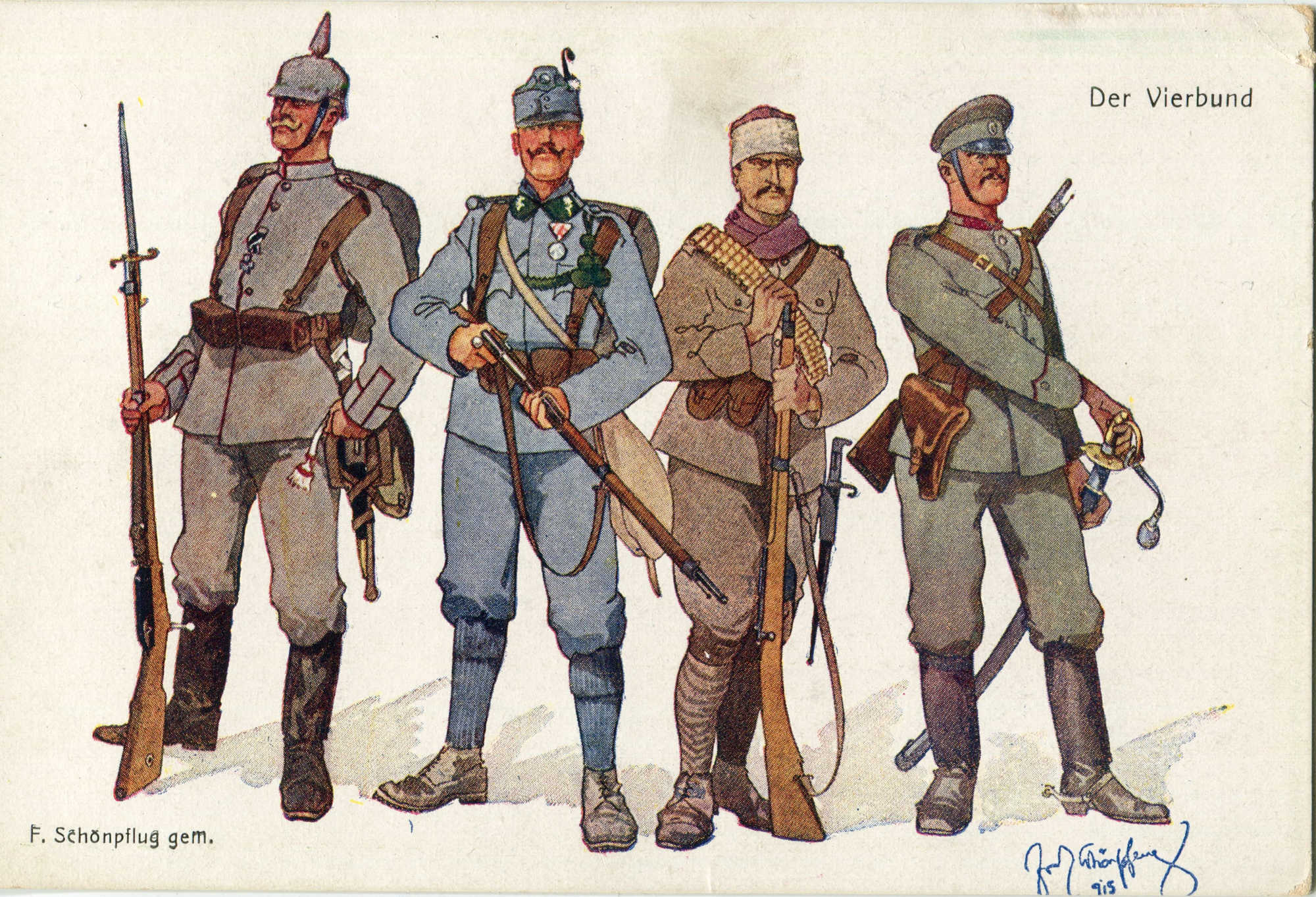
Another of my favorite Austrian artists, Fritz Schönpflug (1873 – 1951), chose a different theme for his contribution to a soldiers benefit association. In his postcard four stalwart soldiers, each in a different uniform take a heroic defensive stand. The short caption reads: Der Vierbund, or the Quadruple Alliance, which was the German term for the Central Powers in the war. Starting on the left, Schönpflug shows a soldier of the German Empire wearing their distinctive pickelhaube helmet; next to him is a soldier in the pale blue uniform of the Austro-Hungarian Empire; then a soldier in dusky brown of the Ottoman Empire; and finally on the right a soldier from the Kingdom of Bulgaria.
Before the war, Schönpflug made hundreds of humorous postcards, often lampooning military life in Wien with stinging satire. But he was a skilled artist who knew how to manipulate a drawing and change a comic moment into a courageous image.
The card was never mailed but Schönpflug's signature has the number 915 beneath it which was a shorthand for the year 1915. Bulgaria also officially entered the war on 14 October 1915, so he was tasked with depicting Austria's allies in a way that would make plain their unified power.
The irony is that in 1915 Bulgaria was a very young country, first established seven years earlier in 1908 as a supposedly constitutional monarchy under its leader, Tsar Ferdinand I. Previously it had been just a principality within the Ottoman Empire though with closer ethnic, religious, and political ties to the Austrian and Russian empires than to the Muslim Turks.
In 1914 Bulgaria was very familiar with war because in October 1912 it had joined a coalition with Greece, Serbia, and Montenegro to fight the Ottoman Empire over territory in the Balkan region. This First Balkan War lasted only 7 months, 3 weeks and 1 day, but just three weeks after a peace treaty was signed in London, Bulgaria took issue with the settlement and started a Second Balkan War against its former allies Greece, Serbia, and Montenegro as well as the Ottoman Empire and Romania, too.
The casualties from both Balkan Wars are very disturbing considering that the two conflicts lasted from 8 October 1912 to 10 August 1913, barely a week over nine months in total. One estimate of casualty deaths in combat listed Bulgaria - 32,000; Greece - 5,000; Montenegro - 3,000; Serbia - 15,000; and the Ottoman Empire - 30,000. Other estimates are even higher when including death from diseases. And there were hundreds of thousands of civilian who perished in the wars and even more were displaced from their homelands. The messy conclusion of these two short regional conflicts wars set up the conditions that caused all of Europe to explode into war in August 1914.
Offizielle Karte für Rotes Kreuz, Kriegsfürsorgeamt Kriegshilfsbüro Nr. 370 ~ Official card for Red Cross, War Welfare Office War Relief Bureau
The notice on the back of this card shows it came from the same welfare office but it now included the Austrian Red Cross as well. The number 370 implies that the series involved many artists, so I may have to start a new collection category.
* * *
This third postcard from the Great War has a painting made by another of my favorite artists, Arthur Thiele, (1860 – 1936). Thiele was German and here he depicts a cavalryman playing his trumpet while what looks like a battle goes on in the background. The caption reads:
Behüt Dich Gott! Auf Wiedersehen! ~ God protect you! Until seeing you again!
The curious caption is actually the title of a song from a well-known German opera from 1884, Der Trompeter von Säckingen, by Alsatian composer, Viktor Ernst Nessler, (1841–1890). It is based on an epic poem with the same title by German poet, Joseph Victor von Scheffe, (1826–1886). The storyline from its Wikipedia entry describes the opera best.
The setting is 17th-century Heidelberg and Säckingen, after the Thirty Years' War. The trumpeter Werner loves Maria, the daughter of the Baron, but her father and mother want her to marry the cowardly Damian. Werner proves himself a hero and is opportunely discovered to be of noble birth, so all ends happily.
In the 1890s and 1900s the character of Werner with his trumpet (bugle) proved tremendously popular in Germany as hundreds of different postcards were produced with an image of the gallant 17th century trumpeter. The setting in the small rural town of Bad Säckingen, which is in the state of Baden-Württemberg in southwest Germany, close to the Swiss border, was tied to Germany's violent history with France and the disputed region of Alsace-Lorraine which in 1914 was part of the German Empire.
In the opera there is a slow sentimental song, Behüt Dich Gott!, that includes a famous trumpet solo. My English translation of the title follows a more literal meaning which, I believe, is how Arthur Thiele intended his picture to link this familiar song of the 1880s to a battle scene in 1914. The postcard was sent by a soldier via free military Feldpost and dated 16 October 1914 from Borkum, a tiny island on Germany's North Sea coast, practically part of the Netherlands, and a very long distance from Bad Säckingen.
* * *
This next postcard artwork of the Great War is unsigned but made by a competent artist who certainly knew how to draw a horse. It shows a few cavalrymen vainly firing their rifles (and shaking a saber!) at a biplane high above them in the blue sky. A description is found printed in a caption on the back.
Ulanen beschießen ein feindliches Flugzeug ~ Lancers fire at an enemy plane
A larger printed caption identifies this card as another benefit for wounded soldiers.
Herausgegeben am Besten von Schwestern des Verbandes deutscher Krankenpflege-anstalten vom Roten Kreuz.
Preis 10 Pfg.— Dem Wohlfahrtszweck fliessen 3 Pfg. zu. ~
Edited as best by sisters of the Association of German Nursing Homes of the Red Cross.
Price 10 Pfg. — 3 Pfg. flows to the welfare purpose.
* * *
Some of the wartime artists took their inspiration from older wars. In this sepia-tone drawing, a fearsome medieval melee of soldiers fight hand to hand with bayonets and swords. There is a struggle over a flag. The back has a caption describing it:
Der grosse Krieg 1914/15.
Eroberung einer französischen Fahne bei Lunéville ~
The great war of 1914/15.
Conquest of a French flag at Lunéville
I believe this depicts, supposedly, the Battle of Grand Couronné from 4 to 13 September 1914, where the German army captured Lunéville, a French town on the border of German-held Lorraine. However a few days later the Germans withdrew, returning it to French forces. According to the Wikipedia entry the German 6th and 7th armies together lost 66,000 casualties, with an estimated 17,000 men killed in this battle.
The postcard was never sent but on the back is a symbol of a German Iron Cross medal
for a veterans organization honoring the years 1870 and 1914. A large caption reads:
Wohlfahrtskarte des "Reichsverband zur Unterstützung deutscher Veteranen E. V."
für Kriegsteilnehmer des Heeres und der Marine ~
Welfare card from the "Reich Association for the Support of German Veterans E.V."
for combatants in the army and navy
Mindestertrag 3½ Pfg ~ Minimum yield 3½ Pfg.
* * *
The French also produced a great number of artist designed postcards. Instead of a picture, this postcard shows a clay sculpture of a bugler rising from the battleground to call his comrades. The artist is not identified on the card but the name on the model is T. Cartier. I believe this is the work of Thomas Francois-Cartier, (1879–1943), a French sculptor, born in Marseilles, who specialized in creating bronze works in the animalier style, a mid-19th century trend of naturalistic yet romanticized portrayals of animals, particularly dogs and big cats, i.e. lions. The title of this work is printed at the bottom with a quote at the top.
Le Clairon ~ The Bugle
Et sur sa lèvre sanglante.
Gardant sa trompette ardente.
Il sonne, il sonne toujours!
~
And on his bloody lip.
Keeping his fiery trumpet.
It sounds, it still sounds!
The trumpeter stands next to a monolithic gravestone, that has an engraving of the face of a bearded man and the words:
1914 Quand Même ~
1914 All the same
The image is of Paul Déroulède (1846–1914), a French author and politician, and one of the founders of the rightwing nationalist League of Patriots. His early career started with the publication of a collection of patriotic poems (Chants du soldat) in 1871 during the time of the Franco-Prussian War. This quote may come from a poem in that work. After France's defeat Déroulède helped organize the League of Patriots to demand the return of Alsace and Lorraine from Germany. His opposition to the French government became so extreme that he was arrested in 1899 and tried for conspiracy against the republic. He was convicted and sentenced in January 1900 to banishment from France so he moved to Spain. When he died in January 1914, six months before war began, his funeral procession in Paris attracted the largest crowds since that of the novelist Victor Hugo.
Clearly there is more context behind this trumpeter's sculpture that is not easy to recognize in the 21st century. In 1914 French politics was incredibly volatile and a "patriot" had a different meaning depending on whether it came from a leftist or rightist viewpoint. The back of this card has no postmark but was dated by the writer 18 January 1915. By coincidence it was sent to a young woman in Lyon who lived at 12 rue Victor Hugo.
UPDATE:
There was something familiar about the image of Paul Déroulède that triggered a memory of one of my other stories on a French political postcard. In my story Music as Metaphor from 15 January 2015, days after a terrible terrorist attack in Paris, I featured a postcard of a band made up of French politicians. The face of Déroulède is in the upper right corner as the leader of the the Ligue des Patriotes or League of Patriots.
* * *
My second French postcard links to Cartier's bugler with a impressionist painting of a troop of French drummers and buglers. They march down a street dressed in blue jackets and bright red trousers. A caption reads: Les Zouzous, a nickname for young soldiers from the Zouave light infantry regiments of France's North African colonies, principally Algeria. The zouave soldiers wore distinctive uniforms characteristic of their North African origin with short open-fronted jackets, baggy trousers, sashes, and a chéchia, a fez-like head-dress. The artist is not identified except for the initials L.V.C. painted in the lower corner.
There is no postmark but the writer sent the postcard to another soldier of the 3rd Zouave regiment staying in a temporary hospital in Marney, (?) France and finishes their message offering best wishes for:
une bonne sante et que cette mauvaise guerre sera finie en 1917
~ to good health and that this bad war will be over in 1917
* * *
My last art work depicts another regimental trumpeter blowing his instrument and holding a rifle too. (Actually it's a crudely colorized photo, but it fits with my trumpeter theme anyway) The frilly black-green plume on his hat marks him as a Bersagliere, a soldier in the special troop of marksmen in the Italian Army's infantry corps. The plume is made of hundreds of feathers from the black capercaillie bird, a Eurasian wood grouse. This distinctive decoration on the Bersagliere's uniform served a practical purpose of camouflage and as a sunshade for the marksman's shooting eye. The postcard's sender has added a translation of Sharpshooter under the imprint on the card.
The soldier's bugle is unusual because unlike other bugles, this one has a single piston valve. This gives the instrument a second overtone series that is one whole-step lower in pitch which greatly increases the melodic potential of its bugle calls. I suppose this is should not be unexpected for an Italian musical instrument but Italian army bugle calls must have been far more complicated than those of other nations as I've never seen it used in any other bugle corps.
The two 5 centesimi stamps have the face of King Victor Emmanuel III and a postmark of either 2 or 12 October 1914, coincidently sent almost the same week as the postcard of Thiele's cavalry trumpeter. It was mailed to James J. Martin of Lincoln, England. The writer here added a rubber stamp of his name and address: Michele Atlante di Gius, Bari (Italy), which is a port city on the Adriatic Sea on the heel of Italy's boot-shaped peninsula.
Please send me, if you can, some English papers with war pictures. Thanks for. Your friend M. a. d. G.
When the Great War started no one, from Kaisers down to generals, politicians, journalists, and eventually to the proverbial man-in-the-street, expected the war to last more than a few months. The expectation was that like the two recent Balkan Wars, or the Russo-Japanese War, or the Spanish-American War, the conflict would be brief and end quickly. No one expected or understood the terrible consequences that would come from over 4 years of total global warfare. It was unimaginable.
By 1914 photography was already a well-established tool for documenting a war, and it was used by all the belligerent nations to promote and define their national goals. Though a good writer might describe a war in bold, even terrifying words, once a reader saw a picture of a battlefield's devastation their emotional response was intensified more than any polished prose could accomplish.
Fine art was an even older and more familiar medium that people were accustomed to seeing in advertisements, propaganda, posters, and postcards. What intrigues me is the way artists used their imagination and artistic skills to provoke a more immediate reaction from the viewer. People were moved to contribute to a veterans' charity because the image of an attractive nurse and handsome soldier sharing a moment caught their attention. It's the essential quality of all advertisements. Grab the eyes. Then persuade.
In the 21st century we daily, even hourly, endure an endless barrage of competing media trying to change our focus. People in 1914 probably felt the same, even though the scale of their media was smaller, required live voices, and was only on printed paper. But these small postcards were important because this was a media that people regularly used for communication and the images were how they interpreted what was happening in this tempestuous time. I hope that Michele Atlante di Gius's English friend was able to oblige and send him British postcards if not newspapers with pictures of the war.
The Bersaglieri were renown for their unique style of marching in parades, and that tradition continues in the Italian army corps of our modern time too. It's a very unusual style so I can't resist finishing with a short video of a Bersaglieri band in Bologna, Italy on the occasion of the rally for the 6th Bersaglieri Regiment.
I can't decide who has the more impressive technique, the tuba players or the trombonists. In any case it is a brass method that must require lips of steel.
Watch out for the little mascot who follows the band. Apparently they start training at a young age in Italy.
This topic of art in the Great War of 1914-18 is one which I plan to revisit soon as I have acquired many more postcards on this theme.
This is a web gallery of antique photographs of musicians. Most are of people whose names are now lost in time but they represent the many kinds of players, instruments, and ensembles that once defined musical culture. But these photographs also capture a moment in the history of people and places, so I write about that too.
All the photos shown here are in my personal collection.
For Best Effect Click on the Images for a Larger View
For information on my music for horn - go to the bottom of this column.