This is a blog about music, photography, history, and culture.
These are photographs from my collection that tell a story about lost time and forgotten music.

Mike Brubaker
{ Click on the image to expand the photo }
Showing posts with label boys band. Show all posts

A Quartet of Boys' Bands

18 January 2025

 
They called themselves Black's Juvenile Band of Nowata, Oklahoma. While there are certainly a good number of youngsters in this band of 26 musicians, for a half dozen or so it's been a few years since they were called juvenile. The photographer followed a tradition of small studios to arrange everyone very compactly with all the instruments and faces neatly visible. The bandleader, Mr. Black, is surely the older gentleman with a cornet  seated center behind the bass drum with his hat cocked back on his head. I also suspect there are a few fathers and sons in this group. The half-tone image means this postcard was likely printed by a local newspaper which put the caption in a fancy Gothic calligraphy font to add a touch of class.

Nowata is a small city in Nowata County, Oklahoma, United States where it is also the county seat. The origin of the town's name is a bit of a mystery as it was originally named Metz, after its first postmaster, Fred Metzner. From 1834–1907 this part of the United States was officially Indian Territory, and became Oklahoma Territory in 1890. The name Oklahoma comes from the Choctaw language phrase okla, 'people', and humma, translated as 'red'. 

In 1828 a treaty with the Cherokee Nation assigned the area of Nowata County to the Cherokee people. Later the placename became Nowata, possibly from a Delaware or Lenape word "noweta" meaning "friendly" or "welcome". However in the Cherokee language, the town was called ᎠᎹᏗᎧᏂᎬᎬ (A-ma-di-ka-ni-gunh-gunh, roughly), which means, "water is all gone," crudely translated into what the word meant: "No Water".

The postmark on this card is from Coffeyville, Oklahoma dated 16 November 1908, exactly one year after Oklahoma achieved statehood. It was sent to someone in Nowata but the pencil handwriting has faded the name. In 1900 Nowata had a population of 498 but in 1910 it expanded 637.3% to 3,672 citizens, which is close to its current population of 3,517.


Dear Sis  Had a very
good night rest
Many thanks
all O.K.  I have
a headake this
morning. good
bye  Lola


* * *


In this next postcard "The Kids Band of High Point, N. C." stand outside of an ivy-covered brick building, perhaps a church as is has stained glass windows. The boys in the band are dressed in matching white shirts and knee length pants with dark forager caps reminiscent of a Civil War soldier's hat. The image is very grainy and I think the original photo had limited contrast as it looks like the figures' outlines were improved with penciled lines and thatching before it was printed. It is a typical brass band of 14 musicians with a single clarinetist and two drummers. Their band director stands behind them on the right. I would judge their ages to be around 12 to 17. 

The city of High Point is one-third of North Carolina's northcentral Piedmont Triade along with Greensboro and Winston-Salem. It presently has a population of around 116,926 in 2023 but in 1910 it was still a small town with only 9,525 residents. 

This postcard was sent on 9 June 1910 from High Point to Mr. Joe F. Robbins of Hendersonville, NC, a city about 25 miles south of where I live in Asheville, NC.  


Hello Mr. Robbins
How is the mountains?
So glad to hear
from you.  Will
write to you
tonight.
Best wishes
                D. B.
6/9/10


* * *


The 25 musicians in this next boys' band also stood outside of a building for their photo. A caption identifies them as the Mullan School Band of Mullan, Idaho. They are dressed in a style of military cadet uniforms with mostly brass instruments with a few clarinets and drums. I don't see an adult band director but the boys' ages seem to range from 8 to 18. I found a photo online of the Mullan School taken in 1904 with a line of students outside standing in snow. It's an imposing two story brick building and the entrance matches the brickwork behind the band. 


Mullan School in Mullan, Idaho, 1904
Source: Barnard-Stockbridge Photograph Collection

 
Mullan is located in Shoshone County, in the northern panhandle of Idaho, east of Spokane, Washington. The town was established in 1884 at the east end of the Silver Valley in between two mines, which initially produced gold and then mainly lead-silver ore. Mullan's current population is just 646 residents but in the year this photo of the Mullan School Band was taken it had around 1,600.

The postcard was sent from Mullan on 29 November 1908 to Mrs. Mae Risley of Atlantic City, New Jersey.


Thanks for the big
turkey,  He's a dandy
Call again
          Phil. J. Starcks (?)


* * *


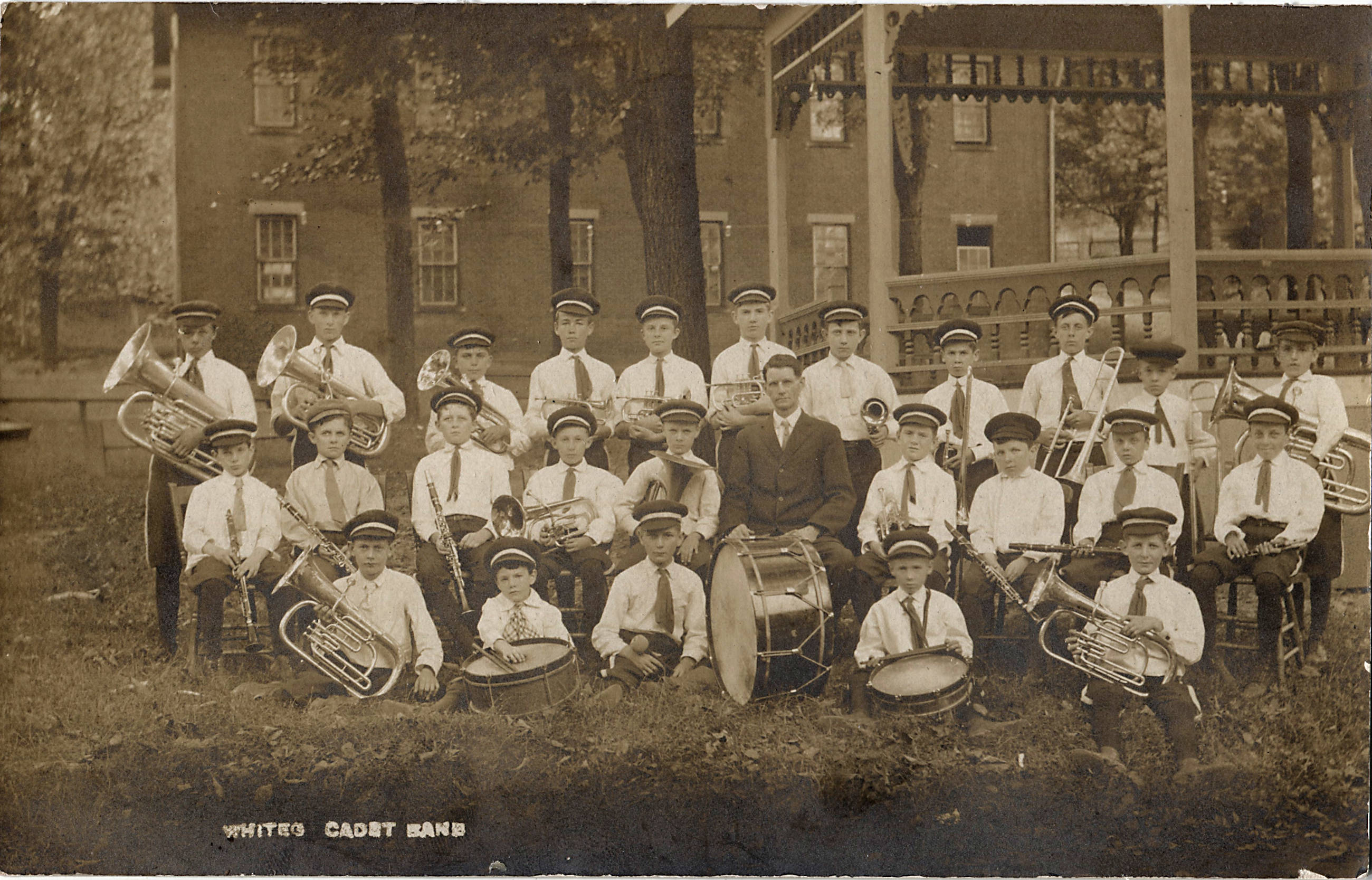
My final boys' band is a large group of 25 boys seated outdoors next to a park bandstand. The location is unknown as this postcard was never mailed. But the photographer did provide a simple caption: Whites Cadet Band. Presumably Mr. White is their leader, the man seated center behind the bass drum, which, sadly, does not have the usual stenciled band logo with a town name. 

The boys are roughly aged 8 to 16 and are dressed in simple white shirt, long tie, and military hats. Their instrumentation is a nice balance of brass instruments with clarinets and drums. I would date them to around 1910. Most boys bands of this size would usually not be part of a school but would be a separate ensemble with their instruments and music provided by a sponsor, usually a local merchant in the community. 


In my story last week, The Ladies' Band of Foxhome, Minnesota, I featured a brass band from a very small rural town. My collection has many examples of similar postcards of both boys' and girls' bands from 1890 to 1920. These musical groups were often connected to family bands by being lead by an enterprising adult musician in their communities whose children were in the band. They also were often sponsored by a town band of adult amateurs, almost always men. 

The children's bands rarely mixed boys and girls as America's society conventions were strict in this era. The popularity of brass bands for boys and girls across America was driven by a combination of fads. One was the way music in this time could only be heard live. Professional bands and celebrated instrumentalists were becoming very well known through their concert tours. It created an enthusiasm in both adults and children to pick up an instrument and make music themselves. 

The second driver of making bands popular in America was from band instrument manufacturers who sponsored professional bands and soloists to promote their instruments. They used newspapers and catalogs to market bargain sets of instruments of all kinds, delivered anywhere. The music instrument industry was also aligned with publishers of sheet music who similarly promoted the latest trends of songs, marches, and dances. 

Another important motivator for starting a band for girls and boys was to develop wholesome activities for children. In this era most team sports were not included in school programs and there were no outside organizations that provided physical recreation like Little Leagues or Scouting either. Music was considered a worthy year-round activity that kept children occupied and taught them a useful skill. Every community wanted the best for their children. Otherwise, as Professor Harold Hill said, "Ya Got Trouble."


The classic 1957 musical The Music Man 
was written and composed by Meredith Willson (1902-1984),
who based the story on his own experience growing up in Mason City, Iowa.
Willson was also an accomplished flutist who got his start playing in a small town band.


This is my contribution to Sepia Saturday
where good pals are treasures for life.


Notes from a Time Traveler

16 November 2024


I am a time traveler. Nearly every day I set off on a journey to meet people in some far-off place in the infinite dimensions of history. However my span of infinity is actually pretty narrow as modern time transport technology has strict limitations. Generally it's some date between 1845 and 1945, though occasionally I'll end up somewhere during my lifetime. 

Most of my encounters with people of the past are very brief, only lasting a split second really. Sometimes we might be properly introduced, but typically they remain nameless. And, due to the fleeting brevity of this moment, I am invisible to their eyes, so they never know that I can see them. I tend to seek out musicians, though once in a while I'll be attracted to other showbiz occupations like dancers, singers, or comedians. Lately I've become fascinated by aviators and artists. 

When I do learn who these vintage people are I like to ask questions about their life, their family, and in the case of musicians, their instruments and musical ensembles. Unfortunately in that blink of an eye that we connect they don't talk much, so it's a real challenge to get answers. In fact the time goes by so fast that I'm lucky if I can determine a location or a decade of when I first make their acquaintance. 

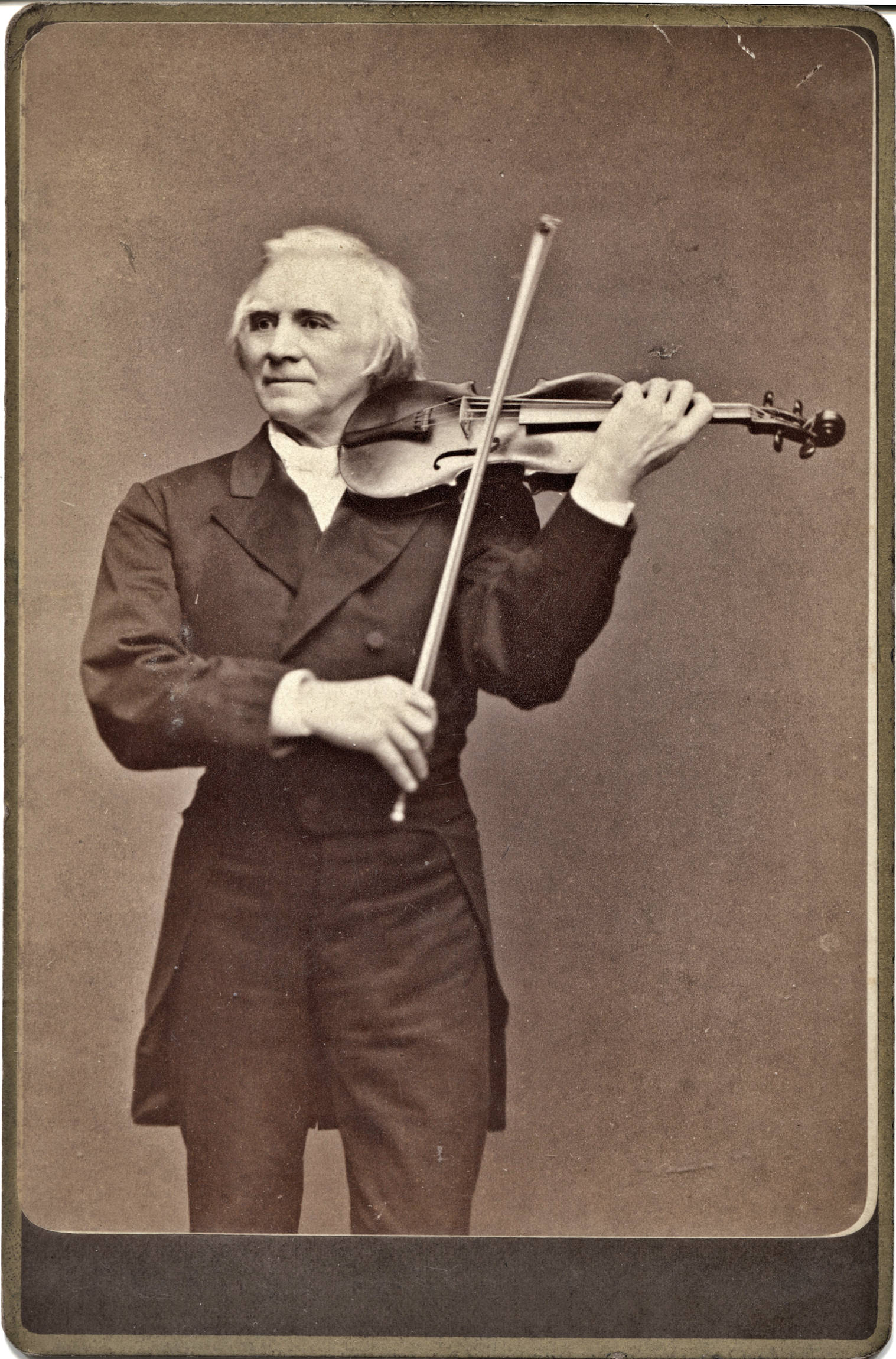
Today, in honor of the special 750th weekend of the Sepia Saturday Club (more about that later), I thought I would present a few of my antique friends whom I've renewed contact with on my time travel adventures in just the last few weeks. They should be familiar to longtime readers as I have already featured  them  in previous stories here on my blog. One is the gentleman that begins this post. He is the celebrated Norwegian violinist Ole Bull. I've grown so found of him that I often set the controls on my time machine to go visit him. But first I'll bring back a new souvenir of one of my favorite child performers.


I first introduced these three boys in July 2022 in my story The Little Vernon Brothers. They are Sidney Clyde Vernon, the tallest boy holding a violin, born 1878 in Elgin, Ontario, Canada; Howard Alexander Vernon, the boy with a piccolo, born 1881 in Marshalltown, Iowa; and Percival Lessington Vernon, the youngest with the long blond hair and a cello, born 1884, also in Marshalltown.  The three brothers are accompanied in this picture by their mother, Mary Jerusha Vernon, who is seated at a reed organ.  

This cabinet card was produced by the Holdridge studio of Trenton, New Jersey, at 223 East  State Street. The other four photos I have of the "little" Vernon brothers were taken by photographers in Marshalltown, Iowa; Beloit, Wisconsin; and Philadelphia, Pennsylvania. That photo is of the whole family with their mother Mary and their father, Edward H. Vernon, an accountant who evidently was successful enough to support moving his family around the country. 

This photo from New Jersey shows Sidney at his tallest so based on my previous research I think it was taken around 1895-96. This photo was also the only one that came with a caption for the "Little Vernon Brothers" so it was clearly intended to be a promotional photo for their performances. Unlike a troupe of vaudeville theater entertainers, the Vernon family played at churches and society halls. Their repertoire was designed to appeal to a family audience with an emphasis on Christian songs, hymn tunes, and wholesome folk tunes, interspersed with recitations of poetry. This review from 1895 describes one of their concerts in Goshen, New York.


Goshen NY Democrat
14 March 1895


The entertainment in the Presbyterian church last Friday evening was a success.  It was well attended, considering the condition of the roads.  The Little Vernon Brothers are all they are recommended to be.  Sidney, the eldest, who plays the violin, has a very fine touch; Howard, the next, plays the piccolo well; and Percy, the child who plays the violincello, is a prodigy, is natural and homelike on the stage, plays his part perfectly and sings just as well.  His childish movements on the stage are a strong hold on the public. 


_ _ _

The Vernon brothers began performing in 1889 in Marshalltown, Iowa and continued giving regular concerts around the country until about 1899 when they were not so little anymore. By the turn of the century the Vernon family was living in Detroit and the boys were beginning higher education. What I find remarkable is that all three brothers entered seminaries and became ordained ministers, two in Baptist churches and one in a Presbyterian. Reader's can find out more in my original story of the Vernon brothers. 


* * *


One genre of postcards that I regularly search for is "orphan bands". I few weeks ago I spotted this one and recognized it as a picture of a children's band that I featured on this blog back in 2018. There are 14 boys and girls holding musical instruments, mostly brass, and dressed in nice Sunday best. They called themselves "The Jolly Entertainers". I told their story in two parts, The Children's Home Band of Des Moines, Washington and Mr. Draper's Children's Home Band of of Des Moines, Washington. This "Children's Industrial Home" was established and run by Mr. Herman M. Draper, seen here seated center holding a cornet. A native of Canada, Draper was born in Ontario in 1857, but immigrated to the United States in 1882. As a young man he pursued a career as a music teacher, specifically for chorus and voice using a music education technique called Solfège which uses syllables for the musical scale pitches, i.e. Do, Re, Mi, Fa, So, La, Ti. 

In 1887 he taught music in several Nebraska public schools where he developed his own methods for teaching elementary music. Ten years later in 1897 he moved to Calumet, Michigan where he was employed as a superintendent of an orphanage of about 50 children. In 1906 after a dispute with the orphanage's board of governors Draper and his wife left Calumet and "took" six children with them to Seattle where he decided they could operate a smaller but more compassionate orphanage in the Pacific Northwest. After a couple of years in Seattle, in 1908 the orphanage moved to Des Moines, a small village on Puget Sound named by its first settlers after the much larger Des Moines, Iowa.

Draper wanted it to be a self-supported private orphanage so he trained his young charges in various practical trades including music and printing. I have two other postcards with the same image that date from the summer of 1910, but this one has a notice on the back that is not on the others. It reads:

Help us pay for
OUR HOME

We own a complete printing outfit and
our boys are printers;  send us an order
for cards, letter heads, bill heads, etc.
We guarantee satisfaction   and
We need your help.

But there is a message too, which cliched the sale for me. 


Geo. saw these
children as he
came from     
Seattle the    
other day.     
He wanted the
little girl marked
X  but they would
not let her      
go.               


The message is a bit ambiguous since the writer is not identified and we don't know if Geo(rge) is age six or sixty.  So it is both charming or creepy depending on ones interpretation. But the X mark is actually on the back just above the U in OUR. It corresponds to the little girl seated right with an alto horn. 


This postcard was produced at a time when Mr. Draper was beginning to take his children on short tours in the region. He had some success so purchased a small bus and organized more trips to Oregon and California. In 1925 he undertook the biggest adventure taking 22 children on a year-long tour of the United States playing benefit concerts everywhere they could. It made the pages of newspapers all across the nation.

Sadly Mrs. Annie Draper died on 13 April 1927. Four days later just before her funeral, her husband followed her, tragically succumbing to a heart condition. Herman M. "Daddy" Draper was 70 years old. He and his wife had cared for over 300 children at their orphanage. It's an inspiring story of perseverance, dedication, and love. Here's the link to part one.


* * *


We met this handsome violinist in my three part series Ole Bull, Adventures in America, part 1, part 2, part 3. He is Ole Bornemann Bull (1810–1880) a Norwegian violin virtuoso who was one of the first violinists in the early 19th century to create a successful career as a concert soloist. By 1837 Ole Bull was performing hundreds of concerts each season in Europe that established him as the equal of other Romantic musical artists like his contemporaries: Felix Mendelssohn (1809–1847), Frédéric Chopin (1810–1849), Robert Schumann (1810–1856), Franz Liszt (1811–1886) and the great Italian violinist  Niccolò Paganini (1782–1840), whom he tried to emulate as a violinist and composer,  too. But no concert artist of his time ever covered as much distance in traveling the world as Ole Bull. 

My series on Ole Bull focused on a set of carte de visite photos that were produced by a Chicago photographer in the winter of 1867-68. This was during his third tour of America just after the end of the Civil War. He made his first tour in 1843-45 and his second tour in 1852-57. This happened to be when photography was just becoming popular as a new portrait art form. However early photographs like daguerreotypes and ferrotypes of the 1840s and 1850s were each singular positive images and could not be easily duplicated. In the 1860s when the carte de visite, or cdv, were introduced the process used a negative image on a glass plate which allowed multiple copies to be printed quickly and cheaply. It was the perfect medium for an entertainer who wanted pictures to promote themselves. In 1867 Ole Bull clearly recognized the value of cdvs as souvenirs for devoted fans. 

Since publishing my Ole Bull series in January 2021, I've acquired even more photos of him, including more cdvs from Chicago, a ferrotype–tintype, and recently last month a couple of larger cabinet card photographs. The first one shows Ole Bull seated in a relaxed pose. His hair is long but now quite white. The photographer was S. W. Felt of Chicago, a different photographer than the one who made the cdvs in 1867-68. This photograph could have been taken during Ole Bull's fourth appearance in America in 1871-72 when he played Chicago in March 1872. That was just  five months after the Great Chicago Fire destroyed the city center's theater district where he had last performed. But I think this image fits better with his fifth tour from 1876-77 when reviewers took note of the "snow in his hair." The photograph print is a bit soiled and abraded but I like that his name is written in pencil on the front. I'm not certain yet, as the simplicity of his name makes it easy to reproduce, but I think it might be Ole Bull's real signature. 


This second cabinet card of Ole Bull is very clear and well preserved, requiring little correction of contrast. It shows a 3/4 view of him with his violin and bow in playing position. The photographer was J. P. Moore of Meriden, Connecticut. Ole Bull's face and expression resembles his other photo, so I think this may date from 1876-77 too. 

Bull returned to America once more in 1878 but reports describe him as diminished,  no longer fit as a fiddle as some might say. He did play a final concert in Chicago in May 1880, but concern over his poor health forced him to return to his home in Bergen, Norway where he died on 17 August 1880. Readers can read about the exciting adventures of Ole Bull's 1867-68 tour by starting at this link.

Most of the musicians I meet in my time machine are mute, their stories and biographies locked away in the secret vaults of history. Ole Bull is a rare exception as there are literally thousands of newspaper reports, letters, and books on his life. It makes it much easier to know the man, but more difficult to puzzle out exactly when his photos were taken. I'm planning a reprise story on Ole Bull so I can display these two photos alongside the other new photos I've found. Stay tuned.


* * *


My final photo is a postcard that just arrived in the post a few days ago. It's obviously not a picture of a musical group but, as the caption says. it's a track team from E.P.H.S. Those initials stand for East Palestine High School and some of these boys appeared in my three part series The Glee Club of East Palestine, Ohio - part 1, part 2, part 3. 

East Palestine, Ohio is another place I frequently check out in my time machine, specifically during the period from 1906 to 1910 when one young man in particular was a student there. Here he is seated on the floor in front, one of ten members of the track team and the only one with a dark African complexion. His name is James Aaron Washington and I'm rather proud to have figured out who he was, as he did not grow up in Ohio but in Asheville, North Carolina, the city where I now live. 

This photo was taken in 1909, either in the spring or maybe the previous fall of 1908. In 2024 this picture is not unlike thousands of similar high school team photos. But in 1909 it was exceptionally rare to see a Black student sitting as an equal with fellow White students. America's terrible legacy of slavery continued in the post-Civil War era with society strictly divided by race using countless harsh laws to enforce racial segregation. How James Washington came to be in eastern Ohio was the first question I asked in part 1 of his story.  Certainly in 1909 North Carolina a young African-American man would never be accepted as a member of a high school athletic team, much less photographed with one. There are still many questions I want to ask but may never get an answer. 

This postcard is also an example of when I get to hear someone from the past speak across the vastness of the spacetime continuum. It was sent to Mrs. C. E. Oliver of Pittsburg, Pa. on 19 May 1909, perhaps care of Mercy Hospital.

Will be up Saturday
if my head gets
well.  I will have to
jump against the
same fellows that I
jumped against Saturday


The boys competed in springtime track meets against other high school teams in the region. A year later in May 1910 there was an all-county contest with four schools and the East Palestine Reveille Echo reported that Washington placed second in the 220 yard dash and Oliver got third in the running broad jump. But their rivals as Lisbon High still took the most points to win the championship leaving East Palestine to settle for a 2nd place. 


If you look closely some of the boys have medals pinned to their shirts. James has one and the boy behind  him on the right has six. The boy to the left is the same boy in the E.P.H.S. Glee Club photos wearing a top hat. I believe his name is Cecil Oliver. He and James sang duets in the Glee Club concerts. Could he be the son of Mrs. Oliver writing for some sympathy on this postcard? Yet another question that may go unanswered. 


This is actually the second photo postcard I've found of the E.P,H.S. track team with young James Washington. The other one is dated 1908 and is even more remarkable because James is not the only Black athlete in the group. That photo is in the Postscript at the end of  part 3.   

James Aaron Washington's story took another surprising turn when I discovered that after high school he returned to North Carolina; attended Shaw College in Raleigh; got married in Asheville, raised a family there; and then in the 1920s moved to Washington, D. C. where he worked for the U. S. Post Office. That's all explained in part 2.  

But the biggest surprise was to learn that his son, James Aaron Washington Jr. became a noted civil rights attorney, a law professor and dean at  Howard University in D. C., and later a judge to the Superior Court of the District of Columbia appointed in 1971 by President Richard Nixon. But more significant was that Professor James Washington Jr., the son of the young man in East Palestine High School's Glee Club and track team, was also one of the advisors who helped to craft the 1954 case of Brown vs. Board of Education of Topeka which became a landmark decision of the U.S. Supreme Court ruling that U. S. state laws establishing racial segregation in public schools were unconstitutional, even if the segregated schools were otherwise equal in quality. That's a real story of bending the arc of justice.


I am a time traveler.
Even just a glimpse of a moment in time
can contain millions of threads of history.
Some lead backwards and some forward,
but they all weave into an amazing fabric of time.
That's why I keep alert when I'm in my time machine.
You never know when you might meet an old friend.


This is my contribution to Sepia Saturday
where everyone is celebrating
the art of vintage photos.


This is my 724th post on my blog TempoSenzaTempo — Time Without Time. I first joined the Sepia Saturday club hub pub on January 8, 2011, number 56. I submitted A Mystery Band which seems incredibly brief compared to my usual output (like this one) in 2024. It took me a few more weekends before I settled into the idea of following Alan's theme image, but since February 2011 I have participated in nearly every Sepia Saturday, which makes about 690 weekends. That's a lot of postcards and photos.

I never expected that my hobby of collecting vintage musician photos would become the passion it is today. (Some people, like my dear wife, think it might be an illness.) But the inspiration really came from meeting fellow time travelers who shared my interest in telling stories about old photographs. It's sad to say that many of those bloggers have faded away into the Sepia Mists. But I am very grateful for all that I learned from reading each blogger's stories and gaining a different perspective on writing, collecting, analyzing, research, and presentation on this wonderful medium of the internet. I continue to delight in every blogger's contribution to Sepia Saturday. Thank you, Alan, for keeping the Sepia Saturday club pub going and offering up a fascinating image every week. I look forward to Number 1000. I'm pretty sure I'll still have enough photos in my collection to make a good match.

Riding Around in Mason City, Iowa

29 June 2024

 
It's that double-take we all do.
You are out and about  
and another vehicle drives past.
Suddenly you catch a glimpse
of something out of the ordinary.
Was that fella holding a tuba?


Or maybe it's just the odd face of a stranger
that makes you shake your head.
Was that guy for real?


Today I present some postcards
of curious automobile scenes
that people 
once encountered
in Mason City, Iowa.
.  


The first is a photo of a large open top bus carrying at least 16 men who sit on four bench seats. It would be a tight fit even without their musical instruments as on either side of the driver is a trombonist and a tuba player and behind them are men with a tenor horn, mellophone and a snare drum. The men are dressed in ordinary business suits and most wear bowler hats, According to the caption they are the Mason City Band in Mason City, Iowa. The photographer's name is Washburn.  

Mason City is the county seat of Cerro Gordo County in north central Iowa. In 1910 it had a population of 11,230 residents which included a young boy named Meredith Willson who became a very successful flautist, composer, conductor, music arranger, bandleader, playwright, and author. Meredith Willson is best remembered for his musical, The Music Man, which he wrote as a tribute to his home town and state. The show premiered on Broadway in 1957, and has been adapted twice for film in 1962 and 2003. Many of the characters in it were based on people Willson knew from his childhood in Mason City.


                                                                4/13/09
                                    Dear Lew:
                                                Some one is looking
                                    for a letter.  Do you suppose
                                    someone will get it to-
                                    morrow?  May I?
                                    Isn't this a bright happy
                                    Spring day!  but say I do need
                                    that letter.  Ho! Ho!  "Bet I do"
                                    Are you busy  busy busy today?
                                    Or have you got another tele?
(?)
                                                                            William

                                                    This is one of
                                                    our City Bands.
                                                    Are to have
                                                    only 2 this
                                                    year as well
                                                    as a Boys Band
                                                    up the M. Y.
                                                    It truly makes
                                                    me sick  Ha! Ha!


Longtime readers may remember this band before as I featured a colorized version ten years ago in my story The Mason City Band from January 2014. 


This postcard is identical to the first but is a color halftone print that is not as clear as the photo postcard. It also has some abrasion that diminishes its quality but the 1910 postmark and message make up for that. 

The front of the bus has the marque The Overland for the Overland Automobile Company, of Terre Haute, Indiana, which began building motorcars in 1903. The company was sold in 1908 to John North Willys  who renamed it the Willys-Overland company, which became best known in World War 2 as the manufacturer of the all purpose military vehicle, the Jeep. Notice that the rear axle has a chain drive and on the front right is a brass horn not unlike a miniature tuba.


                            Dear  Son   I am at Mason
                            today it has been raining
                            for some days but it is
                            clear this morning I have
                            been trying to start
                            home for a week but have
                            not got started yet but
                            I am going to start Mon
                            shure am going back to
                            Rockwell this afternoon
                            going out Home tomorrow and
                            start home at 6 ...day Mom ur.. love


My third automobile photo has no musicians but the driver is an old geezer who would attract anyone's attention if he drove past. He is seated in a open top runabout with an American flag mounted on the front. His alarming face is actually a crude mask with whiskers so he may be  participating in a patriotic parade like for July 4th. Behind him is a loading dock and a horse-drawn wagon with the words BOTT_NG WORK painted on the side. 

I recently acquired this postcard for its uncanny resemblance to a photo of my great grandfather William Dobbin that I featured last year in Car Stories, the Rural Mail Carrier. 


Both cars are, I believe, a Maxwell Model LD. My great grandfather used it for his job as a rural mail carrier in Glenwood, Minnesota. The location of this other masked driver suggests that perhaps he used it as a delivery car, too. What amazed me when I compared the two cars is that William Dobbin's Minnesota number plate is 73733 and the other car's plate has 73750 with IA for Iowa. How cool is that? 


                            Mason City
                                Oct 5, 14.
                            Can you recognize
                            who this is   you
                            saw him before
                            Guess Who.


The seller added a note: 
                                    Hub Bottling Works
                  215  W. Fifth

The writer included "Mason City" next to the date but there is a Mason City in Ohio, Illinois, Nebraska, and West Virginia as well as Iowa. But this puzzle was easy to solve using the city directories available on Ancestry.com. In the 1914 city directory for Mason City, Iowa has a listing for:

                        HUB BOTTLING WORKS (Thomas F Cain, Joseph F Cibuzar).
                                Mnfrs of Hub Brand Soda Water and Jobbers of
                                Ciders and Soda Fountain Supplies, 215 W. 5th, Tel 739.


1914 city directory for Mason City, Iowa


On my first real photo postcard of the Mason City Band the writer William mentions a boys band. This next postcard is surely the one he was referring to. It's a photo of a boys' band from the I.O.O.F. — International Order of Odd Fellows orphans home in Mason City. The initials FLT on the drumhead are the fraternal order's "Triple Links" symbol for its motto "Friendship, Love and Truth". The photographer was the same Mr. Washburn who took the photo of the Mason City band.


 I have several photos of this boys' band and I featured three in a story The Orphans Home Band of Mason City, Iowa which I wrote way back in January 2011. They were produced in around 1910 and on the back of one postcard were all the names of the boys. It was this rare annotation that inspired my first efforts at researching genealogy and musical history. As it predates my joining Sepia Saturday, very few people have read it. I've been pleased that the few comments I've received were from people who were once residents at the I.O.O.F. home when they were children. 

In February 2015 I wrote a story on a similar photo of a girls' mandolin/guitar "orchestra" at the orphanage, The Iowa I.O.O.F. Orphans Home Orchestra. That story was updated in 2018 with two more photos of the home's string ensembles. Mason City was clearly a very musical place in the 1910s so it's not surprising that the town's music traditions influenced the young Meredith Willson.  


I'll close with this clip
from Meredith Willson's 1962 film
"The Music Man" starring Robert Preston & Shirley Jones
It's the opening scene subtitled Rock Island. 
It's my favorite bit in the musical.


Want to bet that the old geezer
in the Maxwell runabout
was a member of Mason City's
Odd Fellows lodge?

I think he knew the territory, too.


This is my contribution to Sepia Saturday
where parking might be a problem this weekend.


The Glee Club of East Palestine, Ohio - part 3

09 September 2023


I have a dream that one day this nation will rise up
and live out the true meaning of its creed:
‘we hold these truths to be self-evident – that all men are created equal’.

Martin Luther King Jr. – “I have a dream” speech, 1963


This the third story of a 3 part series. 
I recommend starting with the first one:


Asheville NC Citizen-Times
3 June 1914

On 3 June 1914 the Asheville Citizen-Times published its regular notice of matters of public record from the city's registrar of deeds. Under marriage licenses were two names.

J. M. Washington, colored, to Vivian B. Alston, colored.

This brief line was not like the wedding notice found in The New York Age that finished my first story in this series, The Glee Club of East Palestine, Ohio - part 1. Here James' first name is missing and his middle initial was incorrect, while Vivian's middle initial and surname are at least properly separated by a space which the New York Age mistakenly reported as "Balston." But the Age did include details like James was a graduate of East Palestine, Ohio and Miss Vivian a graduate of the Allen Home in Asheville and that they were wed June 2 at the First Baptist Church. All very useful information that helped me identify them in other records.

But in Asheville a single bureaucratic word was added
that made this record standout in stark contrast—"colored".

A century later it is difficult to describe how awkward, even offensive, this word is. Yet history does not allow us to ignore institutional racism and in fact I could not have done my research without taking advantage of this word. The name James Washington is shared by more men than I can count, yet I have been able to identify the young man in my photos from East Palestine, Ohio because in 1908 America marked people by the color of their skin. Sometimes it was "colored", or an initial C or B or M, or just an asterisk next to a name. It was an era when every government or official document included a line or box to indicate race.

In North Carolina the word was used everywhere. Parks, churches, restaurants, businesses, schools, libraries, and hospitals, not to mention public toilets and drinking fountains were labeled "Colored". The state mandated "Jim Crow" codes that defined racial segregation throughout every part of North Carolina society and assigned strict penalties for any infraction. These laws devised  by white men effectively divided Southern culture into two separate communities. White people were pretty much free to go and do as they like without causing offence. "Colored" folk needed to know the right entrance to use at a theater; the right place to sit in a restaurant; where their children could play; and even how to speak to a white person in a deferential manner. 

Going to school in East Palestine, Ohio, James Washington had a rare opportunity to experience a part of America where the rules of racism were less strict and the community was more accepting. No doubt Ohio had its share of prejudice and bigoty, but in 1908 it was not a society that blatantly placed restrictions and boundaries on people of color. So why did James return to Asheville?

Maybe because his family and friends were more important to him. 


Asheville NC Citizen-Times
18 December 1904

While James was in East Palestine high School, Vivian Alston was a student at the Allen Home School. Originally called the Allen Industrial Training School, it was established in 1887 by the Woman’s Home Missionary Society of the Methodist Episcopal Church as a private school to teach African American children to read and write. It was named after Marriage Allen, an English Quaker philanthropist, who donated money for construction of a dormitory building when it added a boarding school for girls. The teachers were white female missionaries so classes followed “Christian ideals” but there was also vocational training in domestic tasks such as cooking and sewing. The Allen Home School set high academic standards which let it train teachers too. It became a state accredited private high school in 1924 and closed in 1974.


Asheville Academy and Allen Industrial Home
1916 Asheville city directory


Boys were allowed to take classes there as day students, and it's possible James attended during his middle school years. But it's very likely that he met her at the Young Men's Institute, the Y. M. I. where in December 1904 she and her brother sang for an entertainment there. When James returned to Asheville in the summer of 1910 before going to Raleigh to enter Shaw University, it seems likely he renewed a friendship with Vivian then. She may be part of the reason his time at Shaw was limited to just two or three years.  

After their marriage they moved to 47 Circle St. on the east side of downtown Asheville, a very short distance from the home on Valley St. where James had lived in 1900 and close to his elementary school on Catholic Hill. In the 1915 city directory his occupation was listed as a porter for the Southern Railway. Curiously the address on Circle was also where James' mother, Lula (Louise) Sims, lived in 1910, presumably after her employment with families in Ohio and Massachusetts ended.  [See the previous story in this series: The Glee Club of East Palestine, Ohio - part 2]


1915 Asheville, NC city directory


Despite its small population in 1915 Asheville was becoming a tourist destination in the region and could boast of 25 hotels, several offering high class service, and 92 boarding houses, many catering to seasonal visitors who came to Asheville for its cooler mountain summers. As a railway porter, James may have worked long days onboard trains serving the area, perhaps supplementing that occasionally as a hotel porter. He did find time for music and his name appears in notices for entertainments at the Y.M.I. where he sang in a men's quartet. 

On 8 August 1916 there was a concert at Asheville's city auditorium of two hundred "colored" singers celebrating "the first Negro Folk-Song Festival". It was organized and led by Mrs. E. A. Hackley of Chicago who was on a mission to resurrect and present "negro folk-songs and plantation music." She was aided by Dr. J. W. Walker, a "colored physician" of Asheville who helped assemble a chorus of men, women, girls, and boys who learned the music in just two weeks. The audience was a rare mixed group of black and white patrons who were generous in their applause. I like to think James and Vivian Washington were part of that chorus. Sadly, though the organizers promised this concert would become an annual event in Asheville, it never did.


Meanwhile James and Vivian started a family and by 1916 had two children. But for some reason they left Asheville in the early half of 1917. This was actually fortunate as they missed a terrible tragedy that happened in November, not 300 yards from their home. 


Asheville NC Times
16 November 1917

Around 11:30 Friday morning, 16 November 1917, a fire swept through the Catholic Hill School where James had attended elementary grades. After teachers first noticed smoke coming from the basement it took 20 minutes before the firemen arrived, and then more time was lost laying out hoses up the hillside as the nearest fire hydrants were down below on Valley Street. Fanned by a strong wind the school building's roof and walls collapsed at 12:30. Though most of the students and teachers escaped, seven children perished in the fire and several more were injured. The school was totally destroyed. Afterwards the teachers and children moved into temporary classrooms set up in a nearby "colored" sanatorium. In 1922 a new school for African-American children, Stephens-Lee High School, was built on the site. Its construction cost $115,000. Seven years later in February 1929, a new high school for white children was opened. It cost $1.3 million.


In June 1917, like most American men between the ages of 18 and 45, James Aaron Washington registered for the draft as the United States prepared to join the war in Europe. He was living at 1810 Sharswood St. in Philadelphia, Pennsylvania. He listed as dependents his mother, wife, and two children and he was employed as a cook at a diner run by Henry Burns on Girard St. He was 26 years old, born on 1 May 1891 in Asheville. The lower left corner of his draft card was clipped to indicate to military administrators that he was of "African origin".  

I looked up James' employer and discovered that Henry Burns' home residence was the same address as James'. I believe Henry was Lula Sims' father, which would explain why they were living there, but I was unable to find enough records to confirm that relationship. And in this case the huge Philadelphia city directory was not helpful to a genealogist as it did not mark people's race. However of the 15 men with the name Jas Washington in the 1918 directory only one was a cook and living at 1810 Sharswood. 

1920 US Census Philadelphia, PA

To make it more confusing the 1920 census for Philadelphia has James and Vivian living with three children, a son and two daughters, all born in North Carolina, the youngest at age 1 being marked as both Son and F  (female). James is now age 28 and he works as a "R R C" at the "Terminal", which I interpret as railroad clerk at the Philadelphia train terminal. His mother's name was not Sims but was now Lulu Dyer, She was age 48, born in South Carolina and she had another son living with them, John C. Dyer age 19, born in South Carolina. Adding another layer to the household was an aunt, Catherine James (? or Janes), and a brother-in-law, B. P. Austin, which I think was another spelling error of Alston, Vivian's family name.

The reason the Washington family moved to Philadelphia in 1917 and remained there for 4 years are unknown to me, as are reasons that brought them back to Asheville in 1922 when they returned to 47 Circle St. James was now employed as a clerk at the "Ry M S" which stands for the Railway Mail Service. This work involved sorting mail at the Asheville train terminal or sometimes working on a post office railcar included on mainline train routes. Interestingly, his mother is living with them too and has taken the name Lula Washington.


1923 Asheville, NC city directory

The Washington family had added another child and no doubt found Asheville familiar and small after living in Philadelphia. The Asheville newspapers make no mention of James or Vivian, but in June 1921 there is a court notice that a divorce has been granted to George and Lula Dizer after 5 years of separation. A check of the city directory showed that Lula Sims lived at 47 Circle in 1910, and George and Lula Dizer lived there in 1911. [Figuring out name misspellings and phonetic homophones are just one of the many challenges my research encountered]

Sadly on 7 April 1926, Lula Washington Deyer (another misspelling of Dizer) died of cancer. James Washington provided the information for her death certificate. She was age 54. occupation: Domestic. Her father's name was Henry Burns. 

James and Vivian stayed in Asheville for a bit longer, but in 1927 only James was listed in the city directory. He worked at the Service Drug Store, a "colored" pharmacy on the ground floor of the Y. M. I., but his residence was in Washington, D. C.! 


* * *


When I first acquired the two postcards of the East Palestine High School Glee Club and Orchestra, the face of one young man fascinated me. Who was he? How did an African-American boy get to perform with white boys in 1908? Was it even possible to identify him? Needless to say this research involved a lot of detective work. None of the preceding history of James Washington came from Wikipedia or the  New York Times or a family tree on Ancestry.com. It involved checking a lot of false leads and mistaken connections as well as triangulating locations in three states. However I am confident that I have correctly identified that young man and learned enough to describe some of his history behind these two photos. 


But there is also a history in front of the photos too. It involves a connection that was so intriguing that I had to continue my research to prove it. It's a personal detail about James Washington that hinges on his middle name—Aaron.  


Following the trail of little breadcrumbs of history is often very frustrating because most individuals share a name with dozens, even hundreds, of other people at any one time. Such is the case with tracking down James Washington. Fortunately America's institutional racism eliminated anyone who was not "colored." When he became a married man it narrowed the list to only those men with a wife named Vivian. But James' middle name eluded me as only occasionally did he use an initial A. Then I found his 1917 draft notice, carefully filled out by James Aaron Washington, who kindly gave enough information to confirm his identity on other records. But there was one problem. There was another James Aaron Washington. And this one had a more recent biography that was fairly well known. However it did not include enough family history to positively connect him to my James Washington. But after piecing together all the crumbs I determined that they were actually father and son.  

In 1927 the Washington family moved to Washington, District of Columbia. This was probably a decision based on James' work with the U.S. Postal Service. By this time he and Vivian had four children, two daughters and two sons. Vivian Louise was then age 9; Placide was 8; Charles, the  youngest, was 6; and James Jr. was 12. 


1932 Washington, District of Columbia city directory


It took a few years before finding the right place, but the Washingtons settled on a brick townhouse in the 1200 block of Columbia Rd. in northwest D.C. [The 1932 directory got the number wrong.] It was very close to the National Zoological Park, the Old Soldiers Home, and Howard University, one of the most prestigious historical black universities in America. 

The family had not escaped racism by leaving North Carolina as James Jr. attended three schools in D.C. from 1st to 12th grade, all segregated for only Black children. As a young man he entered Howard University and graduated with a B.A. degree in 1936. Choosing to pursue a degree in law he was was awarded an LL.B. from Howard University School of Law in 1939 and a LL.M. from Harvard University in 1941. 

During the war James Jr. served briefly as a second lieutenant in the army's chemical warfare service. But he found his true calling as an attorney, first working with the U.S. justice Department and then in 1946 becoming a professor at Howard University Law School. He also worked closely with other attorneys and in a 1942 case helped the National Association for the Advancement of Colored People, the NAACP, represent a black employee of the War Department who sought $5,000 damages after being struck on the head by a guard who prevented him from entering the department cafeteria. After filing the case, the "restrictions on service to Negroes at the cafeteria were removed."


Staunton VA Daily News Leader
9 August 1950

In 1950 Gregory Swanson, a prospective student at the University of Virginia law school, was denied admission because of his race. He filed a lawsuit seeking an injunction to prevent the university from barring Negroes. On the legal team representing Swanson were three attorneys from the Virginia conference of the NAACP; two from Howard University, George M. Johnson,  the dean of the school of law, and James A. Washington Jr.; and a special NAACP attorney from New York City, Thurgood Marshall.   


Miami FL Times
6 October 1951

In October 1951, the United State Supreme Court heard a case from Negro public school students of the District of Columbia who sought a court order that would remove racial segregation from their school system. For many decades the Supreme Court had addressed the concept of "separate but equal" in several cases, always allowing states the right to set their own "equal accommodation" for segregated schools and other public facilities. But in this case the plaintiffs asserted that "segregation of American citizens is of itself wrong and unconstitutional and in violation of the fifth amendment to the constitution of the United States." Among the group of seven lawyers representing the students was James A. Washington Jr.  


Durham NC Morning Herald
18 May 1954

The students from D.C. did not win their case, but the struggle was not finished. In 1952 the Supreme Court agreed to hear collectively five separate cases filed by the NAACP regarding school segregation. Though each case was different in some aspects, they all involved children from Black elementary schools that were deemed inferior to white schools. Instead of challenging the inferiority of the separate schools, each case claimed that the "separate but equal" ruling violated the equal protection clause of the 14th Amendment. Arguments were presented to the court over three days in December 1953. The five consolidated cases were given the title: Brown v. Board of Education. 

Five months and eight days later on 17 May 1954 Chief Justice Earl Warren delivered the court's  unanimous opinion. School segregation by law was unconstitutional and "in the field of public education, the doctrine of 'separate but equal' has no place." This landmark decision overturned three Supreme Court rulings from over a half-century earlier that sanctioned segregation in both public and private schools. 

The three lead attorneys who presented this monumental case were George E.C. Hayes (1894–1968),  James Nabrit, Jr. (1900–1997), and Thurgood Marshall (1908–1993), a NAACP attorney and future Supreme Court Justice. Among the several legal scholars and attorneys assisting them to prepare this case was a professor from Howard university School of Law, James Aaron Washington Jr. 
 

Winston-Salem NC Journal
18 May 1954

In this 1954 map of the 20 states that required schools to be segregated, it is worth noting that only 11 were states that seceded from the Union in 1861. Maryland, Delaware, Kentucky and Missouri were called Border States and stayed in the Union. Kansas became the 34th state on January 29, 1861 when it was admitted as a free state. West Virginia, originally the northwestern part of Virginia, rejected Virginia's secession and its people organized their own government and constitution, eventually joining the United States as the 35th state on June 20, 1863. Wyoming, Oklahoma, and New Mexico were still territories during the Civil War and were not admitted as states until 1890, 1907, and 1912 respectively.

In February 1953 as the nation began to take notice of the school segregation cases being considered by the Supreme Court, James A. Washington Jr was a member of a panel of legal experts that discussed it at a meeting of an inter-racial group celebrating Abraham Lincoln's birthday. Mr. Washington said, "We're living in a time when the Supreme Court can't go backwards, but must go forward.  We can be sure we're not going to lose anything by its ruling.  The old idea of separate-but-equal facilities was so imbedded even in us, that we took two months to write an argument that did not mention it."

That was the insidious way that racism had become an accepted part of American culture and its  laws. Even oppressed people can become accustomed to injustice, bigotry, and abuse. The attorneys in this historic case knew the only way to reverse racial segregation was to insist that all people were equal under the Constitution.

The 1954 ruling on Brown v. Board of Education unleashed countless legal challenges and years of public protest, often horribly violent. The civil rights movement was beginning to slowly bring about changes but it would be decades before all schools were desegregated. Even today, almost 70 years later, America continues to struggle with issues of equality and fairness in our public education systems. 


What surprised me when I tried to solve the puzzle of the unidentified African-American face in my two photos of the East Palestine Glee Club and Orchestra, was that James Aaron Washington Sr. was not just a peculiar accident of tolerance and acceptance. Someone recognized that he had merit and potential. However it happened, James was given a chance to thrive in an environment of Ohio people who accepted him without following the engrained prejudices of North Carolina.  

What is more amazing is that his legacy became his son and namesake, James Aaron Washington Jr., who turned these pictures into a kind of prophesy of what life could be like if people were judged by their character instead of the color of their skin. 

I will never know the entire picture of these two lives, James Washington, father and son. Did James Senior share his  stories of East Palestine High School with his children? Were they happy ones, full of promise and hope? And did James Junior take these stories to heart when he used his education and knowledge of the Constitution to help correct one of America's great injustices? 

To begin this story I chose a line from Martin Luther King Jr.'s famous speech delivered on 28 August 1963 on the steps of the Lincoln Memorial. Hundreds of thousands of people were there that day. I hope James Aaron Washington, father and son, were with their families somewhere in that great congregation listening to Dr. King's inspiring words.


CODA:


There are still a few pieces missing from this puzzle.


Washington D.C. Evening Star
22 July 1977

Dr. James A. Washington of Columbia Rd. died on Thursday 21 July 1977. He was 86 years old. He was survived by his wife Vivian A. Washington; one son, Judge James A. Washington Jr.; one daughter, Placide T. Robert; eleven grandchildren; and sixteen great-grandchildren.

The mystery is his honorific, Dr. James A. Washington. What did that mean? Was he a doctor of medicine? A doctor of divinity? A doctor of some academic study?  Until I found his obituary, I had not uncovered any evidence of higher education other than two years at Shaw University. But when I looked closely at the 1940 census I saw that on the question, "highest grade of school completed", Vivian Washington listed C2, two years of college and James had C5 for five years. Yet for most of his life James worked for the U.S. Post Office. How was he a doctor?

Most physicians would put the letters M.D. after their name. A church pastor would have Rev. Dr., and an academic would have PhD after their name. My hunch is that James was a pharmacist and that he operated the Service Drug Store in Asheville from around 1926 until he left in 1928. It was taken over in December 1928 by the Y.M.I. Drugstore which was in the adjacent shop space. One of his mentors in Asheville was the Y.M.I. director and bandleader, Dr. William Johnson Trent Sr. (1873–1963) who ran the Y.M.I. drug store and later became president of Livingston College in Salisbury, NC.  By odd coincidence, his son and namesake, William Johnson Trent Jr. (1910–1993) went on to be a civil rights activist and the first executive director of the United Negro College Fund, from its inception in 1944 until 1964.


Judge James Aaron Washington Jr.
Source: The O’Shaughnessy’s Reader


Raleigh NC News and Observer
2 September 1998

James Aaron Washington Jr  continued representing clients in other civil rights litigation in the 1950s while remaining professor at the Howard University School of Law. For a time he was assistant, and later, dean of the law school. After a long distinguished career he was appointed judge to the Superior Court of the District of Columbia in 1971 by President Richard Nixon. Despite a serious injury from an accidental fall in 1976 that left him confined to a wheelchair, he remained on the bench until his retirement in 1984. He died at his home in Silver Spring, Maryland, outside of D.C., on 29 August 1998. He was 83.


For the first and second parts of this series check out:


Postscript


A few months after I wrote this series I came across two more photo postcards from East Palestine High School. Both were listed by the same dealer in Ohio and had been attached to an old scrapbook found at a family estate sale. Other that the caption on the front there are no annotations for date or names. The E. P. H. S. Glee Club is clearly the same group of boys that are in the photo that started this series, but here they are playing their instruments. The instrument that James Washington is blowing is a bugle, not a trombone as I first thought. The fellas are showing off a bit more in this photo with some goofiness that lets their individual personalities come out. I bet they made an impressive good noise too.


The second photo is identified in the caption as the E. P. H. S. Track Team 08. There are twelve boys wearing white athletic shirts and shorts and their coach. The boys have sashes across their chests with initials EPHS. The tallest boy in the back is the drum major in a top hat in the Glee Club photos. James Washington is standing back row left and skipping one over is another African-American boy that I believe is likely William Mitchell, James' cousin, who was mentioned in the April 1908 report that Mrs. Louise Sims was taking her son James and his cousin William to Canada for a summer vacation, courtesy of her new employer. 


I was unable to find William Mitchell in census records or newspaper reports in Asheville, North Carolina or East Palestine, Ohio. But I did find a North Carolina certificate of death of a William E. Mitchell, dated 23 January 1922, who died from "tuberculosis pulmonary acute pneumonia". His age is listed as 29 years, 4 months, and 10 days with a date of birth of 22 September 1892, so he was a year and almost five months younger than James Washington which fits with the age of the boy on the track team, about 16. In 1922 William Mitchell is described as a "negro" and married, though his wife is "unknown". Information on his parents is also "unknown." He was employed as a "Chauffeur & Mechanic" but his employer is "unknown", too. He lived in Franklinton, NC, but for the previous 18 months he resided at the U. S. Veteran's Hospital in Oteen, North Carolina, about five miles east of Asheville. Next to his name was a rank "D. C. S. Pending. Pvt. Canadian Forestry Service." I don't know the meaning of "D. C. S. Pending." The medical officer noted that his disease was caused by "military service."  

Is this the same person? I'm not sure, but, despite his tragic death, it does seem possible that it is. It's very intriguing that this William Mitchell worked in Canada. Perhaps after that summer holiday in 1908 with James, William stayed there, since he did not appear in the 1910 census for either East Palestine or Asheville. Surely his presence in East Palestine must have provided James Washington with a close friend who could share memories of Asheville and the liberating experience of being free of segregation in East Palestine.  

These two photos offer new evidence and even more questions. I knew James played on the track and field team in high school as his name was included in a 1907 newspaper report, though Mitchell's was not. But look closely at this photo and we see that every young man stands proudly wearing their school sash just as we would expect to see them in 2024. But this is 1908. How was this remarkable photo of unprejudiced equality even possible then? The stories of James A. Washington, Sr., and now William Mitchell, are not yet finished.


Postscript
# 2


It amazes me that yet again I am able to add more photos to James A. Washington's story. Here he appears in another postcard of the East Palestine High School track team. This time he sits on the floor in front  of his fellow teammates with a small medal pined to his shirt. Several of the boys were also pictured in the glee club photos.


The ten boys strike a more serious pose, perhaps feeling a bit self-conscious at being photographed in their short pants and sleeveless shirts. The postcard was mailed from East Palestine on 19 May 1909 to Mrs. C. E. Oliver of Pittsburg, PA at Mercy Hospital. There is a story hidden in this message too. 


Will be up Saturday
if my heal
(sic. heel, head?) gets
well.  I will have to
jump against the
same fellows that I
jumped against Saturday.


Here is one more photo of another East Palestine High School athletic team that James was not part of, but other members of the glee club were. It's the E.P.H.S. basketball team of the 1908-09 school year.


The photographer has helpfully added surnames to the photo just below the basketball.

08 — 09
Wolfe                Forney                Dorsey
 Ward                Atchison
  Oliver                 Arnold                 Atkinson
E. P. H. S. Basket Ball Team.


The boy seated left is named Oliver and is surely the boy who sent his mother the previous postcard where I believe he is in the back row second from left. He also appears in the other track team photo seated left just in front of James. I think he is also the snare drummer in the glee club photos.

I think both photos illustrate a level of comradery and friendship that made East Palestine High School a remarkable place for James and his cousin William to get an education. Perhaps one day I will be able to find answers to my many questions.


This is my contribution to Sepia Saturday
where everyone else is taking a walk this weekend.


nolitbx

  © Blogger template Shush by Ourblogtemplates.com 2009

Back to TOP