This is a blog about music, photography, history, and culture.
These are photographs from my collection that tell a story about lost time and forgotten music.

Mike Brubaker
{ Click on the image to expand the photo }
Showing posts with label jazz. Show all posts

Double the Fun with the Beverly Twins' Orchestra

27 April 2024

 
To the Hannon Twins
Dorothy & Margaret
cute
identical
smart
shapely
18
not conceited
swell

W. B.
S. B.

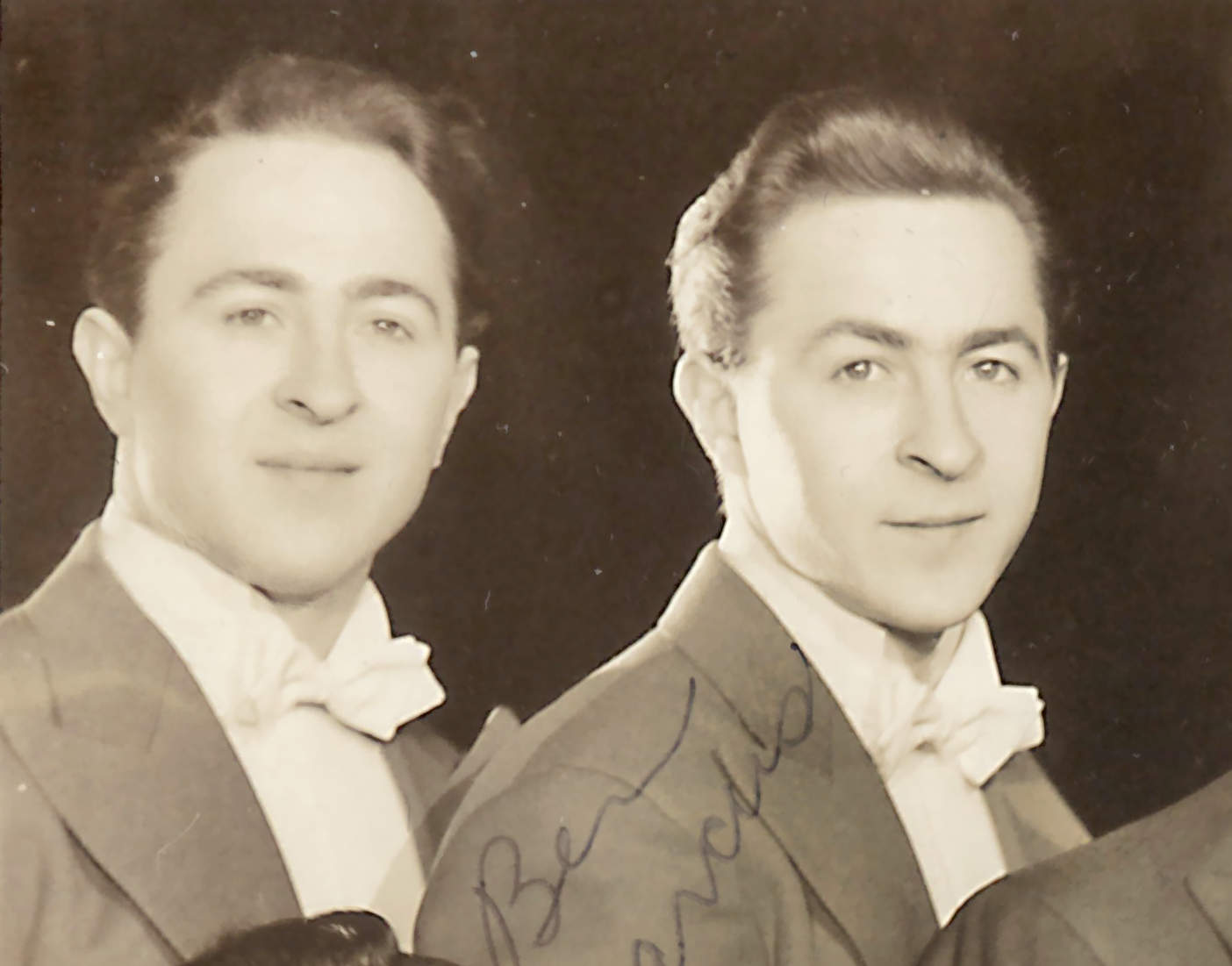
I don't usually collect this type of photograph. The two young saxophonists have beautifully engraved instruments, alto and tenor saxes made by the C. G. Conn Company. They are quite debonair young men with wild wavy hair. But it's still a common 8" x 10" glossy photo that was usually reproduced by the thousands to promote a pop star. Their name printed on the bottom border was unfamiliar. At a casual glance they looked like a pair of sidemen for a big band that probably no one ever heard of.  

But then I spotted their inscription and signatures to Dorothy and Margaret. That attracted my attention and made me curious about their band. These guys certainly looked like identical brothers. What was that all about?


Then I found this next photograph from the same dealer.
Walter and Sol were in it but without their instrument.
They had signed this photo, too,
along with nearly everyone else.
That gave the photos a unique quality
worthy of my collection.

Today I'm going to tell the story 
of Walter and Sol Brudno
featured in
The Beverly Twins and the All Twin Orchestra.


Both photos have the official logo for the band's management agency, MCA – Music Corporation of America. Founded in 1924 as a booking agency by Jules Stein and William R. Goodheart, Jr., by the end of the 1930s this company was the largest talent agency in the world. In addition to musical artists, it represented hundreds of celebrities working on Broadway, in Hollywood, and on radio. From its early years MCA quickly developed an aggressive business model that bought out the competition and expanded into so many other areas of the entertainment industry that it earned a nickname "The Octopus". Today its successor company is Universal Pictures now known as Comcast NBCUniversal. 

But back in the 1930s and 40s the biggest live acts in America were dance bands playing swing  jazz and MCA promoted dozens of big bands, or "orchestras" as they were often called, like those of Xavier Cugat, Gene Krupa, Tommy Dorsey and Kay Kyser. These two photographs were taken at the studio of James J. Kriegsmann (1909–1994), in his day one of the foremost photographers of entertainers in New York City. Photos like his don't come cheap. Someone at the MCA agency thought this unusual ensemble merited a serious investment.   

In February 1941 MCA made a contract to book dates for the Beverly Twin's All Twins Orchestra. Their first major venue was in New York City at the Arcadia "million dollar ballroom" on Broadway and 53rd Street. Entrance was 55¢ for ladies and 65¢ for gentlemen, no extra charge for dancing. And as a special attraction for this band, "All twins admitted free before 9 P. M."


New York City Daily News
26 March 1941

As the MCA publicity machine went to work, the Beverly Twins Orchestra's appearance in New York was reported in newspapers all across the country. Among many hooks that followed the twin concept was their theme song cover of "Exactly Like You" a song from the 1930 Broadway show Lew Leslie's International Revue with music by Jimmy McHugh and lyrics by Dorothy Fields. 

This tune remains a dance band standard and has been recorded many times by different artists, even as recently as 2021. Here's a version recorded in New York on 26 March 1937 for Decca Records and played by the Count Basie Orchestra with Count Basie on piano and Jimmy Rushing doing the vocals. The video has no film or pictures, so press play for some music to listen to as you continue reading the story. 


The Arcadia Ballroom in New York City doesn't seem to have any history online that I could find, so its timeline is unknown. It seems to have opened in the 1920s and was still in operation in the 1950s, but other than that I can't offer much more. It was located right in the heart of Broadway's theater district and is now the site of the Broadway Theatre and just a short walk from the Ed Sullivan Theater. 

But I did find this colorful vintage postcard of the Arcadia ballroom interior which gives an idea of how a band would set up. The description on the back notes that it is "the most spacious dance floor in all New York ... is not obstructed by pillars or posts; air conditioned; new scientific ventilating system assures purity of air at all times."   "Matinee Dansants (sic) Sunday, Wednesday, Saturday, and Holidays."

The postcard was sent on 8 November 1941 by a soldier from Fort Bragg, North Carolina to Miss Edith Butti of Woodside, Long Island.


 Hello Edith                             
 Guess you heard I'm
on maneuvers.  It's a nice place
for beauty.  Hope your feeling fine.
Regards to all.   Harry —       
May be home in a      
month.  

One month latter, America was at war,
so it was probably some time before Harry made it back home. 


The Billboard
19 April 1941

In April 1941 the Beverly Twins' performance at the Arcadia got reviewed in The Billboard, the national magazine for the entertainment industry. The writer uses a lot of showbiz lingo but gives the group a favorable critique noting that: 

    "Twins tootle a very commercial and danceable brand of stuff, and strive to please with a versatile library consisting of can-can congas, pop ballads, swinger-dingers, and waltzes.  Entire ork plays with youthful enthusiasm.  Arrangements, for the most part, are good; and the doubling of two of the sax men on brass, plus another switch of a brass man on sax, gives added flexibility.  At this point, band does its best job on the swing stuff, but some more months together will no doubt round them out.
    "Song department is handled solely by the Beverlys, whose voices are as much alike as their looks.  They do a good straight job on the vocal choruses.  Boys should loosen up more on their dual batoneering to dispel automaton-like impression. Biz of dressing the sets of twins in various colored jackets is smart showmanship, and the same motif is also carried out with the music stands, each bearing the respective color scheme plus the first name of each.  Exploitation possibilities, of course are infinite with an outfit such as this.
    "It's a co-op outfit thruout, each set of look-alikes having a hunk of the ork. Line-up includes, besides the Beverlys, Myron and Harry Robbins on trumpet and trombone;  Russ and Bill Whalen, trumpet and trombone;  Jim and Joe McCarthy, saxes;  Walter and Sol Brudno, saxes;  Rodger and Rodney Harmon, bass and guitar;  and Ben and Sol Marcus, piano and drums."

That last paragraph with the musicians' names was the kind of treasure I often seek but rarely find when doing research on photos in my collection. In this case it corroborated the signatures on the band's photo and, more importantly, identified each man's instrument which was absent in the formal studio photograph of the group.


The Beverly Twins, seated center, Don on the left and Gene on the right, were the duo co-leaders of the All Twins Orchestra band which they themselves originated. According to several reports their idea for a band of twin musicians came about as early as 1934, after they had dropped a notion of becoming Catholic priests. After searching the country for seven years they had supposedly hired the best musical twin brothers for this unique ensemble. 

Jacksonville FL Times-Union
28 June 1941

Gene and Don were identical twins who had won first prize at a New Jersey contest for "most identical twin." They oviously had musical talent but not as instrumentalists. In their orchestra/band they performed as either conductor or as a vocalist and hired a non-twin musician to make their arrangements.

The two Beverlys shared a mutual receding hairline and look older than they actually were. Their birthday was 25 June 1915, so in the winter 1940-41 when they secured a contract with MCA they were only age 25. 

Tracking down that "most identical twin" contest was not too difficult and paid off with a very thorough newspaper report and some photos too. The contest was held on 17 June 1939 in Camden, New Jersey, just across the Delaware River from Philadelphia, by the Camden Courier-Post newspaper. The Beverlys, the two young men "most alike", won a $25 prize and were pictured with a brother-sister duo, Leroy and Dorothy Garmen, who took home a prize for the "least alike twins."


Camden NJ Evening Courier
18 June 1939

The report revealed a lot about the ambitions of the Beverly Twins. Four years earlier they had  formed a band of seven twins, including themselves, but circumstances had forced them to break up the group. They had given up becoming priests and now hoped one day to marry twin sisters. Their latest dream was to get their pilots licenses, buy an airplane, and fly across the Atlantic,  becoming the first twins, if not brothers, to do so. 

But more revealing, but not explained, was that their surname was originally Barcik, not Beverly. They were "the sons of Mr. and Mrs. Andrew Barcik...born in Camden June 25, 1915." Using these very useful clues I determined that their first names, Don and Gene, were not original either. One brother was Andrew Method Barcik and the other Frank Cyrill Barcik. The twins were the youngest of six children of Andrew and Sophie Barcik, who immigrated in 1904 and 1903 respectively from  what was called Czechoslovakia in the 1930 Census. Both spoke Slovak as their native language. Around their home in N. Fourth St. their neighbors spoke German, Romanian, Russian, Polish, and Slovak. Andrew Senior worked as a freight loader at a railroad yard. 

In the 1940 Census the family had moved to Marsden St. in Philadelphia to live with a daughter and her husband. Andrew Senior and his twin sons worked at a butcher shop. However on their draft card, completed in October 1940, both Frank and Andrew Junior put down "Self" for employer .

The Beverly/Barcik brothers claimed to have written some songs and clearly had talent as singers, but no report described them as instrumentalists. How they learned to be suave band leaders in white tie and tails after laboring at a butcher shop was never explained. And I've been unable to discover why they changed their names. Sometimes ambition alone can make its own luck.  


The two saxophonists with the amazing wavy hair, Walter and Sol Brudno, stand on the right in the group photo with their autographs written across their light color tailcoats. They were born on 22 January 1921 in Cleveland, Ohio, so in this photo they are age 20. They were the twin sons of Phillip and Lillian Brudno, both identified as Russian-Jewish immigrants in the 1930 Census. Phillip listed his occupation as an egg dealer. On their draft cards completed in February 1942, both brothers listed no middle name and gave their father's name as their employer.


Standing to the left of the Brudno twins, was Rodney and Roger Harmon, who played bass and guitar in the All-Twin Orchestra. They were from Cincinnati, Ohio where they were born on 21 July 1918 to  Frank and Clara Harmon. In the 1930 census Frank worked as a mail clerk for a railroad and he and his wife also had a daughter and son older than their twins. But like the Beverly/Barcik twins, the Harmon twins had an alternative name. According to their draft cards, completed in October 1941, Rodney was actually Alfred Earl Harmon and his brother was Rodger Clark Harmon. 


The fourth set of twins, seated right in the photo was Russell and Bill Whalen, who played trumpet and trombone. They were from Superior, Wisconsin where they were born on 18 March 1920. They were the sons of Edna and George W. Whalen. George worked as an electrician in Superior, which is located on Lake Superior across the St Louis River from Duluth, Minnesota.   


The Whalen brothers filled out their draft card on 1 July 1941, earlier than the other men, and the form is different with a box for occupation. Both Russell August Whalen and his brother William Robert Whalen listed their occupation as Musician and their employer as The Beverly Twins or Gene and Don Beverly, Music Corp. of America. 


Lowell MA Sun
18 April 1941

On the day of the Beverly Twins' All-Twin Orchestra photo shoot, Mr. Kriegsmann's studio must have stayed pretty busy sorting out the pairs of musicians. In April 1941 the newspaper in Lowell, Massachusetts ran a variation of their group photo. The band's formal outfits were colored-coded, of course, though unfortunately Kriegsmann's camera only recorded sepia tones. Having some of the twins sign their names on the photo was very helpful as otherwise I might never have figured out who was who. The Billboard review proved crucial in making certain I got all their identities straight. However some names still remain hidden.


Seated left of the Beverly twins is Harry and Myron Robbins, who filled out the brass section on trombone and trumpet respectively. In the photo only Myron Robbins signed his name and his brother Harry on the far left did not. My investigation on their names hit the most common obstacle in family research: too many people who share the same name. I tried several methods in both civil records and in newspaper archives and still failed to find a pair of brothers who fit. My best hope was a survey of WW2 draft cards which include date of birth, but none of the dozens of Myrons and Harrys shared the same birthday. Nonetheless I still hope to track them down.


On the back left are Sol and Ben Marcus, part of the rhythm section with Ben on piano and Sol on drums. Only Ben signed his name. Like the Robbins twins, the Marcus twins turned out to have too many duplicates in the archives and I've been unable to properly identify them. Without clues for their hometown or family background they remain partly concealed with a name only. 

The Beverly twins were reported to be active in the International Twins Association. This organization was established by and for twins in 1932 as a way to promote the spiritual, intellectual, and social welfare of twins and multiples throughout the world. I suspect Don/Andrew Gene/Frank used their connection in this social organization to recruit musicians for their orchestra. It's quite likely that none of the twins knew anyone else when they started their first rehearsal. 


Standing left of center are twins who did not add their autographs to the photo. By the process of elimination, they must be Jim and Joe McCarthy, the other two saxophone players in the band. Their names are arguably two of the most common names in America and I didn't expect I would  be able to track them down. But I discovered a photo of the Beverly Twins Orchestra on Flickr that had comments from descendants of both the Harmon twins and the McCarthy twins. One relation wrote that the McCarthy's were from Des Moines, Iowa. That was all I needed.


James Anthony McCarthy and Joseph Thomas McCarthy were born in Des Moines on 2 January 1917. When they registered for the draft in October 1940 they both listed the "Beverly Twins" as their employer located at the same Marsden St. address in Philadelphia which Andrew and Frank Barcik  listed as their home. Both cards for the McCarthy twins also had a penciled address added on 8/5/1941 of the "Hotel Roosevelt, Jacksonville, Florida."  

The dates suggest that the Beverly twins were working on their idea of this new all-twin band at least from the fall of 1940, maybe earlier. Putting together a band of any kind, much less one restricted to identical twins, requires careful recruitment to get good talent. Don and Gene must have traveled a lot to audition all these musicians and probably even more for those that didn't measure up.


Jacksonville FL Times-Union
18 August 1941

After the Beverly Twins Orchestra had played New York for a few weeks and polished up their  show they were sent out on concert tour. The MCA agency booked them in dancehall parks in Dayton, Ohio; Hershey, Pennsylvania; Patterson, New Jersey and possibly a few other smaller venues in between. By July 1941 they were on the bill of the Hotel Roosevelt in Jacksonville, Florida. Written on the back of both my photos of the All-Twin Orchestra and the Brudno brothers is "1941 Roosevelt Hotel."

Originally named the Carling Hotel, this 13 story deluxe hotel opened in 1926 and was described as: "300 rooms with bath, running ice water, fans and the latest equipment in the rooms. The three lower stories are faced with Indiana limestone above which is a shaft of red brick. The upper stories are trimmed with terra-cotta, and surmounted by a balustrade with limestone coping. The building is of completely fireproof construction." That last claim would get challenged a few decades later. 

In 1936 the name was changed to Hotel Roosevelt and it became a popular lodging with visitors to Jacksonville which was then the principal gateway to Florida's resorts. No doubt the Beverly Twins Orchestra traveled there by train as did most people in the decades before the interstate roadways were built in the 1960s. However playing a concert in Jacksonville in July was literally a hot date, as in this era it was the mild winters without snow that brought northern tourists to Florida, not the sweltering summer sunshine.  Fortunately the Hotel Roosevelt dance patio was indoors with air conditioning. 


Jacksonville FL Times-Union
9 July 1941

The Beverly Twins really pushed the novelty of their all-twins orchestra. One of the reasons each pair wore formal suits in same color was that during their show each twin would switch instruments making the audience guess who was who. In New York, and probably for other shows, admission was advertised as free for twins. During their two weeks at the Arcadia ballroom it was reported that 350 sets of twins came to see them play. And in Jacksonville they added a Twin Contest, open to all. This was the event that the Hannon twins, Dorothy and Margaret entered when they caught the eye of the Brudno brothers. 


Jacksonville FL Times-Union
11 July 1941

I couldn't find a report of who won the contest for most identical twin, but judging from the Hannon twins' graduation picture in the Jacksonville newspaper they look hard to beat. I wonder if Dorothy and Margaret wore their caps and gowns for the contest. Even in the grainy scan the sisters have winning smiles. 


Providence RI Evening Bulletin
12 August 1941

In August 1941, the Beverly Twins Orchestra got a big break when they were invited to play on a popular Sunday evening radio show, The Bandwagon, over NBC Radio's Red Network. The location of their half-hour concert is not clear, but I think it's possible it was picked up from the Hotel Roosevelt in Jacksonville. For Don and Gene Beverly this must have been a fantastic prize, bigger even than winning a "most identical twin" contest. 

But their showbiz success was marred by a new concern which was affecting every young man in America in the summer of 1941. It was the military draft. This law, the Selective Training and Service Act, signed by President Roosevelt on September 16, 1940, started the first peacetime conscription in the history of the United States. It required all men between 21 and 35 to register with the Selective Service System. After the German army had defeated French and British forces in Hitler's invasion of France in the summer of 1940, America was reluctantly realizing that it would soon need to join the war against European fascism. In August 1941 many men were already being called up for basic training. This was an obligation of 12 months military service, which by October was to be extended by another 18 months. 

The Beverly brothers believed their band faced a very difficult hardship should one or more of their musicians, including themselves, be called up. Replacing twins was not easy. They decided to apply for a deferment for the band, and it seems from the publicity that they were supported by the MCA agency. This concern was shared by many groups in the entertainment industry, from orchestras to circuses, who recognized that their acts would be in serious jeopardy if they lost team members with special talents and skills.  

Whether the Beverlys were ever granted a deferment was not reported in the newspapers, and by December 7th, 1941 with the Japanese attack on Pearl Harbor, Americans suddenly had far more important things to think about. The All-Twins Orchestra seems to have played their last show in early September 1941 and then disbanded. In the 31 January 1942 edition of Billboard magazine it was noted that many dance bands like that of the Dorsey brothers (not twins) were losing their sidemen. "The Beverly Twins' orchestra, composed of seven sets of twins, has already been wrecked, with seven of the 14 now in the armed forces." Even band leaders were close to being called up. 

By the winter of 1941-42, all the twins returned to their hometowns, scattered around the country. Most, if not all, (since I don't know the full history for two of the seven twins) would enter military service for the duration of the war. Again I am not certain, but I believe, that all of the men completed their duty without harm and with an honorable discharge. Whether any of them pursued a music career after 1945 is unknown. I do know that the Beverly/Barcik brothers returned to their original names and chose different paths in life. I don't think they ever got to fly an airplane across the Atlantic Ocean. But for a few months in 1941 they and six other talented twin brothers got to have double the fun playing music. 


One of the consequences of the war for America's entertainment industry was the dramatic change in the public's taste for popular music. Dance bands like the Beverly Twins' Orchestra did not disappear entirely after 1945 but swing music now competed with a much wider variety of music styles that included jazz, blues, western, country, and soon rock & roll. The competition for the public's ear was fierce, and was now largely driven by Americans listening to music through recordings and radio broadcasts instead of at live concerts. When a radio broadcast allowed young people in Nebraska to hear the latest club music from New York, Chicago, or Los Angeles just by turning a dial on their radio set, their enthusiasm for live music naturally was diminished a bit. By the 1950s the novelty of seeing seven sets of twins perform music of the 1930s had worn off. As the music and songs changed everyone began dancing to the beat of a new and different drummer. 


  Footnote:  

On the morning of 29 December 1963 a fire broke out in the Hotel Roosevelt, supposedly a fireproof structure. Some time before, during renovations to the hotel, its ballroom's old wooden ceiling, which had been deemed a fire hazard, was covered with a new ceiling without removing the old one. An electrical fault sparked a fire there which quickly spread through the building. Though many people were rescued, some saved from the rooftop by the use of Navy helicopters, 22 people perished in the fire, mostly from carbon monoxide poisoning. It became the worst disaster in the city of Jacksonville's history. While I can't be certain, I believe the ballroom was the same danceroom where the Beverly Twins' Orchestra played in 1941. 


This is my contribution to Sepia Saturday
where sometimes one pair will beat a full house.


Music for an Aeroplane

10 September 2022


It was a modern age of wonder.
Things once impossible were now ordinary.
People flew across the sky in powerful machines.
The sound of voices and music traveled over invisible air waves.
Mankind attained an incredible new perspective
with the invention of airplanes and radio.
It didn't take long before
someone imagined combining the two.

How about a music concert
inside an airplane moving faster than a locomotive
and broadcast live over the radio?
How cool would that be?


This large 8" x 10" photograph shows about 16 musicians, dressed in winter overcoats and hats, crowding onto a precarious wooden stairway to board a large airplane, all while playing their instruments—accordion, guitars, trumpets, trombone, saxophones, double bass, and drums. They seem to be directing their attention to a man standing underneath the airplane which is marked Heracles, Imperial Airways. 

The back of the photo provides an explanation along with useful names, date, and place.


JACK HYLTON"S BAND BROADCASTS
FROM AN AEROPLANE                            15.12.33.
 
   Jack Hylton and his famous band played up in an aeroplane over
London today, and the programme was picked up by the Post Office
receiving station at Baldock, Herfordshire, and sent from there
by land line to Faraday House, and then to the Post Office
Exhibition in the Strand, London.  This musical experiment was to
test a new Post Office transmission apparatus.
O.P.S.     Jack Hylton and his band entering the air liner
               at Croydon.
                    HHS/S Keystone.


The photo was distributed by the Keystone View Company of Fleet Street in London. The band's comical pose boarding the aircraft was to promote their special radio broadcast for the B.B.C. This show would use a new wireless system that would transmit a live music concert over the radio airways as the musicians were literally traveling through the air. This press photo of the event ran in several British newspapers over the next few weeks. The man standing left was the band's leader, Jack Hylton. He and his orchestra were used to attracting attention as they were then one of the most poplar music groups in Britain.
 
 
London Daily Telegraph
15 December 1933


Jack Hylton (1892-1965)
Source: Wikipedia

Jack Hylton, born John Greenhalgh Hilton in 1892, was an English pianist, composer, band leader and impresario whose music became popular in Britain during the 1920s and 30s. He developed a light high society dance music that combined elements of popular songs with a British interpretation of American swing jazz. In 1930 it was estimated that of the 50 million records sold in the UK in the previous year, 1929, between 4 and 5 million discs were recorded by Jack Hylton and his orchestra.
 
By 1933 his orchestra had already made several successful tours of Britain and Europe and were recognized for their recordings and live radio broadcasts, mainly over the British Broadcasting Corporation, the BBC, which established Great Britain's first national radio network in 1922.


Handley Page H.P.45 'Heracles'
Source: ipernity.com

The aeroplane that they were embarking on was named Heracles, a Handley Page H.P.42/45, manufactured by the British aviation company Handley Page specifically for Imperial Airways, one of the first commercial long-range airlines that operated from 1924 to 1939. When this bi-plane aircraft was introduced in 1931, it set a record in its first years of service as being the largest airliner in the world with a wingspan of 130 ft (40m) and a length of 92 ft (28m). It was designed to carry 24 passengers with a crew of 4. Each of the four  9-cylinder air-cooled radial piston engines generated 490 hp which was sufficient for the Heracles to reach a maximum speed of 120 mph and a cruising speed of 100mph. Only eight H.P.42/45 airliners were ever built, with the model HP42 designed to carry lighter loads over longer distance to places like Egypt or India, and the HP45, which was the Heracles model, modified for heavier cargo over shorter distances in Britain and Europe.
 
 
Kingston ONT Whig-Standard
11 January 1934

This aeroplane stunt was successful but did not attract much interest in America, perhaps because Jack Hylton and his orchestra had not yet toured there. However Canadian newspapers picked it up and reported a few more details. 
 
The flight lasted about an hour and a half and the live concert was devised as a test of a new type of radio apparatus for the General Post Office which was then in charge of Britain's radio system. Every member of Jack Hylton's band took part except the pianist and the harpist–whose instruments were too big for the plane–and the flutist. whose flute was broken just before the band left Croydon airport.  The main tune they played was "I'm on the Telephone Now."
 
 
* *

 
The interior of the Heracles aeroplane was clearly not very spacious and Jack Hylton's musicians must have felt cramped to play their instruments during the flight, not to mention suffering with the engine and wind noise. Nevertheless Jack Hylton and his orchestra performed at their scheduled time and were heard over a few radio stations around London. The photo gives us a sense of scale of this adventure but not of the music. But fortunately there was a movie camera filming the action for a British Pathé newsreel short, On The Air - In The Air! With Jack Hylton And His Band and through the magic of YouTube we can watch and listen to this historic occasion.
 
 
***


***
 
 
As I was searching for newspaper accounts of this 1933 BBC concert, I happened upon an article that mentioned an earlier radio concert from the air that was attempted in November 1925.
 
 
London Weekly Dispatch
8 November 1925

This concert would involve male and female vocalists from London's theatres accompanied by a small ensemble, the Savoy Orpheans. They would be flying at 10,000 feet in another earlier Imperial Airways airliner, a Vickers Vanguard Type 170. 


Vickers Type 170 Vanguard, circa 1924
Source: The Internets

This aircraft was also a double wing design developed towards the end of World War 1. It had a wingspan of 87 ft (27m) and length of 54ft (16.5m). It was powered by two Rolls-Royce Condor III water-cooled V12 engines, each capable of 650 hp. The Vanguard had a maximum speed of 112 mph and could reach an altitude of 16,400 ft (5,000 m). Like the Heracles, the passenger cabin was enclosed, but the pilot's cockpit was open. It could carry 22 passengers with a 2 man crew. This airliner was originally planned for service between London and Paris, but later included a route to Brussels and Cologne.\

 
Leicester Mercury
10 November 1925

The "concert from the air" was scheduled for 6:45 on 10 November 1925, following a short performance of the Royal Air Force Band at 6:05, a talk by Capt. Douglas Sinclair from the Air Ministry on the civil aviation wireless system, as well as a demonstration of "direction finding from an aeroplane." The concert was supposed to last 15 minutes. The date was important as this was the evening before the seventh anniversary of the end of the Great War. The Prince of Wales would be giving a special Armistice Day message and there was music from several military bands.
 
Unfortunately heavy ground fog in London forced a cancellation and the concert was rescheduled for a few days later. The details were reported in the 25 November 1925 edition of Wireless World, a weekly magazine for British radio enthusiasts. This journal was in its 13th year of publication and rivals the geekiest magazines of our computer age, as it was filled with articles like "Measuring Anode Potential" and "Thermionic Rectifier for Battery Charging"; detailed comparisons of radio tubes and crystal sets; and countless mathematical formulas, graphs, and wiring diagrams.
 

Wireless World
25 November 1925

On page 737, Capt. A. G. D. West described how this was not the first broadcast made from an aeroplane, as two previous wireless transmissions had been made while in flight. But those had been microphones picking up only speech. This exercise was attempting to broadcast music at nearly studio quality level. 

The first tests of the in-flight radio equipment had to overcome the issue of electrical power, so a wind-driven generator supplying 1,500 volts was installed on the aircraft. This introduced another problem because noise from the aeroplane's engines interfered with the sound from the musicians. Situated on either side of the fuselage the big Rolls-Royce engines  were so loud that voices had to be just inches from the microphone to be audible. This issue was tolerable if the engine power was reduced and the plane "glided", but that diminished the air speed, thereby lowering the voltage output of the generator below what was needed for the radio transmitter. Engineers found a solution by finding a place in the cabin for a separate electric motor generator powered by large batteries. 
 
Wireless World, vol. XVII, no. 22, p. 738
25 November 1925


The final plan was to take the Vanguard up to 10,00 feet, cut down the engines to one third maximum speed, and use the other generator to run the radio transmitter as the plane descended. Considering that the aeroplane would be carrying 20 people, a piano, other musical instruments, and all the heavy equipment for the radio equipment, the scheme limited the concert to only about 15 minutes duration before the pilot would have to return the engines to full power. 
 
I'll let Capt. West finish the story.
 
 
"Arrangements were made that during the concert the various artists and musicians should be as close as possible to the microphones. One microphone dealt with the orchestra , the other one with the artists and the piano. The various parts were balanced up as far as could be done.

It is interesting to note that during the concert in the air it was impossible for any one else to hear actually what the announcer was saying or to hear the artists singing. Mr. Yearsley, of Messrs. Dix, Ltd., who provided the artists for the transmission, kept time throughout by signs; even the musicians themselves heard no other instrument but their own. It was really astonishing that under these circumstances any music at all was received at Keston and re-transmitted; but it was received well, and what was more, the engineers at Keston even sent it on to London in a better condition than they received it, as by the careful use of a form of a filter circuit, they were able to cut out a good deal of the engine noise and thus to purify the music that they received... Listeners on the ground had a much better idea of the music that was going on inside the machine than anybody actually there. It was therefore surprising that the re-transmission was so good."


Though the broadcast in 1925 did prove that music could be made in the air, I don't know if the BBC ever tried another "concert from the air" before repeating the concept with Jack Hylton and his orchestra in December 1933. The two aeroplanes were similar enough in cabin features that I think the in-flight entertainment was equally challenging for performers and radio audience to hear.
 
Both musical flights were genuine experiments in radio technology and aviation that revealed a number of problems and obstacles that would require many years, if not decades, to overcome. I don't believe these "concert from the air" were really expected to generate ticket sales for Imperial Airways or wireless radio sales for the BBC. But they did introduce a new perspective for the world that continues into our modern times whenever we take our seat on a 747, buckle up, plug in our earbuds and switch on the in-flight entertainment video screen to search for something to distract us for a few hours.
 
 
* * *


I can't resist including one last video of the Heracles, Imperial Airways Handley Page H.P.45  preparing for flight operations at Croydon Airport in about 1935. Looking at this ungainly two-wing airliner from the vantage point of 2022 leaves me wondering if I would have had sufficient courage to climb on board the Heracles to play a concert in the air. At the very least I would have demanded double pay. Those were some brave musicians back in the day.
 
***


***


 This is my contribution to Sepia Saturday
where the conductor will always hold the bus.


The Novelty Dance Band

09 April 2022


 Let's talk pompoms.
Are they really a good look for men's fashion?


And what about frilly collars?
Didn't that fad disappear in the 18th century?


  Shiny satin may have a place
in dressing gowns and pajamas,
but it's a bit over-the-top
for a business suit.


These are the kind of apparel decisions
everyone in show business has to consider.
Sometimes an entertainer has to set aside
personal objections and dress for the part,
because the more flamboyant a costume
the more attention they'll get from an audience.

At least that's the idea.
 
Today I present two photos
of a novelty dance band that may have made
a poor choice in their concert wardrobe.


Dressed in pillbox hats and satin pajamas festooned with pompoms, five young men sit with their instruments in a large empty room as if waiting for an audition or dental appointment. The ensemble consists of a pianist, an alto saxophonist doubling on clarinet, a cornet player, a trombonist, and a drummer. Painted in large letters on the trap set's bass drumhead is the group's name:
 
 Ohio 5

Conveniently it's also written again on the back of the large 8"x 10" photo, along with the musician's  names, the place, and a date. It's a trifecta of useful information to find on any antique photograph, and in this case it happens to be on a photo from exactly a century ago.


" Ohio Five"
    Reading from left to right:    Forest Ulery,
Troy, Herbert Ginn, Georgia, Lloyd Smith, Covington,
Charles Patty, Troy, Arthus Wesler, Tippicanoe City

Roseburg, Oregon
Feb. 1st, 1922
"Ohio Five"

Ren to Mrs. Weieman
Troy, O


Roseburg OR News-Review
31 January 1922
 
 
The phrase "Ohio Five" was surprisingly common in newspapers in the 1920s as a shorthand for team sports like basketball and bowling. But fortunately it was not used much in Oregon, so it was easy to spot an advertisement in the Roseburg News-Review for a "Big Dance given by Ohio Five Novelty Orchestra" to be held at the Elks' Hall in Roseburg on February 1st, 1922. It was "A real dance with real music from the East. gorgeously costumed. Admission $1.10, inc. tax, Ladies free."
 
 
It's not very often that I can find such a perfect confirmation of the notes on a photo, so it's very likely that the photo of the Ohio Five was taken at the Elks' Hall in Roseburg.
 
_ _


In the previous week the group had played 100 miles  south of Roseburg in the communities around Medford, Oregon. The newspaper there reported that the Ohio Five had been on the road for seven months and were on the return leg to their native state by way of the northern route after having visited Honolulu and the southern states. However in mid-December 1921 they were still in Ohio playing at a Moose Lodge in Coshocton, Ohio. Tickets there were $1.10 a couple, 40¢ for an extra lady.

Roseburg is a small town in the heart of Oregon's Umpqua River valley. In 1920 its population was about 4,300 and its main industry was lumber production. There were only a very few notices to be found in the newspaper archives for the Ohio Five, and those were only in similar small towns in Oregon and Ohio. While it's possible they played a long concert tour traveling south and west from Ohio, even to Hawaii, in 1921-22, evidently they didn't attract much publicity.


The second photo shows the five musicians of the Ohio Five in a very different pose, a rare musical action shot on a small indoor bandstand. Each player strikes an animated posture with their instrument as if the band was really wailing away. It's easy to imagine the pompoms shaking to the beat. Above them the ceiling is decorated with hanging oriental fabrics and ribbon streamers. It's a cut-down photo, probably originally 8"x10" like the first photo, and there is nothing written on the back, but I presume it was taken by the same photographer in Roseburg or possibly somewhere in southern Oregon. 

The names of the Ohio Five were written in pencil with a wide cursive style that made figuring out their surnames into a kind of genealogist's Wordle puzzle. But the addition of each musician's hometown added an important clue that let me find all of them in the archives of Ancestry.com. Surprisingly all five men had their family tree information recorded by a descendant on the website so that I could quickly check the full history of each one. Following the photo's annotation here is the Ohio Five left to right.
  1. The drummer was Forest (Stahl) Ulery. Born in September 1901 in Ohio, he would have been age 20 in the band's photo. In the 1920 census for Troy, Ohio he worked as a clerk in a factory. In the photos there is a large xylophone next to or behind the drum set, which is an instrument typically played only by a versatile percussionist. Ulery died in 1972.
  2. The trombone player was Herbert (Clark) Ginn. A native of Georgia, he was born in April 1897 and was the oldest of the group at age 24. In the 1920 census for Atlanta, Herbert listed his occupation as "Musician/Theater". A few years later in 1928 he lived in Memphis, Tennessee working as a musician at the Lowes Theater. Ginn died in 1972
  3. The cornet player was Lloyd (William) Smith. He was born in Ohio in August 1900 so in the photo is still 21 years old. In the 1920 census for Covington, Ohio, ten mile northwest of Troy,  Lloyd's occupation was "Musician/Band". Twenty-two years later on his 1942 draft card the line for employer's address read "unemployed musician". Smith died in 1944 in New York. 
  4. The reed player was Charles (George) Patty. Also born in Ohio, his birthday was 3 February 1903 so he was the youngest musician and would celebrate his 19th birthday only a couple days after the band's photo was taken. In the 1920 census for Monroe, Ohio, 45 miles south of Troy, Charles was only sixteen and had no occupation, but in the 1930 census for West Milton, Ohio where he lived ten miles east of Troy, his occupation was "Musician/Band Orchestra" and again for the 1940 census too. On his draft card his employer was the Colonial Theater in Dayton. Patty died in 1977.
  5. The pianist was Arthur (Woodson) Wesler, who was born in Ohio in May 1898 and was still age 23 when the photos were made. Like Charles Patty, he lived in Monroe, Ohio in 1920 and was employed in the sales department of the Electric Co. His sister, Hazel Patty, worked as a ticket seller for a movie theater, so it's possible he might have worked as an accompanist for silent films, but he seems to have chosen more traditional, and probably more reliable, employment for his life. Wesler died in 1985.

All the men were single when the Ohio Five went on tour in 1922, but with the exception of Lloyd Smith who remained a bachelor until his death in 1944, all soon took wives and started families in the following years. It's interesting to learn that three members of the group made their livelihood in music, though we don't know if it was in the same kind of ensemble. As best as I can determine, the Ohio Five Novelty Orchestra did not remain together beyond 1922. And whether any of the group continued in another similar band is unknown. 
 
These two photos may be all that remains of the Ohio Five's showbiz history, but I like to imagine that somewhere, hidden in an old trunk at the back of an attic or closet is a satin tunic and pillbox hat with fuzzy pompoms.


Elks Lodge, Roseburg, OR
Source: Google Maps, 2018

A century later the Elks Hall in Roseburg, Oregon where the photo of the Ohio Five was taken still stands. It appears in the street view on Google Maps and shows the Elks sign hanging on a gray-painted building. The plywood covered windows give a closed appearance but on the side-street they advertise bingo games every Tuesday, and the hall is available for banquets and receptions with the "Largest Dance Floor in Town". 


Elks Lodge, Roseburg, OR
Source: Google Maps, 2018


I've written two other stories about similar photos of small dance bands. The Bell Hop Orchestra wore equally nutty costumes and hats. And All That Jazz is my fictionalized short story about how a studio photo was made of a similar quintet of young "wild and crazy" guys. Like most of the photos in my collection the biggest mystery is what kind of music did they play? What kind of dance tunes did the Ohio Five Novelty Orchestra perform at the Elks Hall in Roseburg?  With those pompom costumes, not, I think, waltzes and polkas.
 
The answer may be hidden in subtle clues from the exuberant photo posed on the bandstand and also in the band's instrumentation. Discarding their satin pajamas, the group looks very like another quintet that was then shaking the whole world of music. 

They were called the Original Dixieland "Jass" Band.


The Original Dixie "Jass" Band
Source: The Internet

The history of American music is filled with many monarchs, from the March King, John Philip Sousa, to the King of Rock & Roll, Elvis Presley.  But many consider the first royalty of jazz to be the five men who played in the Original Dixieland "Jass" Band. This group from New Orleans made the first commercial recording of jazz music in 1917 and helped establish jazz, or "jass" as it was first spelled, as a new American musical idiom.
 
The original members were Nick LaRocca, cornet and band leader; Eddie Edwards, trombone; Larry Shields, clarinet; Henry Ragas, piano; and Tony Sbarbaro, drums. Unlike other vaudeville bands, the ODJB played for dances, and their early recordings introduced America to syncopated rhythms and catchy tunes that got everyone moving their feet. They didn't necessarily invent "Jazz" but they took it beyond its roots in minstrel and ragtime music, and made it a popular and commercial success. It's a story that deserves wider telling, but what interests me is their photos and instruments.


The Original Dixie "Jazz" Band
Source: The Internet

Like any group of entertainers, the Original Dixie Jass Band made numerous promotional photographs and postcards. These images look very like the photos of the Ohio Five. The quintet instrumentation is also nearly the same too. But it is this next photo of the ODJB with their instruments in kooky action that makes me believe that the Ohio Five were imitating them and playing dixieland jazz tunes too. 


The Original Dixieland "Jass" Band
Source: The Internet

In the post-WW1 era of the 1920s, dance music was a new craze sweeping the country and it was fueled in part by jazz music. The American public wanted fresh upbeat music that was lively and fun. Just like the Original Dixie Jass Band, I think the Ohio Five were offering the people of rural Oregon their interpretation of that same kind of novelty sound.


Here is the Dixie Jass Band One Step
recorded in 1917 by the Original Dixieland "Jass" Band.
 
As you listen to this go look at the photos of the Ohio Five
and imagine the flash of satin and pompoms.
But was it the best costume decision?


# # #


# # #


Coda: 

The photo of the Ohio Five
had one other name written to one side,
Mrs. Weisman of Troy, Ohio.

She was Willie May (Billie) Weisman,
a newspaper reporter
and editor of the Troy Record.
Maybe the Ohio Five got their picture in the paper too.


Obituary for Willie May (Billie) Weisman
16 April 1952


This is my contribution to Sepia Saturday
where everyone is under the boardwalk
dancing on the beach!


nolitbx

  © Blogger template Shush by Ourblogtemplates.com 2009

Back to TOP