This is a blog about music, photography, history, and culture.
These are photographs from my collection that tell a story about lost time and forgotten music.

Mike Brubaker
{ Click on the image to expand the photo }
Showing posts with label accordion. Show all posts

Five Family Orchestras

14 March 2026


An orchestra doesn't really need 100 musicians to call itself an orchestra. In past times five would do. In this case two violins, cello, double bass, and a pump organ make up a family orchestra of a husband and wife, and their two daughters and son. On the side is a caption in German:

Musikdirektor Edmund Link
mit seinem unübertreffbaren Künstler-Familien-Orchester
Inhaber des gesetzlichen Kunstscheines  

~
Music director Edmund Link
with his unsurpassed Family Artist Orchestra
Holder of the Official Artist's License 

The photo has a personal quality, almost like a Christmas family picture to send to friends and relations. Notice that the young violinist stands on a small box to balance her height in the grouping. But this photo was clearly designed to market the family as concert artists. To what degree they succeeded is unknown, but the parents seem duly proud of their talented offspring. 

The postcard was sent from Görlitz, Germany on 26 October 1913 to Herrn Hermann Raschig of Cottbus. It's odd how the message and address are arranged on the proper sides of the divided back but are flipped so the address is on the left. Perhaps the writer was a bit dyslexic?  


* * *


In this postcard a similar group of five pose in a photographer's studio set pretending to be a home salon. Here the mother is missing but father plays cello as two daughters play flute and piano, his son plays violin, and the youngest daughter, around age five, plays a triangle. The caption reads in German:

Capelle Wolf – Gasthof "Drei Königen", Herisau (Telephon 245) 
~
Wolf Band – "Three Kings" Inn, Herisau

Here the father leads not from the treble but from the bass line. His children are younger, the oldest girl on piano might be 14. The flutist sister and violinist brother are clearly not in their teens yet. And of course the littlest sister is assigned the easiest instrument which still requires strong confidence to ring it at just the right moment. 

Kapelle is a German word used confusingly for both a chapel and a band/orchestra. Here is it spelled with a C as this is a Swiss-German family band. Herisau is the capital of the canton of Appenzell Ausserrhoden in Switzerland, a very small country with four official languages: German (62%), French (23%), Italian (8%), Romansh (0.5%).   This postcard was sent on an unknown date from a Swiss army base to a young woman in Thusis, Switzerland, a small town 90 miles south of Herisau, deep into the Alps following the Rhine river to one of its tributaries.


* * *


In my third family orchestra we see another quintet with father and mother and three daughters, though one is much older than the other two and might be an aunt or cousin. In the card's caption they called themselves:

Familie Heinrich.  

The daughters play cello and violins and father, who sports an impressive beard, holds a blackwood flute. His wife sits center with her hands resting on a few books, presumably music. She doesn't hold an instrument but next to the cello is a large folk harp which may be her musical specialty. It's another charming family scene demonstrating music culture if not novelty entertainment. Their postcard is typical of thousands of other souvenir cards produced for small ensembles like this during the time of the German and Austrian empires. I expect they performed light music at cafes, restaurants, and hotels which appealed to a respectable clientele, the opposite of the boisterous patrons of music theaters and beer halls.

This card was never posted but the back has the printed name of the photographer, Arthur Eckerlein of  Lindau im Bodensee, a major town on the eastern side of Lake Constance (Bodensee in German) in Bavaria, Germany. It's actually not far from Herisau, Switzerland, just 38 miles around the southern bowl of the lake.

* * *


This next family orchestra is another string quintet with two violins, cello, contraguitar, and a German type of button accordion. They are identified by the caption on their postcard as:
Familie Röttig
Singspiel und Possen Ensemble und Schrammel Quintet
~
Musical and farce-ensemble and schrammel quintet 

Mother, seated center, holds a contraguitar, also known as a Schrammel guitar, which is a type of harp guitar with two necks and extra strings. It was developed in Vienna in the mid-19th century and is associated with the light music of Viennese cafes and wine gardens.  The squeezebox played by her husband, is, I believe, a Chemnitzer concertina. This instrument originated in Saxony and became popular in polka bands. The father and his son on violin, both wear dark but not-too-formal suits, while mother and her two daughters wear dresses and shawls embellished with colorful folk patterns. Their address under the caption was in Komotau, Bohemia which is now known as Chomutov, Czechia. So they probably had a few polkas in their repertoire. 

This card has a 5 heller Austrian stamp of Kaiser Franz Joseph and the postmark date looks to be 31 January 1911. It was sent to someone in Berlin.


* * *


My last family orchestra are certainly the largest with an octet of 8 family members and are perhaps the most colorful and exotic. They called themselves: 

Künster-Familien-Ensemble "de Espania Aida"
mit dem kleinsten Kappelmeister Carlos
~
The Artist Family Ensemble ""the Spanish Aida"
featuring the youngest conductor, Carlos.

Father and mother stand at the back with their eldest son who holds a violin. Two daughters, twins I think, sit in front of their father and play violin and mandolin. In the center is the youngest, a girl wearing a top hat and holding drum sticks, I think. Beside her is an older son on cello. And on the far left is young Carlos on violin. A Kappelmeister is a German word for the principal violinist or concertmaster of an orchestra.

Their outfits pass for a kind of flashy Spanish costumes with all the men wearing silly double-eared montera hats like a toreador would wear. The women wear heavy embroidered short-sleeved jackets. The printer has gone to extra expense to colorize the fabrics in yellow, red, and a faded blue. The lower caption claims this ensemble performed music, songs, dances, and farces, which I interpret as humorous skits. The "Spanish Aida" may not be their real name, since their contact address was in Cöln, now spelt as Köln or Cologne, Germany. 

This group resembles more of a music hall act, i.e. "vaudeville". Their costumes are clearly a theatrical dress which suggests they played Spanish or Italian music, maybe opera too, rather than Germanic folk tunes. There are dozens of other ensembles in my collection that claimed to have the world's youngest or smallest bandleader. It was a common showbiz embellishment.

This postcard was never mailed but "Prosit Neujahr" ~ "Cheers, New Year" is printed on the back. It included a year but someone scratched it out. Maybe 1908 which seems about right for this type of card.  

String instruments are not very loud compared to brass instruments. These "orchestras" played a different repertoire from brass bands. They did not march in parades or play ceremonial fanfares. Their music was quiet and refined, a cultured sound that charmed with the talent of the children. 

As I have noted in my previous stories on family bands, the shelf life for these ensembles was very short since inevitably children always grow up and eventually are no longer cute. However in the time before World War One musical families were once very common, especially in Central Europe. It offered enterprising parents a way to make some money as entertainers while training their children in a respectable trade. And they made a lot of grandparents smile.  


This my contribution to Sepia Saturday
where families are on the march for March.


Music with Guitar

22 February 2025

 
In the age before electric amplification the guitar was a relatively quiet instrument. It provided useful chords to accompany a melody sung by a vocalist or played on an agile treble instrument but guitarists were never the front man in an ensemble. They usually sat at the side strumming along to keep the music moving. The placement of a guitar in this trio is typical. The two lead musicians play a mandolin and a zither, a string instrument played flat on a table which helps amplify its sound. The group had other instruments to add color: a violin, likely played by the mandolinist as it has the same string tuning; a wooden folk xylophone called a Strohfiedel or Straw Fiddle; and a collection of wine glasses improbably standing on a near vertical tray. They were tuned by filling with water (or even spirits) so that they vibrated at different pitches when stroked by the player's fingertips. There is one more instrument if you look carefully. As a clue, it is from the percussion family.

This unknown trio were photographed seated outdoors, possibly at the wine garden where they performed,  by a photographer from Dresden, Germany. Their colorful bow ties and satin trimmed coat collars are typical of professional musicians in the 1900s. The postcard was sent from Dresden (Altstadt), on 18 April 1910 to someone in Breslau, Germany which is now known as Wrocław, Poland. The handwriting is a peculiarly neat penmanship with completely indecipherable cursive letters that run together. Take a look at the third line — mnmnmnnm.Who could translate that? I believe the writer was the guitar player as he is marked with a discrete X. His signature looks like M. (or W.) Lappitsch.


* * *


Sometimes a guitar defines a group's style even though it isn't the lead instrument. These four young ladies are the Original Damen Schrammel Quartett from the "Jankowski" Kozert Ensemble. The guitarist here plays a contraguitar called a Schrammel guitar which is an instrument associated with the light folk music of Wien or Vienna, Austria. In addition to the standard six strings the Schrammel guitar has a second, fretless neck supporting as many as nine bass strings that are tuned to a scale. This player accompanies two violinists and a button accordionist as they sit in a photographer's studio, but they very likely performed at a wine garden like the previous trio. 

The postcard has no postmark or date but is addressed to someone in Wilhelmsburg on the the Elbe river, a district of Hamburg. There is a faint imprint of a variety theater named Hohenziller(?). The card was printed in Leipzig, Germany probably in around 1910. 


* * *


My last guitar photo is unusual as the guitarist is seated front and center of the ensemble. In this case it is a brass quintet with rotary valve instruments in five different different sizes, left to right: baritone horn, alto horn, bass tuba, tenor trumpet, and soprano trumpet. Needless to say, a brass band really has  no use for a guitarist, especially one with a guitar that looks a bit smaller than a standard modern acoustic guitar. Another odd thing is a small fir tree behind the tall trumpet player on the right. Perhaps this group is playing for the Christmas season. 

The photographer left an imprint on the back of this unposted postcard, R. Fuchs of Kurort Wörishofen. This place was a Kurort or "cure resort" in Bad Wörishofen, a spa town in Bavaria, Germany that is known for a water-cure or hydrotherapy developed by Sebastian Kneipp (1821–1897), a Catholic priest who once lived there. Many of the town's hotels and boarding-houses still offer their guests treatment using Kneipp's methods. 

I wonder if the guitarist is a spa guest who has joined with the health resort's band for a souvenir photo. He is neatly dressed in a nice suit with a small corsage in the lapel and some of the musicians have one too. Maybe he is a bridegroom celebrating his wedding day. But what amuses me is that the man's shoes are polished while the brass players' shoes could use a good cleaning. Evidently this guitarist did not march in any parade.


Did you spot the triangle in the first trio?


Since I don't often feature photos
of musical wine glasses, i.e. a glass harp,
here is a demonstration of one  by Anna Szafraniec from GlassDuo.
She plays an arrangement of a well known guitar piece,
the Spanish Romance by an anonymous 19th century composer.


This piece is a standard of any guitarist's repertoire
so I looked for another version played on guitar for contrast.
There are thousands of renditions of it on YouTube
but I found one that is played on a harp guitar,
an instrument very similar to the Schrammel guitar.
Here is the same Romance de Espana
performed by Canadian harp guitarist Jamie Dupuis.


This is my contribution to Sepia Saturday
where some guitarists always attract a crowd.


The Squeeze Box

06 January 2024


There are many ways to make sound and musical instruments come in a bewildering variety of shapes and sizes. In the past few years I've expanded my collection to include photos of musicians who played unusual instruments that are rarely seen today, but once were common members of musical ensembles.

This trio, for example, has a violin, a button accordion and an unusual guitar called a contra or Schrammel guitar. It's a string instrument first popularized in Vienna, Austria in the late 1840s. The design combines a traditional six-string guitar with a secondary fretless neck that has nine longer bass strings. 

In this kind of group, the violin would generally play the melody; the contraguitar the chords and bass line; and the button accordion could add sustained sounds that covered both the tune and the accompaniment. 

Here is a short video of
the Wiener Salonschrammeln,
a similar quartet of two violins, accordion,
and the Schrammel guitar
performing outdoors in a Viennese wine garden.
The music reflects Gemütlichkeit,
the Germanic tradition
of warm friendship and good cheer.   


* * * *


But my theme for this week's collection of photos of musicians is really the accordion. It's not an  obscure instrument like the contraguitar but it does come in a wide assortment of types and sizes. In this postcard Rensi and Truco, Akkordion-Orchesterkünstler, a music-hall duo act, sit in a photographer's studio posed with their two accordions. Their instruments are examples of an early style of squeezebox, or to use its proper music family name, the free reed aerophone. The sound of an accordion or concertina begins with air supplied by bellows which vibrate brass free-reeds, the  same as found in mouthblown harmonicas or pump-action parlor reed organs.  At each end of the squeezebox are buttons or keys that activate the reeds. 

This postcard was sent from Buchholz, a town in Lower Saxony, Germany, on 10 May 1903. The recipient lived in Mügeln, a town near Leipzig in upper Saxony. 


To demonstrate the sound of two accordions
and give an idea of what kind of music-hall act
Renzi and Turco might have performed,
here is a British Pathé short film from 1935
entitled "Four Handed Melody - Isidoro And Catarina".
Their accordions use a piano style keyboard for the right hand.


* * * *


This next postcard shows a sextet of men dressed in matching vests and knee pants. The caption identifies them as the Bremer Schrammel-Capelle „Arion“. Here the melody instruments are flute, trumpet, and violin with a double bass, and two accordions handling the accompaniments. The ensemble also has two drums available too. They were essentially a dance band and probably performed at beer halls or outdoor restaurants.

The accordions are a type of square squeezebox called a Chemnitzer concertina. They were originally produced in Chemnitz, the third-largest city in the German state of Saxony. Simpler versions of the Chemnitzer concertina have anywhere from 38 to 52 buttons, but more professional models can have an amazing 65 or even 76 for a full three octave range with extra buttons that add a function for chords too. 

This postcard was sent from Bremen, Germany on 8 October 1906. If I'm not mistaken, each musician is identified with a name written in pencil on their shirts sleeves. 


For this kind of accordion music
I found this delightful couple on
Ruud Sligchers YouTube channel.
They call themselves Duo Alpen-Gold
and they are playing a dance tune
called "Schneewalzer" on two different accordions,
one with a piano keyboard and the other with buttons.
Wait until about 2:00 when someone gets the giggles.


* * * *


Finally I present a large band where the main instrument is clearly the Chemnitzer concertina as there are seven in this group of 17 musicians. Even with four brass players, two clarinetists, one violinist (look for the bow) and two drummers, the sound of concertinas would have been very dominant. Two of the men sit on beer kegs marked with S11. The postcard was never used so there is no date or identification but the bass drum has lettering. Using the magic of image software I was able to better highlight the words. The top word is still obscured but the second is "Falkenau" over the year 1911. Falkenau is a village in Saxony, Germany only 10 miles east of Chemnitz. Perhaps these men might have worked at the factory which made these concertinas. 


But if you think seven concertinas
are a lot of squeezeboxes
you should hear a 3 or four dozen!
Here is a concertina jam session
at the 2022 Polka Festival in Pulaski, Wisconsin.
I suspect this music is best appreciated
while consuming lots of beer, pretzels and string cheese.


Encore!

I can resist adding this 1940 British Pathé video
of The Two Eddies performing on accordions
using an unusual acrobatic technique.

Don't try this at home!


This is my contribution to Sepia Saturday
where the sound of music
is best heard in sepia tones.


Musical Clubs

28 April 2023

 
A musical instrument is a satisfying recreation
for anyone of any age to take up.
After all, it is called
playing
music.


Joining a band or orchestra
offers an even more rewarding experience
of playing on a team.


But for the ultimate musical gratification
nothing beats playing your instrument
with other musicians who play the same instrument.
It's just pure fun.
 
When you read as many old newspapers as I do
it doesn't take long to discover
that in the late 19th and early 20th century
people loved to join clubs.
There were clubs for every kind
of political, fraternal, religious,
occupational, and recreational  interest,
and music was equally represented
by countless amateur choirs, bands, and orchestras.
 
One special type of social club
that became very popular in the 1900s
was designed specifically for enthusiasts
devoted to one particular musical instrument.


Today I present a small medley of these musical clubs
that featured unusual musical instruments.


My first photo is an instrumental club on a German postcard of 16 men and 2 women with various string instruments, but predominantly zithers. With nine zither players and only two violinists this is an ensemble that loves to strum. Of course I'm defining what I call a musical club very broadly as I suspect these musicians are probably a private club run by the man seated center, third from right, who is holding a conductor's baton. He is the music professor and these are his string students.

A zither belongs to the psaltery line of string instruments. It has many metal strings attached to a shallow box with four or five strings stretched over a fretted fingerboard and the other strings tuned in a scale like a harp. It is played either on the player's lap or on a table. There are two types pictured in this group. The concert zither has between 29 to 38 strings, with 34 or 35 being most typical. The Alpine zither has 42 strings with a curved extension that supports the longer lower bass strings. 

Alpine Zither
Source: Wikipedia


The postcard was mailed on 12 February 1915 from Remscheid, a city in North Rhine-Westphalia, east of the Rhine River near Düsseldorf, Germany. We can only speculate how many of the men would be called up for military service in the next three years. Did they pack a zither in their soldier's kit?


 To demonstrate the beautiful sound of the zither
here is a quartet that performed at
the Saitenstrassen music festival in 2021.
This festival of traditional Germanic music
is held in the alpine communities
of Mittenwald, Krün and Wallgau
in the Upper Isar Valley of Bavaria.
The unusual instrument played by the man at the back right
is a Viennese contraguitar or Schrammel guitar
which has extra bass strings like the zither
which gives it a harp-like sound.


 * * *


The next group comes from a photo postcard that was never mailed but conveniently identifies the group and date on a printed caption. They are the Concertina "Edelweisss" zu Hormersdorf  1908.  As their name suggests this ensemble features six concertina players in what is otherwise a brass band. The 19 men are posed outdoors and wear a kind of formal Sunday best suit that suggests they are giving a concert. I think they look more like an amateur group than professional and again I'm stretching the definition of a club to include bands that promoted one type of instrument. Hormersdorf is a former municipality in the district Erzgebirgskreis, in Saxony, Germany now part of the town Zwönitz. One man seated center has no instrument, unless we count the beer keg in front of him, but he wears a broad sash which I think indicates he is a civic official of the town.  
 
The concertina is a free-reed musical instrument similar in sound to a harmonica but using bellows to provide the air that vibrates the reeds. It belongs to the accordion family and there are many different types of squeeze box instruments that were developed independently by English and German makers in the early 1800s. The English concertina is constructed as a six-sided "box" while the German design is a larger and made as a square "box". Both systems have buttons on both halves of the instrument that activate the reeds, but the arrangement of pitches is very different. 
 
The instrument used by the Edelweiss band are called Chemnitzer concertinas which were developed in Chemnitz, the third-largest city in the German state of Saxony, which is about 13 miles north of Hormersdorf. The reeds are made of steel instead of brass and there are two different notes, sometimes more, that sound independently when the bellows are compressed or extended. The Chemnitzer type concertina became popular in America too and is still found in Polka dance bands. 
 
 
For the past 44 years
concertina enthusiasts
from around the country
flock to Pulaski, Wisconsin
for the Pulaski Polka Days.
Here is a short video of about 50 concertina players
who participated in the 2021 concertina jam in Pulaski.
It captures the passion people have for their favorite instrument
and the great fun it provides to players of all ages.


* * *


This  postcard features 40 men, all holding the same kind of string instrument. They are identified in the caption on the front as C. H. Böhm's Waldzither-Verein. The musicians are neatly arranged in some outdoor park or garden with a large banner that has the faint letters of Böhm and an image of a Waldzither. It resembles a mandolin but looks nothing like the tabletop zithers played by the first musical club. The name and location of the postcard publisher is printed along the bottom edge: Kunstverlags-Anstalt Roepke & Woortman, Hamburg. The postcard also has a postmark of 31 January 1903 from Hamburg, Germany.
 
The Waldzither (which translates as "forest zither") was a late 19th century German improvement on the medieval cittern. It has 9 metal strings set in five courses with the lowest pitch on a single string. The bridge of a Waldzither is made of glass or metal and I believe the neck is hollow to give it more resonance. The tuning mechanism at the head of the neck uses a fine screw adjustment rather than traditional pegs.


The Boehm Waldzithers were made beginning with the founding of the factory in 1897 until it closed in 1942 during the war. I suspect that membership in Herr Böhm's club included a number of his workers, but evidently the Waldzither became such a popular instrument in Germany that there were efforts, (probably supported by Böhm) to make it the "national instrument" of Germany. Sadly the Waldzither never achieved that kind of status as it has largely disappeared except for a few preserved instruments. In fact I would not have been able to learn about the Böhm company until I found this short demonstration video on YouTube this week.

Here is a video of Björn Kaidel
playing a beautiful melody on a Waldzither that was made
around 1925 by the same "C.H. Böhm Company" of Hamburg, Germany
whose instruments are pictured on my postcard.


* * *


 Since last weekend's story,
The Turner Clubs of Old Wien,
was about Austrian Turn-Verein or Gymnast Clubs.
I can't resist including this next postcard
of a Club of Clubs.
Indian clubs to be precise.


This group of 43 young women and two men are all dressed in matching uniforms (the girls not the men) that make them look like students or a church choir. But this is what passed for women's athletic wear in 1900. At the top is a caption: Dámský Odbor Sokola Domažlického or the Domazlice  Women's Sokal Union. The language is Czech and the place Domazlice, is a small town that is now in the Plzeň Region of the Czech Republic, but in July 1902 when this postcard was mailed, it was in Austria. 

The young ladies belong to the Czech equivalent of a German or Austria Turnverein or gymnast club. Along the floor in front of the women are various wooden clubs used in pairs for rhythmic calesthetic exercises. These Indian clubs originated on the India subcontinent, hence their name, and were once a common strength conditioning equipment used in gym clubs by both men and women. In researching this card I was surprised to find many videos on YouTube of modern practitioners of this discipline with a large number from India.

The group is called a Sokola which in Czech means "Falcon" for it's patriotic connotation. Though these Czech gyms followed the same idea for physical training, the Czech Sokol movement, which was founded in Prague in 1862, included more intellectual and moral guidance through lectures, discussions and even military training in support of Czech nationalism. Membership was open to all ages and eventually, as evident in this postcard, women were admitted too. The Sokol training centered on marching drills, fencing, weightlifting and large mass team exercises like this group of women. 
 
The movement's emphasis on national pride led to other Slavic cultures in the Austrian empire starting their own gym clubs. By the 1900s there were Sokols in Slovakia, Poland, Croatia, and other ethnic  areas of Central Europe that were ruled by monarchs of a different historic culture. The Czech Sokols, like the German Turnverein movement, was brought to America by immigrants who established gym clubs and used them to sustain their national traditions. The political power of the Sokol gym clubs was a serious concern for both monarchs and fascists. During the rise of Hitler, the Sokols were shut down, and later in the communist era they were banned too.


 I can't find any reference to this
but I feel sure that
Indian club exercises at the Czech Sokol
included music
since music has always been a Czech tradition.
It don't mean a thing if it ain't got that swing.


Here is a delightful short film
from the Library of Congress archives
entitled: "Hyde Park School, room 2".
It shows a group of American school children
performing an exercise with Indian clubs.
It was filmed in Kansas City, Missouri on April 18, 1904
by cameraman, A. E. Weed for the American Mutoscope & Biograph Company.


This next clip is too good to pass up.
It is a short film made in 1952
of Phoebe Pegram Swinging Indian Clubs.
The details on this YouTube video explain it best.

Phoebe Pegram arrived at the State Normal and Industrial School (now UNCG) in 1892. She studied "physical culture" (now physical education or kinesiology). By her fourth year, she had mastered the Indian clubs (it was said she was better than any of the instructors!) and was asked to join the teaching staff for the next two years.  When Phoebe came back to campus in 1952 for a class reunion, she was in her 80s but still willing to show off her mastery of the Indian clubs. She's wearing the black wool bloomers used in the physical culture classes when she was a student and teacher.


The clip was digitized from a film housed in the University Archives Film Collection, Martha Blakeney Hodges Special Collections and University Archives, University Libraries, at the University of North Carolina at Greensboro, NC.
 
 I think Phoebe Pegram understood
that when you learn a skill well
you gain a lifetime of fun.


This is my contribution to Sepia Saturday
where there are always lessons
to be learned in an old photo.


The Soldiers Salute

16 May 2020


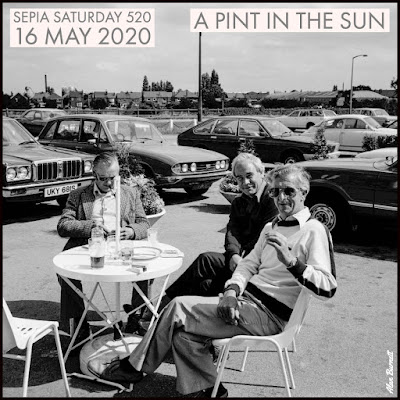
Beer.
It can make a young man wise
and an old man foolish.


With enough lager
a shy man will sing
and a brave man may cry.


Whether sharing a pint, or a litre,
good ale inspires songs of life
and stories of old friends.


One of the curious sub-genres of photographs
in my collection are postcard photos
of small groups of military servicemen
enjoying an off-duty "relaxed" moment
with their mates.
The majority of these photos
are of soldiers and sailors
from the time of the German Empire,
often posed as if
they were in a pub or cafe garden
savoring a glass of beer
while listening to a musical comrade.
 
Today I have three photos
on this theme
to exhibit.


The first image was clipped from a postcard photo of a group of German soldiers seated in a photographer's studio that is staged to look like a romantic forest beer garden. Arranged around a small table are ten soldiers, most holding beer steins. Two enlisted men sit on the "ground" floor strumming two musical instruments. One has a pear-shaped mandolin and the other a similarly shaped but larger lute-guitar. They are the only men whose regiment numbers, 23 and 70. are visible on their shoulder bars. One soldier wears a distinctive Pickelhaube headgear of the Imperial German Army. His helmet plate or Wappen is an eagle, the symbol of a Prussia soldier, but the spike on top is not pointed. Instead it is a round knob that signifies an artillery regiment. The small table has a card with the number 144 which may be connected to their army division. I don't think any of the soldiers are bandsmen, but are just regular enlisted men.

The soldiers' expressions are a bit wistful, even melancholy, as if this was their last round before closing time. While the mandolin and lute-guitar might be studio props, the two men seem to hold them expertly enough. Musical instruments appear so frequently in soldiers' photos like this that I think they represent the German love of music. It's as if the men are sharing a song and a beer with the distant recipient of the postcard.

The postcard was sent from Saarbrücken on 10 July 1910 to a Fräulein Zimmer(?) in P...(?) Rhineland(?). Saarbrücken is located in western Germany, right on the chin of the border with France. However in 1910 it was several kilometers inland of the western region of Alsace-Lorraine which was then part of the German Empire.


* * *


The second clip shows another group of eight German soldiers with beer steins, this time outside under a striped pole with a sign that reads: Nach der Heimat noch 175 Tage ~ 175 days after home. One solider is astride a wooden hobbyhorse and brandishes a short sword. Next to him is a cutout figure of a smiling ape drinking a frothy glass of beer while sitting on a keg. Presumably the mascot of the brewery. On a slate in front is another sign that reads: Treue Freundschaft beim Commiss geht über jedes Hinderniss ~ Loyal friendship at the Commiss(?) goes beyond every obstacle.

But on the left is a soldier seated with a simple accordion or concertina. At his feet is a slate that reads: Nun seht bles diese alten Knochen, die haben nur noch 25 Wochen. Reserve 1914 ~ Now just see these old bones, they only have 25 weeks left. Reserve 1914. This better explains the reason for their celebration. The soldiers are serving their year of military obligation, maybe in basic training, and look forward to going home soon.

But before those next 25 weeks finish the men will wish they were back in the beer garden. The soldiers' postcard was sent from Darmstadt, Germany on 25 March 1914. In less than 18 weeks they will be marching through Belgium on a line to Paris.


* * *


The third image shows a concertina player knelling in the center of a group of 23 men dressed in striped pajamas and holding beer steins. They are German soldiers too, but their casual attire is the uniform of a wounded warrior. One soldier on the far right wears a long apron and I think he is a medical orderly. The picture was taken at the Reservelazarett or Reserve hospital in, appropriately enough, Weingarten, Württemberg. The postmark is dated 29 November 1915, nearly one year and three months since the beginning of the Great War.

There are few smiles on the faces of these men. They look reasonably fit and whole, and probably expect to return to duty soon. All the more reason to enjoy a glass of beer with their mates. The bonds of friendships during wartime are like no other.


Over the past few weeks of self-quarantine, my wife and I watched the series of seven Harry Potter films. My wife, a big fan of J. K. Rowling's novels, had recently re-read them and wanted to conclude with the complete cinematic experience. However, I have different literary interests and have not read the books, but I will grant that the movies are exciting and distracting enough with their complicated fantasy stories and imaginative characters.

But after seeing the films again in close succession I was struck by J. K. Rowling's theme of memory that connects the series. In Harry Potter's struggle against the evil Lord Voldemort, he encounters several magical devices that reveal old memories, often linked to love and friendship. It's a similar notion to a talisman, an object imbued  with secret human feelings and actions known only to the bearer.

These photographs of German soldiers are also mysterious devices of memory, charmed with hidden powers of remembrance. How did they manage to be preserved for over 100 years though times of war and revolution? What names and stories were recalled by these photos? Who protected these postcards, safeguarding the simple messages on the back for posterity?

We can never know the true meaning of these images, but like the fictional Harry Potter learned, the most powerful magic is found in friendship and love. In the end those are the enchantments preserved in these photos that will always overcome hatred and misery.


This is my contribution to Sepia Saturday
where we always wish
"To Your Good Health!"

https://sepiasaturday.blogspot.com/2020/05/sepia-saturday-520-16-may-2020.html


The Gang at the Sleepy Hollow Ranch

10 March 2017


 It doesn't make a sound.
It takes no real skill to master.
It doesn't need tuning
because it can play in any key.

And yet it's a musical instrument
with such dynamic power
that it changed music forever.
It is a radio microphone.

In this particular case it's an image
of the microphone on the sound stage
of Radio CKLW
broadcasting from Windsor, Ontario, Canada.


 Standing around it are Elmer, Andy, and Pat
on violin, accordion, and bass fiddle.


On the other side are Mike, Pancake Pete, and Happy
playing accordion, guitar, and another bass fiddle.


In the center closest to the microphone
are Julie Murray and Sophie Murray
on mandolin and guitar
backed up by Red and Ken
on violin and guitar.


And let's not forget
Hiram Hillsberry and Uncle Hal
sitting down front on the floor.


Wearing the best in Western fashion
with ten gallon hats, neckerchiefs, and fancy shirts,
they all send

Season's Greetings
from the
Sleepy Hollow Cowboys
and Cowgirls
and the Vagabond Cowboys. 


In 1938 you could hear them on the radio Wednesdays at 3:30 PM in the Detroit, MI and Windsor, ON area. This photo was likely sent out so listeners to radio CKLW could put faces to voices. My guess is that Uncle Hal did the introductions as the show's emcee and Hiram Hillsberry provided colorful commentary with a joke or two. Julie and Sophie Murray were the featured vocal stars while  Elmer and Pancake Pete added the solo instrumentals. I suspect the Vagabond Cowboys are the four musicians on the back row. Two accordions might seem excessive but then this was the land of polkas which are not far removed from western swing music.


Detroit Free Press
9 February 1938

In 1938 the Sleepy Hollow Ranch was just one of hundreds of entertainment choices available to radio listeners in the Great Lake Region of Michigan, Ontario, and Ohio. The radio microphone brought all kinds of music to a new audience over the radio airwaves. For the first time symphonies and operas could be heard in rural homes far from big city concert halls. And likewise small bands performing blues, jazz, and country western music introduced America's urban population to new styles and rhythms. At the center of this new medium and entertainment industry was the microphone. The sound it captured was monophonic, low fidelity and broadcast over an AM signal but people couldn't get enough. Radio shifted the concert experience from an audience watching live musicians on a stage to a network where thousands of individuals listened to music coming from an electronic speaker on a radio cabinet.  Imagination supplied the visuals, and sometimes the postcards at least helped fans visualize the right shade of cowboy hat.


There is no date on this photo which was printed larger than a postcard and in newspaper halftones, so we can't know the precise Christmas season. But the earliest mention of the Sleepy Hollow Ranch on radio schedules was October 1937 and the last was October 1939. But they did not drop off the air, they only changed stations.


Pottstown PA Mercury
29 June 1940


The band had two leaders, Elmer and "Pancake Pete" Newman. In the late 1930s they each married one of the two Murray sisters, whose real name was Bogdonovich. Pete with Sophie were wed in 1936, and Elmer and Julie the following year. 

After some success in the Great Lake market, in 1940 they moved to the Philadelphia area and together opened an amusement park called the Sleepy Hollow Ranch located on Route 663, between Pennsburg and Quakertown. Visitors were entertained by farm animals, pony rides, merry-go-round, picnic food, square dancing, and country western music. The big Sleepy Hollow Barn Dance was broadcast on Philadelphia's WFIL and WEEU radio. 

Much of this information I found on a website devoted to Broadcast Pioneers of Philadelphia. A second website on Philly Regional news had a 2013 article on the story of this popular park from the perspective of two younger Newman brothers who grew up in the family's Sleepy Hollow Ranch. The radio broadcasts made the park an important venue for country and western artists to include on a concert tour. Patsy Cline, Roy Acuff, Roy Rogers, Minnie Pearl, Merle Travis, Roy Rogers, Gene Autry, and Eddie Arnold were among the many notable singers who played the Sleepy Hollow Stage.


* * *


The Sleepy Hollow Ranch was not the only cowboy music venue in the region. In 1940 the entertainment listings for the Labor Day weekend in the Pottstown, PA Mercury included Carolina Slim and his Mountaineers, with Ray Meyers the Armless Wonder, who plays the electric guitar with his feet, at Hickory Park. Over at Quakertown's Circle J Ranch the Nationally Known Group, The Carter Family performed with the Westward Hoo Cowboys, the Calgary Kid of WCAU, and Acrobatic Dancer Dorrie Dale. The Bar C—C Ranch in Elverson had Gene Autry's sidekick Smiley "Frog" Burnette & His Rhythm Wranglers along with the Georgia Crackers, the 3 Cortellis trapeze performers, Wally Walters Jr. and his 3 dummies, and the Cowboy Caravan.  

For Philadelphians the Wild East seemed to have
just as many cowboys and cowgirls as the Wild West.


Pottstown PA Mercury
31 August 1940


Courtesy of the magic of YouTube
we can hear what
the gang at the Sleepy Hollow Ranch
sounded like.
Here is their version of Blue Eyes Crying in the Rain.

* * *


* * *


This is my contribution to Sepia Saturday
where every story sounds better in Sepia Stereo.

http://sepiasaturday.blogspot.com/2017/03/sepia-saturday-358-11-march-2017.html


nolitbx

  © Blogger template Shush by Ourblogtemplates.com 2009

Back to TOP