
It's a curiously simple collage picture,
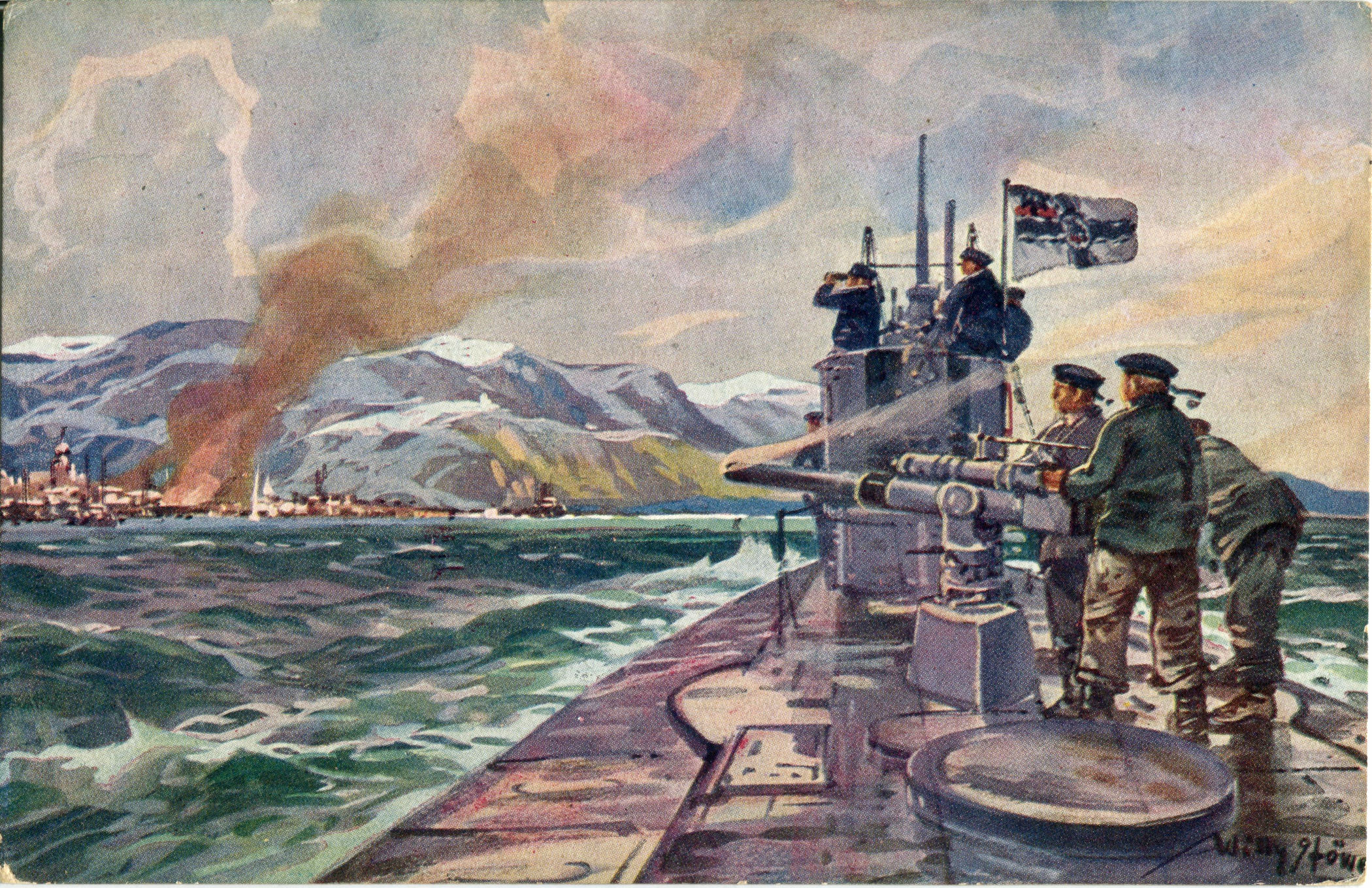
a watercolor painting of a naval warship
steaming through a blue-green sea
next to a vignette of a handsome bearded man
who wears a flashy regal uniform and is framed
in a laurel wreath above two billowing flags.
a watercolor painting of a naval warship
steaming through a blue-green sea
next to a vignette of a handsome bearded man
who wears a flashy regal uniform and is framed
in a laurel wreath above two billowing flags.
In the lower corner is the artist's signature:
Willy Stöwer
Willy Stöwer
I recognized the name as I have collected
many of this German illustrator's nautical artworks on postcards,
but this uncomplicated picture intrigued me for two reasons.
The postmark date is 1898, placing it
at the beginning of the postcard age
as one of Stöwer's earliest postcards.
many of this German illustrator's nautical artworks on postcards,
but this uncomplicated picture intrigued me for two reasons.
The postmark date is 1898, placing it
at the beginning of the postcard age
as one of Stöwer's earliest postcards.
And that man was not the portrait I expected
to find on a 1898 German postcard.
to find on a 1898 German postcard.
Who was he?
Finding the answer uncovered a history of a failed empire.
Finding the answer uncovered a history of a failed empire.
 |
| SMS Deutschland in 1898 at Source: Wikimedia |
The ship was called S.M.S. Deutschland for Seiner Majestät Schiff (His Majesty's Ship) in the Kaiserliche Marine (Imperial Navy), the navy of the German Empire which existed between 1871 and 1919. In 1898 when the photo above was taken, the S.M.S. Deutschland was the flagship of the German navy's East Asia Squadron. Here it is anchored in the harbor of Port Arthur, now known as Dalian, in Liaoning province, People's Republic of China. The position of the ship and its surroundings are very like the illustration on this postcard, but the dates do not align, which I'll explain later.
The S.M.S. Deutschland was the second and final ship of the Kaiser-class of ironclad warships built for Germany by the Samuda Brothers shipyard in London, England. These Kaiser-class ships were ordered just after the Franco-Prussian war of 1870-71 which was won by the North German Confederation states which soon became the German Empire under the King of Prussia, Wilhelm I. These modern ironclad warships were considered military insurance against any future French mischief. The keel was laid down in 1872, it was launched in September 1874, and she was commissioned on 20 July 1875. It would be the last capital ship built by a foreign ship-builder for the German Navy. For the next 43 years all its warships would be built in Germany, with many more to come.

The full postcard shows the picture of the ship centered with lots of empty space along the borders for a message. A caption explains the scene:
Flaggschiff "Deutschland" verlässt Kiel
~
Flagship "Deutschland" leaves Kiel
~
Flagship "Deutschland" leaves Kiel
The sender's message is in German and dated 9 III 98. The writer had so much to say that they risked annoying the Imperial German Postal Service by continuing onto the back, which in 1898 was strictly verboten! The card was sent from Altona, a district of the port city of Hamburg on 9 March 1898 and arrived the next day in Steinhorst, a town in Schleswig-Holstein about 30 miles east of Hamburg. The sender had a florid style and the last name is partly covered by the postmarks but I think it is addressed to Frau(?) Aug. Bruchmüller(?) of Steinhorst.

The S.M.S. Deutschland was 293 ft (89 m) long and had a beam of 62 ft 8 in (19.1 m). It burned coal to fire eight boilers providing power to one 2-cylinder single-expansion steam engine that turned one screw propeller. On full throttle it could make 14.6 knots (27.0 km/h; 16.8 mph) and with less steam travel 3,200 nmi (5,900 km; 3,700 mi) before needing to re-coal. It was armed with one 21 cm (8.3 in) gun and eight 26 cm (10.2 in) guns, and carried a complement of 32 officers and 568 sailors.
In the 1870s steam-powered ships were still thought undependable had not yet become the dominant maritime vessel so the Deutschland was equipped with three masts rigged for sails. It's first service was in squadrons sent to the Mediterranean as Germany, a new empire, was eager to compete with other nations to be a major world power. In the summer of 1889, the Deutschland joined the German fleet which traveled to Great Britain to celebrate the coronation of Kaiser Wilhelm II. This fleet now had many ships larger and faster than the Deutschland so it was relegated to the training squadron based in the North Sea.
 |
| SMS Deutschland before 1896 Source: Wikimedia |
As more navies around the world began expanding their fleets, Kaiser Wilhelm II pushed Germany's shipbuilders harder. During maneuvers in the fall of 1894, the German navy simulated a two-front war against France and Russia. The Deutschland's squadron acted as the Russian fleet during the exercises.
Following this, the Deutschland was rebuilt at the Imperial Dockyard in Wilhelmshaven and converted into an armored cruiser. Work was finished in January 1897 when it rejoined the fleet. It now had thicker, heavier armor; a secondary battery of eight 15 cm guns; four auto-cannon for defense against torpedo boats; and five torpedo tubes mounted in the ship's hull below the waterline. The center mizenmast was replaced with a lighter pole used just for signaling. This was the ship that Willy Stöwer painted for this postcard.
.jpg) |
| Willy Stöwer (1864–1931) in his studio, 1903. Source: Wikipedia |
Willy Stöwer, born in 1864 in Wolgast, a town on the Baltic coast, was the son of a sea captain and as a young man trained as a metalworker and engineering technician in German shipyards. He was a self-taught artist whose first work came from commissions to illustrate nautical scenes of commercial steamships and naval warships. He proved to be a very prolific artist, and over a career from 1892 to d 1929 created over 900 black-and-white and 335 color illustrations for 57 books, as well as countless posters, postcards, trading-cards, labels, brochures and calendars. Stöwer's artwork was praised by Kaiser Wilhem II and he became the Emperor's favorite naval painter, sometimes accompanying him on several sea junkets around Europe. As we can see in this photo of him in his studio, Stöwer painted on really big canvases which was probably part of his artwork's appeal to the people who lived in very big houses.
The man whose portrait Stöwer painted on my postcard of the Flaggschiff Deutschland confused me because this was not Kaiser Wilhelm, whose imperial visage was instantly recognizable for his Prussian mustache with upturned points. This man's trimmed beard more resembled George, Duke of York, the future King George V, or his first cousin, Tsar Nicolas II.
 |
| George, Duke of York and Tsar Nicholas II, circa 1890s Source: the Internets |
As it happens the man on my postcard was actually related to all three. He was Prince Heinrich of Prussia (1862–1929), the younger brother of Kaiser Wilhelm II. Their mother was Victoria, Princess Royal (1840–1901) who was Queen Victoria's eldest child, which made Heinrich, like Wilhelm, a first cousin of King George V (1865–1936).
The German royal family was also related to the Russian Tsar Nicholas II (1868–1918) , so that Heinrich and Wilhelm were Nicolas's second cousins once removed through descent from King Frederick William III of Prussia, and third cousins as great-great-grandsons of Tsar Paul I of Russia. One can see Victorian genetic connection in the photo above, George on the left and Nicholas on the right. It was taken in the 1890s but I've been unable to find a source for the original image. Of the three cousins, Heinrich, born in 1862 is the oldest, and Nicholas, born in 1868 was the youngest.
 |
| Prince Heinrich of Prussia (1862–1929) pastel by Max Krusemark, 1902 Source: Wikimedia |
This portrait of Prince Heinrich of Prussia was made in 1902 by German artist Max Krusemark. The features and uniform resemble Stöwer's smaller portrait, but I think that is a coincidence since most royalty learned at an early age to model their uniforms in their most favored photogenic style.
Since Heinrich's older brother was destined to become the German Emperor, Heinrich followed a different path. When he was 15 years old he entered the Imperial Navy cadet program which began with a two-year voyage around the world (1878–1880). He passed his first naval officer examination in October 1880 and began attending the German naval academy (1884–1886). In 1887, he was given command of a torpedo boat and then simultaneously the First Torpedo Boat Division. The next year he was made commander of the Imperial Yacht S.M.Y. Hohenzollern.
When the S.M.S. Deutschland was refitted in 1897 for a return to service, Prince Heinrich was already an experienced seaman with the rank of Konteradmiral. In December 1897 as commander of the East Asia Squadron Heinrich left Kiel onboard his flagship Deutschland along with a second warship. They arrived in Hong Kong in March 1898. Since this date is the same as when my postcard was sent, it seems impossible that the photo of the Deutschland at Port Arthur harbor was used for Stöwer's painting of it.
It was a chaotic time for a warship to be in Asian waters. In April 1898 the Spanish–American War (April 21 – August 13, 1898) began with the sinking of the USS Maine in Havana Harbor in Cuba. Soon the United States Navy was steaming towards Manila Bay in the Philippines where on May 1, Commodore Dewey, commanding the Asiatic Squadron aboard USS Olympia, defeated a Spanish squadron. In a matter of weeks the United States acquired the Spanish foreign possessions and become a major colonial world power.
The Asian region was still recovering from the First Sino-Japanese War (1894–1895) when a modernized Japanese army sought to acquire the Korean peninsula from China. It was followed by the 1895 Japanese invasion of Taiwan which Japan occupied for the next 50 years.
The S.M.S. Deutschland remained in China until 1900 before returning to Germany, though I don't know if Prince Heinrich stayed for the duration. In any case the ship and its crew were there during the turbulent Boxer Rebellion (1899-1901), an uprising of North Chinese peasants who feared the expansion of foreign spheres of influence. Militant groups of these peasants, called Boxers because they practiced Chinese martial arts, which in this era was called "Chinese boxing", attacked foreigners, destroyed property and railroads, and murdered Chinese Christians and missionaries.
This conflict is remembered for the Siege of the International Legations in Beijing (June 20 – August 14, 1900), The 55 day siege was lifted by a military force of the Eight-Nation Alliance—comprising American, Austro-Hungarian, British, French, German, Italian, Japanese, and Russian troops—that invaded China to relieve the besieged legations. They did not march there. They came by ship.
I've greatly compressed this history yet hope it can still explain how this era of colonial expansion by European powers and the new colonial might of the United State was a time of tremendous stress for the world. There were countless conflicts everywhere that involved people fighting against colonial grievances, class injustice, and religious and ethnic oppression, many of which remain complex problems in the 21st century.
At the turn of the beginning of the 20th century battleships were a way of measuring world power. The S.M.S. Deutschland was just one small ship that served a specific function but it became almost obsolete when it was first commissioned in 1875. When it returned to Germany in late 1900 it was relegated as a harbor ship and renamed Jupiter as a new battleship class would take over the name Deutschland. In 1906 it was removed from the naval register and in 1907 converted into a target ship by adding more watertight bulkheads and ballast. Beginning in June 1908 the ship was deployed in several exercises where multiple battleships and cruisers shelled it. Though it sustained around 140 hits from calibers ranging from 24 cm (9.4 in) down to 10.5 cm (4.1 in), it was not significantly damaged by shell hits above the waterline. However she was sunk twice by shells that struck the water and penetrated the hull below the side armor.
The results of this target practice on an armored cruiser demonstrated that warships were difficult to sink by shellfire alone, but they were vulnerable to the until-then unknown phenomenon of diving shells. The Jupiter/Deutschland was raised both times after she sank, but after the last raising she was sold for scrap in 1908.
 |
| Prinz Heinrich Cigaretten, circa 1910 Source: Wikimedia |
"Prinz Heinrich cigarettes, made from the finest turkish tobacco, are proof that German-made cigarettes far succeed Egyptian brands. Sole manufacturer / Adler Compagnie Cigarettenfabrik Aktien -Gesellschaft Dresden"
The tragic irony here is that Prince Heinrich died of throat cancer on 20 April 1929 at his estate on the Baltic coast.
 |
| S.M.S. „Prinz Heinrich“ takes coal in the port of Kiel, circa 1902 painting by Willy Stöwer Source: Wikimedia |
By the time S.M.S. Deutschland was being broken up for scrap, Prince Heinrich had reached the rank of Großadmiral and made Inspector General of the Imperial Navy. At the start of World War One he was commander-in-chief of the Baltic Fleet. In 1902 he was honored by getting his name on his own armored cruiser, the S.M.S. Prinz Heinrich. And of course, Willy Stöwer painted a picture of it.
The Prinz Heinrich was longer than the Deutschland, at 415 ft (126.5 m) but about as wide. It bristled with armament, including two 24 cm (9.4 in) guns, ten 15 cm (5.9 in), ten 8.8 cm (3.5 in), and four torpedo tubes. It was capable of reaching 20 knots powered by three triple-expansion steam engines, each with it own screw propeller. Surprisingly the ship's complement was a little less than the Deutschland with 35 officers and 532 sailors. During the war the Prinz Henrich served mainly in the Baltic participating in mine-laying and clashes with the Russian navy. In 1916 it was in need of repairs and deemed unsuitable for combat. Her main battery guns were removed and converted into heavy railway guns for use on land. The ship was taken off the navy register and moved to the imperial shipyard in Kiel where for the remaining years of the war the Prinz Henrich served as a floating headquarters for Prince Heinrich, the commander in chief of naval forces in the Baltic.
Prince Heinrich seems to have genuinely earned the many medals and awards he wore on his uniforms. During his life he was an avid automobile driver who promoted the first auto races in Germany. He also was one of the first royalty to travel in Graf Zeppelin's airships. And when the Wright brothers brought their airplane to Germany, Prince Heinrich earned one of the first pilot licenses. Though I expect he followed his elder brother's political policies, I have to wonder what he thought about the terrible war that began in that fateful summer of 1914. Unlike Wilhelm, Heinrich had a broad military experience and surely understood the powerful and horrific havoc which was released upon the world.
 |
| Prince Heinrich of Prussia (1862–1929) photograph by Emil Bieber, 1913 Source: Wikimedia |
This last photo appeared in a book entitled "Men around the Kaiser; the makers of modern Germany" by Frederic William Wile, a prominent American journalist who worked as a Berlin correspondent for the London Daily Mail and the New York Times. About Prince Heinrich he wrote:
It was under the personal supervision of the Kaiser's brother that the German Navy rose to the emergency with promptitude and thoroughness and made itself ready, as if overnight, to hold its own in the new conditions of sea warfare. That is why the Admiral Royal, whose pictures so often make him look like a twin of King George or the Czar, holds a place in the affections of his Fatherland almost second to none. Germans have had few national idols since Bismarck. Prince Henry is one of them.
Thoroughly imbued with the democracy of the sea, with an active career of more than thirty years to his credit, Prince Henry is a sailor-man through and through—an admiral first and a Prince after- wards. He has had little time, and less inclination for the luxurious pastimes of his royal estate. The fashions and frivolities of Court life have never appealed to him. His hobby is the sea, and he is happiest when cultivating it. Naval cadet at sixteen, when the fleet was little more than a flotilla of nondescript frigates; battleship-captain at thirty, and rear-admiral four years later, 1906 found Prince Henry commander-in-chief of the homogeneous squadrons which the German Admiralty keeps assembled in home waters as one great sledge-hammer entity, steam up and eager to deliver the decisive blow at the psychological moment. An apostle of the "Ready, aye ready!" policy of perpetual preparedness for war, he was fitted both by temperament and training for the leadership of the Empire's battle forces afloat.
Only the most urgent diversions, such as important foreign missions on behalf of the Kaiser, enticed
him from his flagship at Kiel, where, too, he has long had his home. A stickler for discipline, his indomitable energy and devotion to duty were at once the marvel and inspiration of the entire Fleet. German naval officers are notoriously the hardest working—and hardest-worked—in the world. They
had a constant example in Prince Henry. He took a deep interest in the men behind the guns and the unseen heroes of the hold. Regardless of personal comfort he participated regularly in the long
practice cruises of the High Seas Fleet in and out of season, and he is to-day given chief credit for the strategic and tactical skill which the Kaiser's battle squadrons have attained. After Prince Henry hoisted his farewell signal as Commander-in-Chief of the Fleet three years ago, he was rowed ashore from his flagship by a crew of lieutenants, a pretty and affectionate tribute to the esteem in which the Navy cherishes him.
 |
| Prince Heinrich of Prussia (1862–1929) Photograph by Ernest Flagg, 1914 Source: Wikipedia |
This story turned out to be a biography, naval history, and art review all-in-one. I had not expected to discover such a prominent, but now largely forgotten, historic figure as Prince Heinrich of Prussia hidden in a postcard. The S.M.S. Deutschland was not an important ship and did not participate in any great sea battles. Instead it represents a little cog in a gigantic military-industrial complex which led the nations of the world to war in 1914. Untold millions of marks, dollars, and pounds were spent on naval warships, each larger and more weaponized than those before. The race between nations to build the largest navy of dreadnaught-size battleships is considered one of the causes of the Great War. Tragically these monstrous and expensive battleships were not a decisive factor during the war. Instead it was new destructive inventions of machine guns, barbed wire, submarines, and airplanes that changed how a war is waged.
Looking backwards at the history of the Great War allows us to see how international political relations broke down; how military decisions were forced upon entire populations; and how futile it was to spend incalculable public money on a conflict that could never be won. In 1898 the outcome could not have been predicted or even imagined, but the wheels and cogs of the military-industrial complex kept turning relentlessly and mindlessly. That is how empires fail. I worry that in 2026 we are facing the same kind of unimaginable dreadful future.
 |
| Prinz-Heinrich-Mütze Prince Henry yachting hat Source: Wikimedia |
I can't resist adding one more historic note on Prince Heinrich. He was clearly a sailor who loved all kinds of ships and boats. Outside of the navy he enjoyed participating in yachting, basically a recreation on big sailboats. His naval uniforms were inappropriate for what was essentially an activity for civilians, albeit wealthy ones. So he popularized a wool cap that was the headgear of the Imperial Yacht Club. It is known today as a Prinz-Heinrich-Mütze or Prince Henry cap. It is usually made of corduroy in dark blue, black, or gray. It is similar to a mariner's cap, also called a Greek fisherman's hat, which I have in my wardrobe and wear in the cooler fall and winter months.
However there is another hat in my home that looks pretty close to being a Prince Henry cap, too. It is on a bust of my father-in-law, Isador Caplan, who many years ago was honored for his generous contributions to a British arts organization by having his likeness preserved in bronze. The artist did such an amazingly accurate sculpture that Isador's glasses and his hat fit perfectly. Isador passed away many years ago but his bust is a treasure my wife and I are proud to display and tell stories about his life. I think he would be very pleased at his cap's connection to Prince Heinrich of Prussia.

This is my contribution to Sepia Saturday
where most folks are tied up securely to the dock.




.jpg)


