This is a blog about music, photography, history, and culture.
These are photographs from my collection that tell a story about lost time and forgotten music.

Mike Brubaker
{ Click on the image to expand the photo }
Showing posts with label drum major. Show all posts

The Showman with a Big Hat

02 March 2024


This is not a practical hat.
For one thing it has no brim
with only 
fuzzy fur to shield
the eyes from the sun.
It might keep the head warm,
but the ears?

Not so much.


It's also ridiculously top heavy
necessitating a strong chin strap
that forces the wearer to maintain
perfect posture at all times.

What happens if you drop something?


I suppose it is large enough
to stow a hot lunch or thermos of tea
inside its extra insulated space.
But in summer maybe a block of ice
would be more appropriate.

Honestly, who would chose to wear such a thing
unless you were paid good money to do so?

The answer is someone who wants
to be the center of attention.

And that would be a man
who was proud to wear
such a towering bearskin hat
and lead a marching band.

He usually carried a big stick, too.


Today I present 
a small selection of
anonymous drum majors.
Each one wearing an impressive bearskin. 


The position of Drum Major in a military marching band has a long history that goes back to the at least the 17th century and probably earlier. Initially a drum major's duties were for leading and maintaining the drum and bugle units that military commanders used to communicate orders to soldiers on the battlefield. In the early 19th century as military wind bands became larger and marching became an important element of military displays, the drum major acquired a new status as the prestigious leader of a band when it was on parade. That required a special uniform with extra flashy equipment.  

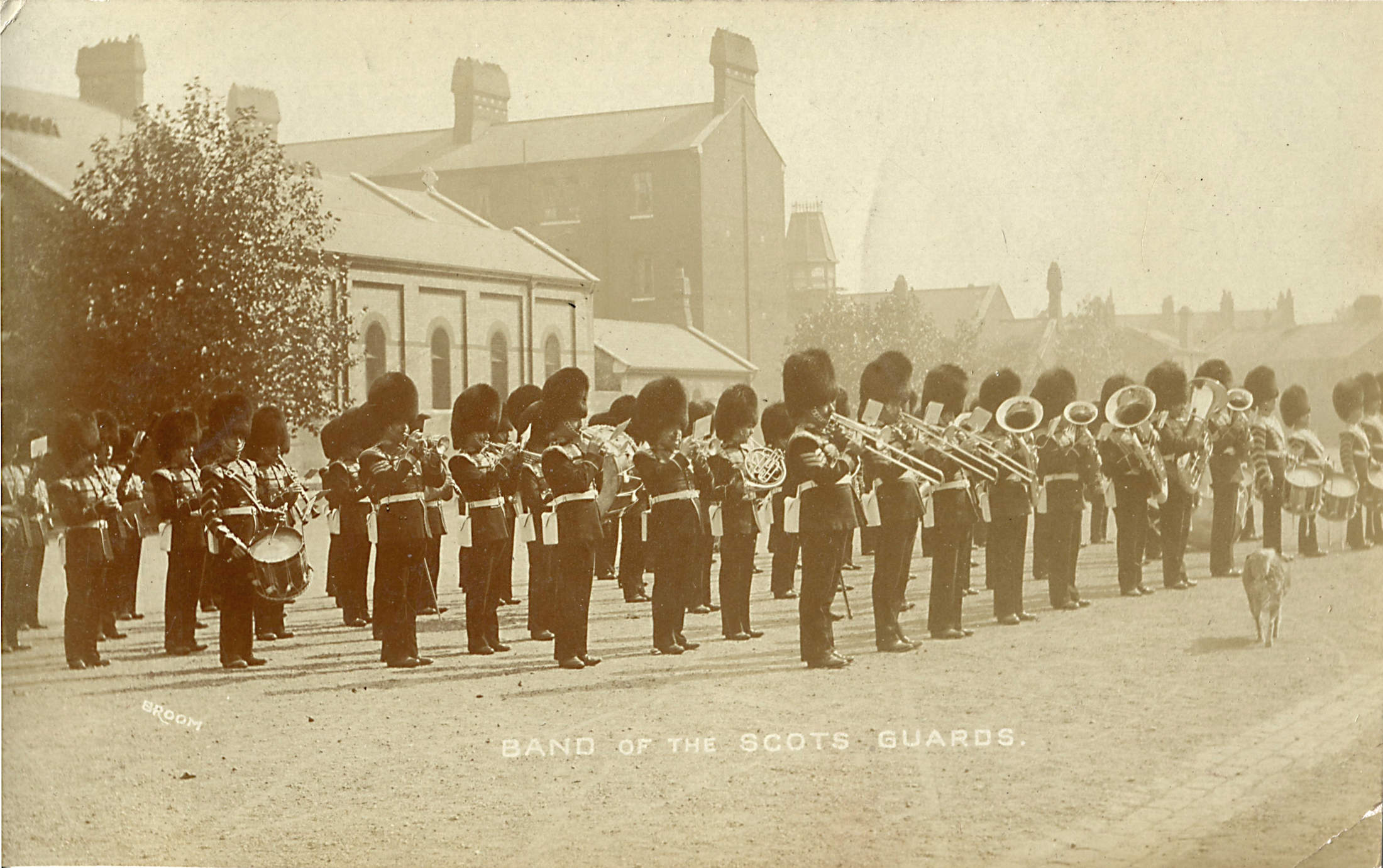
In earlier times no army could surpass the British Army for military pageantry and extravagant livery. The bearskin worn by this Drum Major  of the 2nd Scots Guard is typical of the ceremonial dress headgear worn by soldiers in various British regiments. The Scots Guard are one of the five Foot Guards regiments in the Household Division. They and the Grenadier Guards, Coldstream Guards, Irish Guards and Welsh Guards are entrusted with guarding the British monarch and performing ceremonial service in London. All the regiments have bands that wear similar uniforms topped off by a tall bearskin. 

This drum major of the Scots Guard appeared on a colorful tourist's postcard sent from London to Paris on 29 September 1908 during the reign of King Edward VII. It was addressed to Monsieur Victor, Le Chef Plongeur, the chief dishwasher at the Hotel du Louvre in Paris. Built in 1855, the Hotel du Louvre was the first luxury hotel in Paris. It had 700 guestrooms with a staff of 1,250 and became renowned for its French and international cuisine that earned it a five-star rating. I think to be a chief bottlewasher there was no joke. 


Recently, I acquired a photo postcard of the Band of the Scots Guards performing on a large plaza. The drum major is not in the picture but the bandsmen are all decked out in full dress uniforms with tall bearskins. The postcard was never mailed but the printed instructions on the left side of the divided back, "For Inland Postage Only, This Space May Be Used For Communication" is the form used in postcards from 1902-1906 when messages were first permitted on the back of postcards sent to addresses within Britain but not for places outside the United Kingdom. 

I thought the location of this photo might be the famous Horse Guards Parade in London, but I've been unable to verify it and can't find a vintage photo that matches. When I first visited London in the 80s it was at the end of May when her majesty Queen Elizabeth traditionally celebrated her "official" birthday. This ceremonial event is called Trooping the Colour when all the regiments and bands of the Household Division perform en mass at the Horse Guards Parade near Buckingham Palace. I managed to get a bleacher seat and watched this amazing spectacle which included her majesty riding her horse along with various members of the royal family. 

For an impressionable young American like myself it was like the biggest football halftime show multiplied by 10. What I remember most is that as thousands of soldiers and bandsmen marched in perfect straight step, shod in shiny black shoes with very thick soles, they never avoided the poop left behind by the hundreds of horses that preceded their part of the pageant. During the remainder of this event flocks of London pigeons descended on the parade grounds and consumed the horse refuse so that by the end of the show the ground was perfectly clean again. 


For state ceremonies a drum major of a royal British regimental band does not wear a red coat and bearskin but instead dons a splendid tunic of gold and red with white leggings and a plain black hat, not unlike an American baseball cap. This postcard shows the Drum Major of the Grenadier Guards in Review Order.  [The braided gold trim on the tunic is called a "galloon" or sometime "galon", a useful material to make any garment fancier. The satin strip on men's formal  black trouser legs are also a type of galloon.] 

This postcard was sent from London to a young lady in Switzerland. The postmark shows 2 AM on December 6, but the year is smudged. Sometime in 190_?, I think. A nice touch is that the writer adds an upside down comment at the top. "Voi'la le Tambour Major de la Garde des Grenadiere Regiment Royal."  Ironically the British Grenadier Guards adopted the bearskin hat style for their uniforms from the French Imperial Guard after their victory over Napoleon at the Battle of Waterloo in 1815.


This cabinet card photograph of a drum major in a tall bearskin is unmarked and well worn,  but I'm pretty certain it is of American origin despite the painted backdrop of a classical landscape with palm trees, ferns and ornamental plinths. His mace is likely a standard size somewhere between 52 to 58 inches long. His height is 20% more than the length of his mace so he is about 5 feet 7 inches. But his bearskin hat makes him look 6 feet 6 inches tall!

His uniform has lots of the traditional military style accoutrements like frilled epaulets, braided cords, and three rows of buttons, but I don't believe he is from a regular army band. There are a couple of ribbons pinned to his tunic that could be souvenirs of a recent special event, perhaps a political rally or civic holiday, but the camera didn't have the best focus to make out the words. He could be in the uniform of a state militia band but in the 19th century there were no consistent fashions to place him in any unit. My best guess judging from the card and his mustache is that the photo was taken in the 1880s or early 1890s.


My next drum major comes from a small ferrotype about 55mm x 85mm. This "tintype" was a inexpensive photograph that was popular from around 1865 to 1885. Its photographic method used camera that often picked up very fine detail but since it was preserved only on this little rectangle of sheet metal it meant that no duplicates could be made. The image often came out like this one with very dark contrast that gave the impression the photo was taken at night. When photographers began using glass plates to record a negative, the photos were such a great improvement that tintypes became an obsolete medium. 

Fortunately with the aid of modern computers and scanners, the contrast of a ferrotype can be restored to more acceptable level. Here is my improvement.


The way a ferrotype "tin" is positioned behind a camera lens means it records light just like a mirror does. The image is not really true to life but reversed. If you look at this drum major's tunic buttons you can see his coat's button seam edge is on his left which is opposite from how a man's buttons should be. With digital software it requires only a click and the whole image is flipped horizonal and we can then see the drum major in his true orientation.


This drum major's uniform is very similar to the previous man. The tunic has the frilled epaulets and aiguillette cords, but is longer and only has one row of buttons. Like the other bearskin this drum major's hat also has a frilled badge attached to front. I think this drum major's mace is longer, maybe 58 inches, which would make him about 6 feet tall without hat, and 7 feet with bearskin.

Most ferrotype photos are unmarked unless they are fortunate to have been preserved in the paper envelopes that came from the photographer. This photo was not so lucky but there is a message scratched in the black paint on the back of the photo.


 This is a show 
 man 


The bearskin hat remains a standard feature of formal ceremonial military uniforms in many countries. Beside Britain, the bearskin is worn by soldiers in guard regiments of 13 other nations. It weighs about 2 kilograms (4.4 lbs) and is about 14 to 18 inches tall. It is made from a single bearskin, usually from a female North American black bear, which has thicker, longer fur but is usually brown. This skin is then died black to make into a hat. Recent fashion campaigns rejecting animal furs have forced many military departments to find artificial replacements for bearskin. The British Army has yet to adopt one. 

Success in show biz often depends on getting the best costumes.


***


No one acquires a drum major's skill
without a lot of practice and drill.
This video 
was taken in April 2023 and is titled 
The four drum majors are
Senior Drum Major Gareth Chambers 
Drum Major Chris Rees
Drum Major Stu Liang
Drum Major Scott Fitzgeral.
The bass drummer is unnamed. 


***


Here is video of  the Band of the Scots Guard 
changing the guard on 5/9/2021.
I like it because near the start (0:22)
the camera is positioned directly
in front of the band and the drum major.
Notice that the drum major carries a sword as well as a mace.


***


Here is a short video of 
Trooping The Colour in 2022
with Senior Drum Major Gareth Chambers
giving the commands. 

It's very like the event I saw forty+ years ago.
Anyone who can perform in front of royalty
and thousands of loyal spectators
ordering a company of hundreds of soldiers
who need to turn exactly on the mark
has my greatest admiration.
That's a true measure of a show man.


***


Sharp-eyed readers
may have spotted the animal 
in the photo of the Scots Guard band.
At first I was unsure if it was a dog. or a goat,
or maybe just a blur of motion.


It is, in fact, the hind view of a dog,
something I'm very familiar with as an owner of two dogs.
Whether this dog was the band's mascot
is a detail lost in history.
I bet he could sing along with them. 


This is my contribution to Sepia Saturday
where no one gets their signals crossed this weekend.


Three Drum Majors

14 May 2021

 
It was a drum major! Hurrah
A drum major—no base imitation; a real drum major,
a drum major with a bearskin two feet high;
with a great red plume waving away above that altitude;
a drum major with a gold tipped baton,
a drum major with a gorgeous costume,


A drum major who could walk backward
as gracefully as he could forward,
a drum major with a commanding eye,
whose glare told the band and the small boys
he would stand no nonsense; a drum major who could juggle
with his baton as he sped along.
That was the kind of drum major he was.


He carried his head high and strutted along
with an I–am–the–whole–procession air,
for he knew that heaven had bestowed upon him
the greatest opportunity to exhibit himself
which had ever fallen to the lot of any drum major
since evolution had raised the human race to that
pinnacle of perfection necessary for
the producing of drum majors.

Oh, how he stalked in lonely lordliness and
how he swung his baton as he passed the Governor's stand
with his band filling the air with triumphant melody.
No such drum major was ever seen before
and the world can have no hope that his like will ever appear again.
This was an excerpt from a newspaper account about a parade
in New York City honoring then-Governor Grover Cleveland,
as reported in the Brooklyn Daily Eagle on 2 November 1884.


Once upon a time a parade was a common event in the life of a city. Political rallies, religious processions, and other civic celebrations often called for a parade through the city streets leading toward some kind of public spectacle. Of course any parade required a band to play music, and every band needed someone to lead it in the marching. This important duty was the responsibility of a band's drum major.
 
In November 1884, New York City hosted one of the greatest political parades of the 19th century for its state's governor, Grover Cleveland, the Democratic Party's candidate for President of the United States. The reporter for the Brooklyn Daily Eagle, who was clearly carried away by his enthusiasm for the occasion, began his article with a wonderfully poetic description of the drum major who led the parade's start. He was the unnamed leader of Patrick Gilmore's famous military band and the drum corps of the Twenty-second Regiment of the New York state guard. 
 
The reporter estimated that "It took these people three and a half hours, marching swiftly, to pass the reviewing stand sixteen abreast. There were fully 75,000 people (more likely 35,000) in the line and every one was a voter. It was the finest procession ever given in honor of a Presidential candidate in New York, and the 500,000 people who lined the streets on which they marched were right in applauding it to the echo, as they did." Every group of Cleveland supporters in the parade was led by a band. There must have been hundreds of drum majors marching that day

Grover Cleveland went on to win the Presidency in 1884, the first Democrat since James Buchanan in 1856. Though Cleveland carried enough states to win the Electoral College votes, his Republican opponent, James G. Blaine of Maine, despite numerous scandals of corruption, still did well in the popular vote. Of the total ballots cast, Blaine narrowly lost with 48.28% to Cleveland's 48.85%.
 
In the election of 1888, the tables were reversed and Benjamin Harrison, a former Senator from Indiana, defeated Cleveland, with 20 states going Republican to 18 Democratic. But again the popular vote margin was narrow, 48.6% to 47.8%. Four years later, Grover Cleveland returned to the political stage and won the next election in a three-way contest against the incumbent Benjamin Harrison, and James B. Weaver of the Populist Party, becoming the first, and only, U. S. President to serve two non-consecutive terms.
 
President Cleveland saw a lot of drum majors in his career. Not all of them in a parade either.
 
"Pioneer Cleveland"
26 August 1896, Puck magazine
by Louis Dalrymple (1866–1905)
 Source: loc.gov

This political cartoon was published in August 1896 and shows Cleveland  holding an axe labeled "Political Wisdom", in a forest where he has been cutting trees labeled "Gold Standard". Approaching from the left is a procession led by Mark A. Hanna, as drum major, followed by William McKinley, Garret A. Hobart, Benjamin Harrison, Thomas B. Reed, George F. Hoar, John Sherman, Henry Cabot Lodge, and others. One man carries a banner that states "The Republican Party is unreservedly for Sound Money - the existing Gold Standard must be preserved. Rep. Platform."
 
The illustration of a drum major in tall bearskin hat and colorful uniform was a powerful symbol in America because the public understood a drum major's charismatic power to lead people. Today I present three vintage photo portraits of drum majors.


The first drum major is a very young man, a boy really, about age 13-14 or perhaps a bit older, but not by much. He is dressed in a simple white uniform with short sailor's jacket and knee breeches. His hat is a kind of brimless cadet's cap. Attached to his jacket are the swallow's nest shoulder wings of a military bandsman. The point on his mace has a very fine insignia with the letter S. The card has some bad abrasion but it isn't the reason for his  missing left hand. It is merely hidden, bent behind his hip.

The photographer was Heinrich Veldmann of Kiel, Germany at Holtenauerstr. 32. This style of this carte de visite dates to the 1890s, I think, but it could be from later, perhaps even  the 1900s. Kiel is a major port city on the Baltic Sea in the northern German state of Schleswig-Holstein. It was the home of the Imperial German Naval Fleet and I believe this lad was a drum major for a German navy band. 
 
The faded backdrop behind the young drum major looks like a body of water with a wooden bridge beyond. It's possible that it depicts the great Kiel Canal which connect the North Sea to the Baltic Sea. Construction of this 61 mile freshwater canal transiting from Brunsbüttel to Holtenau was begun in 1887 and officially opened on 20 June 1895 by Kaiser Wilhelm II. Undoubtedly there were many big parades for that event. 
 
And though this boy was German, it's not impossible that he might have been in the parade for Governor Cleveland, as there were many communities of German immigrants in New York who supported the governor.


* * *


My second drum major portrait show a more senior gentleman with a stern military gaze. I would say he is in his late 30s or 40s. Maybe 50s? He wears a mid-length uniform coat fastened with 18 shiny buttons and tied with a sash belt, and a French-style kepi hat which has a star-shaped badge. The stripe on his trouser leg is a feature of military-style bands. One of my theories on men's hair fashions is that his mustache/mutton chops combo with a clean-shaven chin is a sign of a military veteran. 

This cabinet card photograph was taken by W. C. Davis of Waterloo, New York. In the 1900 census, Whitney C. Davis, age 38, was living with his wife Francena S. Davis on the farm of his in-laws, James and Libbie Sutherland. At that time Whitney C. Davis listed his occupation as Photographer, Retired. In the 1894-95 business directory for Seneca County, located in New York's picturesque Finger Lake region, W. C. Davis was listed under Photographers and Bicycle Dealers. So I would estimate this drum major posed for his picture in about 1895-99.


* * *


My third photo of a drum major is a prize winner. This fellow has a splendid uniform with a long coat that gleams from its rows of brass buttons and gold thread embroidery. We can almost see the photographer's camera in the reflection on his mace's dome head. But the real glory is in his tall British-style custodian hat with its horsehair plume. It's a magnificent portrait only marred by the young man's accidental resemblance to Don Knotts, the actor who played Mayberry's celebrated deputy sheriff, Barney Fife. 
 
On his cap's badge and his belt buckle is an American eagle which are symbols that would only be on a true military bandsman's uniform. So I believe he is a leader of a regimental band for a state guard. This is a photo that deserves to be colorized but I can't make up my mind for the coat's color. Scarlet red or Prussian blue?

His cabinet photo was taken by Henry Ehm of 708-710 Broadway in Brooklyn, N. Y., Duplicates can be had at any time. The backstamp on the card is in a rare landscape format and shows a classical Grecian trio of young woman, youth, and cupid admiring a large portrait. Beside them is a camera and artist's palette board. According to Langdonroad.com, a useful list of 19th and early 20th century photographers, Henry Ehm operated a studio in Brooklyn from 1889 to 1912, and was at this address from about 1890 until 1910. The drum major's hat was a popular dress uniform fashion for bands and soldiers in the 1890s. 


It was this drum major's location in Brooklyn that sent me searching for "drum major" references in the Brooklyn Daily Eagle. There were thousands of them in the decades before WW1. The report on campaign parade for Grover Cleveland was just the best of several detailed descriptions of how drum majors captured the attention of the public. It was an era when every ceremonial part of civic life included parades and march music. The drum major's position at the front of a parade served more to command the eyes of the spectators than of just his band. His directions controlled the speed of the marching step cadence and the timing of any special drill instructions. Tossing or twirling the drum major's mace was a display of juggling but it was also a mark of skillful art to generate impressive awe from an audience. 
 
The roll of a drum major still continues in modern military bands, though the need for parade marching has greatly diminished. Many modern high school and collegiate marching bands often have multiple drum majors who assist in presenting extravagant halftime shows. I think those over-the-top forms distract from the old traditions represented in these three portraits of anonymous drum majors. But who knows, maybe Grover Cleveland would have enjoyed seeing his Brooklyn drum major do a strut and spin.


* * *


I found several videos on YouTube
that demonstrated the best qualities of a drum major.
Here is a short video from Nigeria
showing off the drum majors of the FCT Council Boys' Brigade Band
at a 2017 music event  held at Kwali, Nigeria.
The band's playing is rough and unpolished
but the spirit of the drum majors
is inspiring to see.
 
Extra points if you recognize the march tune.


The tune was "Marching Through Georgia" (sometimes spelled as "Marching Thru' Georgia" or "Marching Thro Georgia"), a marching song written by Henry Clay Work at the end of the American Civil War in 1865. The title and lyrics of the song refer to the Union Army's General William T. Sherman's "March to the Sea" to capture the Confederate city of Savannah, Georgia in late 1864.


Here is a video of the Flying V Drum-Majors
from the Canadian Armed Forces Music School in Borden, Ontario.
There is no music, but instead we get to see how military drum majors
practice their movements and commands.


And this last video was also filmed in Borden, Ontario
on the same day in August 2016, I think.
Here Mcpl Brook practices his Drum-Major Routine.
There may be no music but this drum major
can hear the march tune clearly in his head.


This is my contribution to Sepia Saturday
where only the Shadow knows all the secrets.


The Sanford Mills Band

12 October 2019


They look like musicians.
Drummers, trombone players,


clarinetists, and cornet players.


They wear sharp looking band uniforms
with music lyre badges pinned to their military caps.


In the center is a drum major
wearing a tall bearskin hat
and holding a shiny baton.


The bass drumhead even tells us their name:
the Sanford Mills Band
of Sanford, ME

But music was not the principal occupation
of these 23 bandsmen.
 
They are were employed as
weavers, winders, warpers,
burlers, combers, crimpers,
dyers, mixers, finishers,
spinners, spoolers,
twisters, tearers,
block printers, loom fixers,
bobbin setters, robe cutters, wool sorters,
and at numerous other jobs
at the Plush and Worsted Mills of Sanford, Maine,
manufacturers of Mohair Plushes,
Automobile Robes,
and Horse Blankets.


Sanford Mills advert
1919 Sanford, ME city directory


The Sanford Mills was an industrial complex of about 7.5 acres in Sanford, ME. It was developed by Thomas Goodall, an English immigrant, in 1867 on the site of earlier mill industries. His Sanford factories produced coarse woolen blankets for horses and mules; warm robes for drivers and passengers of automobiles which had no heating; and decorative plush mohair fabrics used in commercial upholstery. The seats in Pullman railway cars were covered in this heavy material. The next postcard image of the Sanford Mills suggests a quiet, pastoral landscape which was probably very far from the reality of a large factory employing hundreds of workers.

Sanford Mills, Sanford, ME c. 1919
Source: Wikipedia


The men in the Sanford Mills Band were predominately young. Only one cornet player, seated center on the floor, looks to be 40+ in age. Most of them worked at the Sanford Mills in either one of the jobs listed above or in some other capacity like a clerk, electrician, carpenter, plumber, etc. These skilled trade occupations were attached not only to the census records but to names listed in the city directory too.

Some of the bandsmen may have been employed in other Sanford industries like the lumber mill or shoe factory, but all of them certainly lived very close to the mills and either walked or took a trolley line to work. The reason the mills were located in Sanford was the water power from city's Mousam River. The town counted 9,049 inhabitants for the 1910 census. Sanford. ME is about 35 miles southwest of Portland, ME and 35 miles north of Portsmouth, NH.

The band was organized around 1909-10 and may have been sponsored partly by the mill owners. For some company bands, the rehearsal space was at the workplace, and the band would rehearse and perform during the factory lunch hour. This may have been the case for the Sanford Mill Band early in its history but by 1924 the band kept a rehearsal space on the top floor of a downtown building next to a city park which was a short 5 minute walk from the mill. Company bands were very much a part of the worker's community and the band would perform for all kinds of civic events. American small towns loved parades, and the tall drum major at the back of the band is evidence that the Sanford Mills Band was a marching band. With only three clarinets and seven cornets they were also more of a brass band than a wind band. 

My first simple search for the Sanford Mills Band turned up the most useful information. In July 2015, Vic Firth, the celebrated timpanist with the Boston Symphony Orchestra passed away at the age of 85. He was a very talented percussionist who won this position when he was only 20. In his memorial tribute, he attributed his start in music to growing up in Sanford where his father, Everett E. Firth, was a music teacher and director of the Sanford Mills Band from 1910 to 1954.

Having a name made it easy to find more details on Ancestry.com and I found Everett E. Firth listed in the 1913 city directory as a shoeworker and conductor of the Sanford Mills band. He was also living at home with his father Joseph E. Firth, a clerk as the Hotel Sanford. At the time he was only 19 years old.


1913 Sanford and Springvale, ME city directory

Unfortunately the internet archives have not digitized any Sanford newspapers, but sometimes Sanford's community news were published in Boston newspapers and the band got a brief mention. In January 1915 it was reported that the band had elected officers and Everett Firth was appointed as conductor of the band. Between 1917 and 1919 his name was not in the directory, as according to his draft card he was employed as a weaver at a cotton mill in Lowell, Massachusetts. When the United States entered the war in 1917, Everett was one of hundreds of musicians who were sent to France where he served as an assistant band leader for the 303rd Field Artillery band. On his return he moved back to Sanford and was listed in the 1920 census as Musician, Theatre. In the 1923 city directory he was again identified as conductor of the Sanford Mills band, while his father, Joseph, worked as an operative in the Sanford Mills.

In the photo, one musician's hat is different. It's the cornet player seated right. He has an insignia that is difficult to read as the focus is not clear, but with digital correction it looks like:

F. 1st Regt.
of K O S M


He is also the only musician with a bow tie which stands out because of the high collar on the uniform jacket. I've been unable to figure out the meaning of the initials, K.O.S.M. or H.C.S.M.?, perhaps it's a fraternal society, but 1st Regt. does suggest a quasi-military group. In any case, though I don't know the answer to this puzzle, I think this young man's dress statement marks him as the band leader. And I believe he may be Everett E. Firth.


The photographer of this large 9.5" x 6.5" photo was Fred C. Philpot who operated a studio in Sanford, ME beginning from at least 1893 to 1923. Philpot died in 1925 at age 69, so the band's photo was certainly taken before that. I believe the photo's style and the possible identification of its leader dates it from around 1914-16.


Company bands were more than just a recreation for workers. They were an organization that represented an entire community without connection to church or politics. Factory towns like Sanford, at the beginning of the 20th century proudly promoted the promise of the new industrial city. Here are two postcards to illustrate the Sanford Mills where these men worked and made music.


Sanford Apr 13
Dear Father and
Mother  I got here all right and work this after
noon  it is awful cold and
my room is cold so I am going to bed
I am well  will write soon
C. W. W.


The postcard was sent to Mr. G. H. Willey of Newfield, Maine
on April 14, 1908.
Newfield is about 17 miles north of Sanford
and in 1910 had a population of 620 people.
The photographer was Philpot,
the same studio that took the band photo.


This second postcard is not a photo but an etching of a large factory complex with impressive smoke stacks.


I am sorry but
I cannot exchan
ge souvenir spoons
or magazines
with you for
they are too ex-
pensive for me.
You know I
have to work
pretty hard
for a living I
am alone to
work with one
of my sisters to take care of the house and my dear old
mother and father.  so it makes it quite hard for me.
Hope you will find someone else to exchange with you.
Mary Menard.


The back of the postcard has no stamp or address, but like the previous postcard is "undivided" to be used only for the address. In the United States this officially changed in March 1907 when a sender was permitted to write a message on one half of the address side of a postcard. So Mary's note likely dates from before 1908.


The Sanford Mills Band disappeared from the city directory in the late 1920s, but evidently it continued performing for various civic functions like fairs and mill employee picnics. Eventually it became the Sanford community band which still continues the tradition of band music in Sanford.

In 1953 the Goodall family sold its Sanford Mills to the Burlington Mills Corporation which closed the mill operation in 1955. After many years of vacancy and decay, the remaining buildings were finally scheduled for demolition by the property owner. But concern over losing an important piece of community history motivated the city of Sanford to intervene. Arrangements were made to sell the land to a developer which then cleaned up the existing environmental contamination and rehabilitated the property. Using the remaining brick shell of the main mill building, 36 income-restricted apartment units and 22,000 square feet of commercial space were created.

In June 2017, one of the largest building of the old Sanford Mills was destroyed in a terrible fire.  Fortunately the buildings were unoccupied at the time, but two days later three boys, two 13-year-olds and a 12-year-old, were charged with felony arson. Demolition of this site began in September 2018.


Fire at Sanford Mills, Sanford, ME 23 June 2017
Source: Wikipedia


This is my contribution to Sepia Saturday
click the link to find more good yarns.


http://sepiasaturday.blogspot.com/2019/10/sepia-saturday-491-saturday-12-october.html


The Newspaper Boys' Band

20 September 2019


"What's black and white and read all over?"
"A Newspaper!"
It's an old grandfather's riddle,
perhaps less familiar to children today,
as newspapers,
now printed in glossy multi-colors,
struggle to stay relevant
in the age of the internet.


However at the beginning of the 20th century
newspapers were the dominant media
that gave everyone in their community
something to read and talk about.

Big cities and even small towns
often supported two or more papers.
which competed for readers and subscribers
by reporting on all the latest local, national and international news.


Yet sometimes that wasn't enough
to attract their community's attention,
so creative publishers recruited a few dozen boys,
dressed them up in fancy uniforms,
gave them shiny musical instruments,
and had them parade through their city's streets
playing music to the beat of a big bass drum
advertising the name
of the young musicians' newspaper sponsor.


It was also the age of the postcard
another important innovation
in what we now call social networking.
 
And newspaper publishers
had no problem printing up
thousands of postcards to give away.

But to proper subscribers of course.

This is a story of two of those boys' bands
depicted on three postcards.


* * *


The first image comes from a postcard with the half-tone image of the Denver Post Boy's Band advertising the Colorado State Fair, in Pueblo, Colorado, on September 10 to 12, 1907. The band had 44 boys under the guidance of Prof. Sidney Beal, music director and H. Wayne Russell, manager.


On the bass drum head, at the six o'clock position are the initials J. I. A. which stood for the Juvenile Improvement Association, whose full name was on a banner to the right. This organization was founded in Denver by Judge Ben B. Lindsey (1869 – 1943), a progressive jurist and social reformer known as the "Kid's Judge" who established Denver's first Juvenile and Family Court in 1903. The Juvenile Improvement Association raised money for the betterment of underprivileged children by financing nurseries for poor children, public playgrounds, and a juvenile detention home separate from adult facilities. It even had a bathtub installed in the courthouse basement for arrested children. The J. I. A. promoted sports for Denver's disadvantaged youth, mainly boys, as a way of giving the youth a useful focus, but with the assistance of the Denver Post newspaper, it also created a boys' band to teach discipline and teamwork.


The band leader, Prof. Sidney Beal, stands to the left of his band which seems rather drab in this newsprint image. In fact their uniform jackets were a bright scarlet red over white trousers. Formed in about 1906, the band soon became a favorite musical ensemble at state fairs in Colorado, New Mexico and  Wyoming.


This postcard was posted to Mrs. Maria Nolan of Harvard, Illinois on Sep 13, 1907. 


9–11–07
Dear Mother :-   I
am looking after a
booth for the "Post" at
the State Fair
in Pueblo this week.
AJN


* * *


Not quite a year later, the Denver Post Boys' Band (notice that the pesky possessive ’  has correctly moved from singular to plural. Good bass drum grammarians are hard to find.) put out a postcard advertising their appearance at Frontier Days, in Cheyenne, Wyoming on August 21-21-23, 1908. The band now has 50 boys, mostly on brass instruments with about 9 clarinets and 5 drums. Along the top edge is a slogan, They Met Me At The Depot with a message, "Some company here today from Stanton (?) Neb." (Nebraska) and "And maybe they will meet you."


The band posed on the steps to a different entrance, but the light posts and masonry are likely from the same building which we can presume was home to the Denver Post newspaper. At the back center, to the left of the drum major, is the band's leader, Prof. Sidney Beal. The postmark is obscured by the imprinted emblem on the message side, but 1908 is clear, so it was probably mailed in late August or early September to Miss Elma Osterberg of Colorado Springs, Colorado.


Am sending you letter
with this. Write me
when you are coming
Wish I could go &
come back with us.
Everything as usual here.
Regards to Mr. Miller
Write me again all
the news. how fat
are you getting.
Margaret


* * *


The third bass drum announced another newspaper band, The Independent News Boy's Band of Massillon, Ohio, a city south of Akron and Cleveland and just 8 miles west of Canton. The newspaper was The Evening Independent, and still in print today, minus the "Evening" part. Unlike the so-called unemployed delinquent boys in Denver, these Massillon boys were members of the National Newsboys Association, and worked as "newsies" distributing and selling the Massillon Evening Independent. Dressed in smart white uniforms with braid trim, and with a few trouser hems folded up, the 25 young musicians of the band hold primarily brass instruments with 5 clarinets and three drums. Behind them is the building's cornerstone for the newspaper publisher,  The Independent Company.


The band got its start in April 1908 when it put on an amateur minstrel show to raise around $450–500 to purchase a set of instruments. By the following year 1909, under the direction of Mr. William H. Gary, who stands at back center in a dark uniform and holding a cornet, the Independent Newsboy's' Band put on public concerts at the theatre in the Massillon Armory. On that Memorial Day they joined the city parade to honor the veterans of the G. A. R.  A few weeks later on June 19, 1909, just prior to boarding a tally-ho, a horse drawn coach, for a concert at a village school reunion, the band posed for this very photo. It was noted that "They will return this evening in time to deliver and sell the papers."

Massillon OH Evening Independent
19 June 1909


And just after the 4th of July, 1909 the Evening Independent printed the photo.


Massillon OH Evening Independent
05 July 1909


The Independent Newsboys' Band postcard
was sent from Massillon, Ohio on September 3, 1909
to Arabelle Armstrong of Fredericksburg, OH.


Dear Niece - I'll answer
your card which I rec-
eived a few weeks
ago. We are as well
as usual;, and hope
you are the same
with love –
Aunt Belle


* * *

In April 2013 I wrote a story about A Newsboy from Milwaukee, that featured a cabinet card photo, circa 1903, of a young alto horn player in the Milwaukee Journal Newsboy Band. It's a handsome portrait that disguises the boy's connection to the difficult social conditions that galvanized reform of child welfare. In this era, newsboys were particularly susceptible to exploitation, as they were then considered independent contractors, and not protected by the few laws against child labor. And newspaper publishers took advantage of the cheap labor pool desperate for work of any kind at any wage. Newsboys were forced to pick up papers early in the morning and work until late at night to meet their supplier's quotas. No allowance was made for weather, school, or family. It was a tough trade and unlike children in sweat shops, mines, and factories, newsboys met the public everyday on the street.

Back in November 2012, I posted a story, The Toledo Newsboys' Band, about a band made up of newsboys of Toledo, Ohio. It was founded by a remarkable man, John E. Gunckel (1846-1915), a passenger agent with the Lake Shore & Michigan Southern Railroad, who devoted his life to improving the lives of poor boys. He established the first Toledo Newsboys Association in 1892 at a Christmas dinner he put on for 100 newsboys of the Toledo Blade. In 1904 at the St. Louis World's Fair dozens of similar newsboys associations formed the National Newsboys Association and they chose Gunckel as its first president. Like Judge Lindsey in Denver, John E. Gunckel used sports and bands to build self-esteem and teach useful skills so that boys would be encouraged to stick with their education and break the cycle of poverty. Many Toledo newsboys went on to successful careers in business, politics, and the arts and took great pride in their self-run organization. In 1942 Gunckel's Toledo Newsboys Association became the Boys Club of Toledo, which is now part of the Boys & Girls Clubs of America.

The Independent Newsboys' Band of Massillon, OH had a short run from 1908 to about 1914 when their name disappears from the newspaper. The Denver Post Boy's' band lasted longer with reports of its activities continuing until about 1921. All of these local groups were part of larger state and national reform efforts to eliminate poverty and child abuse in America. And in nearly every town the first idea to help a poor kid on the street was to give him a musical instrument, a uniform, and a march tune to play.


This is my contribution to Sepia Saturday
Extra, Extra! Read all about it!
Getcha Old News at Sepia Saturday!

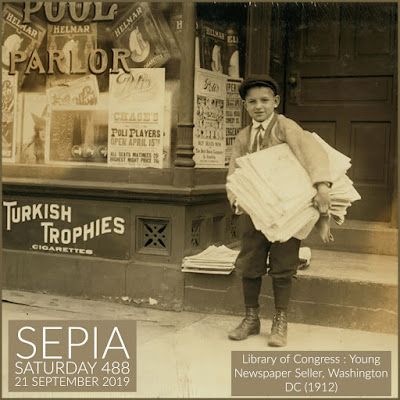
http://sepiasaturday.blogspot.com/2019/09/sepia-saturday-488-21-september-2019.html


nolitbx

  © Blogger template Shush by Ourblogtemplates.com 2009

Back to TOP