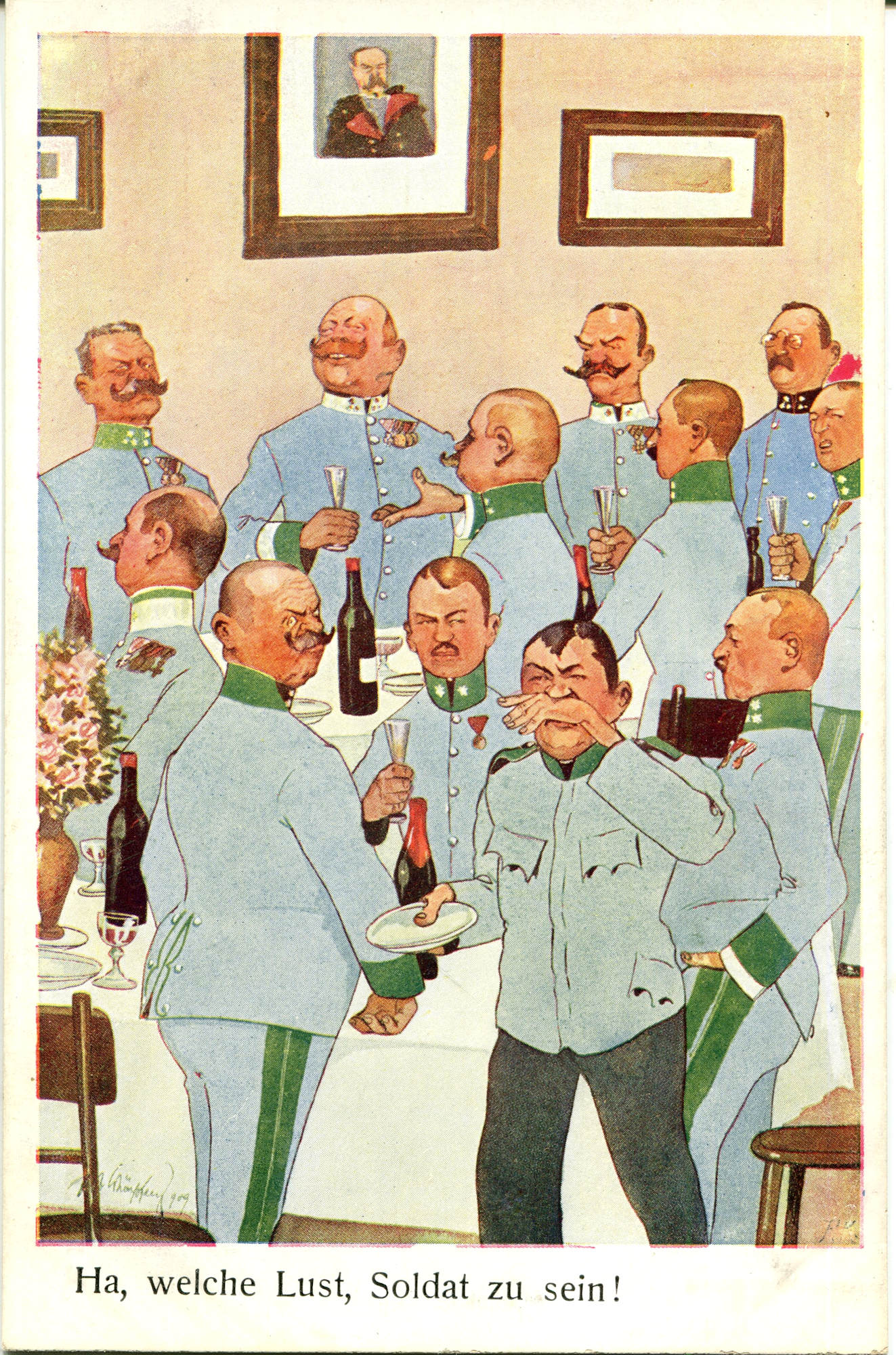
It's a situation that everyone
has probably experienced at least once.
has probably experienced at least once.
You attend a grand banquet,
in this case a special occasion
for a group of Austrian army officers,
and you notice that the server, here an orderly,
displays rather slovenly habits of personal hygiene.
As the poor fellow wipes his nose with his hand,
some of the generals take notice with a look of disgust.
in this case a special occasion
for a group of Austrian army officers,
and you notice that the server, here an orderly,
displays rather slovenly habits of personal hygiene.
As the poor fellow wipes his nose with his hand,
some of the generals take notice with a look of disgust.
Ha, welche Lust, Soldat zu sein!
~
What a pleasure to be a soldier!
~
What a pleasure to be a soldier!

The common soldier of Austria however,
does not dine on white linen
with fancy plates and silverware.
His idea of a good meal involves
every man for himself
making an assault on a food wagon,
grabbing a stein of beer
and a couple handfuls of bread and wurst.
does not dine on white linen
with fancy plates and silverware.
His idea of a good meal involves
every man for himself
making an assault on a food wagon,
grabbing a stein of beer
and a couple handfuls of bread and wurst.
These lighthearted postcards were produced
by the Viennese artist Fritz Schönpflug (1873 – 1951),
whose artwork has become a favorite of mine.
He had a great talent to see the humor in a situation
and compose a painting of it
that needed no translation
to get the laugh.
by the Viennese artist Fritz Schönpflug (1873 – 1951),
whose artwork has become a favorite of mine.
He had a great talent to see the humor in a situation
and compose a painting of it
that needed no translation
to get the laugh.
Unlike the photographers of his time,
an artist like Schönpflug worked in a world of color.
And his caricatures give us a better idea
of the colorful uniforms and dresses
of old Wien during the first decades of the 20th century.
an artist like Schönpflug worked in a world of color.
And his caricatures give us a better idea
of the colorful uniforms and dresses
of old Wien during the first decades of the 20th century.
* * *

Wien, or Vienna, was the capital of a vast empire
and the center of a sophisticated culture.
In this postcard, Schönpflug shows us
a typical quartet of two young officers
with two attractive ladies
seated together under an umbrella
outside a café enjoying a morning coffee.
The caption describes it as a military tactic.
and the center of a sophisticated culture.
In this postcard, Schönpflug shows us
a typical quartet of two young officers
with two attractive ladies
seated together under an umbrella
outside a café enjoying a morning coffee.
The caption describes it as a military tactic.
In gedeckter position
~
In covered position
~
In covered position
This postcard was sent from Graz, Austria on 27 October 1912.
The message to Herrn Hans Maresch is difficult to read,
but I think is comes from a woman named RoseAnna.
In my collection of Austrian and German postcards from this era
the majority, maybe 95%, were sent by men.
This may explain why Schönpflug's postcards
often have masculine subjects like soldiers, horses, and athletes.

* * *

This next postcard has nearly the same café setting,
but this time the table for four is a family group.
A father dressed in an army officer's uniform
reads the daily newspaper,
while his august wife
oversees her two sons.
The older one, a junior officer,
affects a nonchalant attitude smoking a cigarette.
His younger brother, a small boy who also wears
a military uniform, attacks a frothy chocolatey drink with zeal.
Die ärarische Familie.
~
The Aryan family.
~
The Aryan family.
The caption doesn't quite explain the amusing scene
as there is an Austrian sub-text that hides the joke from us.
This postcard was sent in a letter
and dated 13 February 1909
as there is an Austrian sub-text that hides the joke from us.
This postcard was sent in a letter
and dated 13 February 1909

* * *
As I've written before in Two Wise Guys,
humor, like comedy, is a very ephemeral art.
Schönpflug's cartoon style
tells us that his scenes are funny.
And we can still enjoy most of his delightful wit,
and admire the charm of his characters.
But lost in time are layers of subtle satire,
waggish teasing, and sharp mocking
that his Viennese society of 1910 recognized
but we in the 21st century can only guess at.
As it happens to be Easter this weekend,
I'll finish with another postcard by Fritz Schönpflug,
an example of his seasonal holiday themes.
I'll finish with another postcard by Fritz Schönpflug,
an example of his seasonal holiday themes.

There are no Easter bunnies or Easter eggs,
but there is some kind of symbolism going on here.
A young woman brandishes some springtime shrubbery cuttings
that are festooned with six small gentlemen seeking her attention.
I suppose it's about love and springtime in old Wien.
but there is some kind of symbolism going on here.
A young woman brandishes some springtime shrubbery cuttings
that are festooned with six small gentlemen seeking her attention.
I suppose it's about love and springtime in old Wien.
Fröhliche Ostern!
~
Happy Easter!
~
Happy Easter!


